
- First Name
- Darryl
- Joined
- May 9, 2025
- Threads
- 13
- Messages
- 1,606
- Reaction score
- 3,598
- Location
- Tallahassee Florida
- Vehicle(s)
- 2025 Maverick XLT HYBRID
- Engine
- 2.5L Hybrid
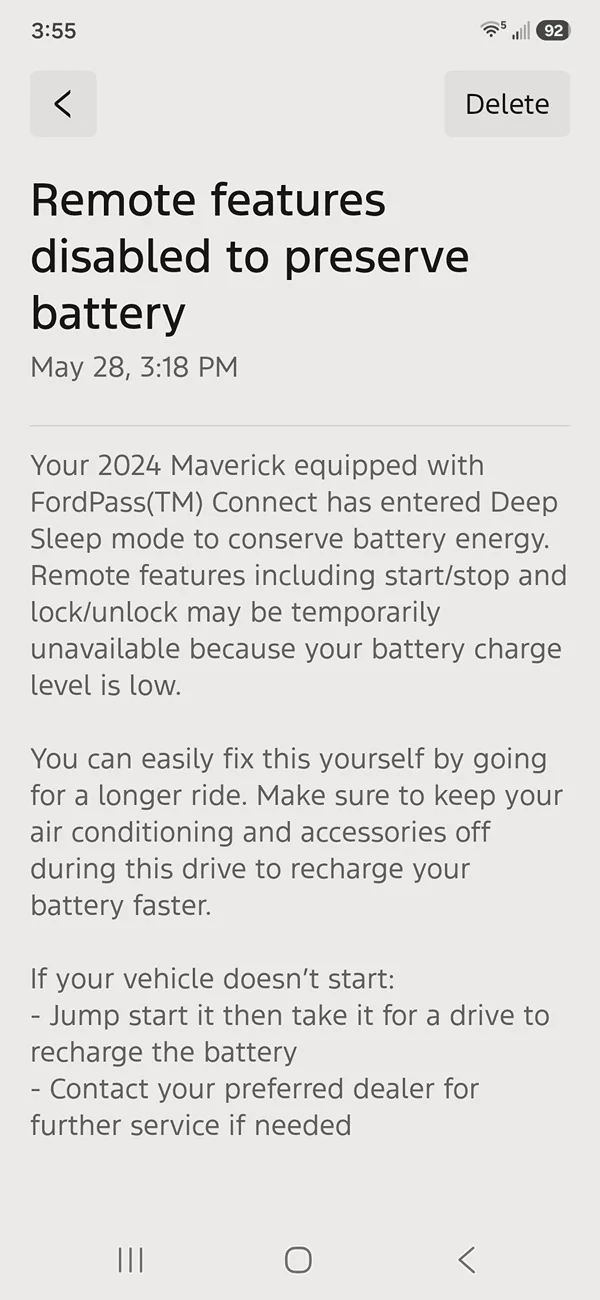
To be honest, I'm simply going by results. If the vast majority of the hybrid Maverick batteries are lasting a normal life, that's what matters. There is a subset that have persistent frequent battery issues and short battery life and those are the ones that Ford is focused on. What's different between the majority with no issues vs the sizable minority with persistent issues.? The problem isn't likely something that's common to EVERY Maverick hybrid. It's most likely something that's occuring in the problem vehicles that isn't occurring in the non problem vehicles.You REALLY need to find the posts that show this is not a DCDC issue.
This is not a drain issue.
This is a purposeful strategy.
You could see it too with a scan tool monitoring some PIDs.
12V battery SOC%, and Amps (Battery2 for showing decimal value), and Volts.
You have a nice long drive into work.
If you do NOT have the headlights on, do NOT have the fan speed 6 or above, or NO trailer light - here's what several posters with the tools have reported already. With picture proof.
If your SOC% is good enough it's upwards of 90%, you'll be getting your float charge of below 1 Amp pretty quickly.
When it reaches 92% - you should start showing a Voltage of 12.8, and discharge from your battery, negative Amps.
Keep at that - and it'll discharge to mid 80's% SOC. Then float charge again to 92%.
Or, when at 92% and it starts discharging - turn on your headlights manually.
Now what happens to Amps and SOC%?
That's it.
Regarding what you think my issue is - it's the same issue many see that don't have a bad battery die overnight.
The BMS system using the battery sensor is reading ALL Amp hours going into and out of the battery.
And it sees balance.
If DCDC was undercharging - it would show less charge, more discharge.
And if I had short/partial discharge events from the ACCM or ABS - there would be more discharge then charge. Except if you drive long enough, it can recover.
Now - I do think I have a bad battery sensor and it's getting inaccurate Amps IN/OUT.
But I can't prove it - when I put a multimeter in DC Amp mode inline with the negative cable - the BMS must not see enough resistance or something - it drops to no Amp charge to the battery.
I cannot confirm Amps to see if the battery sensor is correct.
It does report the Volts under the true value, but that's better than reporting a higher than true value at least.
Since you have a long drive into work - you could probably do the above test during a lunch drive borrowing a scanner - you should be about as charged as you'll get.
Sponsored