

Sponsored

Replacing 12v battery

GPSMan

2.5L Hybrid
Well-known member
Banned
First Name
John
Joined
Jul 28, 2022
Threads
52
Messages
4,325
Reaction score
5,340
Location
CA
Vehicle(s)
Many
Engine
2.5L Hybrid
Clubs
 
Is it possible that people who live in areas with few hills are seeing this issue more? I live in an area where I can coast downhill frequently which is where charging happens and I have yet to see an issue. Granted I have a low amount of miles yet, under 500.

It just seems to me unless you are doing lots of stop and go or getting hills to coast down you might not get much time to charge that the HV battery and then short change the 12 volt charge. But that’s just a theory which much smarter people than me on this forum could likely debunk 🤪
The short version is no.

The HV battery is feeding the 12v system about 13.5 to 14.7 volts any time the key is turned to run. It does not matter if you are going uphill, downhill, or parked in a parking lot.

My current theory is two fold:

1) they are cheap, poorly made batteries to begin with

2) the truck is drawing some low rate of power continuously, even when shut "off".
Sponsored
 

RockHoundTX

2.5L Hybrid
Well-known member
Joined
Aug 22, 2021
Threads
4
Messages
303
Reaction score
499
Location
Austin
Vehicle(s)
97 F350
Engine
2.5L Hybrid
The short version is no.

The HV battery is feeding the 12v system about 13.5 to 14.7 volts any time the key is turned to run. It does not matter if you are going uphill, downhill, or parked in a parking lot.

My current theory is two fold:

1) they are cheap, poorly made batteries to begin with

2) the truck is drawing some low rate of power continuously, even when shut "off".
I am in agreement with both of your points.

I have only had my Hybrid for 2 weeks but been testing the battery voltage 3-4 times a day trying to see if there is some rhyme or reason to things. I use a Klein multi-meter so confident in the readings.

After the 30 mile drive home from the dealer (and waiting 2-3 hours for any surface voltage to wear off), my battery was 12.42 volts (thus was probably <13.5V at the dealer). Batteries tend to start sulfating at about 12.48 volts so this was lower than I would prefer. I have turned off everything I can turn off using the infotainment settings (no wifi, no GPS, no FordPass connectivity, no AT&T connection, etc.) and lock the doors to keep it from "waiking up" every time someone or something walks by (I live out in the country and get visited by deer every night).

Here are my observations:
1) Checking the voltage under the hood and under the seat tend to be a little different by about .1 volt. Not sure what the extra resistive load is between them (the cable should only result in about a .01 change).

2) It is extremely important to check the voltage the same way every time. I get in the front seat, lock the doors, and wait for all lights to go out (I just sit the key fob in the passenger seat). The difference in voltage between the lights/dash/radio logo being on and off is about .1 volts. Where I am extremely confused is that sometimes it is .1 volts higher and other times it is .1 volts lower. This tends to indicate that sometimes the HV battery is doing something when you open the door and other times it is not.

3) Using a BatteryMinder float charger for 2 days using the under-hood connection points, I was able to get the battey up to 12.58 volts steady-state. The BatteryMinder charged at about 12.85 - 13.1 volts and the battery had a surface charge of 12.76 when I removed the charger. After about 2 hours the surface charge was about 12.62 volts and at 6 hours it was 12.58 volts (which is where a fully charged battery should be).

4) Once I had the battery fully charged, I did a BMS reset, locked the doors, and did not touch the truck for 12 hours. The next morning the voltage was 12.42 volts. I drove the truck about 60 miles picking up groceries and had a voltage of 12.52 about 10 minutes after getting home (so still some surface voltage) and 12.47 about 2 hours later.

5) I try to check the voltage each night (about 7PM) and then again in the morning (about 10AM). I lock the doors so there is no "extra" activity. On average, I loose about .1 volts over-night. However, I did have 1 night where it went down by .2 volts (down to 12.27 volts). Each .1 volts equates to about 10% of battery capacity. There is ZERO reason why a battery should be drained by 10% per night. This means that either the battery was sized wrong or there is an absolutely huge parasitic drain going on.

6) If my math is correct, the Group 99 T4 battery in the Maverick should have roughly 300 W/hours of energy (12 volt x 70 minute reserve at 25 amps). If it is loosing 10% over-night, then it is using roughly 30 W/hours of energy for something. In my case, this equates to "something" using an average of roughly 2 continuous watts per hour (or 30 W for one hour and zero watts the remaining time). This is roughly 4 -6 times as much draw as it should have (.03 to .05 amps [.36 to .6 watts] "key off" draw is what is specified by several car manufacturers). I would love to know what the "key off" specification for a Ford Maverick is.

@Ford Motor Company Can you provide us with the "door locked, key off" parasitic amp draw specification for the Hybrid Maverick? That will help us understand if what we are seeing was a design decision by Ford Engineers or if there is something wrong with a large number of our Mavericks. Thanks.
 

GPSMan

2.5L Hybrid
Well-known member
Banned
First Name
John
Joined
Jul 28, 2022
Threads
52
Messages
4,325
Reaction score
5,340
Location
CA
Vehicle(s)
Many
Engine
2.5L Hybrid
Clubs
 
I am in agreement with both of your points.

I have only had my Hybrid for 2 weeks but been testing the battery voltage 3-4 times a day trying to see if there is some rhyme or reason to things. I use a Klein multi-meter so confident in the readings.

After the 30 mile drive home from the dealer (and waiting 2-3 hours for any surface voltage to wear off), my battery was 12.42 volts (thus was probably <13.5V at the dealer). Batteries tend to start sulfating at about 12.48 volts so this was lower than I would prefer. I have turned off everything I can turn off using the infotainment settings (no wifi, no GPS, no FordPass connectivity, no AT&T connection, etc.) and lock the doors to keep it from "waiking up" every time someone or something walks by (I live out in the country and get visited by deer every night).

Here are my observations:
1) Checking the voltage under the hood and under the seat tend to be a little different by about .1 volt. Not sure what the extra resistive load is between them (the cable should only result in about a .01 change).

2) It is extremely important to check the voltage the same way every time. I get in the front seat, lock the doors, and wait for all lights to go out (I just sit the key fob in the passenger seat). The difference in voltage between the lights/dash/radio logo being on and off is about .1 volts. Where I am extremely confused is that sometimes it is .1 volts higher and other times it is .1 volts lower. This tends to indicate that sometimes the HV battery is doing something when you open the door and other times it is not.

3) Using a BatteryMinder float charger for 2 days using the under-hood connection points, I was able to get the battey up to 12.58 volts steady-state. The BatteryMinder charged at about 12.85 - 13.1 volts and the battery had a surface charge of 12.76 when I removed the charger. After about 2 hours the surface charge was about 12.62 volts and at 6 hours it was 12.58 volts (which is where a fully charged battery should be).

4) Once I had the battery fully charged, I did a BMS reset, locked the doors, and did not touch the truck for 12 hours. The next morning the voltage was 12.42 volts. I drove the truck about 60 miles picking up groceries and had a voltage of 12.52 about 10 minutes after getting home (so still some surface voltage) and 12.47 about 2 hours later.

5) I try to check the voltage each night (about 7PM) and then again in the morning (about 10AM). I lock the doors so there is no "extra" activity. On average, I loose about .1 volts over-night. However, I did have 1 night where it went down by .2 volts (down to 12.27 volts). Each .1 volts equates to about 10% of battery capacity. There is ZERO reason why a battery should be drained by 10% per night. This means that either the battery was sized wrong or there is an absolutely huge parasitic drain going on.

6) If my math is correct, the Group 99 T4 battery in the Maverick should have roughly 300 W/hours of energy (12 volt x 70 minute reserve at 25 amps). If it is loosing 10% over-night, then it is using roughly 30 W/hours of energy for something. In my case, this equates to "something" using an average of roughly 2 continuous watts per hour (or 30 W for one hour and zero watts the remaining time). This is roughly 4 -6 times as much draw as it should have (.03 to .05 amps [.36 to .6 watts] "key off" draw is what is specified by several car manufacturers). I would love to know what the "key off" specification for a Ford Maverick is.

@Ford Motor Company Can you provide us with the "door locked, key off" parasitic amp draw specification for the Hybrid Maverick? That will help us understand if what we are seeing was a design decision by Ford Engineers or if there is something wrong with a large number of our Mavericks. Thanks.
Nice work.
I have the same or even more watt-hours lost overnight. I also turned off WiFi and GPS and Telematics. Even deleted the Ford Pass App from my phone.

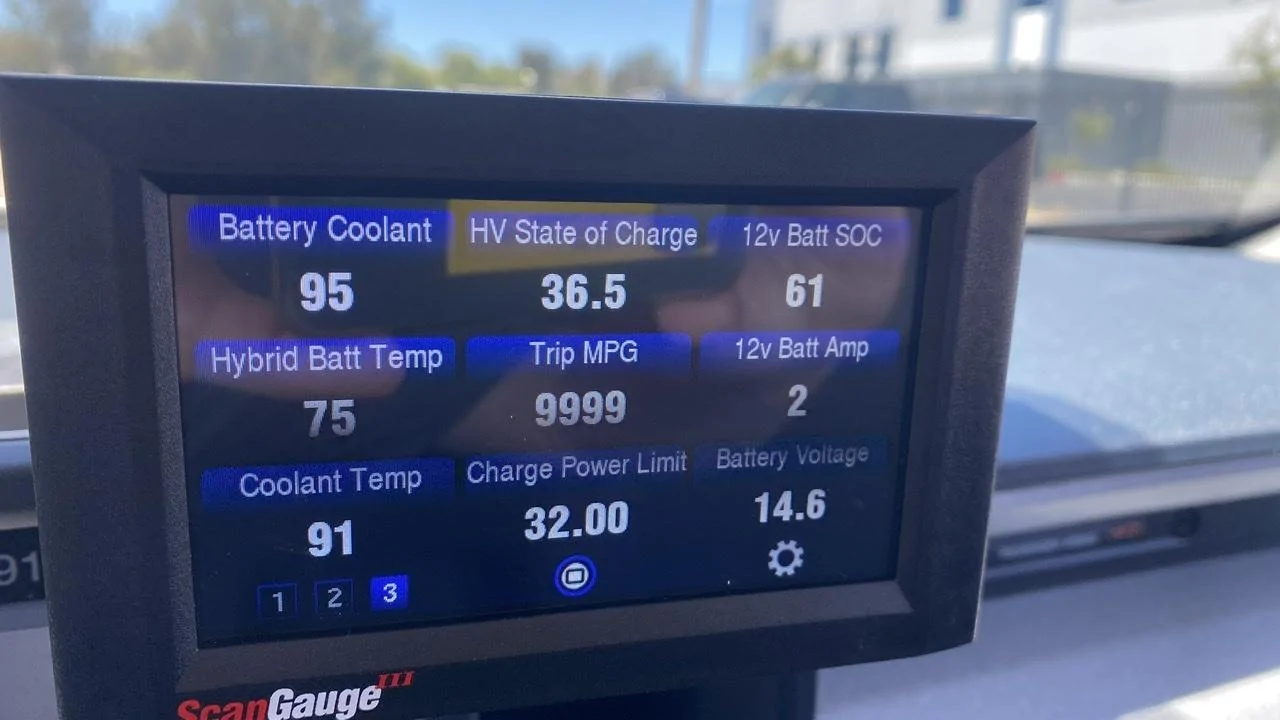
I also have an OBDII scan gauge 3.
It has 12 volt state of charge.

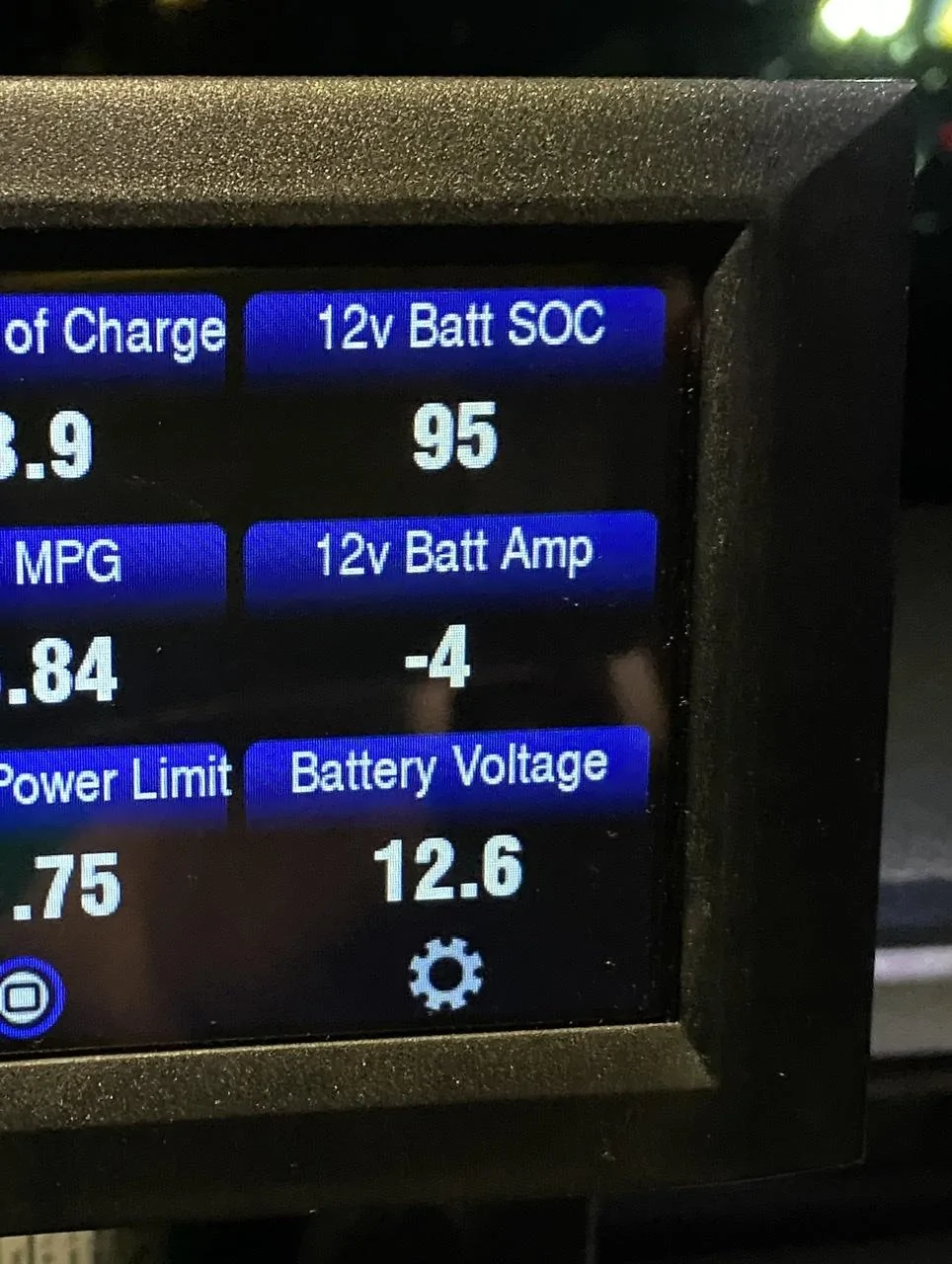
My truck, best I can tell, keeps the 12v battery between 60% and 70%. Never better. Never worse. In over 8 months of monitoring. Exception:

Parked it at a dealer for a month waiting for parts. When Ford returned it to me 12v battery was measuring 32%. That night, I put it on a charger, got it up to the point the automatic charger shut off. Slowly, within a week, battery back to 60% to 70%.

30 to 45 minute A.M commute and 30 to 45 minute PM commute. Always 60% to 70% 12 volt battery.

EXCEPTION.

Drove San Francisco to SE Alaska.
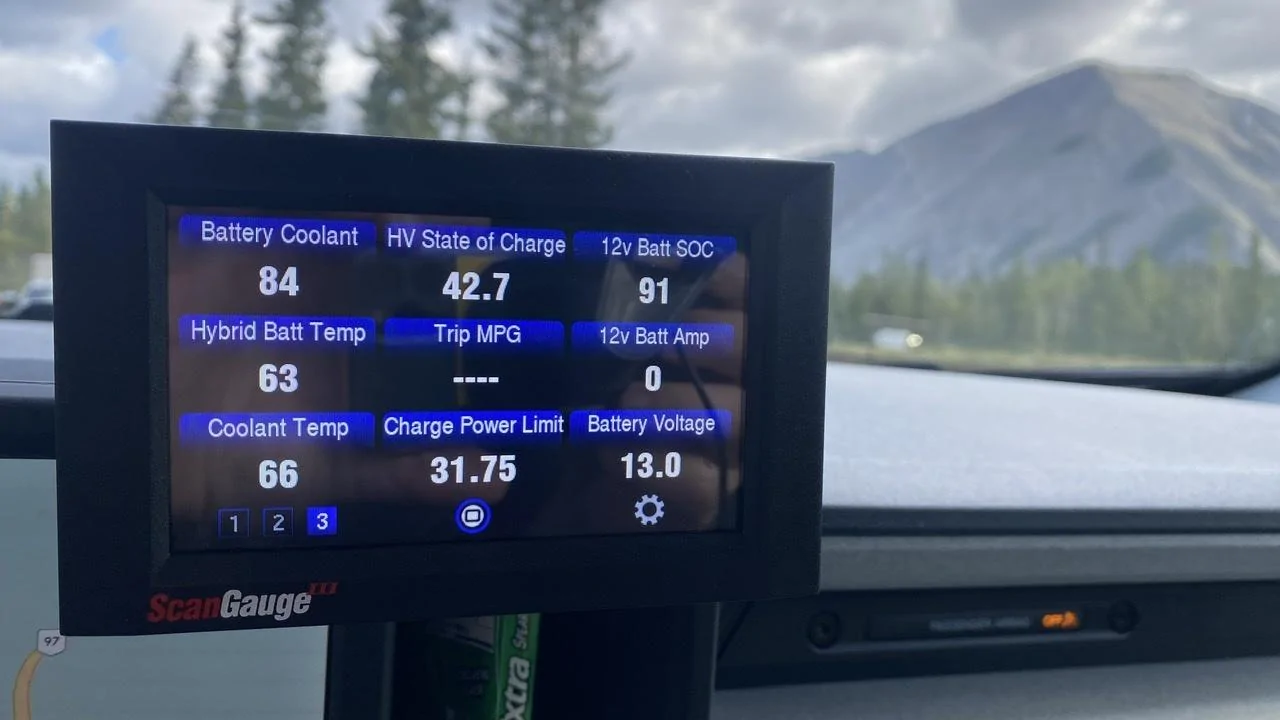
Five consecutive 10 hour days of driving. Not paying much attention until at destination, glanced at meter, was at 99% charge (12v) after 50 hours of run time in 5 days.

Normally:
Ford Maverick Replacing 12v battery 866565FD-6E75-4D2E-BC34-12E176593C39


After 50 hours of run time in 5 days:
Note the voltage WHILE RUNNING. DC/DC was that low. First time I've seen it under 14.0v because it needed no charging for the first time in 8 months?

Ford Maverick Replacing 12v battery D1B90A7F-C156-42B3-867A-062D5483C9C8


Next Day (key on):
Ford Maverick Replacing 12v battery 1882F7DB-0582-4E7A-931B-E61BA0A4D422
 

GPSMan

2.5L Hybrid
Well-known member
Banned
First Name
John
Joined
Jul 28, 2022
Threads
52
Messages
4,325
Reaction score
5,340
Location
CA
Vehicle(s)
Many
Engine
2.5L Hybrid
Clubs
 
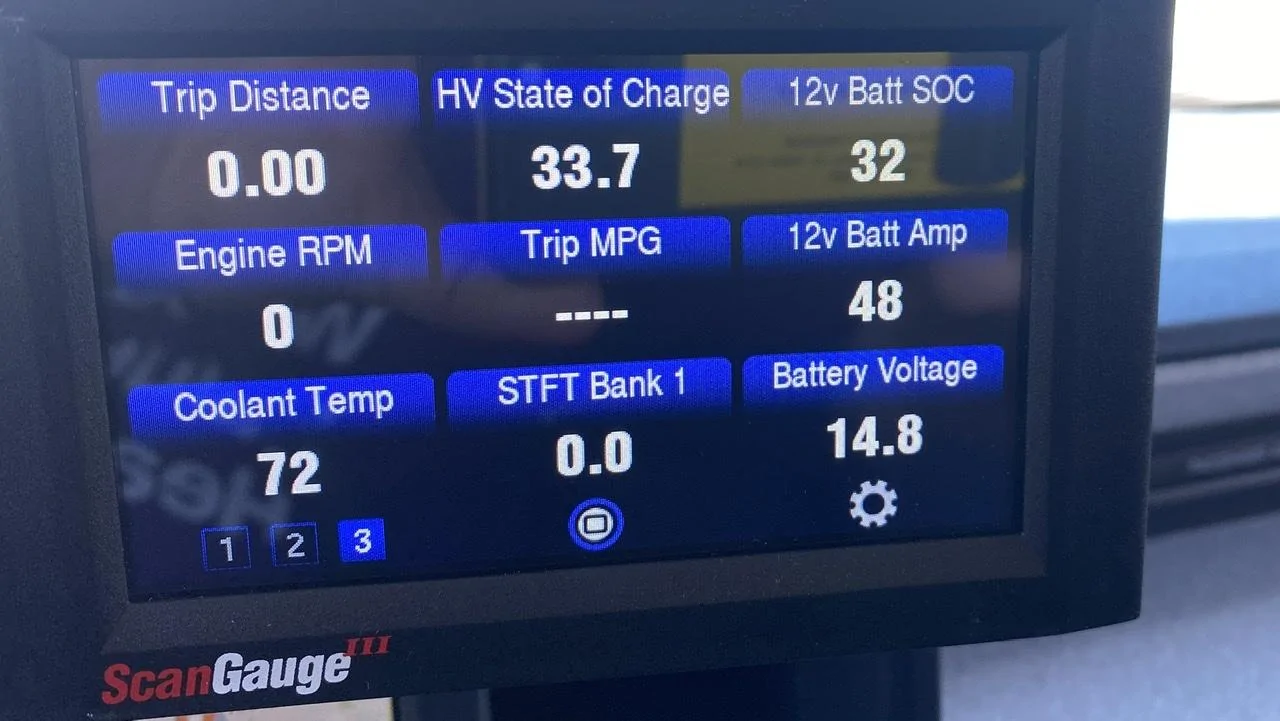
When dealer gave it back to me after having it sit for a month:

Ford Maverick Replacing 12v battery 913BF114-E582-4B3F-9C32-7A019436AAB3


Note heavy charging at 48 amps.
Zeros and ambient temp: I had not started the truck yet. Just turned the key to run.
 

Gullzway

2.5L Hybrid
Well-known member
Joined
Dec 17, 2021
Threads
25
Messages
2,040
Reaction score
2,437
Location
OK
Vehicle(s)
1968 Ford Mustang Fastback
Engine
2.5L Hybrid
Unless you're no longer covered by a warranty, there's no reason to shell out $150-250 for a battery.

You paid for a warranty. Use it.
Unfortunately, the battery will test good at the dealer if it's around 12.2 volts like mine was, and they will not replace it.

They had no explanation as to why it was going into deep sleep daily, just said that I could schedule another appointment for further electrical testing.

This already wasted two plus hours of my time, so I as well just paid the $190 for a new battery.

They finally got the parts for the wiring harness replacement a month and a half after I took it in for that. I'm dreading leaving it there for this fix, not knowing how long it's going to take.
 

Sponsored

RockHoundTX

2.5L Hybrid
Well-known member
Joined
Aug 22, 2021
Threads
4
Messages
303
Reaction score
499
Location
Austin
Vehicle(s)
97 F350
Engine
2.5L Hybrid
I have not hooked up my OBDII (with Forscan) yet. Tonight I did hook up my TopDon battey tester. Resting voltage was exactly the same as my Klein at 12.42. During the test, it said my load voltage was 12.49, State of Health was 100%, State of Charge 81%, and resistance of 5.62mOhms.

I really, really wonder why they system would be programmed for 60%-70% (or more like 60%-80% in my case)??? That is perfect for the longevity of a lithium ion battery but hell on a lead-acid. Lead-acid needs to be kept at > 80% to prevent sulfation.

I am going to track the voltage for the next couple of days before I put the trickle charger back on. With the trickle charger I was able to get a full charge but it did not stay that way for long (but assume that is because of what-ever testing the BMS reset did). Next time I do a full charge I won't do a BMS reset and will see how long the battery stays at > 12.45.

Does anyone know what the software ID is for the latest and greatest software update for the Maverick (that was supposed to help with the 12V issue?)? Is the software ID that shows in the settings on the infotainment system or is that something else? Is the supposed 12V software update an over-the-air, WIFI only, or something that can only be done at the dealership? Truck was built July 30th so would "assume" it has the latest update but not sure. I have crappy AT&T reception at the house and my wifi signal does not make it to the garage so have not been able to check if there is another update. Figure that the next time I go to Walmart I will park as close as I can to the door and try to use their WIFI to download any patches ;-)
 

MakinDoForNow

2.5L Hybrid
Well-known member
First Name
James
Joined
Sep 24, 2021
Threads
2
Messages
8,429
Reaction score
5,994
Location
Texas
Vehicle(s)
2022 Maverick
Engine
2.5L Hybrid
I am in agreement with both of your points.

I have only had my Hybrid for 2 weeks but been testing the battery voltage 3-4 times a day trying to see if there is some rhyme or reason to things. I use a Klein multi-meter so confident in the readings.

After the 30 mile drive home from the dealer (and waiting 2-3 hours for any surface voltage to wear off), my battery was 12.42 volts (thus was probably <13.5V at the dealer). Batteries tend to start sulfating at about 12.48 volts so this was lower than I would prefer. I have turned off everything I can turn off using the infotainment settings (no wifi, no GPS, no FordPass connectivity, no AT&T connection, etc.) and lock the doors to keep it from "waiking up" every time someone or something walks by (I live out in the country and get visited by deer every night).

Here are my observations:
1) Checking the voltage under the hood and under the seat tend to be a little different by about .1 volt. Not sure what the extra resistive load is between them (the cable should only result in about a .01 change).

2) It is extremely important to check the voltage the same way every time. I get in the front seat, lock the doors, and wait for all lights to go out (I just sit the key fob in the passenger seat). The difference in voltage between the lights/dash/radio logo being on and off is about .1 volts. Where I am extremely confused is that sometimes it is .1 volts higher and other times it is .1 volts lower. This tends to indicate that sometimes the HV battery is doing something when you open the door and other times it is not.

3) Using a BatteryMinder float charger for 2 days using the under-hood connection points, I was able to get the battey up to 12.58 volts steady-state. The BatteryMinder charged at about 12.85 - 13.1 volts and the battery had a surface charge of 12.76 when I removed the charger. After about 2 hours the surface charge was about 12.62 volts and at 6 hours it was 12.58 volts (which is where a fully charged battery should be).

4) Once I had the battery fully charged, I did a BMS reset, locked the doors, and did not touch the truck for 12 hours. The next morning the voltage was 12.42 volts. I drove the truck about 60 miles picking up groceries and had a voltage of 12.52 about 10 minutes after getting home (so still some surface voltage) and 12.47 about 2 hours later.

5) I try to check the voltage each night (about 7PM) and then again in the morning (about 10AM). I lock the doors so there is no "extra" activity. On average, I loose about .1 volts over-night. However, I did have 1 night where it went down by .2 volts (down to 12.27 volts). Each .1 volts equates to about 10% of battery capacity. There is ZERO reason why a battery should be drained by 10% per night. This means that either the battery was sized wrong or there is an absolutely huge parasitic drain going on.

6) If my math is correct, the Group 99 T4 battery in the Maverick should have roughly 300 W/hours of energy (12 volt x 70 minute reserve at 25 amps). If it is loosing 10% over-night, then it is using roughly 30 W/hours of energy for something. In my case, this equates to "something" using an average of roughly 2 continuous watts per hour (or 30 W for one hour and zero watts the remaining time). This is roughly 4 -6 times as much draw as it should have (.03 to .05 amps [.36 to .6 watts] "key off" draw is what is specified by several car manufacturers). I would love to know what the "key off" specification for a Ford Maverick is.

@Ford Motor Company Can you provide us with the "door locked, key off" parasitic amp draw specification for the Hybrid Maverick? That will help us understand if what we are seeing was a design decision by Ford Engineers or if there is something wrong with a large number of our Mavericks. Thanks.
RE: 0.1 voltage drop. I watched my nightly drops for quite some time my cheapo cig style monitor only has readings in tenths of a volt. I left it in my hybrid when I traded for my Tremor so I am without currently. I had my hybrid parked inside well insulated garage temps generally varied between 45°F to 94°F. I did not keep written records but it appeared to be 0.1v drop near 65-70°F and at 85-90°F it would 24-30 hours to drop 0.1v. and at 50-55°F I would see 0.2v range. These figures are borderline due to the display restrictions of my meter but there appears to be a greater draw related to ambient temp loss. Could it be that there is a small movement of HVB fluid periodically? Or ??? It also appeared that there is less of a drop in the 12v battery voltage if I pushed the lock button on key fob twice vs once and got the horn honk which I believe activates the anti theft alarm which has its own battery.?? does the battery in anti theft reduce at least some of the draw on 12v?. Also I believe the 70AH was for the AGM 760 CCA of the battery in my Tremor and the AH of 99rt4 in hybrids is less.
 

huunvubu

2.5L Hybrid
Well-known member
First Name
Steve
Joined
Jul 21, 2021
Threads
56
Messages
2,754
Reaction score
4,699
Location
coppell tx
Vehicle(s)
2023 Ford Maverick Hybrid
Engine
2.5L Hybrid
The 12 Volt battery is not the issue.

The issue is that the software that decides to charge the 12 volt battery is deficient.

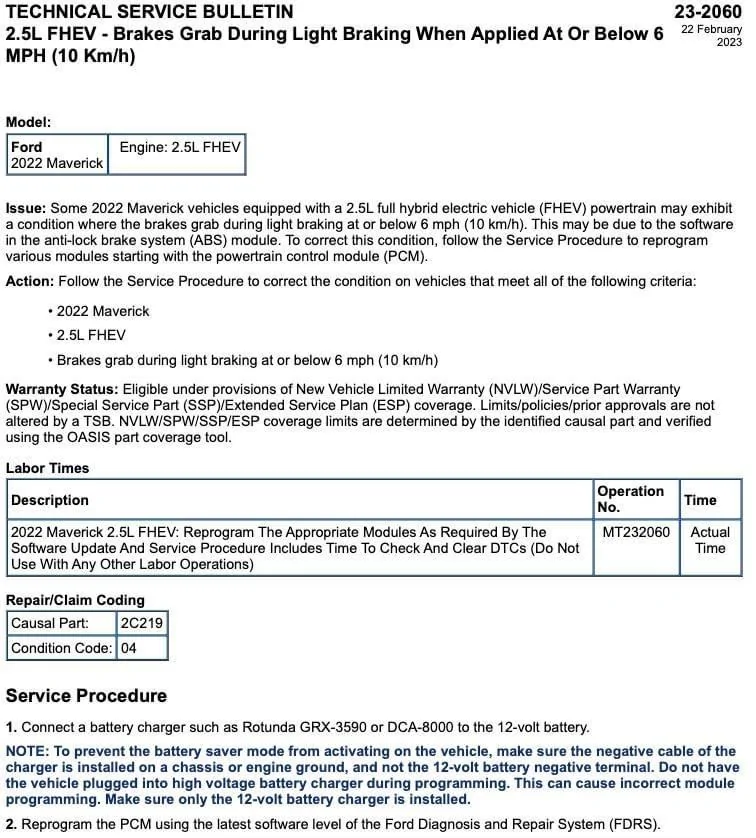
Have TSB 23-2060 done because not only does it vastly improve low speed braking but doing that TSB also updates the software that charges the 12 volt battery.

After I had TSB 23-2060 done I no longer had any Deep Sleep issues.

Ford Maverick Replacing 12v battery 908DF5E3-F181-4AA6-8748-82FA2A801355
 

RockHoundTX

2.5L Hybrid
Well-known member
Joined
Aug 22, 2021
Threads
4
Messages
303
Reaction score
499
Location
Austin
Vehicle(s)
97 F350
Engine
2.5L Hybrid
RE: 0.1 voltage drop. I watched my nightly drops for quite some time my cheapo cig style monitor only has readings in tenths of a volt. I left it in my hybrid when I traded for my Tremor so I am without currently. I had my hybrid parked inside well insulated garage temps generally varied between 45°F to 94°F. I did not keep written records but it appeared to be 0.1v drop near 65-70°F and at 85-90°F it would 24-30 hours to drop 0.1v. and at 50-55°F I would see 0.2v range. These figures are borderline due to the display restrictions of my meter but there appears to be a greater draw related to ambient temp loss. Could it be that there is a small movement of HVB fluid periodically? Or ??? It also appeared that there is less of a drop in the 12v battery voltage if I pushed the lock button on key fob twice vs once and got the horn honk which I believe activates the anti theft alarm which has its own battery.?? does the battery in anti theft reduce at least some of the draw on 12v?. Also I believe the 70AH was for the AGM 760 CCA of the battery in my Tremor and the AH of 99rt4 in hybrids is less.
The Hybrid battery is 470 cranking amps with 70 minute reserve capacity (this seems to be up from the 65 minute reserve capacity of the battery in the 2022 Mavericks). From what I can tell, reserve capacity is the number of minutes from full charge down to 10.5V at a constant 25A draw. Thus, something around 300W hours or a little less since would not expect anything below around 11.5V to be usable.

Been hot, hot, hot here in Austin. I am mostly under a tree and have a sunshade up but figure the truck stays in the 85-110 degree range pretty much all day. One thing to note is that voltage reading is dependant on temperature. For the exact same battery, the voltage will read differently depending on ambient temperature. I should note that volt-meters are "correct" for approoximately 80 degrees and there is some sort of correction factor for above or below that. As an example, measureing in the middle of the day (probably 105 in the cab) and at the end of the day (probably around 90) I saw a .03V difference (voltage reading was higher when it was cooler).

What I have not tried is the difference between "locked" and "locked with horn". DId not realize there was a difference. Anyone tried this? Do you have to click twice for anti-theft (crap. Got to go read the manual again.)?
 

GPSMan

2.5L Hybrid
Well-known member
Banned
First Name
John
Joined
Jul 28, 2022
Threads
52
Messages
4,325
Reaction score
5,340
Location
CA
Vehicle(s)
Many
Engine
2.5L Hybrid
Clubs
 
The Hybrid battery is 470 cranking amps with 70 minute reserve capacity (this seems to be up from the 65 minute reserve capacity of the battery in the 2022 Mavericks). From what I can tell, reserve capacity is the number of minutes from full charge down to 10.5V at a constant 25A draw. Thus, something around 300W hours or a little less since would not expect anything below around 11.5V to be usable.

Been hot, hot, hot here in Austin. I am mostly under a tree and have a sunshade up but figure the truck stays in the 85-110 degree range pretty much all day. One thing to note is that voltage reading is dependant on temperature. For the exact same battery, the voltage will read differently depending on ambient temperature. I should note that volt-meters are "correct" for approoximately 80 degrees and there is some sort of correction factor for above or below that. As an example, measureing in the middle of the day (probably 105 in the cab) and at the end of the day (probably around 90) I saw a .03V difference (voltage reading was higher when it was cooler).

What I have not tried is the difference between "locked" and "locked with horn". DId not realize there was a difference. Anyone tried this? Do you have to click twice for anti-theft (crap. Got to go read the manual again.)?
It does not make any sense that two locking methods would make any difference. I read these blogs voraciously and have not seen or heard anything about this.
 
Sponsored

GPSMan

2.5L Hybrid
Well-known member
Banned
First Name
John
Joined
Jul 28, 2022
Threads
52
Messages
4,325
Reaction score
5,340
Location
CA
Vehicle(s)
Many
Engine
2.5L Hybrid
Clubs
 
What "seems" to happen is:

The truck uses a lot of battery wattage in the first hour or two after you shut it off, then it settles in or goes into a lower power state after a while.

No proof. Just I've observed that more than a few times.
 

bgn

2.0L EcoBoost
Well-known member
Joined
Jun 12, 2021
Threads
5
Messages
3,002
Reaction score
5,570
Location
WA
Vehicle(s)
Maverick
Engine
2.0L EcoBoost
Clubs
 
Unfortunately, the battery will test good at the dealer if it's around 12.2 volts like mine was, and they will not replace it.

They had no explanation as to why it was going into deep sleep daily, just said that I could schedule another appointment for further electrical testing.

This already wasted two plus hours of my time, so I as well just paid the $190 for a new battery.

They finally got the parts for the wiring harness replacement a month and a half after I took it in for that. I'm dreading leaving it there for this fix, not knowing how long it's going to take.
There are multiple tests they need to do per Ford. Mine passed the first, but failed the second. I make decent money, but I don't make $100 an hour to make it not worth less than 2 hours of my time. 😉
 

Scupking

2.5L Hybrid
Well-known member
First Name
Matt
Joined
Aug 13, 2021
Threads
33
Messages
2,253
Reaction score
3,313
Location
CT
Vehicle(s)
2025 Ford Maverick XLT Hybrid
Engine
2.5L Hybrid
The 12 Volt battery is not the issue.

The issue is that the software that decides to charge the 12 volt battery is deficient.

Have TSB 23-2060 done because not only does it vastly improve low speed braking but doing that TSB also updates the software that charges the 12 volt battery.

After I had TSB 23-2060 done I no longer had any Deep Sleep issues.

908DF5E3-F181-4AA6-8748-82FA2A801355.webp
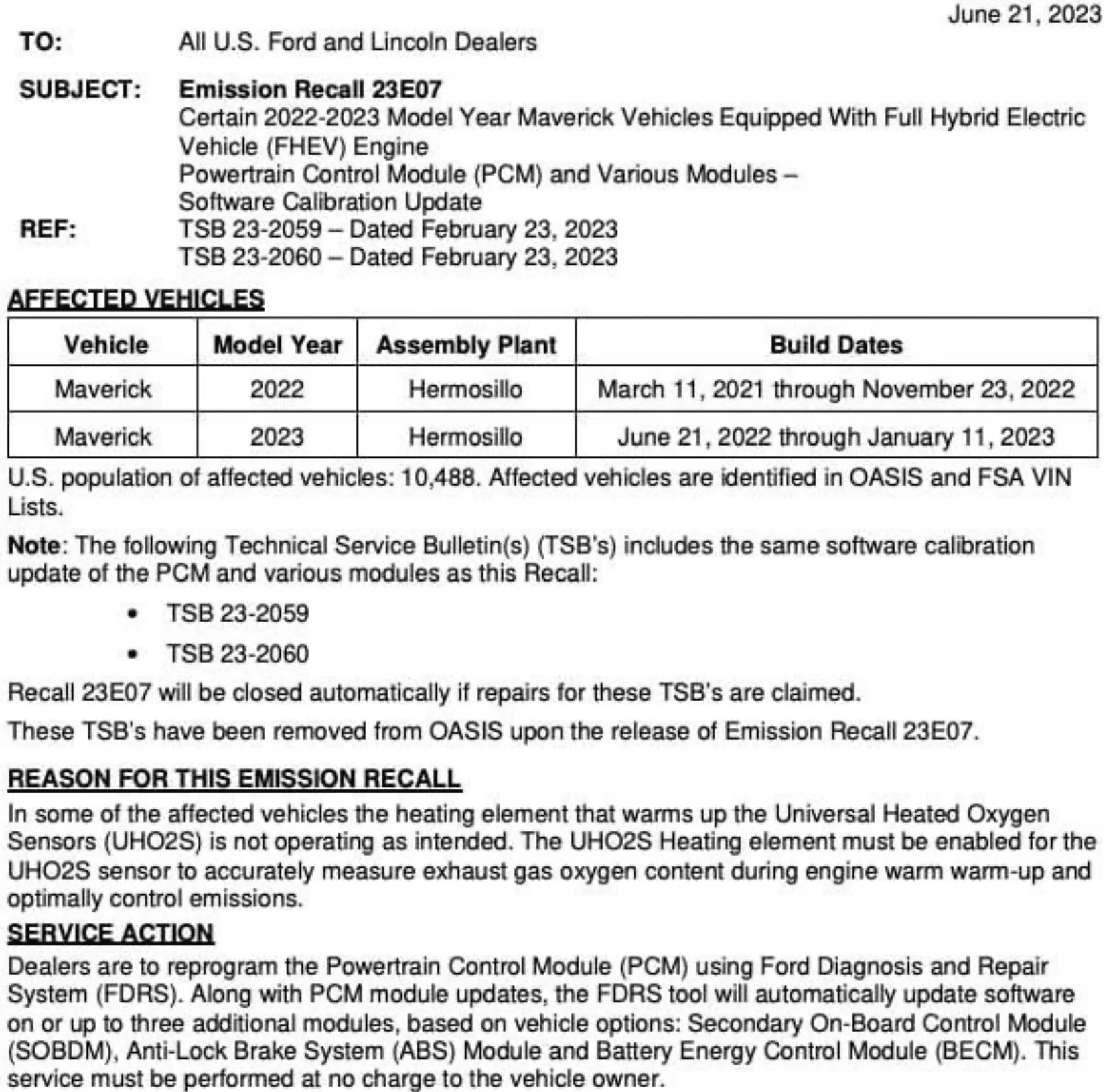
Apparently there is a recall now 23EO7 that replaces 232060.

Ford Maverick Replacing 12v battery 1693998485149
 

MakinDoForNow

2.5L Hybrid
Well-known member
First Name
James
Joined
Sep 24, 2021
Threads
2
Messages
8,429
Reaction score
5,994
Location
Texas
Vehicle(s)
2022 Maverick
Engine
2.5L Hybrid
The Hybrid battery is 470 cranking amps with 70 minute reserve capacity (this seems to be up from the 65 minute reserve capacity of the battery in the 2022 Mavericks). From what I can tell, reserve capacity is the number of minutes from full charge down to 10.5V at a constant 25A draw. Thus, something around 300W hours or a little less since would not expect anything below around 11.5V to be usable.

Been hot, hot, hot here in Austin. I am mostly under a tree and have a sunshade up but figure the truck stays in the 85-110 degree range pretty much all day. One thing to note is that voltage reading is dependant on temperature. For the exact same battery, the voltage will read differently depending on ambient temperature. I should note that volt-meters are "correct" for approoximately 80 degrees and there is some sort of correction factor for above or below that. As an example, measureing in the middle of the day (probably 105 in the cab) and at the end of the day (probably around 90) I saw a .03V difference (voltage reading was higher when it was cooler).

What I have not tried is the difference between "locked" and "locked with horn". DId not realize there was a difference. Anyone tried this? Do you have to click twice for anti-theft (crap. Got to go read the manual again.)?
I am NE of Burnet near Lake Victor. The manual is not directly real clear but after five reads the locked with horn sets if not all of the anti theft but maybe turns on the Ford Pass "your truck is being messed with" notification. What is most obvious is that locked with horn immediately turns off dash, power ports, exterior lighting and probably other things. I take it to be mainly notification to computer of "go to sleep, I am not going to use you for awhile" and the honk is "ok" but only Ford knows. I will take a guess of the newer batteries having more capacity as a result of increasing the purity of the lead. As to why the battery does not have a stated RESERVE CAPACITY is that standard practice is reserve capacity is only shown on DEEP CYCLE batteries (which I believe have higher lead purity and different plate designs). It was specifically stated on O'Reilly's Web site Q&A that BXT99RT4 was not deep cycle. Also on my new Tremor which has CCA760 AGM battery at 95 miles I put my NOCO Genius 5A Sunday at 10AM and it took until Tuesday afternoon for the green charged light to stabilize but the noco does have temperature adjusted procedure.
 

Montauk

2.5L Hybrid
Well-known member
First Name
Brit
Joined
Jul 21, 2023
Threads
8
Messages
216
Reaction score
318
Location
11954, 38829
Vehicle(s)
2024 Maverick XL, 2023 F-150 Rattler pkg
Engine
2.5L Hybrid
I am in agreement with both of your points.

I have only had my Hybrid for 2 weeks but been testing the battery voltage 3-4 times a day trying to see if there is some rhyme or reason to things. I use a Klein multi-meter so confident in the readings.

After the 30 mile drive home from the dealer (and waiting 2-3 hours for any surface voltage to wear off), my battery was 12.42 volts (thus was probably <13.5V at the dealer). Batteries tend to start sulfating at about 12.48 volts so this was lower than I would prefer. I have turned off everything I can turn off using the infotainment settings (no wifi, no GPS, no FordPass connectivity, no AT&T connection, etc.) and lock the doors to keep it from "waiking up" every time someone or something walks by (I live out in the country and get visited by deer every night).

Here are my observations:
1) Checking the voltage under the hood and under the seat tend to be a little different by about .1 volt. Not sure what the extra resistive load is between them (the cable should only result in about a .01 change).

2) It is extremely important to check the voltage the same way every time. I get in the front seat, lock the doors, and wait for all lights to go out (I just sit the key fob in the passenger seat). The difference in voltage between the lights/dash/radio logo being on and off is about .1 volts. Where I am extremely confused is that sometimes it is .1 volts higher and other times it is .1 volts lower. This tends to indicate that sometimes the HV battery is doing something when you open the door and other times it is not.

3) Using a BatteryMinder float charger for 2 days using the under-hood connection points, I was able to get the battey up to 12.58 volts steady-state. The BatteryMinder charged at about 12.85 - 13.1 volts and the battery had a surface charge of 12.76 when I removed the charger. After about 2 hours the surface charge was about 12.62 volts and at 6 hours it was 12.58 volts (which is where a fully charged battery should be).

4) Once I had the battery fully charged, I did a BMS reset, locked the doors, and did not touch the truck for 12 hours. The next morning the voltage was 12.42 volts. I drove the truck about 60 miles picking up groceries and had a voltage of 12.52 about 10 minutes after getting home (so still some surface voltage) and 12.47 about 2 hours later.

5) I try to check the voltage each night (about 7PM) and then again in the morning (about 10AM). I lock the doors so there is no "extra" activity. On average, I loose about .1 volts over-night. However, I did have 1 night where it went down by .2 volts (down to 12.27 volts). Each .1 volts equates to about 10% of battery capacity. There is ZERO reason why a battery should be drained by 10% per night. This means that either the battery was sized wrong or there is an absolutely huge parasitic drain going on.

6) If my math is correct, the Group 99 T4 battery in the Maverick should have roughly 300 W/hours of energy (12 volt x 70 minute reserve at 25 amps). If it is loosing 10% over-night, then it is using roughly 30 W/hours of energy for something. In my case, this equates to "something" using an average of roughly 2 continuous watts per hour (or 30 W for one hour and zero watts the remaining time). This is roughly 4 -6 times as much draw as it should have (.03 to .05 amps [.36 to .6 watts] "key off" draw is what is specified by several car manufacturers). I would love to know what the "key off" specification for a Ford Maverick is.

@Ford Motor Company Can you provide us with the "door locked, key off" parasitic amp draw specification for the Hybrid Maverick? That will help us understand if what we are seeing was a design decision by Ford Engineers or if there is something wrong with a large number of our Mavericks. Thanks.
A modem sending location pings and other data could be a source of this draw, especially if the software doesn’t hibernate the hardware rapidly.
Sponsored


Top