
Sponsored

2.5L Hybrid - Change to 5W-30 oil

Master Blaster

2.5L Hybrid
Well-known member
First Name
Master
Joined
Feb 20, 2024
Threads
8
Messages
1,323
Reaction score
1,947
Location
Toronto
Vehicle(s)
23 Maverick Lariat Hybrid
Engine
2.5L Hybrid
"OP is ignorant on hybrid........."
Wow, did you get your information from God, or maybe Ford himself? Very pejorative comment, there is enough in this forum already. HTHS is a function of oil, and consequently "thickness". Anyone who is educated in tribology will tell you that said "thickness" is a major factor in wear, metal-on-metal. XW-30 is always going to reduce wear, over a 20 weight, which is a requirement of EPA . New designs which use different bearing/driveshaft clearances, etc. can use 20 and get away with it. The Ford L5 Duratec, while optimized for hybrid use, is an old cast design and will benefit with 30 weight oil.
XW-30 is fine if you can actually get it there. Its absolutely useless if you can't. Unlike overheated race engines, lubrication in the Hybrid is all about the cold engine numbers, and the hot ones are just an edge case. Shear strength is completely irrelevant when there is no oil there to shear. And while thickness is a common side-effect of getting sufficient shear strength, its side-effect. The shear strength in the Hybrid comes from using the better long-chain oil molecules that are in the mandatory synthetic oil.
Sponsored


710-oil-614

2.5L Hybrid
Well-known member
First Name
Cal
Joined
Oct 13, 2021
Threads
27
Messages
6,105
Reaction score
11,988
Location
Ohio...but I'd rather be in Boone.
Vehicle(s)
2025 Hybrid AWD Lariat
Engine
2.5L Hybrid
My neighbor upgraded her solar batteries last Nivember. I purchased her old 16 6v 400amp AGM for $400 total. They are five years old and were abused. They have all seen noco maintainers and are holding at 6.4 volts, some for weeks. Game plan is lights and 2 freezers in garage plus well (or at least fill pressure tank from 1250 gallon surface tank filled by solar well pump during day). Also possibly separate from garage power for fans lights etc in a greenhouse. Have agreement with her independent solar installer for additional batteries if in decent shape to buy at scrap plus $6-$8. Will hook these up to inverter and load test to see what I have to work with. One of her batteries only saw service for 8 months but was paired with 7 survivors in a 48v string. MSRP of those 123 lb puppies is right at $700.
That’s awesome! I would love a full PV array but it’s cost prohibitive currently. I think having solar as a supplemental source and not tying into your main panel and local grid is the way to go.

If the electric grid goes down I don’t expect my solar to maintain my whole house electric supply but combined with a 2200w propane inverter generator it is plenty to supply power for basic needs.
 

Robot-Wrangler

2.5L Hybrid
Well-known member
First Name
Brian
Joined
Dec 9, 2024
Threads
12
Messages
496
Reaction score
488
Location
Kentucky
Vehicle(s)
2025 Maverick Hybrid Lariat AWD, 2022 F-350 SCLB 6.7, 1997 Suburban K-2500
Engine
2.5L Hybrid
I saw the big drop in $. I want solar but it's hard to justify in Texas. My ELECTRIC COOP fixed rate is about $0.11/kw PLUS service availability (aka meter) fee of 26.69/month. in my case it would pencil out better to purchase a couple power walls go with time of use power billing charging at night cheaper and discharging during super peak billing times. About the time you think it will work out with 12 year ROI you remember to include finance cost on the investment adds several years. Then you remember buying 100 sh of TSLA at $22.30, selling 90 when it gets to 200% of purchase and keeping the 10 sh forever.
Given my health and age, I would never live long enough to see a payback for a huge solar investment in KY. I have five 200watt solar panels for my RV for convenience when I travel again. I hope to finish the installation after I recover from my second knee replacement next month. I would prefer to do it myself but I might have to use a shop.

With regards to engine oil viscosity, with my long commute, I verified with two cars that require 0W20 synthetic oil. They will get lower efficiency when thicker bulk 5W30 conventional oil is substituted by hack oil change shops.
 

srfdude44

2.5L Hybrid
Well-known member
First Name
Mike
Joined
Jun 7, 2023
Threads
15
Messages
100
Reaction score
59
Location
california
Vehicle(s)
kia optima
Engine
2.5L Hybrid
Given my health and age, I would never live long enough to see a payback for a huge solar investment in KY. I have five 200watt solar panels for my RV for convenience when I travel again. I hope to finish the installation after I recover from my second knee replacement next month. I would prefer to do it myself but I might have to use a shop.

With regards to engine oil viscosity, with my long commute, I verified with two cars that require 0W20 synthetic oil. They will get lower efficiency when thicker bulk 5W30 conventional oil is substituted by hack oil change shops.
That may be true, although 0W-30 would be preferred for a hybrid. But by the same token maybe 0W-8 would even give higher efficiency, you could try that in your experiments.
 

m5040

2.5L Hybrid
Well-known member
First Name
John
Joined
Sep 21, 2022
Threads
5
Messages
214
Reaction score
134
Location
CT
Vehicle(s)
Cummins Dodge
Engine
2.5L Hybrid
engine has a truly stellar reputation for reliability.


In the US the only recommended oil for this engine is 0W-20 (irrespective of climate region!), but that almost certainly has to do with legality as related to EPA/fuel economy standards, and is not necessarily what's best for longevity. Many or actually most modern vehicles in the US require 0W-20 oil, or sometimes even thinner: 0W-16 or 0W-8 in for instance the latest Toyota engine families. :oops:

as it might "plug things up".

Cheers!

🍿
As you say, it has a truly stellar reputation for reliability, why reengineer it?

I don't think you have to worry about plugging things up, I would worry about all the engine stopping and restarting throughout the normal operating cycle of a hybrid but now with thicker oil. Will there be even a fraction of a second delay in building oil psi that could add up to a disaster?
 

Sponsored

srfdude44

2.5L Hybrid
Well-known member
First Name
Mike
Joined
Jun 7, 2023
Threads
15
Messages
100
Reaction score
59
Location
california
Vehicle(s)
kia optima
Engine
2.5L Hybrid
As you say, it has a truly stellar reputation for reliability, why reengineer it?

I don't think you have to worry about plugging things up, I would worry about all the engine stopping and restarting throughout the normal operating cycle of a hybrid but now with thicker oil. Will there be even a fraction of a second delay in building oil psi that could add up to a disaster?
A delay? If, perhaps, you are in minnesota in December. The viscosity of a 30W oil at 40 degrees F is not to worry about.
 

m5040

2.5L Hybrid
Well-known member
First Name
John
Joined
Sep 21, 2022
Threads
5
Messages
214
Reaction score
134
Location
CT
Vehicle(s)
Cummins Dodge
Engine
2.5L Hybrid
A delay? If, perhaps, you are in minnesota in December. The viscosity of a 30W oil at 40 degrees F is not to worry about.
You may not quite get what I was saying, more like how many milliseconds to build acceptable oil pressure for each of the considered oil weights?
 

Phimosis

2.0L EcoBoost
Well-known member
First Name
Larry
Joined
Jul 18, 2024
Threads
2
Messages
1,180
Reaction score
1,520
Location
Santa Clarita, CA
Vehicle(s)
2024 Maverick Lariat FX4 4K tow
Engine
2.0L EcoBoost
You may not quite get what I was saying, more like how many milliseconds to build acceptable oil pressure for each of the considered oil weights?
I’m in agreement, but outside of in-house engineering results, there’s no proof.

if you design an engine for 0w-10 oil, that means you need to have very narrow oil passages and oiling orifices to maintain adequate oil pressure, according to Poisoulle’s law: the volumetric flow rate is proportional to the pressure difference, the fourth power of the radius, and inversely proportional to the fluid viscosity and tube length.

If you put a high viscosity oil into a system with small tube diameter, designed for a lower viscosity, what is going to happen is that the pressure will go up. But oil pumps have an internal bypass valve to prevent overpressure. And if the majority of your oil is going through the bypass valve, according to Poisoulle's law, the volumetric flow rate is going to dramatically decrease.

Does that cause a delay in the delivery of needed lubrication? Not sure. But it is plausible.

There is a reason that the manufacturer recommends a specific oil viscosity and not a range of viscosities.
 

MakinDoForNow

2.5L Hybrid
Well-known member
First Name
James
Joined
Sep 24, 2021
Threads
2
Messages
8,523
Reaction score
6,094
Location
Texas
Vehicle(s)
2022 Maverick
Engine
2.5L Hybrid
Bottom line is 20 weight oil is 20. The 0w, 5w,10w is the winter temp range scale that the 20 (or 30,10,?) maintains the 20 viscosity range (etc).
 

srfdude44

2.5L Hybrid
Well-known member
First Name
Mike
Joined
Jun 7, 2023
Threads
15
Messages
100
Reaction score
59
Location
california
Vehicle(s)
kia optima
Engine
2.5L Hybrid
There is a reason that the manufacturer recommends a specific oil viscosity and not a range of viscosities.
[/QUOTE]
 
Sponsored

srfdude44

2.5L Hybrid
Well-known member
First Name
Mike
Joined
Jun 7, 2023
Threads
15
Messages
100
Reaction score
59
Location
california
Vehicle(s)
kia optima
Engine
2.5L Hybrid
There is a reason that the manufacturer recommends a specific oil viscosity and not a range of viscosities.
[/QUOTE]
That was the case years ago, before the EPA took over the requirements for manufacturers to specify their oil requirements. Virtually all passenger cars currently (and for the last 10 or so years) all have requirements for 20W oil in the US. But the same cars/engines in other parts of the world have sometimes wildly differing requirements, all the way to XW-40. So no, just because the manual in the US says 0W-20, is that what the manufacturer really wants, just what they are forced to state.
 

Phimosis

2.0L EcoBoost
Well-known member
First Name
Larry
Joined
Jul 18, 2024
Threads
2
Messages
1,180
Reaction score
1,520
Location
Santa Clarita, CA
Vehicle(s)
2024 Maverick Lariat FX4 4K tow
Engine
2.0L EcoBoost
That was the case years ago, before the EPA took over the requirements for manufacturers to specify their oil requirements. Virtually all passenger cars currently (and for the last 10 or so years) all have requirements for 20W oil in the US. But the same cars/engines in other parts of the world have sometimes wildly differing requirements, all the way to XW-40. So no, just because the manual in the US says 0W-20, is that what the manufacturer really wants, just what they are forced to state.
I’m pretty sure you just made all of this up to promote your unfounded beliefs.

Ford doesn’t instruct you to use 0w-20 because the EPA forces them to. That’s crazy talk. Ford instructs you to use 0w-20 because they designed the engine for 20 weight oil.

And they don’t recommend 20 weight oil for every engine. They only recommend 20 weight oil in the engines engineered for 20 weight oil. For example, the ecoboost maverick is designed to use 5w-30. Because of the turbo and higher specific power output, the heat generated is increased and bearing loads are increased, which means you need more oil volume for lubrication and heat transfer, which means you need larger diameter oil passages. Poiseuille’s law says that if you increase the tube diameter, the flow will increase, but your pressure will also drop. The way they can get the pressure back up to the desired range is to increase the oil viscosity.

Same thing with the 5.2 coyote used in the Shelby GT 500 and in the Raptor R. Because it is a high hp engine that will see higher bearing loads, higher average rpm and higher heat loads, they have designed it with even larger oil galleries for higher oil flow rates. Again, larger tubes = lower oil pressure at a given viscosity. So they upped the viscosity again and they recommend 5w50 for the 5.2 L. Factory recommended 50 weight.

If the EPA was forcing them to use 20w, they would have had to design the ecoboost engines and the 5.2 L with smaller oil passages, but then included more oil passages to provide adequate lubrication, heat transfer, adequate oil pressure and still comply with a law that forces them to use 20w oil. But no such law exists. So Ford doesn’t go that route because more oil passages = more expensive to design and manufacture.

And there’s no “wildly differing requirements” for different parts of the world. A 2.0 ecoboost maverick in the US, a 2.0 ecoboost Kuga in Europe or a 2.0 ecoboost Taurus in China all recommend 5w-30, or 0w-30 if above 5,000 ft elevation or below -4F temp.

So no, just because the manual in the US says 0W-20, is that what the manufacturer really wants, just what they are forced to state.
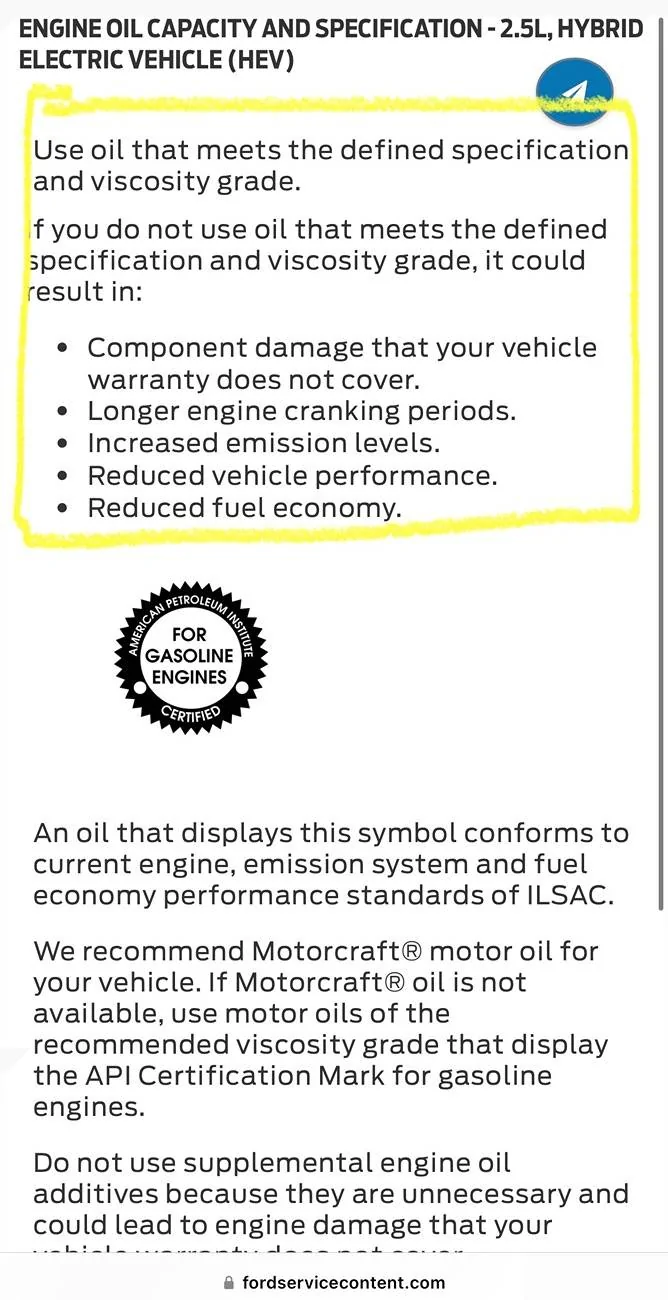
Nope and more nope. They are not forced to tell you to use 20w oil. And they unequivocally tell you in the user manual that you should not be using anything other than their recommended viscosity.

Ford Maverick 2.5L Hybrid - Change to 5W-30 oil IMG_2201
 
Last edited:

Master Blaster

2.5L Hybrid
Well-known member
First Name
Master
Joined
Feb 20, 2024
Threads
8
Messages
1,323
Reaction score
1,947
Location
Toronto
Vehicle(s)
23 Maverick Lariat Hybrid
Engine
2.5L Hybrid
Bottom line is 20 weight oil is 20. The 0w, 5w,10w is the winter temp range scale that the 20 (or 30,10,?) maintains the 20 viscosity range (etc).
The cold number is the important one on the Hybrid. The hybrid engine rarely gets up to the temperature of the EcoBoost, and routinely spends its time a lot cooler. No matter any other number, you want 0W synthetic oil and no other. Its all about the first 20msec of lubrication, not weird other numbers like viscosity during a race. Some dealers have been putting in the 5W30 that they use on the EcoBoost, and that will kill mileage and engine life. There are some disadvantages in using 0W30 instead of 0W20, like an increased amount of plastic in the oil instead of something that actually lubricates, but given that the engine rarely reaches EcoBoost temperatures, maybe you can get away with the hot number being weird.
 

Robot-Wrangler

2.5L Hybrid
Well-known member
First Name
Brian
Joined
Dec 9, 2024
Threads
12
Messages
496
Reaction score
488
Location
Kentucky
Vehicle(s)
2025 Maverick Hybrid Lariat AWD, 2022 F-350 SCLB 6.7, 1997 Suburban K-2500
Engine
2.5L Hybrid
I heard that Aunt Jemima pancake syrup is a sweet substitute for 0W20 oil. I would like confirmation from the lubrication experts trolling this post before I fill up my $40,000 2025 hybrid lariat awd crankcase with syrup. 😆 I'm diabetic, so perhaps I should use sugar free? What do y'all think? [🐂💩 bs alert]
 

srfdude44

2.5L Hybrid
Well-known member
First Name
Mike
Joined
Jun 7, 2023
Threads
15
Messages
100
Reaction score
59
Location
california
Vehicle(s)
kia optima
Engine
2.5L Hybrid
I’m pretty sure you just made all of this up to promote your unfounded beliefs.

Ford doesn’t instruct you to use 0w-20 because the EPA forces them to. That’s crazy talk. Ford instructs you to use 0w-20 because they designed the engine for 20 weight oil.


Same thing with the 5.2 coyote used in the Shelby GT 500 and in the Raptor R. Because it is a high hp engine that will see higher bearing loads, higher average rpm and higher heat loads, they have designed it with even larger oil galleries for higher oil flow rates. Again, larger tubes = lower oil pressure at a given viscosity. So they upped the viscosity again and they recommend 5w50 for the 5.2 L. Factory recommended 50 weight.

If the EPA was forcing them to use 20w, they would have had to design the ecoboost engines and the 5.2 L with smaller oil passages, but then included more oil passages to provide adequate lubrication, heat transfer, adequate oil pressure and still comply with a law that forces them to use 20w oil. But no such law exists. So Ford doesn’t go that route because more oil passages = more expensive to design and manufacture.

And there’s no “wildly differing requirements” for different parts of the world. A 2.0 ecoboost maverick in the US, a 2.0 ecoboost Kuga in Europe or a 2.0 ecoboost Taurus in China all recommend 5w-30, or 0w-30 if above 5,000 ft elevation or below -4F temp.


Nope and more nope. They are not forced to tell you to use 20w oil. And they unequivocally tell you in the user manual that you should not be using anything other than their recommended viscosity.

IMG_2201.jpeg
Well thats a lot of words, most of which is simple conjecture and guesswork on your part.
"I’m pretty sure you just made all of this up to promote your unfounded beliefs."
LOL, my beliefs are much more than unfounded, while yours....

Re: the Raptor and Coyote, there are exemptions for high performance engine/cars.

Here's a little secret, Ford (and all other manufacturers) are responsible for the length of the warranty. After that, well you are on your own. And the quality of oil, inc. 0W-20 is good, and with frequent oil changes will work just fine. Do you recall just a few years ago when manufacturers were saying transmission were sealed, no service required? Do you think a transmission would really last over say 100K miles with no service? Ask any tranny shop about that.
While there is no "law" regarding oil, the EPA is god. Period. They require the total fleet of cars a manufacturer makes to hit certain fuel economy numbers. So maybe a 'Vette or Cobra etc may get by, the total sales of those cars is very small compared to the total numbers, and thus won't affect the fuel economy numbers. And while the mileage difference between 0-W20 and 30 is small, over a million cars total it will make a difference.

Obviously you have never heard of CAFE. Corporate Average Fuel Economy. Before you start telling folks that they are crazy and have unfounded beliefs, you might educate yourself.
Sponsored


Top