

- Thread starter
- Banned
- #1
Why is there so much debate over headlamp "brightness"?
This explains... A LOT.
According to Google:
Astigmatism is a common eye condition that affects about 1 in 3 people worldwide:
Response: LEDs often feel intense to human eyes for several interesting physiological and technical reasons:
1. Small Source Size:
- LEDs concentrate light from a very small area (often < 1mm²)o
- This creates extremely high luminance (brightness per unit area)
- Our eyes evolved dealing with larger, more diffuse sources
- When we look directly at an LED, this concentrated light hits a small retinal area
2. Blue Light Content:
- Many white LEDs use blue LEDs with phosphor coating
- The blue component is particularly stimulating to our retinas
- Our eyes are very sensitive to blue wavelengths
- This can cause more discomfort than equivalent warm sources
3. Sharp Spectral Peaks:
- LED spectra often have sharp peaks rather than smooth distributions
- This differs from natural light and incandescent sources
- Can trigger stronger biological responses
- May cause more glare sensitivity
4. Limited Natural Diffusion:
- Traditional sources naturally scattered light more
- LEDs need intentional diffusion added
- Without proper diffusion, the sharp contrast can be uncomfortable
-------------------------------
LED headlights are using LED chips when our eyes, and nervous system, aren't evolved to deal with such a light source. Limiting the intensity and blue wavelength light will somewhat mitigate the LED disaster, but in reality, headlamps must use technology that emits light that our eyes evolved with. This means car headlamps must use halogen/tungsten filament or similar, not tiny LED chips.
See Also:
www.softlights.org
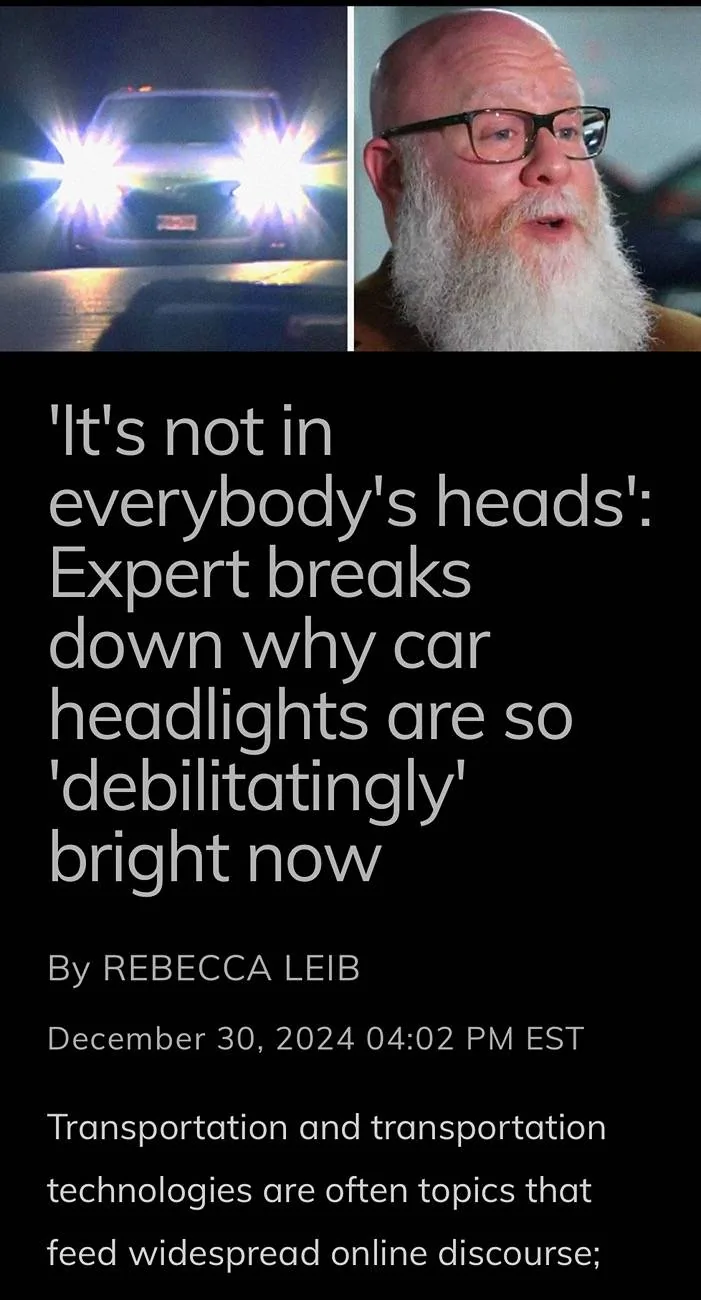
Good news story here:
https://www.dailydot.com/news/led-headlights-astigmatism/
PLEASE READ and PLEASE HELP make a positive change.
PLEASE HELP 33% of the population.
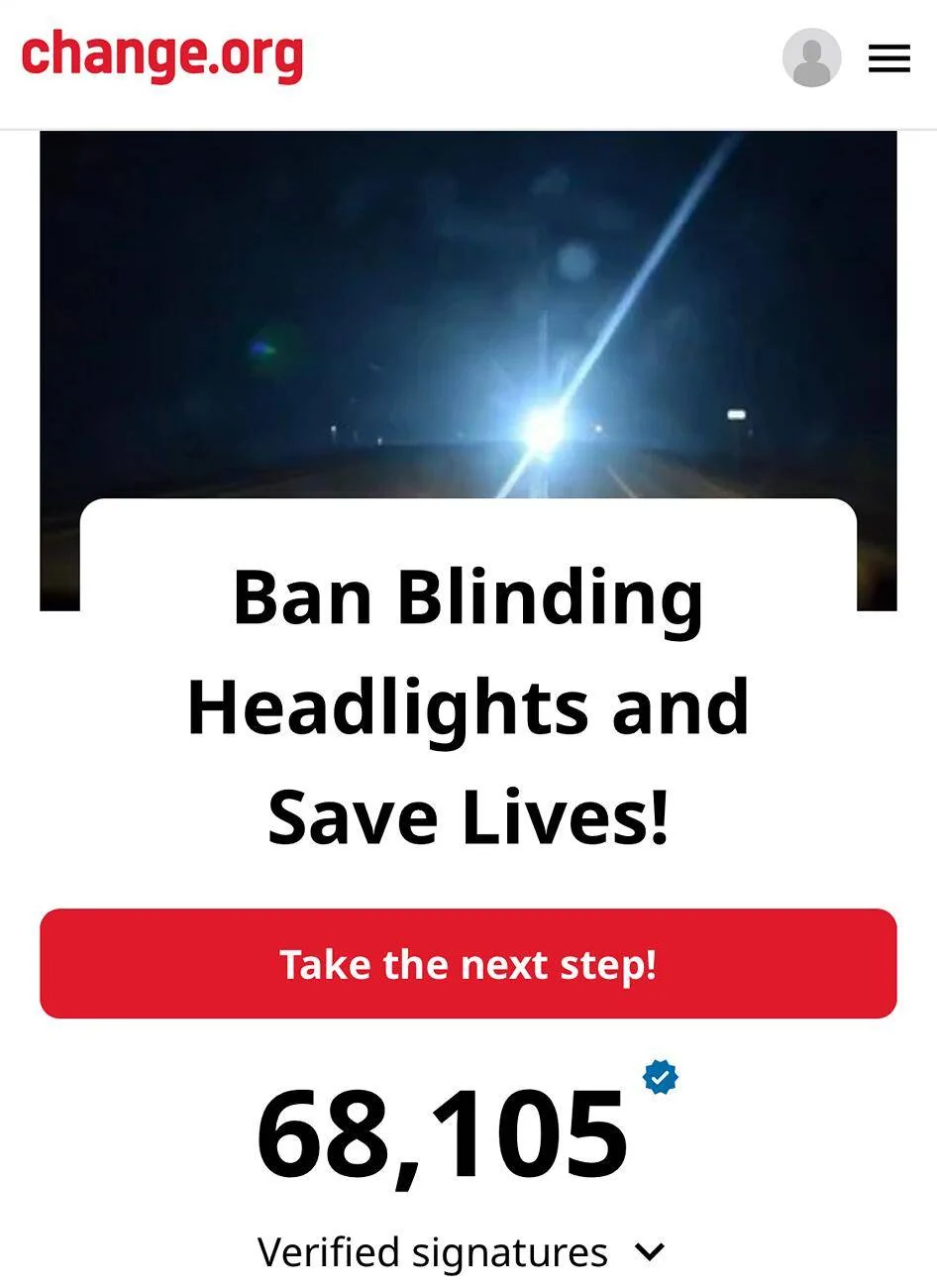
PLEASE SIGN HERE TO CHANGE.
https://www.change.org/p/u-s-dot-ban-blinding-headlights-and-save-lives
This explains the strong opinions on both sides. 1 in 3 are badly affected. 2 in 3 are not.
Hopefully if you are part of the 2 you will have sympathy, compassion, and understanding for the other 33%. Bright LED headlamps are literally causing pain and suffering for 33% of the people out there.
Will you be part of the solution?
Thank you.
https://www.change.org/p/u-s-dot-ban-blinding-headlights-and-save-lives
As of January 16, 2025
This explains... A LOT.
According to Google:
Astigmatism is a common eye condition that affects about 1 in 3 people worldwide:
- Prevalence: In the United States, 33% of people have astigmatism. In a systematic review, the prevalence of astigmatism in adults across the World Health Organization regions was estimated to be 40%.
- Age: Astigmatism can be present at birth, but most babies outgrow it.
- Blurred vision
- Objects appearing wavy or distorted
- Squinting
- Headaches
- Poor night vision
- Sensitivity to bright light
- Frequent eye strain
Response: LEDs often feel intense to human eyes for several interesting physiological and technical reasons:
1. Small Source Size:
- LEDs concentrate light from a very small area (often < 1mm²)o
- This creates extremely high luminance (brightness per unit area)
- Our eyes evolved dealing with larger, more diffuse sources
- When we look directly at an LED, this concentrated light hits a small retinal area
2. Blue Light Content:
- Many white LEDs use blue LEDs with phosphor coating
- The blue component is particularly stimulating to our retinas
- Our eyes are very sensitive to blue wavelengths
- This can cause more discomfort than equivalent warm sources
3. Sharp Spectral Peaks:
- LED spectra often have sharp peaks rather than smooth distributions
- This differs from natural light and incandescent sources
- Can trigger stronger biological responses
- May cause more glare sensitivity
4. Limited Natural Diffusion:
- Traditional sources naturally scattered light more
- LEDs need intentional diffusion added
- Without proper diffusion, the sharp contrast can be uncomfortable
-------------------------------
LED headlights are using LED chips when our eyes, and nervous system, aren't evolved to deal with such a light source. Limiting the intensity and blue wavelength light will somewhat mitigate the LED disaster, but in reality, headlamps must use technology that emits light that our eyes evolved with. This means car headlamps must use halogen/tungsten filament or similar, not tiny LED chips.
See Also:
www.softlights.org
Good news story here:
https://www.dailydot.com/news/led-headlights-astigmatism/
PLEASE READ and PLEASE HELP make a positive change.
PLEASE HELP 33% of the population.
PLEASE SIGN HERE TO CHANGE.
https://www.change.org/p/u-s-dot-ban-blinding-headlights-and-save-lives
This explains the strong opinions on both sides. 1 in 3 are badly affected. 2 in 3 are not.
Hopefully if you are part of the 2 you will have sympathy, compassion, and understanding for the other 33%. Bright LED headlamps are literally causing pain and suffering for 33% of the people out there.
Will you be part of the solution?
Thank you.
https://www.change.org/p/u-s-dot-ban-blinding-headlights-and-save-lives
As of January 16, 2025
Sponsored
Last edited: