

Sponsored

More Torque Than Specified?

heady

2.5L Hybrid
Well-known member
Joined
May 14, 2025
Threads
4
Messages
328
Reaction score
519
Location
MI
Vehicle(s)
'25 Lariat
Engine
2.5L Hybrid
Here's a datafile for 2024 Sport Mode since the TM seems to be used more, and the HVB is certainly attempted to be kept charged up better when not being used (not in this data though).
This was actually part of a coast down test to compare modes for regen (still working on making a post about it).
So I wasn't going flat out acceleration (pedal only at 44% max), rather I just wanted to be at 60 mph at a certain point so all the coasts were over the same ground.
Steps: Turned to Sport Mode (ICE off when stopped of course), turned on logging, foot off brake so ICE on, jammed pedal.
So 16 sec almost, so not getting max values here. I'll have to find a road to do that and log it.

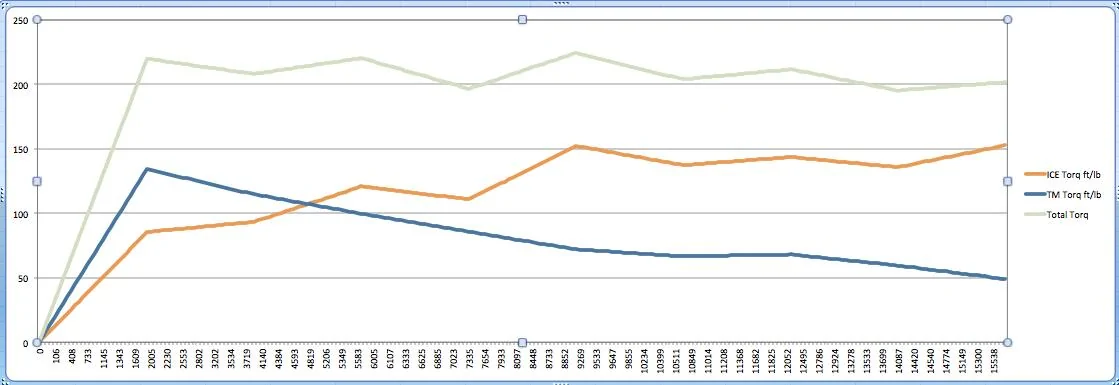
Graph of torque curve for time.
So perhaps telling enough.
Oh - why not a smooth ICE curve?
Sport Mode, the simulated shifts with a real change of ICE RPM with change of Generator Motor RPM so actual "gear" change.
1751652661066-t2.jpg


There's an extra graph in the attached data file if desired to see anything else.
Like HVB Amps staying strong the whole 16 sec, GM torq/RPM changes, DCDC Conv Hi Amp changes.
Fantastic work!
Sponsored


heady

2.5L Hybrid
Well-known member
Joined
May 14, 2025
Threads
4
Messages
328
Reaction score
519
Location
MI
Vehicle(s)
'25 Lariat
Engine
2.5L Hybrid
Here's a datafile for 2024 Sport Mode since the TM seems to be used more, and the HVB is certainly attempted to be kept charged up better when not being used (not in this data though).
This was actually part of a coast down test to compare modes for regen (still working on making a post about it).
So I wasn't going flat out acceleration (pedal only at 44% max), rather I just wanted to be at 60 mph at a certain point so all the coasts were over the same ground.
Steps: Turned to Sport Mode (ICE off when stopped of course), turned on logging, foot off brake so ICE on, jammed pedal.
So 16 sec almost, so not getting max values here. I'll have to find a road to do that and log it.
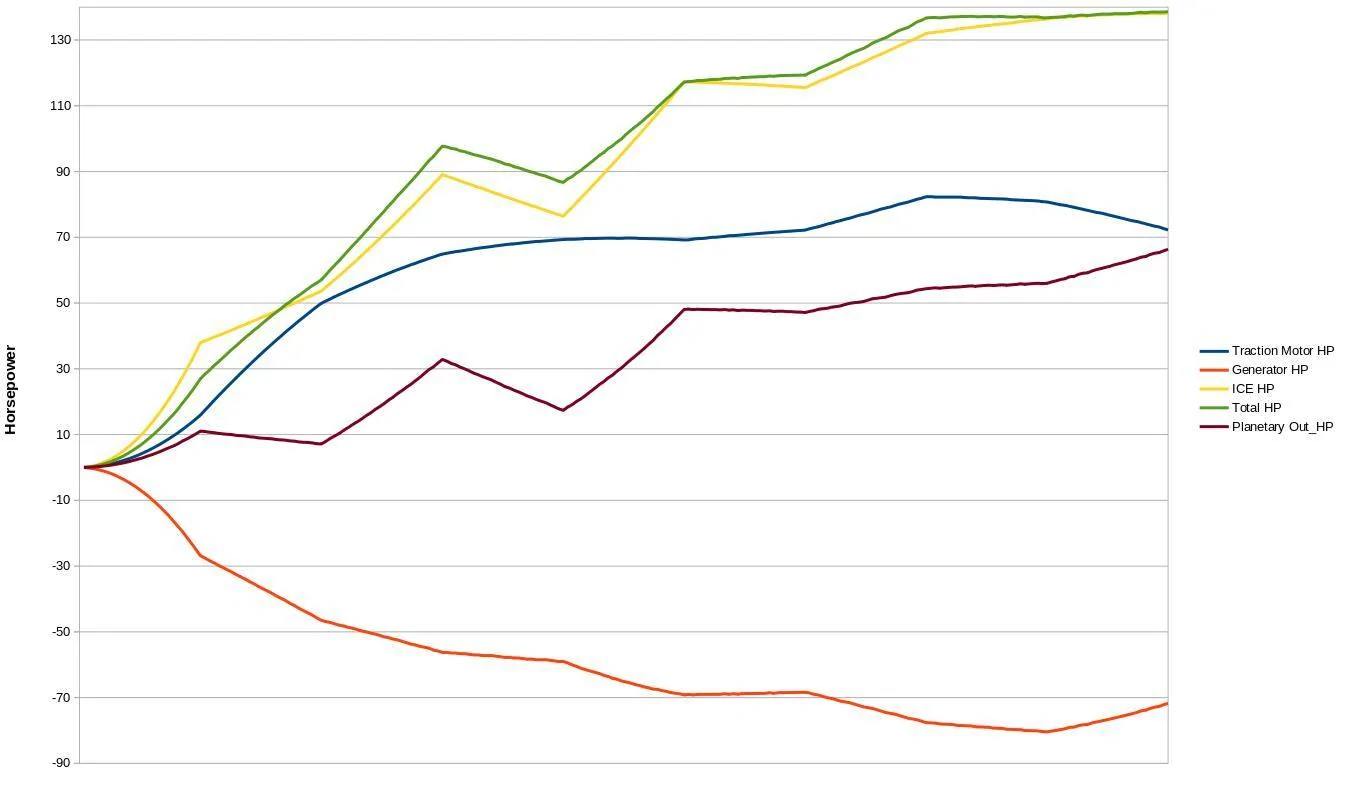
I made another quick graph from your ~16 seconds of data to demonstrate the power flows through the transmission, and how much power came from the engine vs. the battery, I hope you don't mind:
Ford Maverick More Torque Than Specified? Screenshot from 2025-07-04 17-25-02


The green line is total HP, any time it is higher than the yellow line, some horsepower is coming from energy drawn from the battery, any time it is lower than yellow, energy is flowing into the battery. The other lines demonstrate the power split through the transmission, how much is being transmitted electrically from the Generator to the Traction motor through the inverter, and how much is being transmitted directly through the gears mechanically is shown by Planetary Out_HP. Generator HP is shown as a negative value because it is being used to regenerate power out of the planetary gear set and onto the high voltage bus, where the energy is then sent to the traction motor or battery, electrically.

edit: I looked at your logged HV battery state of charge and amps, and it looks like the HV battery was being used slightly to provide power the entire acceleration run; in that case the PCM is just making a measurement error when it is calculating the ICE torque value, and the battery was never actually charging during this short datalog run. ICE Torq ft/lb in column K in your spreadsheet is probably a torque demand request instead of a back-calculated value from the mechanical torque ratio in the planetary and the measured power from the generator motor; I verified that the torque ratio, while close to the actual mechanical torque ratio of 3.53:1 in the planetary, does have some measurement error in it and it the computer calculated ratio ranges from 2.9 right at the start of the run to as high as 4, with an average of 3.63 in the data.
 
Last edited:

HeyBales

2.5L Hybrid
Well-known member
First Name
Mike
Joined
May 3, 2024
Threads
4
Messages
4,843
Reaction score
4,399
Location
KC Metro area
Vehicle(s)
2005 Toyota RAV4, 2024 XLT Hybrid
Engine
2.5L Hybrid
That's why I included the data file.
Fun with numbers!
(not everyone can say that)

I just wish there was a PID for HP.
Other scanners must display it only by means of math, or it's hidden behind a PID name that has nothing about HP, horse, or power that I've searched for.
Maybe it uses the German term!
"Pferdestärke" in German, this unit is used in some European countries. PS.
 

heady

2.5L Hybrid
Well-known member
Joined
May 14, 2025
Threads
4
Messages
328
Reaction score
519
Location
MI
Vehicle(s)
'25 Lariat
Engine
2.5L Hybrid
The computer really doesn't have any use for a HP figure to do its job, only torque and RPM. We can calculate HP for ourselves though as long as we have those two values for any power segment of the power train, just: Torque * RPM / 5252 = HP

You should be able to make a gauge or dial to display this in many apps like Torque Pro if you'd like to see it in real time in the car.
 

Bil13h

2.5L Hybrid
Well-known member
First Name
Bill
Joined
Aug 25, 2024
Threads
4
Messages
196
Reaction score
211
Location
Collingwood, ON
Vehicle(s)
'22 Hybrid XLT Lux
Engine
2.5L Hybrid
Here's a datafile for 2024 Sport Mode since the TM seems to be used more, and the HVB is certainly attempted to be kept charged up better when not being used (not in this data though).
This was actually part of a coast down test to compare modes for regen (still working on making a post about it).
So I wasn't going flat out acceleration (pedal only at 44% max), rather I just wanted to be at 60 mph at a certain point so all the coasts were over the same ground.
Steps: Turned to Sport Mode (ICE off when stopped of course), turned on logging, foot off brake so ICE on, jammed pedal.
So 16 sec almost, so not getting max values here. I'll have to find a road to do that and log it.

Graph of torque curve for time.
So perhaps telling enough.
Oh - why not a smooth ICE curve?
Sport Mode, the simulated shifts with a real change of ICE RPM with change of Generator Motor RPM so actual "gear" change.
1751652661066-t2.jpg


There's an extra graph in the attached data file if desired to see anything else.
Like HVB Amps staying strong the whole 16 sec, GM torq/RPM changes, DCDC Conv Hi Amp changes.
Can you try similar testing in Tow mode? I have always found Tow to be the superior mode vs Sport and always use Tow when making a hasty pass
 

Sponsored

HeyBales

2.5L Hybrid
Well-known member
First Name
Mike
Joined
May 3, 2024
Threads
4
Messages
4,843
Reaction score
4,399
Location
KC Metro area
Vehicle(s)
2005 Toyota RAV4, 2024 XLT Hybrid
Engine
2.5L Hybrid
Can you try similar testing in Tow mode? I have always found Tow to be the superior mode vs Sport and always use Tow when making a hasty pass
I had never used Tow mode much, your request I finally did, on a few of the tests so far, gotta do braking still, but my notes as to location and anything besides from 60 is lacking - gotta jog the memory since May.
Didn't realize Tow mode did the same simulated shifts as Sport mode.
The braking seems more like Slippery mode though, not heavy on regen on the coast or top end, gotta dig deeper on the pedal.

And I'll need to drive in some night-time no traffic to observe if the same heavy traction motor usage comes into play when the HVB is near 70% already, in other modes I've not noticed.
I rarely have the hills and traffic for regen that allow getting up to 70% SOC. I'm usually living up to 50% down to 30%.
So I've never noticed besides Sport & now Tow modes using the TM so much along with the ICE for torque. Many times 1/2 or better of torque was from TM.
If that's the case - I may want to rethink the acceleration test.
 

HeyBales

2.5L Hybrid
Well-known member
First Name
Mike
Joined
May 3, 2024
Threads
4
Messages
4,843
Reaction score
4,399
Location
KC Metro area
Vehicle(s)
2005 Toyota RAV4, 2024 XLT Hybrid
Engine
2.5L Hybrid
I made another quick graph from your ~16 seconds of data to demonstrate the power flows through the transmission, and how much power came from the engine vs. the battery, I hope you don't mind:
Screenshot from 2025-07-04 17-25-02.jpg


The green line is total HP, any time it is higher than the yellow line, some horsepower is coming from energy drawn from the battery, any time it is lower than yellow, energy is flowing into the battery. The other lines demonstrate the power split through the transmission, how much is being transmitted electrically from the Generator to the Traction motor through the inverter, and how much is being transmitted directly through the gears mechanically is shown by Planetary Out_HP. Generator HP is shown as a negative value because it is being used to regenerate power out of the planetary gear set and onto the high voltage bus, where the energy is then sent to the traction motor or battery, electrically.

edit: I looked at your logged HV battery state of charge and amps, and it looks like the HV battery was being used slightly to provide power the entire acceleration run; in that case the PCM is just making a measurement error when it is calculating the ICE torque value, and the battery was never actually charging during this short datalog run. ICE Torq ft/lb in column K in your spreadsheet is probably a torque demand request instead of a back-calculated value from the mechanical torque ratio in the planetary and the measured power from the generator motor; I verified that the torque ratio, while close to the actual mechanical torque ratio of 3.53:1 in the planetary, does have some measurement error in it and it the computer calculated ratio ranges from 2.9 right at the start of the run to as high as 4, with an average of 3.63 in the data.
It appears up until about 27 mph the HVB and TM were providing the majority of torque right?
Amp increase to 55 A finally stopped about 31 mph.
I don't think there was any charging of the HVB until coasting started, which is off the graph in the hidden data rows.
Positive reading is Amps from the battery, negative not shown in acceleration is to the battery.
So you mean it's likely the ICE torque is not correct?
I can totally believe they math out several figures being obtained in these PIDs, or as you say the requested value.
I know getting timely figures isn't being helped by having that many PID's on display.
When I added the 4 wheel brake pressure, each if those entries is like a delay in the logs by one increment extra per wheel, I'm removing after some brake tests. Some of the others are notable delays. Seems to depend on the module the figure is pulled from - I've tried to use the few same modules. Like VSS in 3 different modules, but used the one is same module with other PIDs I'm logging.
 

Bil13h

2.5L Hybrid
Well-known member
First Name
Bill
Joined
Aug 25, 2024
Threads
4
Messages
196
Reaction score
211
Location
Collingwood, ON
Vehicle(s)
'22 Hybrid XLT Lux
Engine
2.5L Hybrid
I had never used Tow mode much, your request I finally did, on a few of the tests so far, gotta do braking still, but my notes as to location and anything besides from 60 is lacking - gotta jog the memory since May.
Didn't realize Tow mode did the same simulated shifts as Sport mode.
The braking seems more like Slippery mode though, not heavy on regen on the coast or top end, gotta dig deeper on the pedal.

And I'll need to drive in some night-time no traffic to observe if the same heavy traction motor usage comes into play when the HVB is near 70% already, in other modes I've not noticed.
I rarely have the hills and traffic for regen that allow getting up to 70% SOC. I'm usually living up to 50% down to 30%.
So I've never noticed besides Sport & now Tow modes using the TM so much along with the ICE for torque. Many times 1/2 or better of torque was from TM.
If that's the case - I may want to rethink the acceleration test.
That's very interesting! I always found I didn't have to put the pedal as far down in Tow as sport, that it was more responsive, but I have certainly not done extensive testing of any sort, just the feels

I look forward to what comes of the query as you are able to figure more of it out! This vehicle has never felt within the few % of my old 2018 Escape as it was on paper, it feels better than my old v6 2011 Escape ffs.
 

heady

2.5L Hybrid
Well-known member
Joined
May 14, 2025
Threads
4
Messages
328
Reaction score
519
Location
MI
Vehicle(s)
'25 Lariat
Engine
2.5L Hybrid
It appears up until about 27 mph the HVB and TM were providing the majority of torque right?
Amp increase to 55 A finally stopped about 31 mph.
I don't think there was any charging of the HVB until coasting started, which is off the graph in the hidden data rows.
Positive reading is Amps from the battery, negative not shown in acceleration is to the battery.
So you mean it's likely the ICE torque is not correct?
I can totally believe they math out several figures being obtained in these PIDs, or as you say the requested value.
I know getting timely figures isn't being helped by having that many PID's on display.
When I added the 4 wheel brake pressure, each if those entries is like a delay in the logs by one increment extra per wheel, I'm removing after some brake tests. Some of the others are notable delays. Seems to depend on the module the figure is pulled from - I've tried to use the few same modules. Like VSS in 3 different modules, but used the one is same module with other PIDs I'm logging.
No, most of the torque was still supplied by the engine, in your torque graph there is one small error, you need to subtract the GM torque (it's negative in the sheet so you can just add the torque in column M to the other two columns) from the total torque, so you total torque is reading about 20-40 ft-lb too high on your graph in many sections. You can calculate roughly how much of the TM torque was supplied by the battery by making a ratio of the GM kilowatts to the battery kilowatts, that will basically be the percentage that was supplied from the battery/percentage supplied by the engine through the GM power pathway. At about 798 milliseconds, the GM is providing more than half the energy for the TM, and the ratio supplied by the GM increases throughout the run - which is energy drawn directly from the engine. At ~5.7 seconds the battery kW peaked at just under 12kW, at that time the GM was providing 42kW to the traction motor. There was no direct datalog for amps from or to the motors that I saw, so I converted HP to kW using the RPM and torque data you logged from each motor, so (RPM * Torq / 5252) * 0.7457


*Oh I just saw you asked about what I meant with the ICE torque, but yes that is not a strictly measured value from what I can tell; although the transmission can act as a dynometer since we have an electric motor we can measure the output of, when I added up the power values it showed early in the run a point where engine power was greater than total power (generator output was bringing the total below the engine-only value) - normally you'd think this was because excess energy was going into the battery, but not in this case since we know the battery stats separately.

The other possibility I can think of is that at low generator RPM the efficiency is low, and so the missing power from those simple addition calculations just might be lost power from low generator efficiency at those speeds, too. Since we are being given a motor torque and RPM from the PID's, it's quite possible that motor efficiency is already taken out of those values to provide a more accurate torque reading, this is calculated and stored in many motor controllers during the motor characterization process. In that case, the engine torque reading could be quite accurate, as it's basically hooked to a calibrated dyno at that point.
 
Last edited:

Escapologist

2.5L Hybrid
Well-known member
Joined
May 26, 2025
Threads
28
Messages
1,056
Reaction score
1,434
Location
Niagara Region, ON
Vehicle(s)
2025 Lariat Hyb AWD 4K, '25 Escape PHEV, Versa, T&C
Engine
2.5L Hybrid
Clubs
 
Is 12kW the highest draw anyone is seeing from the battery? What's that, like 250 Amps? ... Just soaking up background info for back burner machinations.
 
Sponsored

heady

2.5L Hybrid
Well-known member
Joined
May 14, 2025
Threads
4
Messages
328
Reaction score
519
Location
MI
Vehicle(s)
'25 Lariat
Engine
2.5L Hybrid
HeyBales posted it here but there's a PID that will tell you max charge/discharge, he listed a reading of 27kW/32kW

Oh I missed another point where the current rose from the battery in the run, I scrolled down through the table again and at around 10.6 seconds it hit just under 14.4kW from the battery; 51kW were coming from the generator motor at the same time.

Another thing people may not be aware of is both the motors often see 80+ hp each in normal use just as a function of the power split, that energy creates the same heat load in the transmission as if they were being powered externally by a big battery, but in normal use it's just a power transfer operation from GM to TM of >160HP total motor loads.
 
Last edited:

The Real Maverick

2.5L Hybrid
Banned
Banned
First Name
Jack
Joined
Jan 13, 2024
Threads
31
Messages
2,999
Reaction score
4,143
Location
USA
Vehicle(s)
Maverick Hybrid
Engine
2.5L Hybrid
In Tow/Haul the fake shift isn't present or at least not sensed by this driver if your foot is near the floor.... example accelerating from zero to 60 uphill with a large trailer behind.

Brakes are NOT like "slippery".
But it may have felt like that by coincidence if your HVB was over ~65% and little room for regen. Which is likely.

Tow/Haul boosts the baseline HVB SOC.

Tow/Haul also evokes engine braking really soon after taking your foot off the go pedal.

I have experienced fake downshifts when slowing. Kinda like opposite of Sport. I've used Sport the least of any. Does it fake downshift on the way down? (Slowing down) I don't think so.
 

Escapologist

2.5L Hybrid
Well-known member
Joined
May 26, 2025
Threads
28
Messages
1,056
Reaction score
1,434
Location
Niagara Region, ON
Vehicle(s)
2025 Lariat Hyb AWD 4K, '25 Escape PHEV, Versa, T&C
Engine
2.5L Hybrid
Clubs
 
HeyBales posted it here but there's a PID that will tell you max charge/discharge, he listed a reading of 27kW/32kW

Oh I missed another point where the current rose from the battery in the run, I scrolled down through the table again and at around 10.6 seconds it hit just under 14.4kW from the battery; 51kW were coming from the generator motor at the same time.

Another thing people may not be aware of is both the motors often see 80+ hp each in normal use just as a function of the power split, that energy creates the same heat load in the transmission as if they were being powered externally by a big battery, but in normal use it's just a power transfer operation from GM to TM of >160HP total motor loads.
Thanks, I was somewhat unsure of which vehicle he was talking about as those figures seem to imply a 220V battery. I am also seeing figures for the Mavericks HVB all over the place with some saying 450V some saying 330V and others on here assuming it's the new 48V system used in Euro hybrids and the MachE now.... very little info that can be easily verified around the whole drivetrain.
 

heady

2.5L Hybrid
Well-known member
Joined
May 14, 2025
Threads
4
Messages
328
Reaction score
519
Location
MI
Vehicle(s)
'25 Lariat
Engine
2.5L Hybrid
at the ~50% SoC that HeyBales battery was at, it was at ~220V +/- for most of the run. I wasn't sure until I looked through his datalog, but the motor inverter volts starts out at ~220 too, and then rises to over 350V as the run progresses. This is while the battery was still supplying meaningful power to the Traction motor, even though the inverter bus was over 100V higher than the battery could supply. Back in the old days, if you look at WeberAuto's videos on these, the HD-20 big change from the HD-10 was a boost converter. It appears that a boost converter is mostly likely still present on this generation. If SoC is ~50% at ~220V, I would suspect a 60 series cell pack, with a peak voltage of around 252V if it were to be taken to 100% SoC, which it isn't. There's probably individual cellV PID's so we can see exactly how many cells are in there that way.

(Plug-ins should have a ~350V nominal, 400-450V peak pack)
 
Last edited:


Top