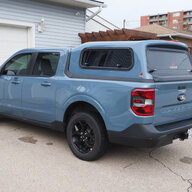

22 mpg? I consistently get close to or over 30 mpg with our ecoboost maverick.This analysis compares the long-term fuel cost savings of a hybrid vehicle versus a conventional gasoline vehicle,
while also accounting for the cost of replacing the hybrid's high voltage battery (HVB) after 10 years.
The goal is to determine whether the hybrid's fuel savings justify the eventual battery replacement cost.
Scenario:
We're comparing two similar vehicles that are equivalent in size, utility, and features, including fuel tank size. The only major difference between them is their powertrain (gasoline vs hybrid).
Assumptions:
- The conventional ICE vehicle averages 22 miles per gallon (MPG).
- The Ford Maverick hybrid averages 37 MPG.
- Both vehicles are driven 13,000 miles per year.
- Fuel costs $3.00 per gallon.
- The hybrid's high voltage battery is expected to be replaced in year 10 at a total cost of $5,000 (parts + labor).
- We apply a 3% annual discount rate to adjust for inflation and calculate the present value (PV) of fuel savings.
Annual Fuel Savings:
At $3.00/gallon, the driver of the hybrid saves approximately $718.68 per year compared to the gasoline-only vehicle.
Present Value of 10 Years of Fuel Savings:
Using a 3% discount rate, we compute the present value of receiving $718.68 in fuel savings each year for 10 years:
=> PV = $6130.49
High Voltage Battery Replacement Cost in Year 10:
=> $5000.00
Net Present Value (NPV) of Fuel Savings after Battery Replacement:
=> NPV = $1130.49
Conclusion:
Despite the $5,000 cost to replace the hybrid battery in year 10, the hybrid still comes out ahead financially.
Even after adjusting for inflation, the present value of fuel savings over 10 years exceeds the cost of the battery.
This means that over a 10-year ownership period, the hybrid provides a clear economic advantage without requiring you to own it beyond that point just to break even.
This analysis supports the idea that hybrid vehicles can be cost-effective long-term, even when accounting for major maintenance costs like battery replacement, provided that the vehicle is otherwise similar in cost and utility.
Edit:
I understand that everyone wants to justify their purchase—it's a natural emotional response. My goal here isn’t to criticize anyone’s decision, but simply to look at the long-term costs objectively using tangible numbers based on real-world fuel usage, EPA estimates, and inflation-adjusted calculations.
If you're looking for a direct comparison between the Maverick EcoBoost and Hybrid models, see Post #10 for the detailed breakdown.
Sponsored