

- Thread starter
- #91
Thanks for just putting up with all the dummies and letting them breath the same air! Appreciate it bro!My biggest chuckle are the comments from non-educated or under-educated posters (posers?) on sites like this one.
Sponsored

Thanks for just putting up with all the dummies and letting them breath the same air! Appreciate it bro!My biggest chuckle are the comments from non-educated or under-educated posters (posers?) on sites like this one.
EPA rates it at 33.7kwh per gallon link at the bottom. My bolt EUV lifetime is at 4.4 miles per kwh. Based on your $.36 it's $.081 per mile traveled with my bolt. We drive 15k miles a year which is 1,250 per month at $.081 per mile it costs us $101.25 a month to fuel the Bolt. I was fortunate to get it for MSRP during COVID along with a bunch of other discounts and rebates that brought it down to $26k for lt2 with leather heated and ventilated seats. Pretty much the only thing you need in a car. Gas is $5.50 a gallon in LA. $5.50 a gallon / 61 mpg is $.09 per mile traveled on your Prius. 2024 Prius, which looks very cool, gets 57 mpg. You have to convert to cents per mile traveled to get the right comparison. Basically gas has to be really high like $5.50 and up for EVs to make sense assuming you can live with the size of the car. The Bolt EUV has been great car for us shuttling kids around town even for the size it holds all of their soccer and kung fu gear. We drive it as much as possible as the cost to operate is cheaper than my Maverick. There's also the convenience of not having to go to a gas station as we just plugin when we get home. Wife does not like the gas smell and I don't like her going with 2 young kids in the car. Our city is safe but gas stations are where incidents happen. The cost of safety for me is priceless. Once the solar panels go in it will be super cheap. Hopefully a plugin hybrid ranger or Maverick will launch soon.On Average, EVs get about 3 miles per kWh (Tesla claims 3.3 to 3.8, but my friend who has one says that is not true) we will ignore the fact that there is power loss when charging a battery. The Walmart near me charges $0.52 per kWh to charge (is that a gotcha/tourist location). Compare that to the average gas price of $4.50, and you are looking at a comparison of roughly 9kwh is 1 gallon of gas. Which means a car charging in that public charger is getting 27mpg.
my at home power rate is $0.36 per kWh, assuming I don’t charge during peak hours (which is doable, unless I am planning a trip) then I get about 12.5kwh for the price of a gallon of gas. Which is about 37.5 mpg equivalent.
the biggest problem with everyone’s argument (including mine) is that everyone is speaking from their own standpoint. For me, an EV won’t work because it is expensive to charge around me, even at home, and there are no charging stations around me in central California. I live rurally and the closest EV charging is about 5 miles from my work. I have young children and family that is just outside the range of most EVs, so I would have to add that charging time to the already long car ride. Financially, for me, it is better for me to not purchase a hybrid. And for those of you attacking me for hating the environment, know this. I am giving up my Chevy Silverado that got 18mpg for a maverick that gets 30. I m giving up my Chevy Cruze that gets 38mpg for our Prius that gets averages 61. And, our power company tells us to charge at night, when all the polluting power plants have to run.
The point I am usually trying to make is to run your numbers and see what works best for your situation. In 6-8 years, as long as I get to keep the cars I have right now, my oldest will be driving. maybe an EV will be in the cards. I will still have my ICE for trips. However, I am not looking forward to the day that California tells me I can no longer buy a car that runs on gas. Based on past and current observations, we will not be ready.
I think the credit does go away for the more expensive luxury BEV models already. I say just do away with any of these credits. The car makers will find away to market them to the masses especially if they see the infrastructure concerns being addressed.Agree with this, completely ridiculous that we are subsidizing these "luxury" vehicles for the middle and upper class. Let's face it, EVs are so expensive that nobody who is considered low income is really going to afford one anyway and if need be, make the subsidy/credit only available to low income individuals but across the board EVs are expensive and there's no reason tax dollars should help especially considering the fact that manufacturers have baked in the credit anyway for most EVs.
I just had two weeks with a Hyundai Ioniq 5 EV rental while traveling for work and while it was nice to drive and I enjoyed the 1 pedal driving, charging in a relatively large city was a major pain in the ass. EVs really only make sense for those who have the ability to charge at home, otherwise it was expensive to charge using charging stations and in the whole metro area I was in I was only able to locate one charging station that I could access reliably so the infrastructure needs a ton of work.
Wow good to know all those folks paying $1,150 to $2,750 to purchase and install a 240-volt charging station are just getting ripped off! Good info right here on Mav forum!You can use an electric dryer socket in any home / garage that already has one. No special wires or upgrades needed in those cases. And yes, 25 foot cords are common as well.
We had a Mach E from July of 21 until November of last year. Loved the car but we decided to sell it because of some long road trips we had planned for this year. Luckily for us we were able to sell it before the market crashed and got most of our money back!
You can do all of the what abouts you want but overall EVs are a win for cradle to grave emissions when compared against ICE. There have been multiple studies that have looked into this exact thing. The only time it gets closer to similar is if your electricity is something like 100% coal generated. That's not very many places in the US and Canada. We have quite a few renewables, nuke plants, etc.Not to mention the 5%-15% transmission loss across the power lines. So utilities have to burn 5%-15% more carbon fuels just to cover the line loss, not to mention the added load of EVs.
And it takes 2.1 gallons of fuel to deliver 1 gallon of fuel to the gas station.Not to mention the 5%-15% transmission loss across the power lines. So utilities have to burn 5%-15% more carbon fuels just to cover the line loss, not to mention the added load of EVs.
It's completely true.Wow good to know all those folks paying $1,150 to $2,750 to purchase and install a 240-volt charging station are just getting ripped off! Good info right here on Mav forum!![]()
![]()
And it takes 2.1 gallons of fuel to deliver 1 gallon of fuel to the gas station.
Is your point electricity is WAY MORE efficient than using liquid petroleum fuels???
I stand corrected in regards to m/kwh. But in my area, there is no 25 cents per kWh charging.![]()
TLDR but...
Teslas get lower end range per kWH due to all the electronic gizmos and enormous EV like hummers and lightnings get lower end range due to their huge mass. You can't change laws of physics my friend.
Commuter EV's will go 4 miles per kWh on average. I sometimes went 5-6 miles per kWh in mild weather in my Chevy Bolt.
Around CA most public charging averages out to 25 cents per kWh. Some are 50 cents. Some are free. Never seen nor paid more than 50 cents in 6 years, 60,000 miles.
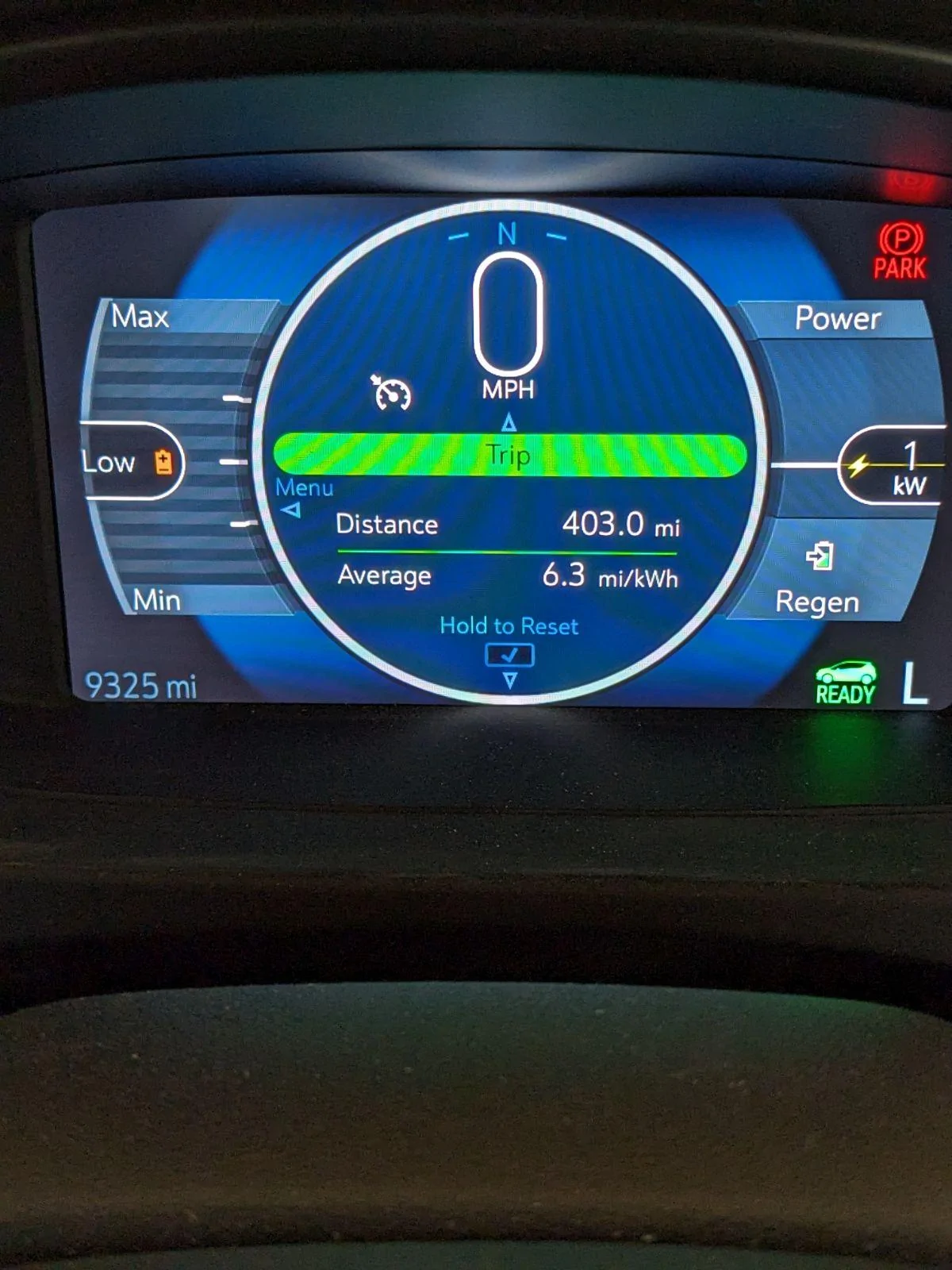
Chevy Bolt EV pictured above.
6.3 miles per kWh per 25 cents.
113.4 miles per gallon at $4.50 for gas.
It would appear you are not the average user, by the way![]()
TLDR but...
Teslas get lower end range per kWH due to all the electronic gizmos and enormous EV like hummers and lightnings get lower end range due to their huge mass. You can't change laws of physics my friend.
Commuter EV's will go 4 miles per kWh on average. I sometimes went 5-6 miles per kWh in mild weather in my Chevy Bolt.
Around CA most public charging averages out to 25 cents per kWh. Some are 50 cents. Some are free. Never seen nor paid more than 50 cents in 6 years, 60,000 miles.
Chevy Bolt EV pictured above.
6.3 miles per kWh per 25 cents.
113.4 miles per gallon at $4.50 for gas.
15 yrs ago here in AZ, we had a huge gas issue, the infrastructure for gas broke, and left us with no gas.Those instances are rare occasions. I remember lines years ago when they had the odd and even last digit on licence plates. With hurricanes I never had to wait in lines or have no gas available. I live up north.
Dont like the EV related thread in Mav EV area, feel free to not read it.How is this thread even remotely associated with Ford Mavericks? Keep on topic or go somewhere else. I come here for Mav info not arguments.