


I just did my 2nd oil change yesterday. 3600 miles for the first one and 4700 miles for the second. Both times the Oil Life was showing above 50%. I could probably get by With one oil change per year but I don’t want to take that risk!
Sponsored


Yeah, those two locations are slotted in the plate rather than holes, allowing you slide the plate into place and then support it as you install the remaining bolts.Another great video
I've changed mine and my wife's oil at 5K miles for the last 10+ years and will continue to do so with my Maverick. Good tip on putting the last 2 bolts in first to slide the skid plate into them - I didn't think about that this weekend when I was putting the skid plate back on; I was holding it with one hand, and putting bolts in with the other
Why would you? You'll be smiling when your Maverick is still humming along at 200K...I just did my 2nd oil change yesterday. 3600 miles for the first one and 4700 miles for the second. Both times the Oil Life was showing above 50%. I could probably get by With one oil change per year but I don’t want to take that risk!

Good input. I did not send a sample of the factory oil out for testing, since I had no idea what it was and will never use it again.There's no universally acceptable number for oil change intervals especially on a turbocharged direct injected engine. If you're not using UOA to determine your OCI then you're just throwing a dart at a board full of oil change intervals.
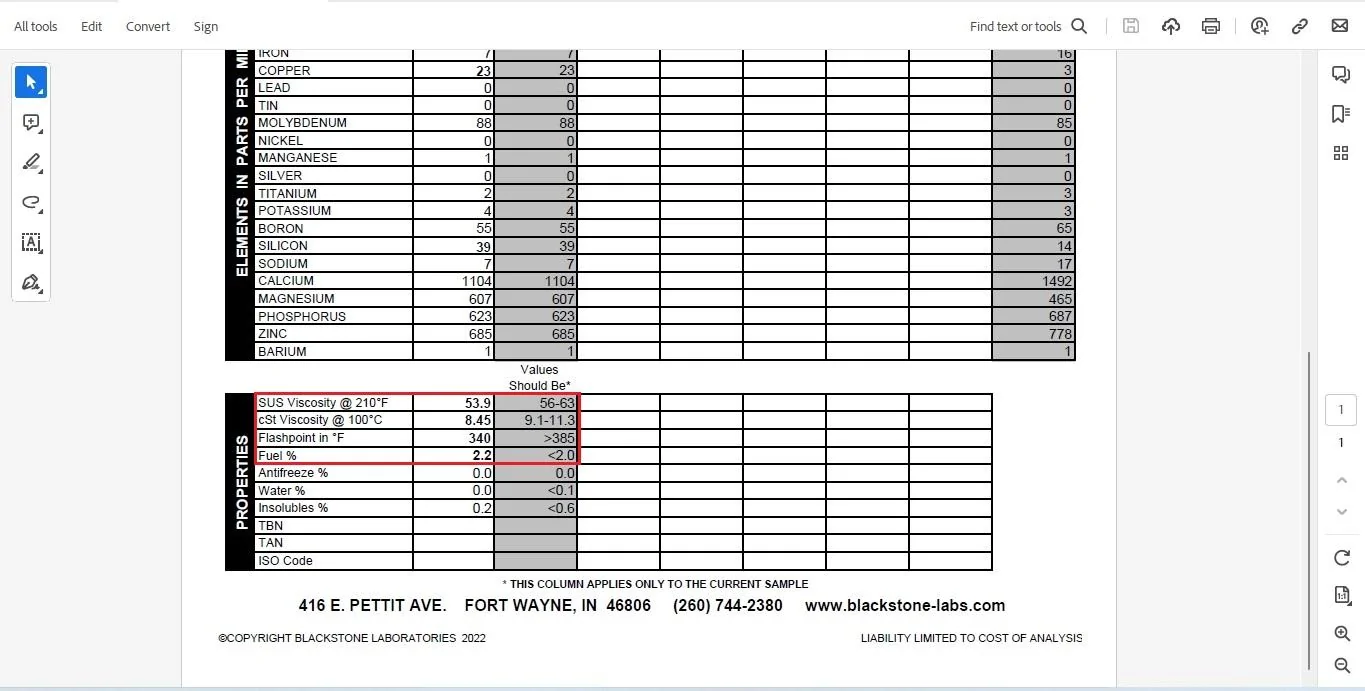
Different engines are operated under different conditions and then add in environmental factors (ie, dusty areas), oil brand, fuel quality, injector spray pattern, ambient temps and so on and so on. A used oil analysis can tell you how much fuel dilution exists at whatever interval you choose or what the flash point and effective viscosity of the oil is at any given interval. The biggest problem with these motors is carbon buildup in the piston rings so considering that cylinder temps on the ecoboost motor can approach 400 degrees, if you have oil that is fuel diluted you're going to see the flash point drop severely which means that oil in your rings will burn and turn to carbon seizing them up.
For example, this is the first UOA I had done for my 22 Ecoboost. ~5k miles on the oil and as you can see the viscosity, flash point and fuel dilution are not good. I have since reduced my interval to 3k miles so we'll see if those numbers improve. This is on Castrol Edge full synthetic. I believe that if I blindly kept a 5k oil change interval without having a UOA performed there's a good chance I would have wound up with seized piston rings in under 70k miles. Also, DO NOT listen to Blackstone's advice, they were telling me to try pushing my interval out to 8k miles despite the glaring issues with the oil at 5k miles. Pardon me lab dude but just run the numbers and don't give me maintenance advice.

I love it.There's no universally acceptable number for oil change intervals especially on a turbocharged direct injected engine. If you're not using UOA to determine your OCI then you're just throwing a dart at a board full of oil change intervals.
Different engines are operated under different conditions and then add in environmental factors (ie, dusty areas), oil brand, fuel quality, injector spray pattern, ambient temps and so on and so on. A used oil analysis can tell you how much fuel dilution exists at whatever interval you choose or what the flash point and effective viscosity of the oil is at any given interval. The biggest problem with these motors is carbon buildup in the piston rings so considering that cylinder temps on the ecoboost motor can approach 400 degrees, if you have oil that is fuel diluted you're going to see the flash point drop severely which means that oil in your rings will burn and turn to carbon seizing them up.
For example, this is the first UOA I had done for my 22 Ecoboost. ~5k miles on the oil and as you can see the viscosity, flash point and fuel dilution are not good. I have since reduced my interval to 3k miles so we'll see if those numbers improve. This is on Castrol Edge full synthetic. I believe that if I blindly kept a 5k oil change interval without having a UOA performed there's a good chance I would have wound up with seized piston rings in under 70k miles. Also, DO NOT listen to Blackstone's advice, they were telling me to try pushing my interval out to 8k miles despite the glaring issues with the oil at 5k miles. Pardon me lab dude but just run the numbers and don't give me maintenance advice.
Just for clarification this was not the factory oil, I changed that out at about 750 miles. I don't bother doing a UOA on factory oil since pretty much every engine is going to have a ton of wear metals in it and you're not going to get any kind of accurate idea of engine health. As you can see in my screenshot the engine is still wearing in the main bearings which also could have been slightly accelerated due to the viscosity breakdown, hence another reason to make sure you know what kind of OCI you need. These motors are very very fussy when it comes to maintenance and with proper maintenance can easily go 150k+ miles but anyone following the idiotic factory recommended oil change interval of 10k miles on an ecoboost engine, GOOD LUCK!Good input. I did not send a sample of the factory oil out for testing, since I had no idea what it was and will never use it again.
However, upon my next change, I will send a sample of the used AMSOIL Signature Series. Those results should help me adjust my change interval accordingly.
Thank you again for sharing your experience.
The person running the lab tests probably has no clue about proper vehicle maintenance or why ecoboost engines are so finicky when it comes to oil quality. I appreciate the service as I don't have the means to do an oil analysis myself but I feel bad for people who blindly follow their advice.I love it.
People quote Blackstone lab rat opinions like they are gods. It's a great service but there are those of us that can do without their comments and suggestions by simply reading the numbers.
I've never listened to them telling me to push for longer intervals. It's actually annoying. Glad to see I'm not the only one who thinks so.
Change often early one and then after about 4 or 5 reports you can make your own judgement calls. Great post!

True. Hard to prove cause and effect beyond a reasonable doubt.Ah, oil threads...where the only thing everyone can agree on is that an engine needs oil.
On one hand, I agree that you might as well do oil changes sooner than the oil minder, especially on these tiny displacement engines with turbos.
On the other hand, there are millions of 2-liter EcoBoosts out there that haven't blown up because private customers and fleet customers haven't changed the oil earlier than Ford recommends.
I think the point here is very few people really operates their vehicle in the "normal" mode. Anyone who lives in an urban area has extended idle times, hot and cold environments, etc. People do push their vehicles hard these days. Anyone who wants their vehicle to last anywhere near 200K miles should practice the "severe" duty maintenance schedule.Tim, not sure where you are getting that. I have a 2022, and pages 439-440 of the manual says oil change interval is 7,500-10,000 miles under "normal" driving conditions and 5,000-7,500 miles under "severe" driving conditions. For "extreme" driving conditions (most people will not subject the truck to this), it is 3,000-5,000 miles.
I'll take scientific lab results over anecdotal comments on engine longevity any day. Unless you have fleet records you can provide showing oil change intervals and whether those engines are original, have been rebuilt etc it's all just a fairy tale.Ah, oil threads...where the only thing everyone can agree on is that an engine needs oil.
On one hand, I agree that you might as well do oil changes sooner than the oil minder, especially on these tiny displacement engines with turbos.
On the other hand, there are millions of 2-liter EcoBoosts out there that haven't blown up because private customers and fleet customers haven't changed the oil earlier than Ford recommends.
No arguments there. However, I think the "average" driver probably just visits a quick lube whenever the dash says change the oil.I think the point here is very few people really operates their vehicle in the "normal" mode. Anyone who lives in an urban area has extended idle times, hot and cold environments, etc. People do push their vehicles hard these days. Anyone who wants their vehicle to last anywhere near 200K miles should practice the "severe" duty maintenance schedule.
Yep. Good post and that's what I gathered the intentions were from it. Not to debate oil types or anything. It's pretty scary how little people know about maintaining vehicles.No arguments there. However, I think the "average" driver probably just visits a quick lube whenever the dash says change the oil.
The point of my video is for people like that NOT to do that, but to be pro-active in changing the oil more frequently than the truck is going to call for, and with a higher-quality oil than a basic synthetic blend.


