Sponsored

Atkinson motor and fuel octane

Rkbrumbelow

Well-known member
First Name
Robert
Joined
Jul 23, 2021
Threads
13
Messages
1,216
Reaction score
1,457
Location
Cedartown, GA
Vehicle(s)
HCH2, Hybrid XLT on order
It’s not a true 13 to 1 because the compression stroke is bleed off in the first 20-30 percent back into the intake due to the valve being open. I would guess it’s true compression is more like 8.5-9.0. The negative to this setup is lack off low end power which made up for by the electric motors instant torque.
12.7:1 is considered ideal for HP production but here is a video on how the Atkinson cycle works
Sponsored

 
OP
OP
dvibs07

dvibs07

Well-known member
Joined
Jul 1, 2021
Threads
13
Messages
98
Reaction score
174
Location
Oregon
Vehicle(s)
Jeep Wrangler Unlimited
We know what your going to put in your bed cubby.......Hemp :)
No sir, industrial hemp is very sharp and rough. It would best be suited in our FLEX BEDS®.
 

Ronaldo

Well-known member
First Name
Ron
Joined
Jun 19, 2021
Threads
4
Messages
210
Reaction score
260
Location
Los Angeles
Vehicle(s)
71 bronco, 67 conv Mustang, 93 RX7 R1
12.7:1 is considered ideal for HP production but here is a video on how the Atkinson cycle works
Yes this explains it exactly, it’s compression ratio is 12 to 1 but it actually is 10 to one Because the valve is open the first 20-30 percent. Look at it like this on a regular none direct injected motor with 87 octane the compression is about
8.5 -9 compression ratio. So the Atkins motor true compression ratio is like 8.5 -9ish.
 

Rkbrumbelow

Well-known member
First Name
Robert
Joined
Jul 23, 2021
Threads
13
Messages
1,216
Reaction score
1,457
Location
Cedartown, GA
Vehicle(s)
HCH2, Hybrid XLT on order
Yes this explains it exactly, it’s compression ratio is 12 to 1 but it actually is 10 to one Because the valve is open the first 20-30 percent. Look at it like this on a regular none direct injected motor with 87 octane the compression is about
8.5 -9 compression ratio. So the Atkins motor true compression ratio is like 8.5 -9ish.
I was expanding your excellent answer, not trying to contradict it.
 

DesertSweat

2.5L Hybrid
Well-known member
Joined
Jul 16, 2021
Threads
3
Messages
190
Reaction score
298
Location
Arizona
Vehicle(s)
Ford Maverick Lariat, Honda HR-V 6spd
Engine
2.5L Hybrid
We talk a lot about compression ratios in this which is absolutely true, but you can't forget the timing curves based upon load, RPM, IAT, etc, since timing stresses the fuel a lot and impacts efficiency.

All cars will have a base map of timing created using the intended fuel (I think we are fairly confident that the intended fuel for the hybrid is 87) in fairly ideal conditions. Basically it's just a 2 matrix based upon load and RPM. Then there will be tables that generally multiply, or add or subtract based upon certain parameters. Like if you have really high air intake temps or the knock sensor starts getting pre-ignition, or fuel trims are way off, the motor will pull timing.

The more timing the better. But in my experience, I haven't seen maps that increase timing and try to get better efficiency. Because that is tough and requires instrumentation that engines don't come with. (think individual egt and wideband O2 sensors for each exhaust bank). The only real learning I see is in STFT, and LTFT's. Which are fuel trims based upon closed loop operation. ie. the ECU is looking at the MAP of MAF sensor in relation to the wideband O2 sensor and learning how to hit your desired lambda - AFR, because fueling is always a moving target based upon many variables.

TLDR: intended fuel is 87 and the motor would have been tuned using that. You shouldn't see a performance or efficiency increase using a higher octane since all maps are tuned to take away timing.

On the power question, that's a bit more complex, I could speak to the ICE side, but I think there's more potential on the battery motor side. But regardless of either, the ECU needs to be cracked, and software to modify to make any significant gains. But there probably is not enough interest, so there won't be a lot of support.
 

Sponsored

stick

Well-known member
First Name
Chris
Joined
Jul 21, 2021
Threads
6
Messages
178
Reaction score
236
Location
61525
Vehicle(s)
2021 Jeep wrangler 4xe; 13 vw gli; 21 maverick xlt
With an Atkinson engine the 13:1 compression is mostly theoretical. The intake valve is kept partially open at the beginning of compression so some of the A/F mix is pushed back out of the cylinder. Therefore the total compressed volume (and effective compression ratio) is lower allowing operation on regular octane. The advantage is this allows the post-combustion expansion to utilize the full stroke for maximum efficiency.

Octane rating, on its own, does not produce more power. It simply allows higher compression. So an engine that does not take advantage of this through high compression ratio or forced induction (turbo/supercharger) won't make more power. Ethanol, however, has less power density than gasoline. So regular octane fuel without ethanol will produce the highest efficiency. Availability of that will depend on where you are. Often only Premium fuel is available ethanol-free and if the cost difference is greater than the increase in efficiency it's not worth spending more.
Higher the octane, lower the energy in the fuel, but more chains are 8-carbon, which is the most stable molecule chain in gasoline. hence, octane rating measure percent of 8-chain molecules in the fuel. Total waste to use if your car can not use it. Cars with variable valve timing can advance the spark to increase power utilized on each stroke. Low octane fuel in a advanced timing engine will cause knock, which is early combustion = engine damage. Most modern cars have knock sensors that automatically retard timing if knocking occurs. This engine is set up to have no low end torque, so the torque curves of the electric fills in and keep the torque flat. The electric pulls early and the engine shows up later. thats why the combined torque numers dont seem to add up
 

Darnon

2.5L Hybrid
Well-known member
Joined
Jul 4, 2021
Threads
10
Messages
5,714
Reaction score
7,210
Location
WNY
Vehicle(s)
2022 Maverick
Engine
2.5L Hybrid
Don't know if they still do it or if they're more confident in the knock sensors these days but older Fords used to have a bypass plug under the hood that you removed and it retarded the timing even further if you were somewhere running 85 octane or less.
 
OP
OP
dvibs07

dvibs07

Well-known member
Joined
Jul 1, 2021
Threads
13
Messages
98
Reaction score
174
Location
Oregon
Vehicle(s)
Jeep Wrangler Unlimited
Higher the octane, lower the energy in the fuel, but more chains are 8-carbon, which is the most stable molecule chain in gasoline. hence, octane rating measure percent of 8-chain molecules in the fuel. Total waste to use if your car can not use it. Cars with variable valve timing can advance the spark to increase power utilized on each stroke. Low octane fuel in a advanced timing engine will cause knock, which is early combustion = engine damage. Most modern cars have knock sensors that automatically retard timing if knocking occurs. This engine is set up to have no low end torque, so the torque curves of the electric fills in and keep the torque flat. The electric pulls early and the engine shows up later. thats why the combined torque numers dont seem to add up
It’s not a combined torque, it’s just the torque from the engine I believe on the specs page
 

stick

Well-known member
First Name
Chris
Joined
Jul 21, 2021
Threads
6
Messages
178
Reaction score
236
Location
61525
Vehicle(s)
2021 Jeep wrangler 4xe; 13 vw gli; 21 maverick xlt
It’s not a combined torque, it’s just the torque from the engine I believe on the specs page
2.5L/162-hp/155-lb-ft Atkinson-cycle DOHC 16-valve I-4, plus 126-hp/173-lb-ft electric motors. Yep, they only publish the combined HP. I think the line of thinking still applies. electric on the low end; engine comes to the party later in the revs. I would like to see actual HP/torque curves
 

Peps

2.5L Hybrid
Well-known member
Joined
Jul 22, 2021
Threads
32
Messages
386
Reaction score
439
Location
New England USA
Vehicle(s)
2020 Volvo XC40
Engine
2.5L Hybrid
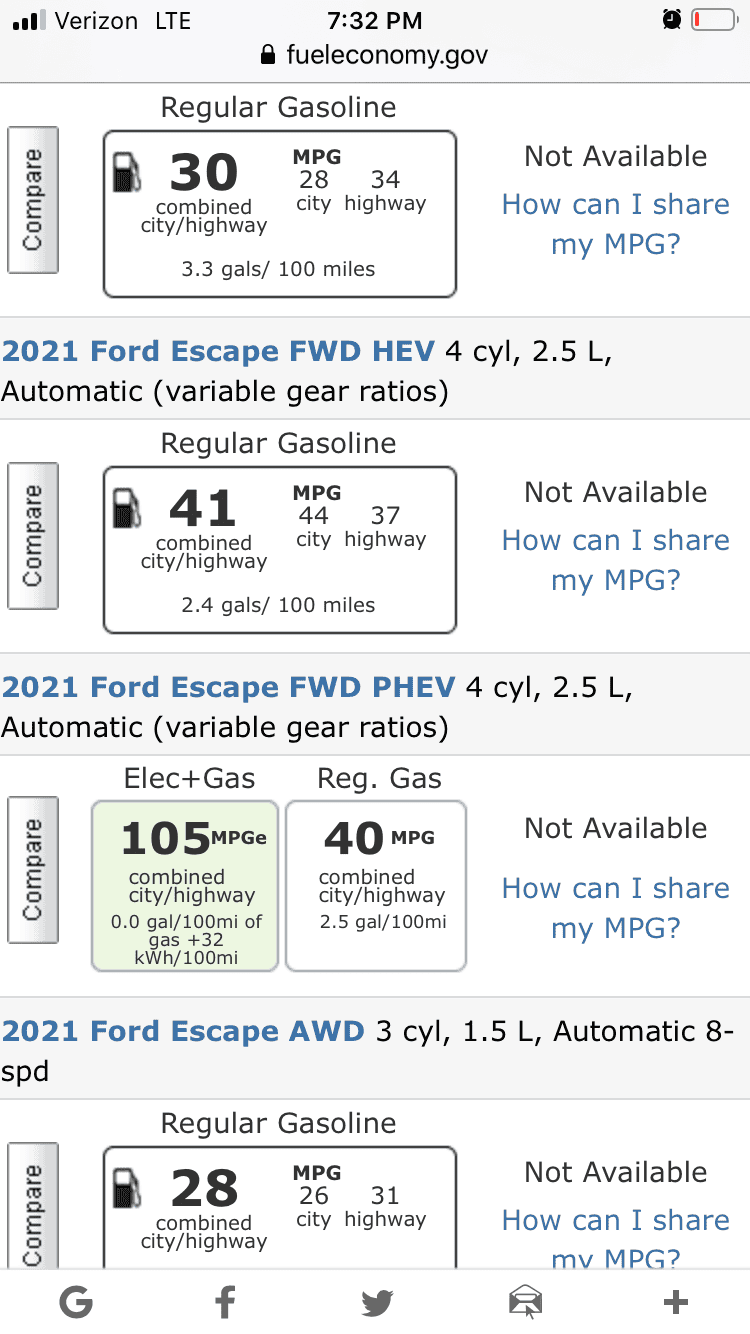
regular gasoline on both the 2.0 and 2.5 hybrid.
for the escape these are the EPA stats with the type if gasoline.

Ford Maverick Atkinson motor and fuel octane 67D9C9EF-A492-44C8-AA94-9932395F925C
 
Sponsored
OP
OP
dvibs07

dvibs07

Well-known member
Joined
Jul 1, 2021
Threads
13
Messages
98
Reaction score
174
Location
Oregon
Vehicle(s)
Jeep Wrangler Unlimited
2.5L/162-hp/155-lb-ft Atkinson-cycle DOHC 16-valve I-4, plus 126-hp/173-lb-ft electric motors. Yep, they only publish the combined HP. I think the line of thinking still applies. electric on the low end; engine comes to the party later in the revs. I would like to see actual HP/torque curves
I hope the hybrid engine surprises with torque. The most utility I could get out of my engine would be slow crawls up hills and a lot of torque to get over obstacles.
 

Rkbrumbelow

Well-known member
First Name
Robert
Joined
Jul 23, 2021
Threads
13
Messages
1,216
Reaction score
1,457
Location
Cedartown, GA
Vehicle(s)
HCH2, Hybrid XLT on order
Higher the octane, lower the energy in the fuel, but more chains are 8-carbon, which is the most stable molecule chain in gasoline. hence, octane rating measure percent of 8-chain molecules in the fuel. Total waste to use if your car can not use it. Cars with variable valve timing can advance the spark to increase power utilized on each stroke. Low octane fuel in a advanced timing engine will cause knock, which is early combustion = engine damage. Most modern cars have knock sensors that automatically retard timing if knocking occurs. This engine is set up to have no low end torque, so the torque curves of the electric fills in and keep the torque flat. The electric pulls early and the engine shows up later. thats why the combined torque numers dont seem to add up
C-C is ~ 80kcal/mol, H-C is ~ 100kcal/mol, ΔHf = -393.5 kJ/mol CO2(g), H2O(g) = -241.8 kJ/mol
H2O(g) if anyone wants to do the genchem maths, oChem, please take into account strain and electro negativity. qChem do the same but account for spin and stabilization as well as what the energy well looks like across the temp range. pChem don’t do any of that: let’s light the bitch and see what happens in a fully closed system ;)
 

Shecster

2.0L EcoBoost
Well-known member
Joined
Jun 10, 2021
Threads
12
Messages
333
Reaction score
436
Location
North America
Vehicle(s)
1930 Model A Ford - 1971 Ford Maverick
Engine
2.0L EcoBoost
May I add a question to this thread? Does octane go down with aging, stored/unused fuel?
Yes it will. Fuel loses its flash point over time and leads to absorption of impurities I.e moisture.
 

fbov

Well-known member
First Name
Frank
Joined
Jun 28, 2021
Threads
0
Messages
452
Reaction score
502
Location
Bushnell's Basin
Vehicle(s)
2020 Escape Hybrid
C-C is ~ 80kcal/mol, H-C is ~ 100kcal/mol, ΔHf = -393.5 kJ/mol CO2(g), H2O(g) = -241.8 kJ/mol
H2O(g) if anyone wants to do the genchem maths, ...
The EPA has defined the energy content of 1.0 gasoline to be 33.7 kWh. I think that's E10, because...

Based on energy/kg, I get 35.24 kWh for 100% gas, 33.25 kWh for E10. Bottom line is the tank holds about 500kWh of energy. Best we can do is waste 60%, so there's 200kWh usable energy in the tank.
 

oljackfrost

2.5L Hybrid
Well-known member
First Name
Mark
Joined
Mar 9, 2021
Threads
39
Messages
1,077
Reaction score
1,826
Location
Minnesota
Vehicle(s)
They're all sold, waiting for Maverick
Engine
2.5L Hybrid
C-C is ~ 80kcal/mol, H-C is ~ 100kcal/mol, ΔHf = -393.5 kJ/mol CO2(g), H2O(g) = -241.8 kJ/mol
H2O(g) if anyone wants to do the genchem maths, oChem, please take into account strain and electro negativity. qChem do the same but account for spin and stabilization as well as what the energy well looks like across the temp range. pChem don’t do any of that: let’s light the bitch and see what happens in a fully closed system ;)
Yikes! I haven’t been so overwhelmed since high school algebra!
Sponsored


Top