
Sponsored

Rear Rotors and Pads

Skifletch

2.0L EcoBoost
Well-known member
Joined
Apr 25, 2023
Threads
6
Messages
108
Reaction score
119
Location
Buffalo
Vehicle(s)
2023 Maverick XL
Engine
2.0L EcoBoost
Closing in on 38,000 miles with my 2023 XL 2.0 AWD and my rear brakes are close enough to end of life that I'd like to replace them now, BEFORE winter. I live in one of the road salt capitals of the World in Buffalo NY. Add city living with no driveway/garage, frequent use of slippery and tow/haul mode, AWD and undersized rear braking equipment for my usage case and I'm not surprised. Boy it must be nice to live where some of you do that can have brakes last, but my world does not allow this.

I therefore am looking for some advice from you folks on both components to choose, AND procedures for dealing with the electronic actuator for the rears. I am not interested in Ford parts as though they were not pitiful, they're less than I hoped for even given my usage case. I am also not buying slotted rotors as prior experience proves the road salt eats them for breakfast. Given the expense of parts from Ford at just shy of $500 for pads and two rotors, I'm willing to pay decent money for aftermarket, but I want the best salt resistance one can find. Some kind of coating of "unobtainium" that will mean they don't turn into rusted/warped piles of dog feces. Alas, there seem to be MANY Geomet coated rotors in today's "paralysis by choice" aftermarket environment. Anyone have experience or opinion with any specific ones that will survive the actual salted ocean I have to drive through all winter long?

Then secondly, actual procedural questions. I've replaced brakes on every vehicle I've owned since 1996, so I'm not a professional mechanic, and I'm not an inexperienced DIY-er, instead residing somewhere in between. My main concerns are the still relatively new to me use of electronic parking brakes and associated service modes and relearn procedures. Heaven forbid we rely on wrenches as I old guy shake my fist at the sky. Having changed rear brakes on the wife's Forester with electronic parking brake, Subaru really locks the service mode functionality behind a bi-directional scan tool which I do not own :rolleyes: but some trickery with use of the "parking brake", a funky star socket set, torque wrench and ingenuity and I was able to get it done without kicking errors. Basically put the parking brake on, remove the e-brake module, check the torque on the strange hex drive shaft, back it WAY off, then do brake job as normal and return the drive shaft to the same torque before re-attaching the motor and it was happy. Would a similar method work with the Maverick, or does Ford offer another way to access a service mode, brake re-learn feature, or some similar that is NOT gatekept behind a bi-directional scan tool? I have tried forum searching, but have yet to massage keywords correctly other than a partially helpful thread from someone suggesting to try my local library for Alldata subscription. I'll keep trying various keyword searches here and seeing if Dr Google can index the site better than the built-in search engine but if anyone has a way to point me to the best/most correct way to deal with the electronic parking brake feature, I'd love to hear it.

Thanks much for reading/helping.

Go Bills
Sponsored

 

Timothyd

2.5L Hybrid
Well-known member
First Name
Tim
Joined
Nov 10, 2021
Threads
54
Messages
4,293
Reaction score
3,789
Location
Illinois
Vehicle(s)
Buick Encore, Miata, motorcycles
Engine
2.5L Hybrid
Clubs
 
Closing in on 38,000 miles with my 2023 XL 2.0 AWD and my rear brakes are close enough to end of life that I'd like to replace them now, BEFORE winter. I live in one of the road salt capitals of the World in Buffalo NY. Add city living with no driveway/garage, frequent use of slippery and tow/haul mode, AWD and undersized rear braking equipment for my usage case and I'm not surprised. Boy it must be nice to live where some of you do that can have brakes last, but my world does not allow this.

I therefore am looking for some advice from you folks on both components to choose, AND procedures for dealing with the electronic actuator for the rears. I am not interested in Ford parts as though they were not pitiful, they're less than I hoped for even given my usage case. I am also not buying slotted rotors as prior experience proves the road salt eats them for breakfast. Given the expense of parts from Ford at just shy of $500 for pads and two rotors, I'm willing to pay decent money for aftermarket, but I want the best salt resistance one can find. Some kind of coating of "unobtainium" that will mean they don't turn into rusted/warped piles of dog feces. Alas, there seem to be MANY Geomet coated rotors in today's "paralysis by choice" aftermarket environment. Anyone have experience or opinion with any specific ones that will survive the actual salted ocean I have to drive through all winter long?

Then secondly, actual procedural questions. I've replaced brakes on every vehicle I've owned since 1996, so I'm not a professional mechanic, and I'm not an inexperienced DIY-er, instead residing somewhere in between. My main concerns are the still relatively new to me use of electronic parking brakes and associated service modes and relearn procedures. Heaven forbid we rely on wrenches as I old guy shake my fist at the sky. Having changed rear brakes on the wife's Forester with electronic parking brake, Subaru really locks the service mode functionality behind a bi-directional scan tool which I do not own :rolleyes: but some trickery with use of the "parking brake", a funky star socket set, torque wrench and ingenuity and I was able to get it done without kicking errors. Basically put the parking brake on, remove the e-brake module, check the torque on the strange hex drive shaft, back it WAY off, then do brake job as normal and return the drive shaft to the same torque before re-attaching the motor and it was happy. Would a similar method work with the Maverick, or does Ford offer another way to access a service mode, brake re-learn feature, or some similar that is NOT gatekept behind a bi-directional scan tool? I have tried forum searching, but have yet to massage keywords correctly other than a partially helpful thread from someone suggesting to try my local library for Alldata subscription. I'll keep trying various keyword searches here and seeing if Dr Google can index the site better than the built-in search engine but if anyone has a way to point me to the best/most correct way to deal with the electronic parking brake feature, I'd love to hear it.

Thanks much for reading/helping.

Go Bills
I believe that, on this site, there's links somewhere to doing a brake job. It sure isn't like the old days where you do a quick pad swap. And, I'm irritated with that electric parking brake- it's just added complexity and less usefulness. My '24 Mav hybrid had the brake pads measured when I had the oil changed and my back pads are like new with about 20k miles on it.
 

shrek

2.0L EcoBoost
Well-known member
First Name
Jon
Joined
Dec 13, 2023
Threads
7
Messages
435
Reaction score
412
Location
Alhambra, IL
Vehicle(s)
2024 Mav Lariat Lux FX4, 4k tow
Engine
2.0L EcoBoost

Hootbro

2.5L Hybrid
Well-known member
First Name
Don
Joined
May 18, 2026
Threads
0
Messages
327
Reaction score
914
Location
Delaware
Vehicle(s)
2025 Ford Maverick AWD
Engine
2.5L Hybrid
Did the rear brakes on my Bronco Sport which is the same setup as the Maverick but had a scan tool to put it in service mode. Really three ways of doing it, scan tool, using the vehicle itself through button, pedal and ignition sequence and physically taking off the brake motor and manually unwinding. There is Youtube video on either methods if you search for them.
 

HeyBales

2.5L Hybrid
Well-known member
First Name
Mike
Joined
May 3, 2024
Threads
5
Messages
5,828
Reaction score
5,692
Location
KC Metro area
Vehicle(s)
2005 Toyota RAV4, 2024 XLT Hybrid
Engine
2.5L Hybrid
Be aware there are some 22/23MY EB's where the Brake Maintenance mode procedure just will not work - from Forscan that shows the option, to manual stated manual process, to dealership FDRS tool.
Gotta do 9V battery or remove them and rewind, as commented above.
Here's the steps you should see commented on in videos, and torques.
(You decide how important to discard items, which probably gives a clue as to being careful on removal so you can ..... sssshhhh, reuse.)


Brake Pads: Removal
WARNING: Service actions on vehicles equipped with electronic brake booster and electronic parking brakes may cause unexpected brake application, which could result in injury to hands or fingers. Put the brake system into service mode prior to servicing or removing any brake components. Failure to follow this instruction may result in serious personal injury.
NOTE: Removal steps in this procedure may contain installation details.
  1. Activate the brake service mode. Refer to: Brake Service Mode Activation and Deactivation .
  2. Remove the wheel and tire. Refer to: REMOVAL
  3. Remove the brake caliper spring.
    Ford Maverick Rear Rotors and Pads {filename}
    Courtesy of FORD MOTOR COMPANY
  4. Detach the parking brake motor electrical connector.
    Ford Maverick Rear Rotors and Pads {filename}
    Courtesy of FORD MOTOR COMPANY
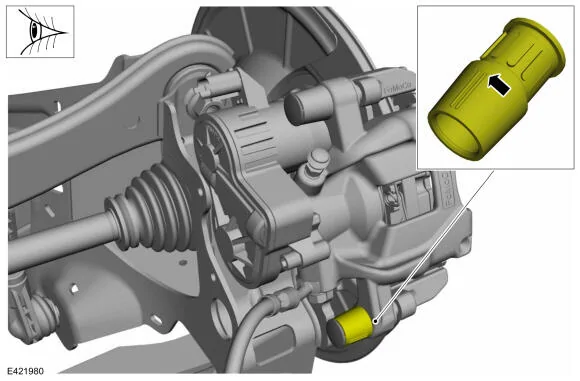
  5. NOTE: Reinforced bush shown below.
    Visually check the type of bush mounted on the brake caliper.
    Ford Maverick Rear Rotors and Pads 1792773664134-vo
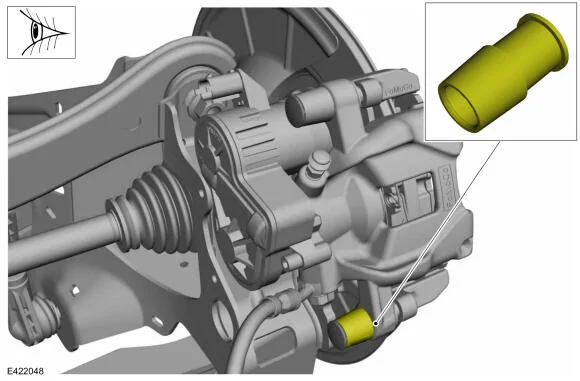
  6. NOTE: Standard bush shown below.
    Visually check the type of bush mounted on the brake caliper.
    Ford Maverick Rear Rotors and Pads 1792773714692-xj
  7. NOTE: This step is only necessary when standard bushing located on the opposite side of the bleeder.
    Remove and discard the brake caliper guide pin cap.
    Ford Maverick Rear Rotors and Pads 1792773714692-xj
    Courtesy of FORD MOTOR COMPANY
  8. NOTE: This step is only necessary when standard bushing located on the opposite side of the bleeder.
    Remove the guide pin and rotate the rear caliper upwards to access to the bushing housing. Discard the guide pin.
    Ford Maverick Rear Rotors and Pads 1792773714692-xj
    Courtesy of FORD MOTOR COMPANY
  9. NOTE: This step is only necessary when standard bushing located on the opposite side of the bleeder.
    Remove the standard bushing located on the opposite side of the bleeder. Discard the bush.
    Ford Maverick Rear Rotors and Pads 1792773714692-xj
    Courtesy of FORD MOTOR COMPANY
  10. Remove the brake caliper guide pin caps.
    Ford Maverick Rear Rotors and Pads 1792773714692-xj
    Courtesy of FORD MOTOR COMPANY
  11. NOTE: Do not pry in the caliper sight hole to retract the pistons as this can damage the pistons and boots.
    NOTE: Do not allow the brake caliper assembly to hang from the brake hose or damage to the hose can occur.
    Remove the guide pins and position the brake caliper aside.
    Ford Maverick Rear Rotors and Pads 1792773714692-xj
    Courtesy of FORD MOTOR COMPANY
  12. NOTE: Note the position of the components before removal.
    Remove the brake pads.
    Ford Maverick Rear Rotors and Pads 1792773714692-xj
    Courtesy of FORD MOTOR COMPANY
  13. NOTE: Brake pads with adhesive on the insulator are one-time use only. When the brake pads are separated from the brake caliper, new brake pads must be installed to prevent brake noise and shudder.
    Separate the brake pad from the brake caliper. Remove and discard the brake pad.
    Ford Maverick Rear Rotors and Pads 1792773714692-xj
    Courtesy of FORD MOTOR COMPANY
  14. NOTE: Brake pads with adhesive on the insulator are one-time use only. When the brake pads are separated from the brake caliper, new brake pads must be installed to prevent brake noise and shudder.
    Separate the inboard brake pad from the brake caliper. Remove and discard the inboard brake pad.
Ford Maverick Rear Rotors and Pads 1792773714692-xj
Courtesy of FORD MOTOR COMPANY


Brake Pads: Installation
  1. NOTE: Do not use a C-clamp to compress the brake caliper piston or damage to the parking brake actuator motor may occur.
    NOTE: Do not manually retract the piston or damage to the parking brake actuator may occur.
    NOTE: Make sure that the brake hose is not twisted when installing the brake caliper or damage to the brake flexible hose may occur.
    NOTE: Use care when pushing the caliper piston into the caliper piston bores or damage to components may occur.
    Compress the brake caliper piston until the piston bottoms out in the brake caliper bore.
    Ford Maverick Rear Rotors and Pads 1792773806322-2
  2. NOTE: This step is only necessary when standard bushing located on the opposite side of the bleeder.
    Clean the brake caliper bush housing.
    Material: Brake Cleaner
    Ford Maverick Rear Rotors and Pads 1792773806322-2
    Courtesy of FORD MOTOR COMPANY
  3. NOTE: This step is only necessary when standard bushing located on the opposite side of the bleeder.
    NOTE: Make sure that the component is clean, free of foreign material.
    Apply the grease on new bush.
    Material: Grease - Silicone (ESA-M1C200-A) (ESE-M1C171-A)
    Ford Maverick Rear Rotors and Pads 1792773806322-2
    Courtesy of FORD MOTOR COMPANY
  4. NOTE: This step is only necessary when standard bushing located on the opposite side of the bleeder.
    NOTE: Make sure that the component is clean, free of foreign material.
    Apply the grease on brake caliper bush housing.
    Material: Grease - Silicone (ESA-M1C200-A) (ESE-M1C171-A)
    Ford Maverick Rear Rotors and Pads 1792773806322-2
    Courtesy of FORD MOTOR COMPANY
  5. NOTE: This step is only necessary when standard bushing located on the opposite side of the bleeder.
    Using an appropriate diameter socket to push the new bushing into the caliper bushing housing.
    Ford Maverick Rear Rotors and Pads 1792773806322-2
    Courtesy of FORD MOTOR COMPANY
  6. Clean the brake pad-to-anchor plate contact points.
    Material: Brake Cleaner
    Ford Maverick Rear Rotors and Pads 1792773806322-2
    Courtesy of FORD MOTOR COMPANY
  7. NOTE: Make sure to apply the grease supplied with the brake pad kit to the brake pad-to-anchor plate contact points.
    Apply the grease on brake pad-to-anchor plate contact points.
    Ford Maverick Rear Rotors and Pads 1792773806322-2
    Courtesy of FORD MOTOR COMPANY
  8. NOTE: Clean all residual pad adhesive from the brake caliper piston area or brake noise may occur.
    Remove the residual brake pad adhesive.
    Material: Brake Cleaner
    Ford Maverick Rear Rotors and Pads 1792773806322-2
    Courtesy of FORD MOTOR COMPANY
  9. NOTE: Clean all residual pad adhesive from the brake caliper finger area or brake noise may occur.
    Remove the residual brake pad adhesive.
    Material: Brake Cleaner
    Ford Maverick Rear Rotors and Pads 1792773806322-2
    Courtesy of FORD MOTOR COMPANY
  10. NOTE: Brake pads with adhesive on the insulator are one-time use only. When the brake pads are separated from the brake caliper, new brake pads must be installed to prevent brake noise and shudder.
    Remove the protective cover from the pad assembly.
    Material: Brake Cleaner
    Ford Maverick Rear Rotors and Pads 1792773806322-2
    Courtesy of FORD MOTOR COMPANY
  11. NOTE: Inner and outer brake pads are not interchangeable.
    NOTE: Make sure that the components are installed to the position noted before removal.
    Install the brake pads.
    Ford Maverick Rear Rotors and Pads 1792773806322-2
    Courtesy of FORD MOTOR COMPANY
  12. NOTE: Make sure that the components holes are correctly aligned.
    Position the brake caliper.
    Ford Maverick Rear Rotors and Pads 1792773806322-2
    Courtesy of FORD MOTOR COMPANY
  13. NOTE: Make sure that the component is installed to the position noted before removal.
    Install the brake caliper spring.
    Ford Maverick Rear Rotors and Pads 1792773806322-2
    Courtesy of FORD MOTOR COMPANY
    • NOTE: This step is only necessary when standard bushing located on the opposite side of the bleeder.
      Install a new guide pin.
    • NOTE: Make sure that the guide pins bolts are centered.
      Insert and pre-torque the guide pins manually to prevent them from entering at an angle detrimental to the anchor thread as well as the guide pin thread (With one hand hold the housing and with the other insert and pre-torque the guide pin).

  14. Ford Maverick Rear Rotors and Pads 1792773806322-2
    Courtesy of FORD MOTOR COMPANY
  15. NOTE: Do not use pneumatic guns torque or manual torque wrench without torque display.
    Tighten the brake caliper guide pin bolts.
    Torque: 28 Nm
    Ford Maverick Rear Rotors and Pads 1792773806322-2
    Courtesy of FORD MOTOR COMPANY
    • NOTE: This step is only necessary when standard bushing located on the opposite side of the bleeder.
      Install a new guide pin cap.
    • Install the guide pin caps.

  16. Ford Maverick Rear Rotors and Pads 1792773806322-2
    Courtesy of FORD MOTOR COMPANY
  17. Connect the parking brake motor electrical connector.
    Ford Maverick Rear Rotors and Pads 1792773806322-2
    Courtesy of FORD MOTOR COMPANY
  18. Deactivate the brake service mode. Refer to: Brake Service Mode Activation and Deactivation .
  19. Apply the brake pedal several times to verify correct brake system operation.
 

Sponsored

710-oil-614

2.5L Hybrid
Well-known member
First Name
Cal
Joined
Oct 13, 2021
Threads
27
Messages
6,331
Reaction score
12,582
Location
Ohio...but I'd rather be in Boone.
Vehicle(s)
2025 Hybrid AWD Lariat
Engine
2.5L Hybrid
I was going to say that I would recommend PowerStop or Wagner Severe Duty.

My wife has a 2018 Honda Odyssey that absolutely destroys undersized front rotors on the vehicle. Every trip through the mountains will warp them. We don't take it through the hills much anymore but the slapped some Wagner SevereDuty on it and they've managed to lost about 40k miles.
 
OP
OP

Skifletch

2.0L EcoBoost
Well-known member
Joined
Apr 25, 2023
Threads
6
Messages
108
Reaction score
119
Location
Buffalo
Vehicle(s)
2023 Maverick XL
Engine
2.0L EcoBoost
Be aware there are some 22/23MY EB's where the Brake Maintenance mode procedure just will not work - from Forscan that shows the option, to manual stated manual process, to dealership FDRS tool.
Gotta do 9V battery or remove them and rewind, as commented above.
Here's the steps you should see commented on in videos, and torques.
(You decide how important to discard items, which probably gives a clue as to being careful on removal so you can ..... sssshhhh, reuse.)


Brake Pads: Removal
WARNING: Service actions on vehicles equipped with electronic brake booster and electronic parking brakes may cause unexpected brake application, which could result in injury to hands or fingers. Put the brake system into service mode prior to servicing or removing any brake components. Failure to follow this instruction may result in serious personal injury.
NOTE: Removal steps in this procedure may contain installation details.
  1. Activate the brake service mode. Refer to: Brake Service Mode Activation and Deactivation .
  2. Remove the wheel and tire. Refer to: REMOVAL
  3. Remove the brake caliper spring.
    Ford Maverick Rear Rotors and Pads 1792773806322-2
    Courtesy of FORD MOTOR COMPANY
  4. Detach the parking brake motor electrical connector.
    Ford Maverick Rear Rotors and Pads 1792773806322-2
    Courtesy of FORD MOTOR COMPANY
  5. NOTE: Reinforced bush shown below.
    Visually check the type of bush mounted on the brake caliper.
    Ford Maverick Rear Rotors and Pads {filename}
  6. NOTE: Standard bush shown below.
    Visually check the type of bush mounted on the brake caliper.
    Ford Maverick Rear Rotors and Pads {filename}
  7. NOTE: This step is only necessary when standard bushing located on the opposite side of the bleeder.
    Remove and discard the brake caliper guide pin cap.
    Ford Maverick Rear Rotors and Pads {filename}
    Courtesy of FORD MOTOR COMPANY
  8. NOTE: This step is only necessary when standard bushing located on the opposite side of the bleeder.
    Remove the guide pin and rotate the rear caliper upwards to access to the bushing housing. Discard the guide pin.
    Ford Maverick Rear Rotors and Pads {filename}
    Courtesy of FORD MOTOR COMPANY
  9. NOTE: This step is only necessary when standard bushing located on the opposite side of the bleeder.
    Remove the standard bushing located on the opposite side of the bleeder. Discard the bush.
    Ford Maverick Rear Rotors and Pads {filename}
    Courtesy of FORD MOTOR COMPANY
  10. Remove the brake caliper guide pin caps.
    Ford Maverick Rear Rotors and Pads {filename}
    Courtesy of FORD MOTOR COMPANY
  11. NOTE: Do not pry in the caliper sight hole to retract the pistons as this can damage the pistons and boots.
    NOTE: Do not allow the brake caliper assembly to hang from the brake hose or damage to the hose can occur.
    Remove the guide pins and position the brake caliper aside.
    Ford Maverick Rear Rotors and Pads {filename}
    Courtesy of FORD MOTOR COMPANY
  12. NOTE: Note the position of the components before removal.
    Remove the brake pads.
    Ford Maverick Rear Rotors and Pads {filename}
    Courtesy of FORD MOTOR COMPANY
  13. NOTE: Brake pads with adhesive on the insulator are one-time use only. When the brake pads are separated from the brake caliper, new brake pads must be installed to prevent brake noise and shudder.
    Separate the brake pad from the brake caliper. Remove and discard the brake pad.
    Ford Maverick Rear Rotors and Pads {filename}
    Courtesy of FORD MOTOR COMPANY
  14. NOTE: Brake pads with adhesive on the insulator are one-time use only. When the brake pads are separated from the brake caliper, new brake pads must be installed to prevent brake noise and shudder.
    Separate the inboard brake pad from the brake caliper. Remove and discard the inboard brake pad.
Ford Maverick Rear Rotors and Pads {filename}
Courtesy of FORD MOTOR COMPANY


Brake Pads: Installation
  1. NOTE: Do not use a C-clamp to compress the brake caliper piston or damage to the parking brake actuator motor may occur.
    NOTE: Do not manually retract the piston or damage to the parking brake actuator may occur.
    NOTE: Make sure that the brake hose is not twisted when installing the brake caliper or damage to the brake flexible hose may occur.
    NOTE: Use care when pushing the caliper piston into the caliper piston bores or damage to components may occur.
    Compress the brake caliper piston until the piston bottoms out in the brake caliper bore.
    Ford Maverick Rear Rotors and Pads {filename}
  2. NOTE: This step is only necessary when standard bushing located on the opposite side of the bleeder.
    Clean the brake caliper bush housing.
    Material: Brake Cleaner
    Ford Maverick Rear Rotors and Pads {filename}
    Courtesy of FORD MOTOR COMPANY
  3. NOTE: This step is only necessary when standard bushing located on the opposite side of the bleeder.
    NOTE: Make sure that the component is clean, free of foreign material.
    Apply the grease on new bush.
    Material: Grease - Silicone (ESA-M1C200-A) (ESE-M1C171-A)
    Ford Maverick Rear Rotors and Pads {filename}
    Courtesy of FORD MOTOR COMPANY
  4. NOTE: This step is only necessary when standard bushing located on the opposite side of the bleeder.
    NOTE: Make sure that the component is clean, free of foreign material.
    Apply the grease on brake caliper bush housing.
    Material: Grease - Silicone (ESA-M1C200-A) (ESE-M1C171-A)
    Ford Maverick Rear Rotors and Pads {filename}
    Courtesy of FORD MOTOR COMPANY
  5. NOTE: This step is only necessary when standard bushing located on the opposite side of the bleeder.
    Using an appropriate diameter socket to push the new bushing into the caliper bushing housing.
    Ford Maverick Rear Rotors and Pads {filename}
    Courtesy of FORD MOTOR COMPANY
  6. Clean the brake pad-to-anchor plate contact points.
    Material: Brake Cleaner
    Ford Maverick Rear Rotors and Pads {filename}
    Courtesy of FORD MOTOR COMPANY
  7. NOTE: Make sure to apply the grease supplied with the brake pad kit to the brake pad-to-anchor plate contact points.
    Apply the grease on brake pad-to-anchor plate contact points.
    Ford Maverick Rear Rotors and Pads {filename}
    Courtesy of FORD MOTOR COMPANY
  8. NOTE: Clean all residual pad adhesive from the brake caliper piston area or brake noise may occur.
    Remove the residual brake pad adhesive.
    Material: Brake Cleaner
    Ford Maverick Rear Rotors and Pads {filename}
    Courtesy of FORD MOTOR COMPANY
  9. NOTE: Clean all residual pad adhesive from the brake caliper finger area or brake noise may occur.
    Remove the residual brake pad adhesive.
    Material: Brake Cleaner
    Ford Maverick Rear Rotors and Pads {filename}
    Courtesy of FORD MOTOR COMPANY
  10. NOTE: Brake pads with adhesive on the insulator are one-time use only. When the brake pads are separated from the brake caliper, new brake pads must be installed to prevent brake noise and shudder.
    Remove the protective cover from the pad assembly.
    Material: Brake Cleaner
    Ford Maverick Rear Rotors and Pads {filename}
    Courtesy of FORD MOTOR COMPANY
  11. NOTE: Inner and outer brake pads are not interchangeable.
    NOTE: Make sure that the components are installed to the position noted before removal.
    Install the brake pads.
    Ford Maverick Rear Rotors and Pads {filename}
    Courtesy of FORD MOTOR COMPANY
  12. NOTE: Make sure that the components holes are correctly aligned.
    Position the brake caliper.
    Ford Maverick Rear Rotors and Pads {filename}
    Courtesy of FORD MOTOR COMPANY
  13. NOTE: Make sure that the component is installed to the position noted before removal.
    Install the brake caliper spring.
    Ford Maverick Rear Rotors and Pads {filename}
    Courtesy of FORD MOTOR COMPANY
    • NOTE: This step is only necessary when standard bushing located on the opposite side of the bleeder.
      Install a new guide pin.
    • NOTE: Make sure that the guide pins bolts are centered.
      Insert and pre-torque the guide pins manually to prevent them from entering at an angle detrimental to the anchor thread as well as the guide pin thread (With one hand hold the housing and with the other insert and pre-torque the guide pin).

  14. Ford Maverick Rear Rotors and Pads {filename}
    Courtesy of FORD MOTOR COMPANY
  15. NOTE: Do not use pneumatic guns torque or manual torque wrench without torque display.
    Tighten the brake caliper guide pin bolts.
    Torque: 28 Nm
    Ford Maverick Rear Rotors and Pads {filename}
    Courtesy of FORD MOTOR COMPANY
    • NOTE: This step is only necessary when standard bushing located on the opposite side of the bleeder.
      Install a new guide pin cap.
    • Install the guide pin caps.

  16. Ford Maverick Rear Rotors and Pads {filename}
    Courtesy of FORD MOTOR COMPANY
  17. Connect the parking brake motor electrical connector.
    Ford Maverick Rear Rotors and Pads {filename}
    Courtesy of FORD MOTOR COMPANY
  18. Deactivate the brake service mode. Refer to: Brake Service Mode Activation and Deactivation .
  19. Apply the brake pedal several times to verify correct brake system operation.
Woof, thanks for all the details. Odd about some 22/23's just not doing the service mode thing. Whatever, so be it. Will the truck freak out if I don't return the pads to the same ultimate distance from the rotors as I remove them? I know on the wife's Subaru, it expects a certain time to run the motor before it senses the torque increase, otherwise it kicks a code. The Subaru uses the turning style caliper though, so it's a little different. Looks like that's not much of an issue here on the Maverick. Good to know.
 
OP
OP

Skifletch

2.0L EcoBoost
Well-known member
Joined
Apr 25, 2023
Threads
6
Messages
108
Reaction score
119
Location
Buffalo
Vehicle(s)
2023 Maverick XL
Engine
2.0L EcoBoost
Also ordered the Powerstop sets. Their cousins lasted longer than the Subaru OEM, so worth a shot here as well. Glad others seem to like them for the Maverick
 

HeyBales

2.5L Hybrid
Well-known member
First Name
Mike
Joined
May 3, 2024
Threads
5
Messages
5,828
Reaction score
5,692
Location
KC Metro area
Vehicle(s)
2005 Toyota RAV4, 2024 XLT Hybrid
Engine
2.5L Hybrid
Woof, thanks for all the details. Odd about some 22/23's just not doing the service mode thing. Whatever, so be it. Will the truck freak out if I don't return the pads to the same ultimate distance from the rotors as I remove them? I know on the wife's Subaru, it expects a certain time to run the motor before it senses the torque increase, otherwise it kicks a code. The Subaru uses the turning style caliper though, so it's a little different. Looks like that's not much of an issue here on the Maverick. Good to know.
When finished - turn to Acc or On - engage EPB, release EPB.
Distance set.

In fact that's a hybrid parasitic drain that was discovered.
If you don't use the EPB frequently enough, ABS is going to test that rear brake pad distance from time to time, or maybe after so many miles, or who knows maybe after so many stops or time engaged braking! (it tracks so many things, like temp or rear brakes too)
And sometimes it goes off the rails and keeps testing it constantly - draining the battery.

I'm just surprised that the logic of that isn't the same on the EB, and the same issue wasn't found.

Ya, with the EPB only backing off so far when released, that required turning of the caliper piston to take up slack from brake wear just not needed.
And from reports it doesn't turn the motor anyway to back it up. You can still ruin that motor even if you did turn it.
Sponsored


Top