

Sponsored

Daily short driving distances, Blackstone engine oil analysis...

Skyline

Well-known member
First Name
Skyline
Joined
Feb 16, 2023
Threads
42
Messages
552
Reaction score
487
Location
CT
Vehicle(s)
'24 Honda Ridgeline
Engine
Undecided
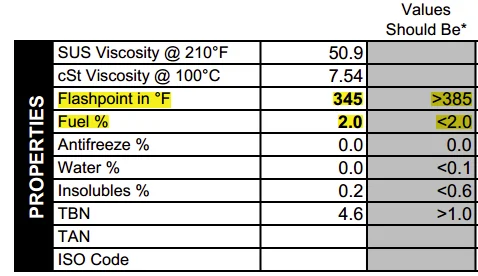
My EB 2.0 Lariat is pretty much driven daily, with an average round trip of ~4 - 6 miles, mainly in the city. That type of driving tends to build up fuel in the oil, as someone mentioned in this forum, due to the engine isn't really getting up to operating temperature. It's one thing to someone stating that and it is an other to have the oil analyzed by Blacktone. Six month after the oil change last year, with close to 1,900 miles on the truck, the oil is a OK, except this:
Ford Maverick Daily short driving distances, Blackstone engine oil analysis... 1704497763302


It seems that that person had been correct. Some questions....

Would the fuel continue build up in the oil, if I waited 12 month for changing it? And if it does...

Can the fuel catch on fire/explode in the crankcase?

TIA...
Sponsored
 

colinl

2.0L EcoBoost
Well-known member
First Name
Colin
Joined
Jun 21, 2022
Threads
32
Messages
5,440
Reaction score
6,179
Location
ICT
Vehicle(s)
'22 Maverick Lariat AWD, '22 Bronco OBX 2-Door
Engine
2.0L EcoBoost
Clubs
 
My EB 2.0 Lariat is pretty much driven daily, with an average round trip of ~4 - 6 miles, mainly in the city. That type of driving tends to build up fuel in the oil, as someone mentioned in this forum, due to the engine isn't really getting up to operating temperature. It's one thing to someone stating that and it is an other to have the oil analyzed by Blacktone. Six month after the oil change last year, with close to 1,900 miles on the truck, the oil is a OK, except this:

1704497763302.png


It seems that that person had been correct. Some questions....

Would the fuel continue build up in the oil, if I waited 12 month for changing it? And if it does...

Can the fuel catch on fire/explode in the crankcase?

TIA...
Strange questions honestly. It appears you also changed the oil after 6 months and only 1900 miles which is premature, so one would expect the oil to still be very high quality in any healthy engine.

I've been in several of the fuel dilution threads.

In several of them I've suggested to drive it at least a half hour with autostop disabled immediately before your oil change. Did you do that? If you changed it cold and had a short drive before, you'll see higher fuel dilution. How much higher, no one could really say without gathering a lot of data, but we know that direct injection does cause dilution.

Regarding exploding or burning, no. Gasoline requires oxygen to burn and there is none available in the oiling system, or at least, nowhere near enough to allow combustion. When you drive longer the gasoline evaporates and goes out the pcv, it does not actually "burn" in any sense.
 

dalola

2.0L EcoBoost
Well-known member
First Name
Retired
Joined
Oct 8, 2021
Threads
15
Messages
2,528
Reaction score
4,341
Location
SE Ohio 🇺🇸
Website
sunsetridgecabinhockinghills.com
Vehicle(s)
'24 Mustang Mach-E P4X, '24 Bronco Big Bend 2Dr Sasquatch, Hot Rods
Engine
2.0L EcoBoost
My EB 2.0 Lariat is pretty much driven daily, with an average round trip of ~4 - 6 miles, mainly in the city. That type of driving tends to build up fuel in the oil, as someone mentioned in this forum, due to the engine isn't really getting up to operating temperature. It's one thing to someone stating that and it is an other to have the oil analyzed by Blacktone. Six month after the oil change last year, with close to 1,900 miles on the truck, the oil is a OK, except this:

1704497763302.png


It seems that that person had been correct. Some questions....

Would the fuel continue build up in the oil, if I waited 12 month for changing it? And if it does...

Can the fuel catch on fire/explode in the crankcase?

TIA...
Given your driving parameters, I would've expected worse, so this is actually good news for you. I would not go past the 6 month change interval based on your conditions staying the same.

As to your questions, yes, if you continue the same driving pattern (short city trips) the fuel dilution will continue to increase. And yes, (tho extremely unlikely for multiple reasons), your oil could combust at some point above 345F. An engine is basically a fancy vacuum pump, so there is plenty enough air available in the crankcase to support combustion. But there would likely be other failures occur first if your oil was approaching that kind of temperature.
 
OP
OP
Skyline

Skyline

Well-known member
First Name
Skyline
Joined
Feb 16, 2023
Threads
42
Messages
552
Reaction score
487
Location
CT
Vehicle(s)
'24 Honda Ridgeline
Engine
Undecided
Given your driving parameters, I would've expected worse, so this is actually good news for you. I would not go past the 6 month change interval based on your conditions staying the same.

As to your questions, yes, if you continue the same driving pattern (short city trips) the fuel dilution will continue to increase. And yes, (tho extremely unlikely for multiple reasons), your oil could combust at some point above 345F. An engine is basically a fancy vacuum pump, so there is plenty enough air available in the crankcase to support combustion. But there would likely be other failures occur first if your oil was approaching that kind of temperature.
Thx...

There are three towns around mine within 2 - 3 miles distance, work from home and it is only running errands, going to the gym, etc. The short city trips will continue, so will the six month oil change interval.

The reason for the early oil change was two folds. One is that I like to change it before winter and the other is that the fuel build up was suspected. The chances are that the 2% fuel content is the culprit for the lower flashpoint than it should be. Should the fuel content increase further, the flashpoint could even be lower than that. Agreed, that it is unlikely that there would be a spontaneous combustion in the crankcase, especially with short driving, where the engine does not even reach operation temperature. Take it to the highway for a half an hour drive with high speed, that probably could happen with higher fuel content in the crankcase, unless the PCV removes the excess fuel.

While the 2% fuel in the crankcase isn't much on the surface, it is around three fluid ounces. Double that and if that goes booom! I'll need a new oil pan, among other things....;)😂
 

NoVaJimmy

Well-known member
Joined
Apr 29, 2022
Threads
26
Messages
1,552
Reaction score
2,451
Location
KCMO
Vehicle(s)
Lexus GX 460
Engine
Undecided
My EB 2.0 Lariat is pretty much driven daily, with an average round trip of ~4 - 6 miles, mainly in the city. That type of driving tends to build up fuel in the oil, as someone mentioned in this forum, due to the engine isn't really getting up to operating temperature. It's one thing to someone stating that and it is an other to have the oil analyzed by Blacktone. Six month after the oil change last year, with close to 1,900 miles on the truck, the oil is a OK, except this:

1704497763302.png


It seems that that person had been correct. Some questions....

Would the fuel continue build up in the oil, if I waited 12 month for changing it? And if it does...

Can the fuel catch on fire/explode in the crankcase?

TIA...
Flash point is huge, cylinder temps on an ecoboost can approach and exceed 400 degrees, at that point your are burning the oil in your piston rings which causes carbon build up which also causes your piston rings to seize up, that is one of the most common killers of ecoboost engines. I have said it before that these engines NEED fresh oil and that fuel dilution is a problem. This is my third ecoboost 2.0 and I based my oil change intervals on common sense and UOA data and it worked out very well for my previous two ecoboost engines, over 150k miles from each and they ran perfect and burned no oil. I feel sorry for anyone who believes the extended service intervals that Ford advertises (10k oil changes) on an ecoboost engine.
 

Sponsored

OP
OP
Skyline

Skyline

Well-known member
First Name
Skyline
Joined
Feb 16, 2023
Threads
42
Messages
552
Reaction score
487
Location
CT
Vehicle(s)
'24 Honda Ridgeline
Engine
Undecided
Flash point is huge, cylinder temps on an ecoboost can approach and exceed 400 degrees, at that point your are burning the oil in your piston rings which causes carbon build up which also causes your piston rings to seize up, that is one of the most common killers of ecoboost engines. I have said it before that these engines NEED fresh oil and that fuel dilution is a problem. This is my third ecoboost 2.0 and I based my oil change intervals on common sense and UOA data and it worked out very well for my previous two ecoboost engines, over 150k miles from each and they ran perfect and burned no oil. I feel sorry for anyone who believes the extended service intervals that Ford advertises (10k oil changes) on an ecoboost engine.
What does UOA data means in this sentence? Just curious...

If the EB pistons reach ~400 degree, presumably Fahrenheit, there will be burned oil on the piston rings. It does not matter, if the oil is fresh or not. The chances are that this isn't as serious issue as you've posted. Otherwise your own experience with the EB engines wouldn't had lasted for 150K miles.

My Maverick has 3,100 miles on it and already changed the oil twice. Is there any carbon build up on the piston rings? Of course there is, slowly but surely it builds up. That does not worry me much, the intake manifold and the valves building up carbon deposits, sludge or whatever it is called, is more serious issue with EB 2.0 in my view.

The lower flashpoint is more worry some, especially with the high piston temperature. While around 2% fuel mixed in the crankcase oil won't go "boom", the oil will certainly burn easier. The chances are that much fuel in the oil also decrease viscosity and may even clean bearing from oil film. The latter one comes in play at cold start.
 

NoVaJimmy

Well-known member
Joined
Apr 29, 2022
Threads
26
Messages
1,552
Reaction score
2,451
Location
KCMO
Vehicle(s)
Lexus GX 460
Engine
Undecided
What does UOA data means in this sentence? Just curious...

If the EB pistons reach ~400 degree, presumably Fahrenheit, there will be burned oil on the piston rings. It does not matter, if the oil is fresh or not. The chances are that this isn't as serious issue as you've posted. Otherwise your own experience with the EB engines wouldn't had lasted for 150K miles.

My Maverick has 3,100 miles on it and already changed the oil twice. Is there any carbon build up on the piston rings? Of course there is, slowly but surely it builds up. That does not worry me much, the intake manifold and the valves building up carbon deposits, sludge or whatever it is called, is more serious issue with EB 2.0 in my view.

The lower flashpoint is more worry some, especially with the high piston temperature. While around 2% fuel mixed in the crankcase oil won't go "boom", the oil will certainly burn easier. The chances are that much fuel in the oil also decrease viscosity and may even clean bearing from oil film. The latter one comes in play at cold start.
UOA = Used oil analysis. I will also say that I do not listen to the lab recommendations from blackstone. One of the early UOAs that I had done had 2.2% fuel dilution for a 5k interval and a flashpoint of 340 degrees and Blackstone recommended pushing the interval out to 7k. I wound up going to a 3k interval and the subsequent UOA showed 1.1% fuel dilution and 378 degree flashpoint.
 

710-oil-614

2.5L Hybrid
Well-known member
First Name
Cal
Joined
Oct 13, 2021
Threads
27
Messages
6,087
Reaction score
11,955
Location
Ohio...but I'd rather be in Boone.
Vehicle(s)
2025 Hybrid AWD Lariat
Engine
2.5L Hybrid
I'll be sending my 10k oil off to Blackstone (only at 6,700 miles currently) which will be slightly over a 5k interval (after changing at 1k, and 4,700 miles).

Using Royal Purple Full Synthetic. I have an engine block heater that I use now in the winter and I generally try to let my vehicle get to temperature at least once during the day, but it is on the highway for 15 mile runs twice a week as well.

I will be driving and warming oil properly before changing, and I am hopeful to see little fuel dilution and maintaining a high flash point.
 
OP
OP
Skyline

Skyline

Well-known member
First Name
Skyline
Joined
Feb 16, 2023
Threads
42
Messages
552
Reaction score
487
Location
CT
Vehicle(s)
'24 Honda Ridgeline
Engine
Undecided
UOA = Used oil analysis. I will also say that I do not listen to the lab recommendations from blackstone. One of the early UOAs that I had done had 2.2% fuel dilution for a 5k interval and a flashpoint of 340 degrees and Blackstone recommended pushing the interval out to 7k. I wound up going to a 3k interval and the subsequent UOA showed 1.1% fuel dilution and 378 degree flashpoint.
Prior to owning the Maverick, I didn't even know anything about the oil, like flashpoint, fuel percentage, Blackstone, etc. I did know to use Mobil1 synthetic and change it once a year. Actually, I did know about Blackstone Inc., the investment company, but that's a different subject.

My UOA showed 2% fuel in the engine oil, or about three fluid ounces, after 1,900 miles in six month with 3 - 6 miles driving most days. Your's showed 1.1% with 3,000 miles and probably longer round trips. Anecdotally, but it shows that short round trips causes faster fuel buildup in the oil. That was my main reason for for the post, just see some data from others.
I will be driving and warming oil properly before changing, and I am hopeful to see little fuel dilution and maintaining a high flash point.
When you do "warming oil properly" the result of the UOA might be misleading, as far as oil fuel percentage is concerned. If I'd do the same with my truck just prior to changing the oil, the fuel % may drop 0.5 - 1.00%. In another word, it would not show normal, usage based value.
 

710-oil-614

2.5L Hybrid
Well-known member
First Name
Cal
Joined
Oct 13, 2021
Threads
27
Messages
6,087
Reaction score
11,955
Location
Ohio...but I'd rather be in Boone.
Vehicle(s)
2025 Hybrid AWD Lariat
Engine
2.5L Hybrid
Prior to owning the Maverick, I didn't even know anything about the oil, like flashpoint, fuel percentage, Blackstone, etc. I did know to use Mobil1 synthetic and change it once a year. Actually, I did know about Blackstone Inc., the investment company, but that's a different subject.

My UOA showed 2% fuel in the engine oil, or about three fluid ounces, after 1,900 miles in six month with 3 - 6 miles driving most days. Your's showed 1.1% with 3,000 miles and probably longer round trips. Anecdotally, but it shows that short round trips causes faster fuel buildup in the oil. That was my main reason for for the post, just see some data from others.

When you do "warming oil properly" the result of the UOA might be misleading, as far as oil fuel percentage is concerned. If I'd do the same with my truck just prior to changing the oil, the fuel % may drop 0.5 - 1.00%. In another word, it would not show normal, usage based value.
I suppose if for your use - you rarely if ever get your vehicle to true operating temps then I agree it would skew your values.

For me - where my Maverick most always reaches operating temps, it would artificially increase or inflate the fuel dilution if I were to simply cold start my truck , let it idle, and then move it on the ramps and change the oil.
 
Sponsored

Vols44

2.5L Hybrid
Well-known member
Joined
Sep 19, 2021
Threads
0
Messages
755
Reaction score
721
Location
Missouri
Vehicle(s)
2018 Edge
Engine
2.5L Hybrid
I just changed oil and notice a light brown milky substance inside the filler cap. My work commute is now 10 minutes each way instead of 25. The milky appearance is suppose to be a byproduct of trips where the engine does not get up to normal operating temperature which is understandable this time of the year.

I just sent for a Blackstone sampling kit. The $35 investment will be well worth the confirmation that I don't have a coolant leak or budding head gasket problem after 16 k miles.
 

Snox801

2.0L EcoBoost
Well-known member
First Name
Levi
Joined
Nov 16, 2023
Threads
39
Messages
1,742
Reaction score
2,036
Location
Spring Lake Michigan
Vehicle(s)
23 F150-2016 RS/ 22 GT500/ rx8 x2/ 95 mustang GT/ 17 edge.
Engine
2.0L EcoBoost
So 2 percent is not very much. Having run ecoboost since they came out this is a very consistent topic. So according to most standard oil analysts, it’s considered bad past 5 percent. Now that is very dependent on the oil and how it’s developed. Amsoil signature series is formulated to pass wear tests all the way up to 15 percent. It’s been a long time since I’ve contacted others for what the standards are. If I remember correctly all the extended drain oils would hold a huge amount of fuel.
I think if you stick with a super high quality oil you are fine running till the oil monitors tell you to change it. I’ve done that for a long time and all my blackstones came back good.
Also no your oil will not light on fire in the engine. Not enough oxygen and it does take a ton fuel dilution before it would light. Much more than 2-5 percent.
 
OP
OP
Skyline

Skyline

Well-known member
First Name
Skyline
Joined
Feb 16, 2023
Threads
42
Messages
552
Reaction score
487
Location
CT
Vehicle(s)
'24 Honda Ridgeline
Engine
Undecided
The 2% fuel in the oil may not seem much, if it is viewed without details posted in the OP. As a reminder, at the time of the test the oil had 1,800 miles and six month time. All these miles with short trips, where the engine may not reach operating temperature, especially in the winter. If the Maverick stays with me, I'll keep changing the oil every six month.

The brand name of the oil does not matter in my view, but with that stated, my choice is Mobile 1 synthetic oil. Is there really that much difference between different brand of oils? Based on Blackstone Labs statement, quote:

We always recommend using an oil grade recommended for your engine by the manufacturer and a brand that fits your budget. But beyond that, we find that brand makes very little difference.
That's a sound advise without any prejudice against brands, that's good enough for me. Swapping oil brands isn't advisable in my view, due to how different brand's additives may interact with the leftover additives. That's just my personal preference, without any actual experience and/or research.

There's plenty of air in the crankcase and it could result in lighting on fire under the optimal circumstances. The lower than normal flashpoint may contribute to that, but even then it is admittedly unlikely. It is more worry some, that the fuel in the oil may just remove the oil film left in the moving parts. One of the advantage of the synthetic oil vs. the organic one is that it'll leave a film on the moving parts to protect the engine at the time of cold start. Higher than normal percentage of fuel may remove this advantage.
Sponsored


Top