

- Banned
- #91
I'll brb...Bravo... How reasonable of you.
I love all the armchair analysis and subsequent bickering, makes for an amusing read.
They didn't add enough butter on this popcorn.
Sponsored
I'll brb...Bravo... How reasonable of you.
I love all the armchair analysis and subsequent bickering, makes for an amusing read.

Take your new Mav out and open it up on the freeway for 20 minutes...that should clean everything up.So it is entirely possible he has had upwards of 5% fuel dilution in his oil consistently (or at various points of the engine's life) and he has never known it - sometimes ignorance is bliss.
And, how does the raw fuel from the bad mixing and cold starts make it into the crankcase?The major cause of GDI fuel dilution is not from blowby gases but from cold starts and questionable mixing in the combustion chamber.
This has nothing to do with the particular boosting system being used.
There is a fair amount of NA GDI engines in use today, do you think these are immune from gasoline/oil dilution? I don’t think so….
Cold start cylinder pressure and temperature are very low compared to cylinder pressure and temperature under high load. This allows for some raw fuel to get past the rings and into the crankcase. High pressure, temperature and better mixing at high speeds and loads all contribute to more complete combustion with less raw fuel available to contaminate the oil. Not rocket science……And, how does the raw fuel from the bad mixing and cold starts make it into the crankcase?
Higher combustion pressures have no bearing on fuel dilution? Extra pressures and forces from a bigger and more powerful turbo have no bearing on reliability?
That there "are a fair amount of NA GDI engines in service" has no bearing on this discussion.
You seem to be quite the expert;And, how does the raw fuel from the bad mixing and cold starts make it into the crankcase?
Higher combustion pressures have no bearing on fuel dilution? Extra pressures and forces from a bigger and more powerful turbo have no bearing on reliability?
That there "are a fair amount of NA GDI engines in service" has no bearing on this discussion.

I do old school 3000 to 3500 tops, no matter what.Moral of the story, run top quality motor oil and change every 3500 miles MAX.
On Ford.com. (I have seen more detailed version also)Do you know that it takes short trips and engine temps into consideration for the calculation?
I've known it to be driven by two factors - miles driven and time since last change. I would interested to see where Ford discusses the calculation.
I don't like to change oil every 10-12 days! I am retired now so that doesn't concern me as much anymore.I do old school 3000 to 3500 tops, no matter what.

I would recomend turning off your auto start/stop system. There is a rich condition every time the car is started do to the high fuel pressures in the direct injection system.So, recently did my second oil change on my 2022 EB. As you can see in the report, I was running AMSOIL Signature Series 100% Synthetic in 5w30. Run time on the oil was 5,600 miles. Note this change interval is WELL BELOW factory recommendation, and the onboard oil life meter indicated 50 percent oil life remaining.
All in report looks good EXCEPT the analysis shows a fuel dilution of greater than 5%, and SEVERELY low viscosity.
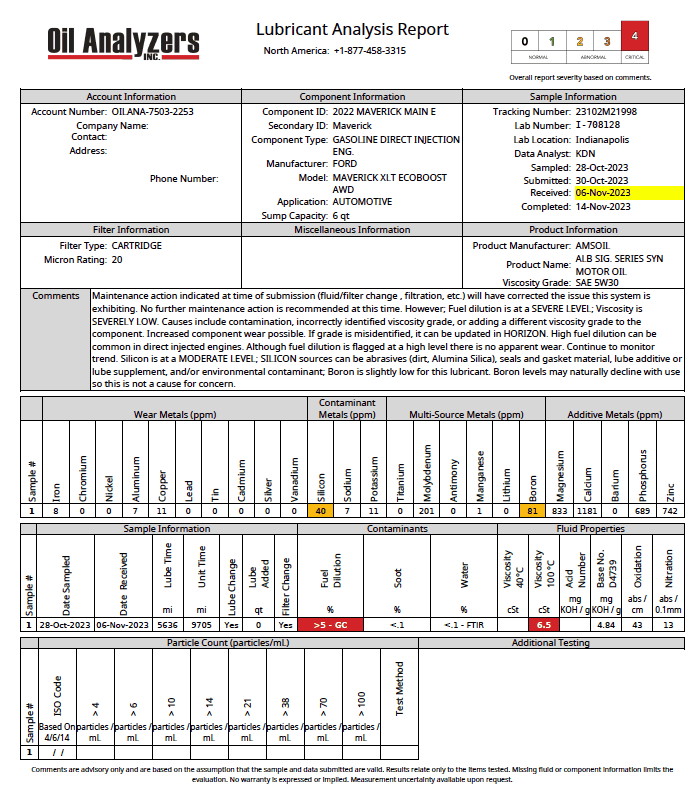
Anecdotally I can confirm the oil definitely had a strong fuel odor when emptied. So, not surprised by result. Question is, what to do? Obvious answer is shorten change interview to perhaps 4,000 miles and sample again.
But beyond that, any other recommendations? Catch can? Vented oil cap?
Please see full report attached.
So, recently did my second oil change on my 2022 EB. As you can see in the report, I was running AMSOIL Signature Series 100% Synthetic in 5w30. Run time on the oil was 5,600 miles. Note this change interval is WELL BELOW factory recommendation, and the onboard oil life meter indicated 50 percent oil life remaining.
All in report looks good EXCEPT the analysis shows a fuel dilution of greater than 5%, and SEVERELY low viscosity.
Anecdotally I can confirm the oil definitely had a strong fuel odor when emptied. So, not surprised by result. Question is, what to do? Obvious answer is shorten change interview to perhaps 4,000 miles and sample again.
But beyond that, any other recommendations? Catch can? Vented oil cap?
Please see full report attached.
Try a long drive before your next oil change. Your suggestion of a lot of short drives seems plausible. I might also try a different oil if those results were mine. A catch can is a good idea on a DI motor but I'm not sure that it would impact this issue. I had an Audi that had this issue but it also went through oil. As many know, it was the rings on Audi's 2.0 turbo. You might want to get another analysis at say maybe 1000 miles. I think that would be telling.So, recently did my second oil change on my 2022 EB. As you can see in the report, I was running AMSOIL Signature Series 100% Synthetic in 5w30. Run time on the oil was 5,600 miles. Note this change interval is WELL BELOW factory recommendation, and the onboard oil life meter indicated 50 percent oil life remaining.
All in report looks good EXCEPT the analysis shows a fuel dilution of greater than 5%, and SEVERELY low viscosity.
Anecdotally I can confirm the oil definitely had a strong fuel odor when emptied. So, not surprised by result. Question is, what to do? Obvious answer is shorten change interview to perhaps 4,000 miles and sample again.
But beyond that, any other recommendations? Catch can? Vented oil cap?
Please see full report attached.
So take your Mav out on the freeway and run it for 20 minutes. That should clean up everything once you reach running engine temps and you won't have to add an additive either. Recommend 91 octane.So, recently did my second oil change on my 2022 EB. As you can see in the report, I was running AMSOIL Signature Series 100% Synthetic in 5w30. Run time on the oil was 5,600 miles. Note this change interval is WELL BELOW factory recommendation, and the onboard oil life meter indicated 50 percent oil life remaining.
All in report looks good EXCEPT the analysis shows a fuel dilution of greater than 5%, and SEVERELY low viscosity.
Anecdotally I can confirm the oil definitely had a strong fuel odor when emptied. So, not surprised by result. Question is, what to do? Obvious answer is shorten change interview to perhaps 4,000 miles and sample again.
But beyond that, any other recommendations? Catch can? Vented oil cap?
Please see full report attached.
I do old school 3000 to 3500 tops, no matter what.