

Sponsored

2,000 lbs Hybrid Tow Capacity?

hsinking1932

2.5L Hybrid
Well-known member
Joined
Jun 7, 2021
Threads
3
Messages
181
Reaction score
299
Location
MA
Vehicle(s)
Explorer
Engine
2.5L Hybrid
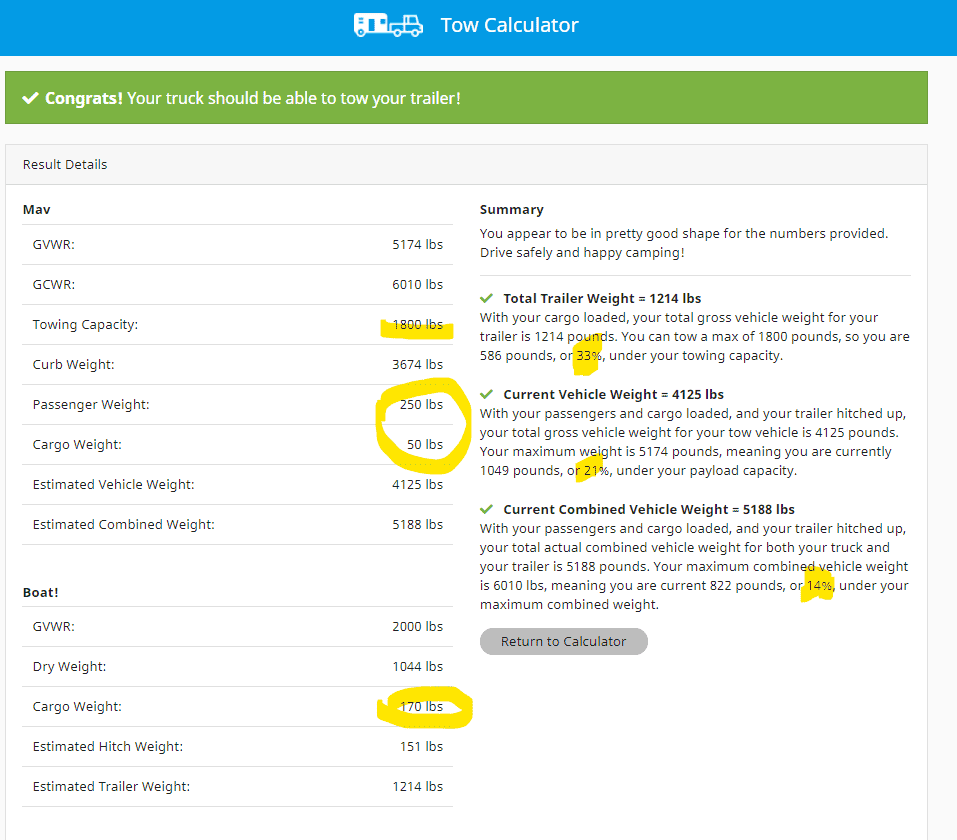
Yes, 15 foot fishing boat, 25HP motor, basic bunk trailer. Mainly going to lakes in Norcal, some elevation to 6,000-7,000 feet. I hope this works for the hybrid, if so this a great compromise over buying a Ranger or F150 with that low MPG's.
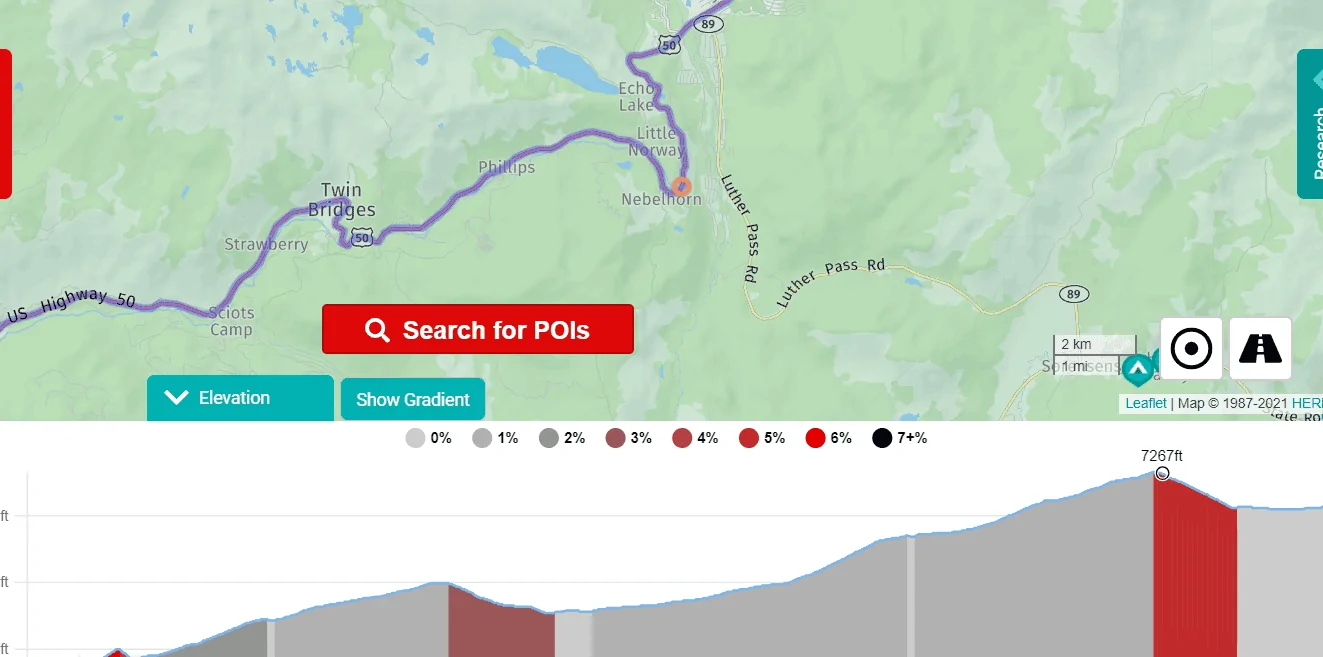
Thank you for your typing. I did some math for you on http://towcalculator.com/# with given numbers. That is a useful website if you like to tow something. The result is not bad. High altitude and gradient are certainly a challenge, though. I planed a trip from El Dorado to South Tahoe on https://www.rvtripwizard.com, and I don't like it. A trailer with electric brakes and a transmission cooler can make me feel more comfortable. Just my 2 cents.

We have a Towing / Flat-Towing / Hitches section in this forum. I learned a lot there. This thread is a must:
https://www.mavericktruckclub.com/forum/threads/towing-ramblings.652/
Ford Maverick 2,000 lbs Hybrid Tow Capacity? tahoe 04
Ford Maverick 2,000 lbs Hybrid Tow Capacity? tahoe 03
Sponsored


fbov

Well-known member
First Name
Frank
Joined
Jun 28, 2021
Threads
0
Messages
452
Reaction score
502
Location
Bushnell's Basin
Vehicle(s)
2020 Escape Hybrid
Depending upon how much the electric motor contributes, it could be little to no difference in power. Electric motors will produce the same power at any elevation.
True for an EV, but a hybrid gets all of its power from gasoline, driving either wheels or generator. No idea how an Atkinson reacts to altitude.
 

jimmy fitzwell

Well-known member
First Name
jimmy
Joined
Jun 15, 2021
Threads
1
Messages
199
Reaction score
200
Location
troy, mt.
Vehicle(s)
73 pinto wagon, 67 olds 98
Check the owners manual when it's finally available. Ford sometimes rates towing a little differently depending on altitude. The F-150 in some trims is rated at 10,000 pounds towing, but Ford states that you must adjust the maximum tow rating down 2% of total for each 1000 feet above sea level. That can add up if you are operating in the mountains. Not sure if the Maverick will follow this same formula, but wanted you to be aware of the possibility.
Is the altitude adjustment for Turbos? I have a coyote and never heard of it.
 

davnau

2.5L Hybrid
Well-known member
First Name
Dave
Joined
Jul 29, 2021
Threads
6
Messages
207
Reaction score
374
Location
Barberton, OH, US
Vehicle(s)
'73 Ford Mustang
Engine
2.5L Hybrid
You just have to meet the towing specs. It's all just knowing the weights of what you are towing and the payload while towing, including hitch weight. along with the front surface area of the towed vehicle, and then doing the arithmetic. Many crossover SUVs and other vehicles have two different weight capacities: one for a braked trailer and a second for an un-braked trailer, the latter of which is always a lower capacity. Ford vehicles typically have just one weight, braked or un-braked.

Interestingly, in looking up the towing capacities for the 2011 Ford Ranger (last year of retail production), a 4-cyl automatic 5-speed SuperCab (6 foot bed) had a towing capacity of 2000 pounds, same as the standard hybrid SuperCrew Maverick with a standard 4 1/2 foot bed. This all seems very consistent to me.
 

SpacemanSpiff

2.5L Hybrid
Well-known member
First Name
Tyreese
Joined
Jun 23, 2021
Threads
11
Messages
354
Reaction score
811
Location
Mid-west
Vehicle(s)
F-15 Eagle
Engine
2.5L Hybrid
Is the altitude adjustment for Turbos? I have a coyote and never heard of it.
With the F-150 example, it was the transmission that was overheating at altitude.
 

Sponsored

vap0rtranz

2.5L Hybrid
Well-known member
First Name
JP
Joined
Jul 28, 2021
Threads
6
Messages
349
Reaction score
464
Location
Wisconsin
Vehicle(s)
'22 Mav Hybrid XLT, '17 Chevy Colo Z71 diesel
Engine
2.5L Hybrid
Interestingly, in looking up the towing capacities for the 2011 Ford Ranger (last year of retail production), a 4-cyl automatic 5-speed SuperCab (6 foot bed) had a towing capacity of 2000 pounds,
I did the same lookup when the Ford tow guide finally came out. The curb weights were a bit different between the two but basically Ford got the Maverick to tow the same as the old 4bangers. Yet another reason I think this trucklet should have gotten the Ranger name, not that other beast of a truck.
 

Probity

2.5L Hybrid
Well-known member
Joined
Jul 6, 2021
Threads
9
Messages
328
Reaction score
546
Location
Covington LA
Vehicle(s)
'24 Silverado CCSB 2.7 (a Mav. Hybrid next time?)
Engine
2.5L Hybrid
The more I think about this, I'm concerned. That rules out the Sierra Nevada's I can probably go to 5,000 feet or so. That cuts the tow cap in half!
Will high altitude driving and towing be a problem with Maverick Hybrid regards usable payload and towed mass?

Short answer is – generally no. I wouldn’t get too worried about high altitude driving or towing effects with the naturally aspirated (N.A.) 2.5l Atkinson cycle engine. Plenty of Hybrid/other N.A. engine drivers in Denver CO, Tahoe CA, Santa Fe NM, etc., all well above 5000 ft.

Very long winded answer is – maybe, depending on actual elevation, temperature, relative humidity, barometric pressure, how much your towing, total payload, etc.

Like a lot of towing topics, how you should account for the physical effects on engine performance at high altitude are controversial to some degree. There’s science and there’s opinions. The science is, at higher altitudes, the oxygen density (not just volume) decreases, and as a N.A. vehicle drives higher and higher it starts to lose more and more horsepower because less oxygen enters the engine’s cylinders. Also, the higher you are, the less atmospheric pressure there is. So, at sea level (higher atmospheric pressure, more oxygen density) there’s more oxygen per cylinder volume to work with.

A rule of thumb a lot of people use is, a N.A. engine will lose “around” 3% of its power for every 1000 ft. elevation gain.

Now say you have turbocharged engine (i.e. the 2.0l). What happens is a little different. At high elevations turbos compress more air into the engine cylinders, making up for the lower air density and allowing the engine to produce power “almost” as if it were at sea level. I say “almost” because there still is some power loss with turbos at altitude (albeit much less of a loss than with an N.A. engine), even with the atmospheric pressure “boost” you get with a turbo because as you go higher the turbo fan has to increase its rpm to maintain a constant “boost” pressure (maybe to the point of spinning faster than is efficient). Not sure about current gen 2.0l EB boost pressure, older ones I think were around ~17 psi stock.

If maximizing engine power at altitude was your sole goal, if you were given a choice of engine/propulsion types, you’d rank them as follows (from worst to best):
  • Older style carburetor engine. If you own a portable generator with a carburetor, you know the manual talks about operating it at high altitudes (i.e. you have to re-jet it with an “altitude kit”).
  • Modern vehicle fuel injected N.A. engine.
  • Modern turbocharged gas engine.
  • All electric vehicle (unfortunately at present few of them have tow ratings, Ford says Mach-E is “not recommended” for towing).
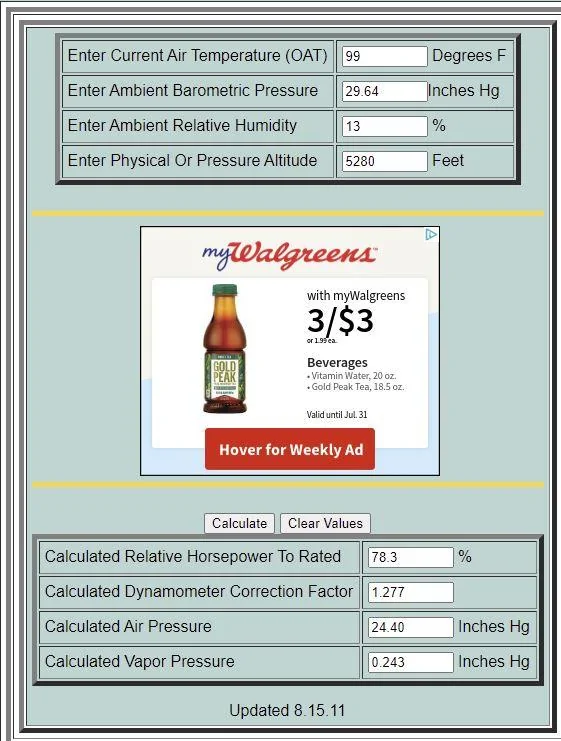
For the Hybrid, if you really really wanted to get down in the weeds (which nobody does), you can go to a couple of different interweb sites and play with some numbers to see what that 162 HP 2.5l Atkinson cycle engine loses at altitude:
Barometric Pressure Forecast and History
Relative Horsepower Calculator (csgnetwork.com)

Once you have air temperature, barometric pressure, relative humidity and altitude for a location you can see what a quick-and-dirty calculated relative HP to rated HP percentage is for the ICE engine. Now the Hybrid will also have some propulsion component provided by the electric motor, not sure what % of total power that will be at any given time, so the engine HP loss you’ll see likely won’t be as bad as you might think with regards to having enough oomph to move you along.

Say you were somewhere in Denver at an exact elevation of 1 mile (5280 ft) at 6pm on Wed.28 July and because you’re bored, you wondered how much power your theoretic Maverick Hybrid ICE engine lost at that time.

Altitude – 5280 ft
Temp. – 99 F.
Baro press - 29.64 in. Hg
Relative humidity – 13%
Relative HP to rated HP – 78.3%; 162 HP x .783 = 127 HP (you lost ~35 HP).
Ford Maverick 2,000 lbs Hybrid Tow Capacity? hp loss

If you play around with the numbers you see how much/what affect temp, pressure, humidity have on power loss. Hot, humid, relative high air pressure makes for more power loss.

All of the above is about engine power loss. Ford “recommends” you derate (reduce) your GCW’s and GVW’s by 2% per 1000 ft of elevation (2022 Prelim. Towing Guide).

Ford (and interesting enough Hyundai for their Santa Cruz) mention this but GM, Ram, Toyota, etc don’t (I haven’t found it in their current tow guides). They appear to say that for their SAE J2807 tow ratings, altitude effects are already “baked into” their tow ratings. Is this true? I don’t know, sounds a little fishy to me but who knows.

It’s a few years old but this article addresses how Ford and others addressed altitude in 2015:
Should Your Pickup Tow Less at Altitude? - PickupTrucks.com News
 

vap0rtranz

2.5L Hybrid
Well-known member
First Name
JP
Joined
Jul 28, 2021
Threads
6
Messages
349
Reaction score
464
Location
Wisconsin
Vehicle(s)
'22 Mav Hybrid XLT, '17 Chevy Colo Z71 diesel
Engine
2.5L Hybrid
All electric vehicle (unfortunately at present few of them have tow ratings, Ford says Mach-E is “not recommended” for towing).
The F150 Ligthening has massive tow capability. 775 lb-ft.
 

fbov

Well-known member
First Name
Frank
Joined
Jun 28, 2021
Threads
0
Messages
452
Reaction score
502
Location
Bushnell's Basin
Vehicle(s)
2020 Escape Hybrid
... the Hybrid will also have some propulsion component provided by the electric motor ...
Until the HVB is depleted, which happens fast under high load in a hybrid. Then, all the electric energy is generated by the ICE, so it becomes "just another load."

What might help is to "turn down Atkinson." Typically, an Atkinson engine only uses 90% of it's intake displacement, but at very high compression ratio, so the resulting pressure at TDC is the same ~10:1 as a conventional NA engine. This partial fill is accomplished by varying valve timing, so it's adjustable, and can be reduced at altitude to maintain the O2 content in the cylinder. No idea if anyone's doing it for altitude, but there are non-hybrids that use an Atkinson mode to improve mileage.
 

oljackfrost

2.5L Hybrid
Well-known member
First Name
Mark
Joined
Mar 9, 2021
Threads
39
Messages
1,077
Reaction score
1,826
Location
Minnesota
Vehicle(s)
They're all sold, waiting for Maverick
Engine
2.5L Hybrid
Sponsored

notfast

Well-known member
Joined
Jun 25, 2021
Threads
2
Messages
916
Reaction score
1,439
Location
Los Angeles CA
Vehicle(s)
Nissan Frontier PRO-4X Lux FFV
Engine
Undecided
Turbos pretty much compensate for altitude.
Turbos create their own atmosphere. 15PSI of boost is 15PSI whether you're at sea level or 15,000 feet above.

However, you will likely be spooling the turbos a lot more the higher up in elevation you go since air density drops and you'll need to give it more skinny pedal to get/keep moving.
 

oljackfrost

2.5L Hybrid
Well-known member
First Name
Mark
Joined
Mar 9, 2021
Threads
39
Messages
1,077
Reaction score
1,826
Location
Minnesota
Vehicle(s)
They're all sold, waiting for Maverick
Engine
2.5L Hybrid

vap0rtranz

2.5L Hybrid
Well-known member
First Name
JP
Joined
Jul 28, 2021
Threads
6
Messages
349
Reaction score
464
Location
Wisconsin
Vehicle(s)
'22 Mav Hybrid XLT, '17 Chevy Colo Z71 diesel
Engine
2.5L Hybrid
but there are non-hybrids that use an Atkinson mode to improve mileage.
The Tacoma V6 did this and still got poor EPA mileage #s. But I'd be curious if folks got better MPG in the wild.

I don't think towing mileage matters as much because towing sucks a lot of MPGs. MPGs & fuel savings for daily commute? Yes, that matters.

I posted to the thread on Hybrid worries about towing. Towing expectations have changed in 20years.

The old 4banger Ranger got <150hp and right about 150 lb-ft. The Tacoma i4 got a bit better hp & torque than the Ranger. The Hybrid's 2.5L power specs -- even without the electric motors -- are a little better than the old 4bangers, but not by much.

Now, you'll hear guys proudly say: "I can't even feel anything back there!" and will PASS anyone on the highway going 70mph. The bar has been raised, so folks need about 300 lb ft or more.

I plan on towing a pop-up camper (hard-sided). I don't plan on passing folks, nor do I want to forget that I'm towing something.
 
Last edited:

Delbert

2.5L Hybrid
Well-known member
First Name
David
Joined
Jul 13, 2021
Threads
10
Messages
338
Reaction score
321
Location
Charlottesville
Vehicle(s)
14 Forester, honda Accord Hybrid
Engine
2.5L Hybrid
Thinking about the hybrid drive train and towing. It is the long steep grades that will stress it.
Battery depleted and still climbing, all you have is a 2.5 liter engine hauling your load. And if it is at altitude, even less power. No manual transmission to gear down and just go slow over the pass.
Downhill could be worse. What happens when the battery is full and you are braking? I assume you are relying only on the brake pads. Again, no low gear to let the engine do the braking.
If the terrain is relatively flat and the battery is not stressed then hybrid set up is ideal for towing. The battery discharges on the uphills and charges on the downhills, improving your gas mileage and relieving any stress on the drivetrain.
If you want to talk high mountain passes and heavy loads, there is no replacement for displacement.
Sponsored


Top