


This is what happens! I guess I didn't think through the design of the roof to well.🫤Wow.
Are you still in Maine?
Solar in Maine?
If you can do it, anyone can.
What happens when it snows?
Sponsored
This is what happens! I guess I didn't think through the design of the roof to well.🫤Wow.
Are you still in Maine?
Solar in Maine?
If you can do it, anyone can.
What happens when it snows?

So does that mean it blocks your sun sometimes but is short lived? Does snow ever stay on the panels for days or weeks? What about ice or heavy frost?This is what happens! I guess I didn't think through the design of the roof to well.🫤


If you put them vertical through snow season they can make as much off the backscatter from the snow as from the watery low angle direct light.This is what happens! I guess I didn't think through the design of the roof to well.🫤
It means my snow clean-up is double. Barn should have a roof with snow sliding to the sides, not back in the driveway and in front of all the doors. Snow on the roof typically is short lived and not an issue. I have a foam ended snow rake that I sometimes clear the ends with. Then the remainder soon slides off. I still have excess solar power. A 2nd EV would take care of that. Driving, mowing, powering the house, etc. on free sunshine is the way to go.So does that mean it blocks your sun sometimes but is short lived? Does snow ever stay on the panels for days or weeks? What about ice or heavy frost?

Huh?Well basically, turn up at any gas station and it's like "Please sir, may I have a bowl of random hydrocarbon soup?" some random soup of the day jumble of decanes, nonanes, heptanes, octanes, benzenes and alcohols that comes out somewhere around the 88 MON+RON/2

yep,use your nose! now the funny thing is its seems that the claimed ratio of E vs Gasoline varies a bit from station to station( you know you can actually add water to E10 to remove the alcohol.do some experimenting if you wish to do this,the water bonds with the alcohol and ends up on the bottom of the continer with a clear container you can see it and these days its seems water in the fuel isn't quite the issue it used to beYou can get about any answer you want on the subsidies/value/carbon footprint etc. aspects of renewable fuels and fossil fuels. We have run a Hayabusa with stock 12.5:1 compression on pump E85 and seen notable power increases. For sure it gets less mpg. There are plenty of fuels that have their distinctive odor. I recall pump fuels with MTBE back in the 90's having a distinct smell, and race fuels today with it are the same.
Finally!Look. I like you. But no, that is not the word. And that's not even the concept.
"hygroscopic" is the word.
Hygroscopic refers to
substances, often dry powders or liquids, that readily attract and absorb water vapor from the surrounding environment.
"Concentrated sulfuric acid, alcohols (like ethanol), and salts (e.g., sodium chloride) are strongly hygroscopic and used for drying or in moisture-sensitive applications.
Ethanol makes things drier. Not wetter.
Most people get that backwards.
For 125 years people have been purposefully adding alcohols to fuel, especially in winter, to keep them from freezing. To keep fuel lines from icing up.
Gas and water do not mix.
Water separates from gasoline.
Water does not separate from ethanol.
And water does not separate from a gas-ethanol-water mixture in any realistic proportions you will encounter. You will need more than a gallon of water in your tank to overwhelm the ethanol. Who does that???? Boats maybe.
Pro Tip: Don't use your Maverick as a boat.
Ever have a bourbon, Scotch, whisky, rum, or any distilled spirit? They are usually more than 50% water! How long does it take for the water to settle out of your whisky? Answer: infinity. It does not separate.
The beautiful thing about alcohol is it REMOVES WATER FROM YOUR GAS TANKS.
Been marketed that way in cold weather areas for 100+ years.
Example:
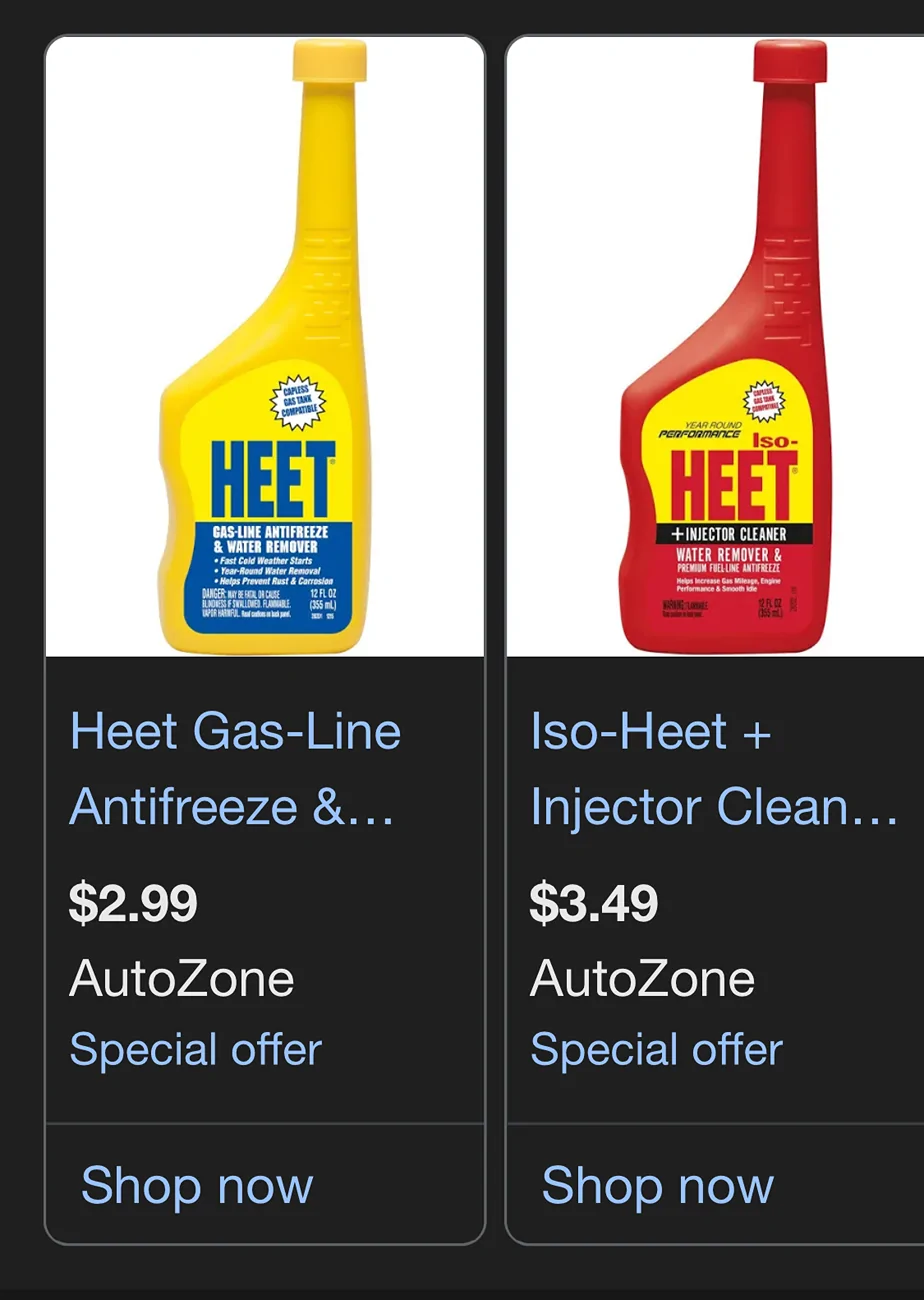
Primary ingredient is alcohol.
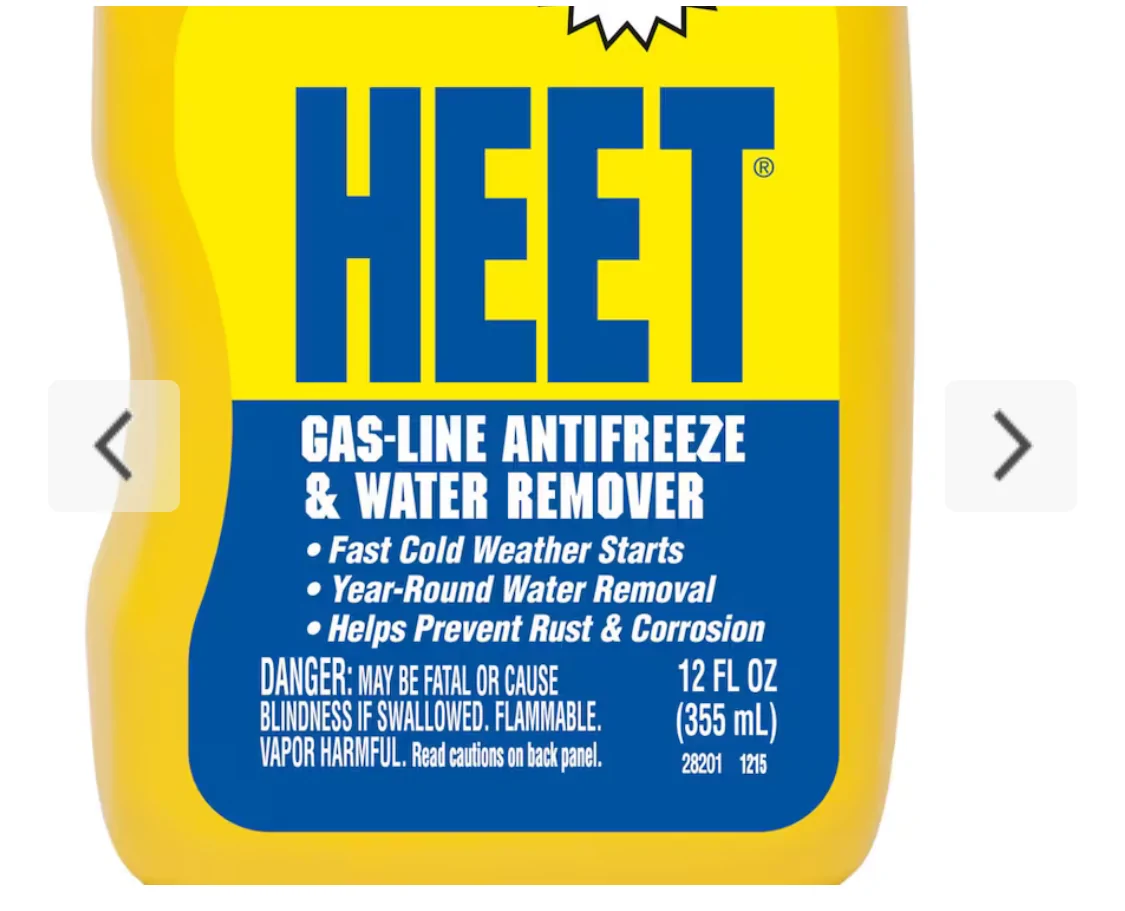
This product is needed for plain gas.
This product serves no purpose in E10.

Yep. That principal is how you measure the ethanol content.yep,use your nose! now the funny thing is its seems that the claimed ratio of E vs Gasoline varies a bit from station to station( you know you can actually add water to E10 to remove the alcohol.do some experimenting if you wish to do this,the water bonds with the alcohol and ends up on the bottom of the continer with a clear container you can see it and these days its seems water in the fuel isn't quite the issue it used to be
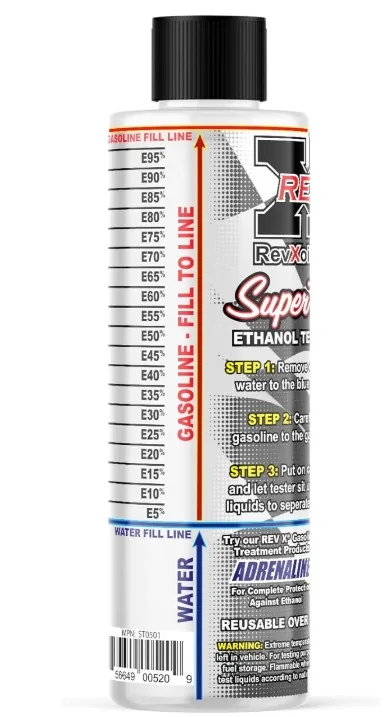
Neat, simple tool.Yep. That principal is how you measure the ethanol content.


I recently bought a kit like that, to verify that the $4.99/gallon ethanol-free gas I was buying is actually so. My snowblower so does not like E10, stored over the summers it badly gummed-up the carb, necessitating a thorough cleaning.Yep. That principal is how you measure the ethanol content.
what I do is when storing I run the equipment completely out of gas,done this for years no problem.I recently bought a kit like that, to verify that the $4.99/gallon ethanol-free gas I was buying is actually so. My snowblower so does not like E10, stored over the summers it badly gummed-up the carb, necessitating a thorough cleaning.
HRG
I will now. Funny thing is, the 2-stroke snowblower I had for 25 years always started on the 1st or 2nd pull after sitting with fuel in it, same with my 4-stroke mower. But, this 4-stroke blower seems pretty sensitive. I always add SeaFoam to my small engine gas can, but that did not prevent it.what I do is when storing I run the equipment completely out of gas,done this for years no problem.
nephew bought a totaled Ford pickup for parts,don't know how long it had been sitting,the gas tank had a lot of gas in it,it didn't smell that bad,I started burning that stuff in my "cub cadet" cut grass most of the summer with that fuel,it was either not that old or maybe it was "E" free gasoline,anyrate was a good way to dispose of it.I will now. Funny thing is, the 2-stroke snowblower I had for 25 years always started on the 1st or 2nd pull after sitting with fuel in it, same with my 4-stroke mower. But, this 4-stroke blower seems pretty sensitive. I always add SeaFoam to my small engine gas can, but that did not prevent it.
HRG

take care of your stuff is a great idea. for all my small engine equipment i do as you are. the local small engine place that sells and works on yard care equipment use me as an example of how long stuff can last when properly taken care of.For my small engines.
Two generators,
The Generac is 16 years old,
The Ryobi is twelve,
Chain saw, 8 yrs old
Back pack Leaf blower, 9 years old.
Lawn mower, 15 years old, Briggs motor.
I’ve replaced the nylon drive gears once.
It’s an AWD like my Mav :’P
All running like new.
The chain saw and blower are Echo with their
Chrome cylinder walls.
I have access to real gas,
93 octane Non ethanol.
I put Star Tron in my stored gas as directed and can keep my gas for Two years with no ‘gumming’ up.
I keep 30 gallons plus all equipment gets stored with full tanks,
Everything gets started every other month off season.
My equipment has lasted all these years party because not one drop of ethanol has ever been fed to them.
Ethanol is hydrostatic I think the word is.
Ethanol collects water from condensation,
It stores poorly. But Star Tron will hold it for two years.
Ethanol gas has a slower,
‘Flame propagation’ small engines don’t like that.





