
Sponsored

Questions on Hybrid power plant.

brictor

2.5L Hybrid
Member
First Name
brictor
Joined
Jul 16, 2021
Threads
1
Messages
12
Reaction score
7
Location
Michigan
Vehicle(s)
22 Maverick
Engine
2.5L Hybrid
I try to understand the max torque at the wheel and max traction on the tires for the Hybrid Maverick. How much torque does it take to spin the front tires say on a 1 year old paved road (best scenario)

Need lots of help as my understanding of math and physic is below / below average.

From spec sheet ICE rated 162hp / 155 lb-ft. MG2 94kw(130hp) / 173lb-ft.

Total system horsepower 191hp / ??? lb-ft.

There are two scenarios.

  • MG2 is the primary power source to final drive. Total system 191hp – MG2 130hp = 61hp. So the max hp can be transfer from ICE to final drive is 61hp. (Max MG1 holding torque)
  • ICE is primary power source to final drive. In this case MG1 holding torque curve become extremally critical because that determines how much power can be deliver to final drive.
Have anyone seen spec for MG1? Holding torque curve is the most important peace of information I think
Sponsored


vap0rtranz

2.5L Hybrid
Well-known member
First Name
JP
Joined
Jul 28, 2021
Threads
6
Messages
349
Reaction score
464
Location
Wisconsin
Vehicle(s)
'22 Mav Hybrid XLT, '17 Chevy Colo Z71 diesel
Engine
2.5L Hybrid
Total system horsepower 191hp / ??? lb-ft.
Yup, some of us have noticed Ford isn't publishing combined torque #s. Either it's terrible and they don't want us to know or it's great and they don't want to outshine something else.

MG2 is the primary power source to final drive. Total system 191hp – MG2 130hp = 61hp. So the max hp can be transfer from ICE to final drive is 61hp. (Max MG1 holding torque)
I'd like to see power curves too. Where did MG2 130hp come from?

The hybrid's final drive ratio is 2.91:1. For traditional ICE, that ratio is considered poor for towing or acceleration but great for mileage. But a powerplant that could theoretically supply near instantaneous torque or great low end torque could throw that traditional pro/con list out the window. Enter electric motors in EVs, stage right. Enter motors assisting ICE in Hybrids, stage left.

I'm not sold that Ford as tuned the HF45 to be great at low end torque. Watch the tach/power in 0-60 test drives of the new Escape Hybrid closely. When the driver floors the accelerator, the motor generates a few kW very briefly near 0 but the engine quickly takes overs to generate the bulk of the power to 60. This is exactly the opposite of what a tuned hybrid powerplant should do, so the Escape barely gets 8sec 0-60.

Also, there's no wheel spinning in Escape Hybrid test drives even in "Sport Mode" and traction control disabled. In my Chevy Volt, I can easily burn rubber.
 

Probity

2.5L Hybrid
Well-known member
Joined
Jul 6, 2021
Threads
9
Messages
328
Reaction score
546
Location
Covington LA
Vehicle(s)
'24 Silverado CCSB 2.7 (a Mav. Hybrid next time?)
Engine
2.5L Hybrid
Yup, some of us have noticed Ford isn't publishing combined torque #s. Either it's terrible and they don't want us to know or it's great and they don't want to outshine something else.


I'd like to see power curves too. Where did MG2 130hp come from?

The hybrid's final drive ratio is 2.91:1. For traditional ICE, that ratio is considered poor for towing or acceleration but great for mileage. But a powerplant that could theoretically supply near instantaneous torque or great low end torque could throw that traditional pro/con list out the window. Enter electric motors in EVs, stage right. Enter motors assisting ICE in Hybrids, stage left.

I'm not sold that Ford as tuned the HF45 to be great at low end torque. Watch the tach/power in 0-60 test drives of the new Escape Hybrid closely. When the driver floors the accelerator, the motor generates a few kW very briefly near 0 but the engine quickly takes overs to generate the bulk of the power to 60. This is exactly the opposite of what a tuned hybrid powerplant should do, so the Escape barely gets 8sec 0-60.

Also, there's no wheel spinning in Escape Hybrid test drives even in "Sport Mode" and traction control disabled. In my Chevy Volt, I can easily burn rubber.
^Yes. The taller the final drive ratio the better suited for towing.
Ford Maverick Questions on Hybrid power plant. 1627923795042
 

Shay

2.5L Hybrid
Well-known member
First Name
Sam
Joined
Jul 3, 2021
Threads
49
Messages
865
Reaction score
3,669
Location
Phoenix, AZ
Website
www.youtube.com
Vehicle(s)
2022 Ford Maverick XL Hybrid (sold)
Engine
2.5L Hybrid
Total torque numbers are not published because they are dependent on too many factors. While the simple math of adding the two power sources torque might seem easy, not how the system works. Because of gearing and software between the two and final drive, the real number available is difficult to really ever calculate. A dyno test might be fun to get a gauge on though.
 
OP
OP

brictor

2.5L Hybrid
Member
First Name
brictor
Joined
Jul 16, 2021
Threads
1
Messages
12
Reaction score
7
Location
Michigan
Vehicle(s)
22 Maverick
Engine
2.5L Hybrid
Where did MG2 130hp come from?
Ford Maverick Questions on Hybrid power plant. 1627924036252

I assume that the 94kw is MG2. If HF45 is just a revision of HF35. I think the gear ratio from MG2 to drive shaft is about 10:1

trying to understand the max usable torque for this vehicle. Anything more then the traction of the drive tires is not useful.
I'm most interested in how much torque can MG1 hold, or how much power from ICE can be seen at the drive wheel.
 

Sponsored

OP
OP

brictor

2.5L Hybrid
Member
First Name
brictor
Joined
Jul 16, 2021
Threads
1
Messages
12
Reaction score
7
Location
Michigan
Vehicle(s)
22 Maverick
Engine
2.5L Hybrid
And I don't understand the 2.91 ratio on a eCVT. Is that the ratio when MG1 spin at the same speed as ICE? I believe on HF35 MG1 speed is 3X ICE when vehicle not moving.
 

Darnon

2.5L Hybrid
Well-known member
Joined
Jul 4, 2021
Threads
10
Messages
5,723
Reaction score
7,234
Location
WNY
Vehicle(s)
2022 Maverick
Engine
2.5L Hybrid
And I don't understand the 2.91 ratio on a eCVT. Is that the ratio when MG1 spin at the same speed as ICE? I believe on HF35 MG1 speed is 3X ICE when vehicle not moving.
That's the final drive to the counter gear. So it's a little misleading since there's still another step of gear reduction between the traction motor and planetary.
 

fbov

Well-known member
First Name
Frank
Joined
Jun 28, 2021
Threads
0
Messages
452
Reaction score
502
Location
Bushnell's Basin
Vehicle(s)
2020 Escape Hybrid
I've seen torque/HP curves for the gas side, so they're out there.

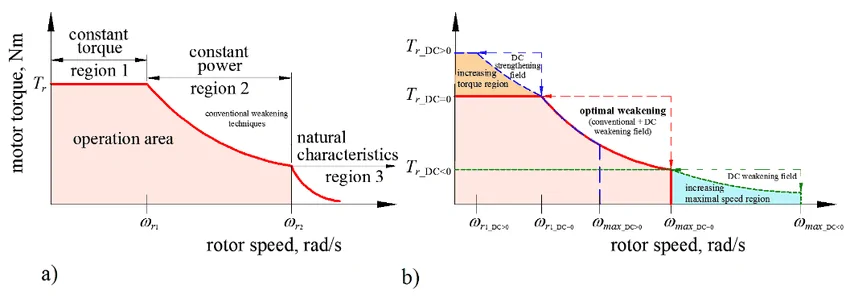
Electric motor torque/HP curves are generic. Peak torque occurs at 0 RPM, but so does peak current load, so all of these motors are current limited in the constant torque region, from 0 RPM to the "torque peak" where current requirements start to fall, along with torque. HP is flat in this region. The challenge is handling the current necessary to produce 94kW. It's a ~211v HVB, so do the math... 94,000/211 = 445 Amps.
Ford Maverick Questions on Hybrid power plant. 1627926063968

Compare the curves and you see that the ICE torque peaks at high RPM, while motor torque peaks at low RPM. That's why the "total" isn't close to the sum of the parts. The specs describe what the control system will provide, not the inherent capability of the combination.
... There are two scenarios.
  • MG2 is the primary power source to final drive. Total system 191hp – MG2 130hp = 61hp. So the max hp can be transfer from ICE to final drive is 61hp. (Max MG1 holding torque)
  • ICE is primary power source to final drive. In this case MG1 holding torque curve become extremally critical because that determines how much power can be deliver to final drive. ...
There are four operating modes. EV, Series, Parallel and Negative split. Scenarios above both sound like parallel mode.
- EV is obvious. Motor runs on battery with ICE off.
- In series mode, the ICE generates electricity through the charging motor, and that power drives the car. Think new CR-V at low speed.
- In parallel mode, both ICE and the driving motor provide torque.
- Negative Split is neat, because it uses the charging motor to slow the ICE when HVB is full (no charging load) and terrain is flat (small driving load). This is a terrain-dependent mode that gives great mileage while retaining HVB charge.

Power numbers for motors come from current use (P=IV) and are easily converted to HP (1HP = 0.75kW).

If you think the final drive ratio is high, consider that the hybrid's final drive ratio is about 6th gear of your 8-speed transmission. It's the Ecoboost engines that get the poor towing ratio in top gear. Plus, you have to downshift the 8-speed to get more engine RPM. Hybrids do this real-time.
And I don't understand the 2.91 ratio on a eCVT. Is that the ratio when MG1 spin at the same speed as ICE? I believe on HF35 MG1 speed is 3X ICE when vehicle not moving.
Which one do you call MG1? Toyota's nomenclature is not clear.

The driving motor is geared to the wheels at a 2.91 : 1 ratio. That's one reason for the top speed limit. When the vehicle is not moving, neither is this motor. No idea what the HF35 reference means, but if the ICE runs when stopped, you'd expect it's generating electricity....
 
OP
OP

brictor

2.5L Hybrid
Member
First Name
brictor
Joined
Jul 16, 2021
Threads
1
Messages
12
Reaction score
7
Location
Michigan
Vehicle(s)
22 Maverick
Engine
2.5L Hybrid
Thank you Frank for the info much appreciated.

Which one do you call MG1?
I mean the starter generator motor.

No idea what the HF35 reference means
I refer to the Ford 3rd generation eCVT with driving motor geared to the wheels at 10.3:1 ratio.
 

fbov

Well-known member
First Name
Frank
Joined
Jun 28, 2021
Threads
0
Messages
452
Reaction score
502
Location
Bushnell's Basin
Vehicle(s)
2020 Escape Hybrid
Sorry, compounded confusion on my part.

The HF35 internal ratios are well documented in the Weber State videos linked by several folks. Do I understand that the 10.3 : 1 ratio is combining final drive with one of the planetary gearset ratios? If so, it's a tooth-count ratio, not a speed ratio, and so irrelevant. Tooth-count ratios never change. Speed ratios change all over the map, as if the transmission were changing gears, but gear ratios never change.
 
Last edited:
Sponsored
OP
OP

brictor

2.5L Hybrid
Member
First Name
brictor
Joined
Jul 16, 2021
Threads
1
Messages
12
Reaction score
7
Location
Michigan
Vehicle(s)
22 Maverick
Engine
2.5L Hybrid
Not counting the planetary gearset. Planetary gearset only transfer power from ICE to wheel / driving motor.
 

vap0rtranz

2.5L Hybrid
Well-known member
First Name
JP
Joined
Jul 28, 2021
Threads
6
Messages
349
Reaction score
464
Location
Wisconsin
Vehicle(s)
'22 Mav Hybrid XLT, '17 Chevy Colo Z71 diesel
Engine
2.5L Hybrid
Electric motor torque/HP curves are generic. Peak torque occurs at 0 RPM, but so does peak current load, so all of these motors are current limited in the constant torque region, from 0 RPM to the "torque peak" where current requirements start to fall, along with torque. HP is flat in this region. The challenge is handling the current necessary to produce 94kW. It's a ~211v HVB, so do the math... 94,000/211 = 445 Amps.
Can this be stickied? :) I've heard this elsewhere but poorly described. You describe it much better, so thank you!
 

fbov

Well-known member
First Name
Frank
Joined
Jun 28, 2021
Threads
0
Messages
452
Reaction score
502
Location
Bushnell's Basin
Vehicle(s)
2020 Escape Hybrid
Not counting the planetary gearset. Planetary gearset only transfer power from ICE to wheel / driving motor.
You're not thinking like a PSD gearset. It can transfer engine power to either the wheels (parallel), or to the charging motor (series mode).

These are AC synchronous motors. RPM is controlled by AC frequency, independent of torque. They turn both ways, and can deplete or charge the HVB in either direction at any speed not near zero. The real magic of a PSD hybrid is in the control system.
Sponsored


Top