
Sponsored

AVC

2.5L Hybrid
Well-known member
Joined
Feb 27, 2024
Threads
5
Messages
230
Reaction score
189
Location
North Texas
Vehicle(s)
'23 Maverick Hybrid XLT, '02 Ranger, '20 Pilot
Engine
2.5L Hybrid
It doesn't look rendered, given the faint reflected images, and in any case, the calibration markings must have been considered in prototypes--again assuming that no other Ford has this exact same dash config-- before settling on % for production.

Given that, it is reasonable to suspect the Maverick power meter may represent some algorithm of combined torque and horsepower, representing an equiv kw of output. It is unlikely representing both peak or average power in absolute metrics, when, for example, the meter remains pegged at 100%. In other words, the meter is likely highly manipulated and at best a relative indicator.

Some dyno runs would clarify what the actual wheel torgue and derived horsepower are, as compared to the power meter. Surprised no one has done that in 4 model years.
Sponsored


 
OP
OP
The Real Maverick

The Real Maverick

2.5L Hybrid
Banned
Banned
First Name
Jack
Joined
Jan 13, 2024
Threads
31
Messages
2,999
Reaction score
4,143
Location
USA
Vehicle(s)
Maverick Hybrid
Engine
2.5L Hybrid
Given that, it is reasonable to suspect the Maverick power meter may represent some algorithm of combined torque and horsepower, representing an equiv kw of output. It is unlikely representing both peak or average power in absolute metrics, when the meter remains pegged at 100%. In other words, the meter is likely highly manipulated and at best a relative indicator.

Some dyno runs would clarify what the actual wheel torgue and derived horsepower are, as compared to the power meter. Surprised no one has done that in 4 model years.
At 100% (briefly) I got 191.8 HP via OBDII.

It's a bit erratic in the 0-20% range but fairly linear after, that I have seen.

But your point is well taken. It is a needle but digitally driven. Not measuring any physical element.

The temperature gauge is the same way. Does not move at all until 120°F.
Then moves in a linear fashion to 180°F then does not move at all until at least 225°F then jumps all at once to the hot zone after a threshold or trouble code is triggered.
 
Last edited:
  • Like
Reactions: AVC
OP
OP
The Real Maverick

The Real Maverick

2.5L Hybrid
Banned
Banned
First Name
Jack
Joined
Jan 13, 2024
Threads
31
Messages
2,999
Reaction score
4,143
Location
USA
Vehicle(s)
Maverick Hybrid
Engine
2.5L Hybrid
FYI "Peak" torque in the hybrid is about the same as the EcoBoost but is only available at lower speeds and with a well charged battery. Ford published what the engine torque is.

(Combined engine + electric torque can be 245 lb-ft for short durations.)
 
Last edited:

HeyBales

2.5L Hybrid
Well-known member
First Name
Mike
Joined
May 3, 2024
Threads
4
Messages
4,917
Reaction score
4,500
Location
KC Metro area
Vehicle(s)
2005 Toyota RAV4, 2024 XLT Hybrid
Engine
2.5L Hybrid
You have discovered on your own a special operating str described elsewhere as "leaving home" or "leaving the mall" mode.

In RARE situations you get more EV amps:

ONLY before the first engine on of a fresh drive cycle and

ONLY if the HV battery is above ~65%.

Seems the truck really does not want to keep a higher than 65% charge so uses power twice as fast (presumably up to ~72 Amps) until HV battery drops below 65%. Ish. I've only seen this a few times.

So leaving home, (or leaving the mall) BEFORE the first engine kick-on, you get great EV power, but for a very short time... seconds.... not even a full minute.
It will then taper.... 50A 40A, etc. as you witness the blue bar shrink.

The blue bar in EV coach DOES indicate how many amps you can pull.

I'll calibrate that next. 😎
This is why I'm wondering if there is a different trans scheme on 24MY.
Because what I'm seeing doesn't match up at all with what you say the limits or max are of usage. Which is why the 6 gauge wire comment caught my attention initially since it seems more than 36 going across it.

Last night coming home (so warmed up and engine on several times) I have a gentle 1/2 mile uphill 30 mph on back street - so tad more staring at a gauge possible - was able to hold steady at 48A almost the entire way except for flatter spot that didn't need that much power, and was not at the top of blue bar. Almost made it over the steep section for my turn down the hill like normal but engine kicked on when I didn't back off enough.

Today watched gauge a tad more on highway section - 62-65 A steady as SOC lowered before I hit rise - then engine kicked on. Perhaps not a minute but felt longer, but much more than seconds.

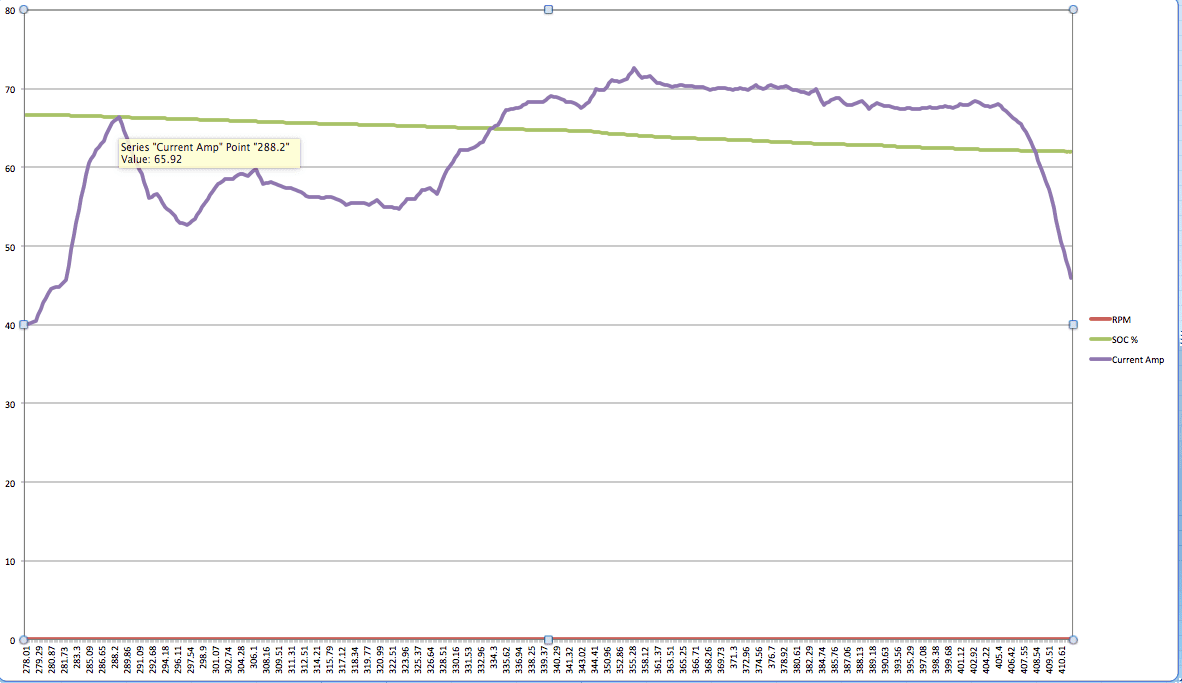
I've got the CSV data from my initial curiosity couple days ago from using Forescan Lite and saving the data.

I almost never can be watching the gauges and power meter at the same time, but the EV only mode is simple because of always being below the 1st tick.
Since that is said to be 19.1 HP combined, or 14.24 kW - curious why that wouldn't apply to motor/battery only. Isn't the system 220V abouts, wouldn't that cover the same 19.1 HP on 1st tick?

Just glancing thru the CSV data for a section on highway:
For 133 second block:
RPM 0.
Took a section with SOC starting 66.71 ending 61.99 A.
BATCURBECM PID used - showing 40 A.
Within 7 sec up to 60 and holding above 50 thereafter, before finally hitting 72.58 within a range of 70's for 28.74 seconds.
Then backing down to 60's for awhile and then 50's and finally 45A I stopped the section.

See if this section graphs nicely.

I'm going to add the HP PID to the mix next, and speed so I can discern highway or hill area.

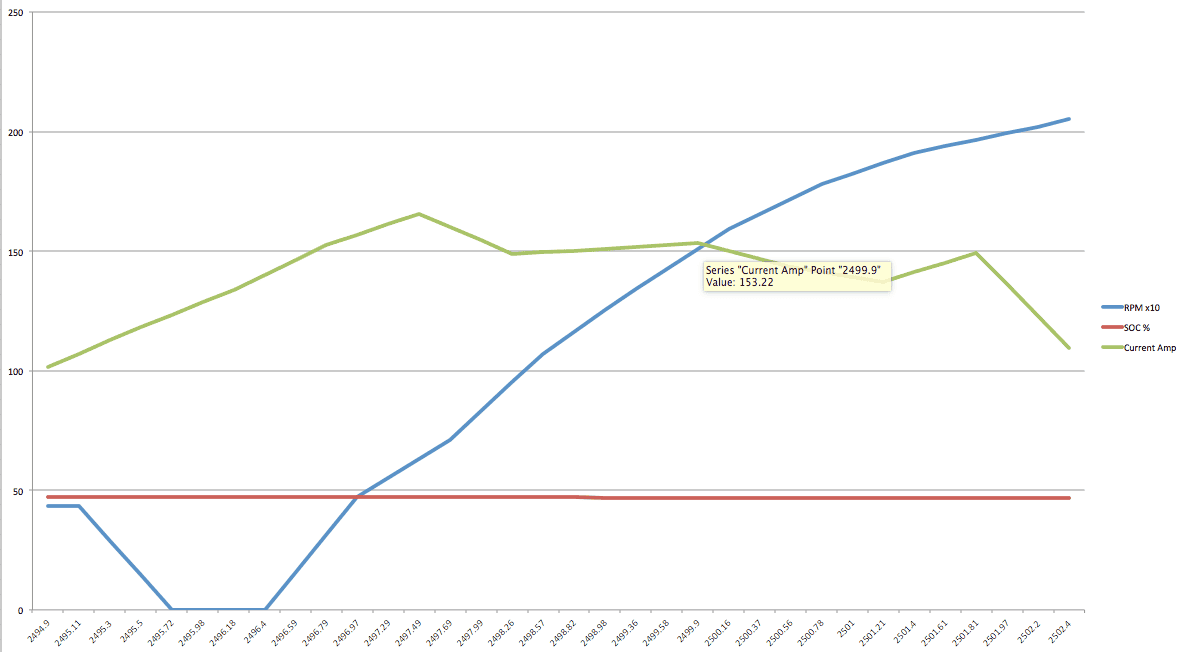
Curious too on a whole section of 53 seconds with engine running that the Battery Current is over 100 A. Not negative as in charging, positive. Goes over 150 A too.
If there is a 6 gauge wire limit to amount of amps going to the battery, I don't see how that is possible.
Unless that sensor is before hitting the wire back to battery and being bled off somewhere, but then calling the PID battery current doesn't make sense.
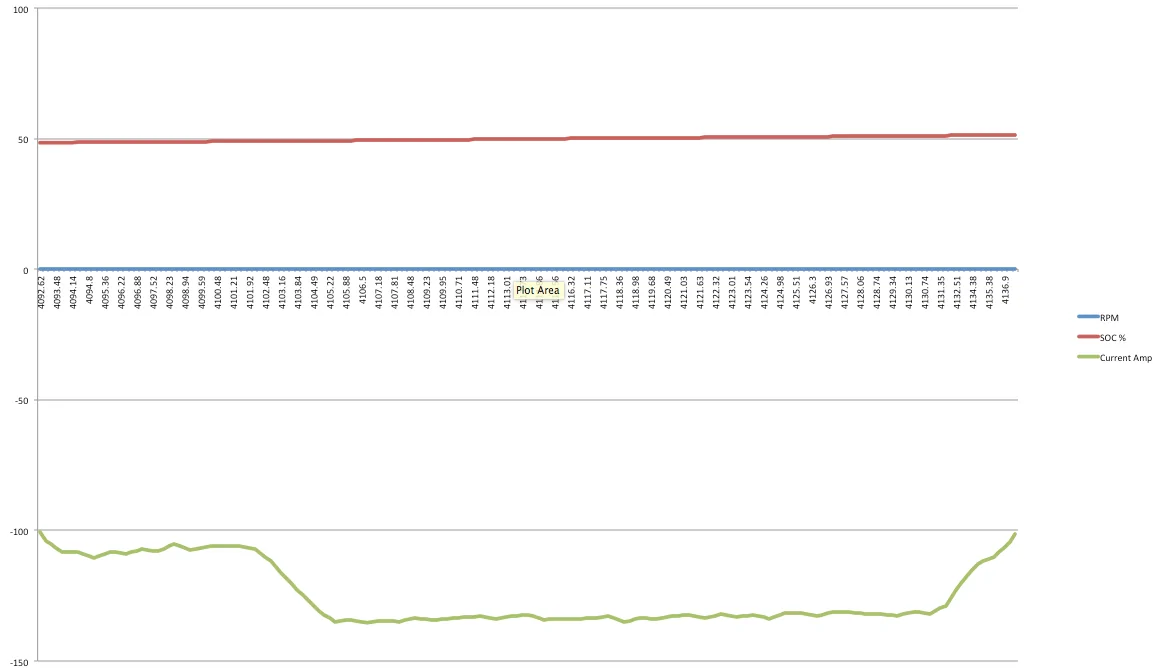
Then my recharging side of gauge hitting -135 A, albeit for brief moments of time, well above the 72A max shown.

Anyway - in my search for meaning on the power meter I'd already been seeing some things and formulating some ideas and then caught this post.
But enough didn't match my observation already I'm logging now.

Ford Maverick Hybrid Power Meter Calibrated Screen Shot 2024-05-30 at 1.59.09 PM
 
OP
OP
The Real Maverick

The Real Maverick

2.5L Hybrid
Banned
Banned
First Name
Jack
Joined
Jan 13, 2024
Threads
31
Messages
2,999
Reaction score
4,143
Location
USA
Vehicle(s)
Maverick Hybrid
Engine
2.5L Hybrid
This is why I'm wondering if there is a different trans scheme on 24MY.
Because what I'm seeing doesn't match up at all with what you say the limits or max are of usage. Which is why the 6 gauge wire comment caught my attention initially since it seems more than 36 going across it.

Last night coming home (so warmed up and engine on several times) I have a gentle 1/2 mile uphill 30 mph on back street - so tad more staring at a gauge possible - was able to hold steady at 48A almost the entire way except for flatter spot that didn't need that much power, and was not at the top of blue bar. Almost made it over the steep section for my turn down the hill like normal but engine kicked on when I didn't back off enough.

Today watched gauge a tad more on highway section - 62-65 A steady as SOC lowered before I hit rise - then engine kicked on. Perhaps not a minute but felt longer, but much more than seconds.

I've got the CSV data from my initial curiosity couple days ago from using Forescan Lite and saving the data.

I almost never can be watching the gauges and power meter at the same time, but the EV only mode is simple because of always being below the 1st tick.
Since that is said to be 19.1 HP combined, or 14.24 kW - curious why that wouldn't apply to motor/battery only. Isn't the system 220V abouts, wouldn't that cover the same 19.1 HP on 1st tick?

Just glancing thru the CSV data for a section on highway:
For 133 second block:
RPM 0.
Took a section with SOC starting 66.71 ending 61.99 A.
BATCURBECM PID used - showing 40 A.
Within 7 sec up to 60 and holding above 50 thereafter, before finally hitting 72.58 within a range of 70's for 28.74 seconds.
Then backing down to 60's for awhile and then 50's and finally 45A I stopped the section.

See if this section graphs nicely.

I'm going to add the HP PID to the mix next, and speed so I can discern highway or hill area.

Curious too on a whole section of 53 seconds with engine running that the Battery Current is over 100 A. Not negative as in charging, positive. Goes over 150 A too.
If there is a 6 gauge wire limit to amount of amps going to the battery, I don't see how that is possible.
Unless that sensor is before hitting the wire back to battery and being bled off somewhere, but then calling the PID battery current doesn't make sense.
Then my recharging side of gauge hitting -135 A, albeit for brief moments of time, well above the 72A max shown.

Anyway - in my search for meaning on the power boost I'd already been seeing some things and formulating some ideas and then caught this post.
But enough didn't match my observation already I'm logging now.

Screen Shot 2024-05-30 at 1.59.09 PM.png
I'm very interested in your data.
I have seen what you are seeing but only on the fresh start before the engine comes on.
 
Last edited:

Sponsored

OP
OP
The Real Maverick

The Real Maverick

2.5L Hybrid
Banned
Banned
First Name
Jack
Joined
Jan 13, 2024
Threads
31
Messages
2,999
Reaction score
4,143
Location
USA
Vehicle(s)
Maverick Hybrid
Engine
2.5L Hybrid
This is why I'm wondering if there is a different trans scheme on 24MY.
Because what I'm seeing doesn't match up at all with what you say the limits or max are of usage. Which is why the 6 gauge wire comment caught my attention initially since it seems more than 36 going across it.

Last night coming home (so warmed up and engine on several times) I have a gentle 1/2 mile uphill 30 mph on back street - so tad more staring at a gauge possible - was able to hold steady at 48A almost the entire way except for flatter spot that didn't need that much power, and was not at the top of blue bar. Almost made it over the steep section for my turn down the hill like normal but engine kicked on when I didn't back off enough.

Today watched gauge a tad more on highway section - 62-65 A steady as SOC lowered before I hit rise - then engine kicked on. Perhaps not a minute but felt longer, but much more than seconds.

I've got the CSV data from my initial curiosity couple days ago from using Forescan Lite and saving the data.

I almost never can be watching the gauges and power meter at the same time, but the EV only mode is simple because of always being below the 1st tick.
Since that is said to be 19.1 HP combined, or 14.24 kW - curious why that wouldn't apply to motor/battery only. Isn't the system 220V abouts, wouldn't that cover the same 19.1 HP on 1st tick?

Just glancing thru the CSV data for a section on highway:
For 133 second block:
RPM 0.
Took a section with SOC starting 66.71 ending 61.99 A.
BATCURBECM PID used - showing 40 A.
Within 7 sec up to 60 and holding above 50 thereafter, before finally hitting 72.58 within a range of 70's for 28.74 seconds.
Then backing down to 60's for awhile and then 50's and finally 45A I stopped the section.

See if this section graphs nicely.

I'm going to add the HP PID to the mix next, and speed so I can discern highway or hill area.

Curious too on a whole section of 53 seconds with engine running that the Battery Current is over 100 A. Not negative as in charging, positive. Goes over 150 A too.
If there is a 6 gauge wire limit to amount of amps going to the battery, I don't see how that is possible.
Unless that sensor is before hitting the wire back to battery and being bled off somewhere, but then calling the PID battery current doesn't make sense.
Then my recharging side of gauge hitting -135 A, albeit for brief moments of time, well above the 72A max shown.

Anyway - in my search for meaning on the power meter I'd already been seeing some things and formulating some ideas and then caught this post.
But enough didn't match my observation already I'm logging now.

Screen Shot 2024-05-30 at 1.59.09 PM.png
After thinking about this for a while, everything you said sounds like mine if you divide by 2.

I think your software (app) is showing 2x (200%) of real battery amps.

The raw data the truck is transmitting is in hexadecimal. The software (app) you are using to record and display the data mathematically converts the hex into any other units useful and legible to the human.

Edit: Or mine is reading 50%.
I think mine was reading 50% scaled. In which case we are in close agreement.
 
Last edited:

Deweyordeweynot

2.5L Hybrid
Well-known member
First Name
Dewey
Joined
May 10, 2023
Threads
32
Messages
585
Reaction score
674
Location
Macomb, MI
Vehicle(s)
2024 XLT Oxford White / 2018 Subaru Forester
Engine
2.5L Hybrid
Clubs
 
All I know is, it's very tricky to keep the ICE from kicking in, and it's always a kick to be on the freeway and see the blue 'electric' text appear at 60mph, no matter how briefly it stays in that mode. I am making half of the fuel stops that I had to make before getting the Maverick, and it's making me think that a EV could be in the driveway in the next handful of years.
 

Automate

2.5L Hybrid
Well-known member
Joined
Jul 21, 2021
Threads
60
Messages
1,798
Reaction score
2,135
Location
Atlanta GA, USA (ATL)
Vehicle(s)
Fusion Hybrid, Mav XL Hybrid
Engine
2.5L Hybrid
Curious too on a whole section of 53 seconds with engine running that the Battery Current is over 100 A. Not negative as in charging, positive. Goes over 150 A too.
Screen Shot 2024-05-30 at 1.59.09 PM.png
Do you have a recording of the amps when the current is over 100A? The graph you posted above never goes above around 72 amps.

You say the engine is running so I'm guess some of the power is coming from generator/motor being turned by the engine and the rest of the power is coming from the battery. The two currents get combined and sent to the traction motor. The #6 wire only has to carry the current from the battery. Not the current from the generator/motor.
 

HeyBales

2.5L Hybrid
Well-known member
First Name
Mike
Joined
May 3, 2024
Threads
4
Messages
4,917
Reaction score
4,500
Location
KC Metro area
Vehicle(s)
2005 Toyota RAV4, 2024 XLT Hybrid
Engine
2.5L Hybrid
Do you have a recording of the amps when the current is over 100A? The graph you posted above never goes above around 72 amps.

You say the engine is running so I'm guess some of the power is coming from generator/motor being turned by the engine and the rest of the power is coming from the battery. The two currents get combined and sent to the traction motor. The #6 wire only has to carry the current from the battery. Not the current from the generator/motor.
I do have that other portion - that was when the engine was running. Different part of description.

The posted graph has the RPM's at the bottom - 0. Engine not running.

But why would a PID which I gave the full name of - be giving a reading of combined amps to the battery if it's really to the motor?
Different PID for motor power I thought - have to look over GPSman's full list of SGIII which I'm using as basis for finding the PID's.
 

HeyBales

2.5L Hybrid
Well-known member
First Name
Mike
Joined
May 3, 2024
Threads
4
Messages
4,917
Reaction score
4,500
Location
KC Metro area
Vehicle(s)
2005 Toyota RAV4, 2024 XLT Hybrid
Engine
2.5L Hybrid
After thinking about this for a while, everything you said sounds like mine if you divide by 2.

I think your software (app) is showing 2x (200%) of real battery amps.

The raw data the truck is transmitting is in hexadecimal. The software (app) you are using to record and display the data mathematically converts the hex into any other units useful and legible to the human.

I suspect, but too soon to prove without being there to trade devices with you, you are seeing 200% (2x multiplication factor).

Which is more likely than you having a different hybrid.
I'm wondering if the 3 phase aspect has something to do with it, since this is from Battery ECM.
And that's actually 3 x the actual value.

I'm going to get another app installed that can use the Vlinker and see what it reports.
I'd be shocked that Forscan wouldn't be using correct conversions for things, but maybe the majority of usage is with the laptop program for making changes & finding values from the systems, not many users of Lite just using as live scan streamer, for bugs to be reported for correction.
 
Sponsored

HeyBales

2.5L Hybrid
Well-known member
First Name
Mike
Joined
May 3, 2024
Threads
4
Messages
4,917
Reaction score
4,500
Location
KC Metro area
Vehicle(s)
2005 Toyota RAV4, 2024 XLT Hybrid
Engine
2.5L Hybrid

HeyBales

2.5L Hybrid
Well-known member
First Name
Mike
Joined
May 3, 2024
Threads
4
Messages
4,917
Reaction score
4,500
Location
KC Metro area
Vehicle(s)
2005 Toyota RAV4, 2024 XLT Hybrid
Engine
2.5L Hybrid
I do have that other portion - that was when the engine was running. Different part of description.

The posted graph has the RPM's at the bottom - 0. Engine not running.

But why would a PID which I gave the full name of - be giving a reading of combined amps to the battery if it's really to the motor?
Different PID for motor power I thought - have to look over GPSman's full list of SGIII which I'm using as basis for finding the PID's.
Here's engine running, well right after it went off and then back on, where it appears 100A and up over 150A for a segment. RPM's divided by 10 to fit better in graph scaling.
Only 8 seconds.

I'm getting different app to confirm some values.

Ford Maverick Hybrid Power Meter Calibrated Screen Shot 2024-05-31 at 10.35.39 AM
 

BAScott62

2.5L Hybrid
Well-known member
First Name
Brian
Joined
Aug 26, 2022
Threads
1
Messages
220
Reaction score
464
Location
Oklahoma City, OK
Vehicle(s)
2022 Maverick Hybrid
Engine
2.5L Hybrid
It's only "trust me, I saw it" but today on an offramp doing around 70, putting it in L (with no one behind me) I saw 3 readings over 100 amps with a max of 138.
 

HeyBales

2.5L Hybrid
Well-known member
First Name
Mike
Joined
May 3, 2024
Threads
4
Messages
4,917
Reaction score
4,500
Location
KC Metro area
Vehicle(s)
2005 Toyota RAV4, 2024 XLT Hybrid
Engine
2.5L Hybrid
I'm curious about the PID values for BECM system HEV Battery Charge Power Limit and Discharge Power Limit.
GPSMan's post about SGIII data mentions the Charge limit, I found that and also displayed the Discharge limit on investigation.

Charge is 32kW (matches his post), Discharge is 27kW.
at 220V avg, that's
148A and 123A.

I don't think the 3-phase aspect of the conversion from DC to AC or back is part of my logged high values, because that conversion happens before the cable to the battery. So my wondering if that's why high values, must not be a reason.

Obviously you don't want to have a system bouncing up against the limits all the time, though I can't find a setting that defines a lower preferred limit where action should occur (like engine brake mode to bleed off excess regen).

Does it take almost 50 sec to max recharge the battery from 30 up to that 70% cutoff?
Or to deplete from 70 to 30% about 1 min at max motor usage?
I think I can time that one.

In my attempts to find better values, I found the HEV Battery current PID under of course the BECM area, also under another section there. Both values the same, though tad delayed on one.
Sort of like RPM's found under 4 different modules, with OBDII and PCM being fastest on updates, 2 other modules not so fast.
Also found the 2 motor sections for torque and RPM, and the current to them.

Still going to find another app for the basic values to compare.
And a better old phone without a worthless battery that must remain plugged in. :idea:


Top