

Sponsored

Cali shifting to 15% ethanol in gas

ZABSMAV

2.5L Hybrid
Well-known member
First Name
Gary
Joined
Mar 7, 2024
Threads
5
Messages
635
Reaction score
692
Location
Utah
Vehicle(s)
2023 Maverick Lariat Hybrid
Engine
2.5L Hybrid
I'm just glad that our county in Utah, nor do most counties here in this state, have emissions testing. Annual safety inspections were also eliminated.
Fun Fact

1990 - Pre ethanol blended fuels
2% of household income was spent on vehicle maintenance and repairs

2004 to 2018 (latest year provided) when 10% ethanol blends become prevalent

1.5% of household income was spent on vehicle maintenance and repairs

Now, it is very hard to prove a cause and effect relationship. Maybe engines just got "better" during this time period.

But, at least there is evidence (not proof) that ethanol did not increase the cost of vehicle maintenance.
That is a poor use of statistics. Pre 1990 vehicles were higher maintenance for a number of factors totally unrelated to the presence of ethanol in the fuel. Those vehicles typically had points and condensers, and spark plug technology that prevented them lasting longer. Also, people tended to keep their vehicles MUCH longer in the past. Cars have, for many, become a disposable commodity, If you keep a vehicle for many years and high miles, it is by nature going to mean a larger percentage going to vehicle maintenance and repairs. Even all said, it likely isn't even a statistically significant change going down slightly from 2% to 1.5% of a households income.

We'll stick to using ethanol-free gasoline in our vehicles as internal combustion engines were designed to use gasoline. Also, we like the 3% boost in miles per gallon that we get versus fuel diluted down with corn alcohol.
Sponsored

 
Last edited:

Mavster Mechanic

2.5L Hybrid
Well-known member
First Name
David
Joined
Jul 29, 2025
Threads
21
Messages
1,788
Reaction score
3,123
Location
USA
Vehicle(s)
Hybrid
Engine
2.5L Hybrid
that programming is adding fuel, and when you were running E50 you were lean, which is a great way to cause detonation.

that's the reason the vehicles aren't flex fuel. it isn't because they don't have the capacity to add more fuel. it's because Ford didn't put a real alcohol sensor in it and program it for flex fuel, as that would cost more money.
It was not running lean.
The code was fuel trim exceeded expectations. Engine was fine. Fuel was able to go above 25% bonus just fine.
 

Mavster Mechanic

2.5L Hybrid
Well-known member
First Name
David
Joined
Jul 29, 2025
Threads
21
Messages
1,788
Reaction score
3,123
Location
USA
Vehicle(s)
Hybrid
Engine
2.5L Hybrid
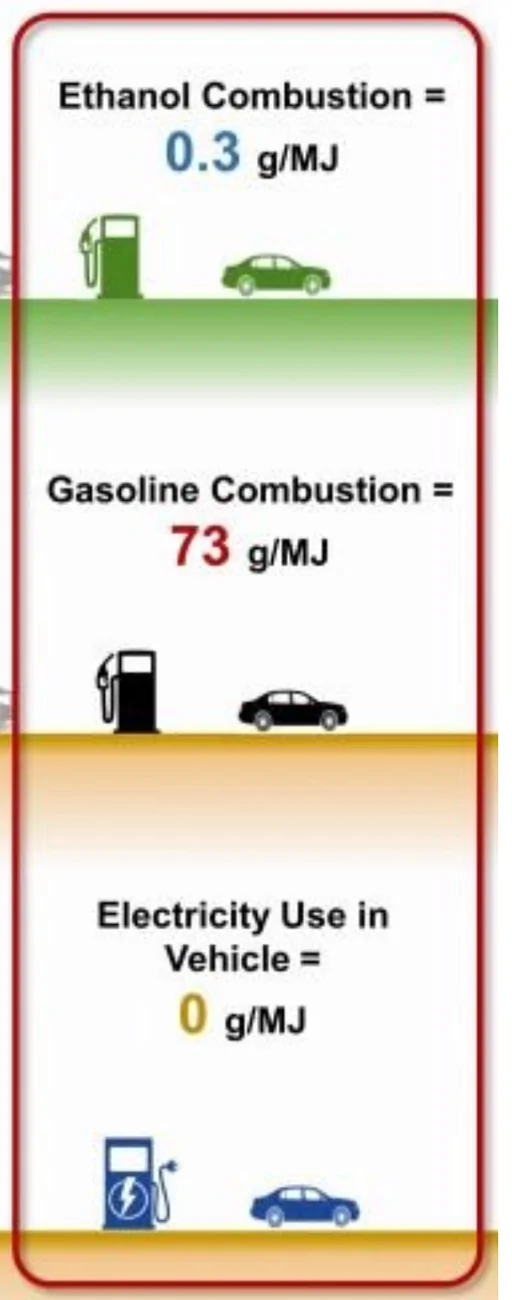
Net Carbon emissions just at the tailpipe:
Ford Maverick Cali shifting to 15% ethanol in gas IMG_5912


Carbon emissions oil well to wheels:
Emits 98.5 grams per MJ or 11.84 kg per gallon of gasoline.

Carbon emissions corn field to wheels:
53.3 grams per MJ or 4.29 kg per gallon of ethanol. Use 33% more to drive the same distance = emit 5.7 kg.

Battery EV can be as low as 1 kg or as high as 10 kg depending on where the electricity comes from.

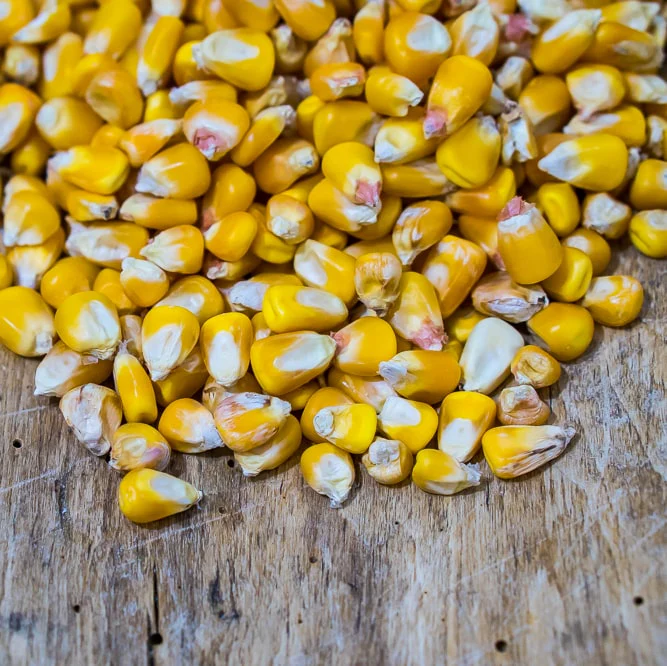
Why does ethanol have a low carbon footprint?

All of this green stuff comes from carbon dioxide removed from the atmosphere. The green stuff does not get burned or converted to ethanol.
Ford Maverick Cali shifting to 15% ethanol in gas IMG_5913


Only the yellow stuff, and only 70% by weight of the yellow stuff gets converted to ethanol. When the ethanol is fermented and then burned, it puts back SOME of the CO2 the growing crops removed.
Ford Maverick Cali shifting to 15% ethanol in gas IMG_5914


Oil refining takes nothing out of the atmosphere, it only adds to it.

Some of the greenery of the corn rots and emits. But not a large fraction.
 

Mavster Mechanic

2.5L Hybrid
Well-known member
First Name
David
Joined
Jul 29, 2025
Threads
21
Messages
1,788
Reaction score
3,123
Location
USA
Vehicle(s)
Hybrid
Engine
2.5L Hybrid
FYI sugar beets are not used because nothing is more efficient and nothing is more cost effective than corn.

Corn kernels are dry, light weight; and almost entirely energy.

Sugar beets are wet. Full of water. Full of fiber. Fiber has little energy. Water has no energy. And all that "dead weight" is expensive to transport.
And because they are moist; they will rot in no time.

Some ethanol is made from wheat, barley, and sorghum in the USA but probably 95% comes from corn.

It is starch, any starch that can be fermented into ethanol. Being a "sweet" crop has nothing to do with it. But of course yeast ferment sugar into ethanol. But starch is one simple step away from sugar. And converting starch to sugar with naturally occurring enzymes is fast, cheap, and efficient at industrial scale.
 

OWP

2.0L EcoBoost
Well-known member
Joined
May 8, 2025
Threads
3
Messages
113
Reaction score
133
Location
Salinas, California
Vehicle(s)
2022 Mav XLT and a bunch of others
Engine
2.0L EcoBoost
Any increase in octane will do that. Also, ethanol absorbs more heat than gas in the evaporation process and burns slower than gasoline as well.
I don't have a boost gauge in mine but did in my F150 3.5 twin and 2.3 Mustang. When running a higher ethanol content, up to 40%, the Mustang woke up phenomenally, buried the boost gauge at 20 psi and took off like a jack rabbit on a date! The F150 normally pushed 13-14 on E10, on E15 it was solidly 15 psi under WOT.
I run E15 in "Bret" most of the time and have never noticed any drop in fuel economy over E10. Happy motoring!
While I'm not a fan of the whole idea for my other cars, I won't complain if my Mav with a Cobb tune automatically gives me extra boost as you describe above.
 

Sponsored

dochawk

2.5L Hybrid
Well-known member
First Name
doc
Joined
Jul 17, 2024
Threads
34
Messages
1,696
Reaction score
1,597
Location
Las Vegas
Vehicle(s)
hybrid '25 lariat, 4 classic Cadillacs, Miata, mustang gt convertible
Engine
2.5L Hybrid
Clubs
 
thing is more efficient and nothing is more cost effective than corn.
that's actually a subject of heated research.

Last I heard, kudzu is potentially significantly more cost efficient than corn for this.

but, for some reason, the idea of farming such a weed at large scale draws heavy opposition . . .

:crazy:

there are other non-food options being considered and evaluated, iirc, but I can't name any.
 

surfstar

2.5L Hybrid
Well-known member
Joined
Feb 7, 2023
Threads
15
Messages
1,129
Reaction score
2,424
Location
CA
Vehicle(s)
2023 XL Hybrid
Engine
2.5L Hybrid
I'm just glad that our county in Utah, nor do most counties here in this state, have emissions testing. Annual safety inspections were also eliminated.
And I'm glad CARB exists and has created standards that have lowered emissions all throughout the nation.
 

Mavster Mechanic

2.5L Hybrid
Well-known member
First Name
David
Joined
Jul 29, 2025
Threads
21
Messages
1,788
Reaction score
3,123
Location
USA
Vehicle(s)
Hybrid
Engine
2.5L Hybrid
there are other non-food options being considered and evaluated, iirc, but I can't name any.
Have you seen the corn sent to ethanol? Probably not.

None of it is human food grade corn.
It is animal feed grade (pigs/cattle) corn. And it is dehydrated field dried corn so it can be stored in silos, for years without rotting. (Well, 2 years anyway.)

And why give sugar and starch to cows? It only makes them hyper(active).

What is done in bulk is win-win.

Take the sugar and starch out of the corn and send high protein and fat feed to cattle. It's partially broken down, easy on the cow's stomach, nutrient rich, calorie dense, and palatable. Cows and farmers love it.

"It" is distiller's grain. And fewer truckloads of it fatten up a herd. It's concentrated animal food.
 
Last edited:

Darryl

2.5L Hybrid
Well-known member
First Name
Darryl
Joined
May 9, 2025
Threads
13
Messages
1,611
Reaction score
3,611
Location
Tallahassee Florida
Vehicle(s)
2025 Maverick XLT HYBRID
Engine
2.5L Hybrid
Clubs
 
CA is in the process of increasing ethanol from 10% to 15% in the fuel mixture sold in the state. Is this a concern if used in the 2.5 hybrid engine in the 2025 Mav. Thanks
No, it's not a concern. Pretty much any engine made after 2,000 can safely use up to 20% ethanol. The fuel economy will be reduced a bit though. Where I live some stations us 15,% most us 10%. I noticed that the fuel economy decreases when 15% is used. It increases with ethanol free gas, but not enough to justify the MUCH higher price,
 

Chico

2.0L EcoBoost
Well-known member
First Name
Jeff
Joined
Feb 22, 2025
Threads
4
Messages
104
Reaction score
195
Location
Chicago Southland
Vehicle(s)
2025 Ford Maverick lariat, 2022 Ford Mustang GT 1980 Shea model A replica
Engine
2.0L EcoBoost
I run E15 in my Maverick, Mustang my 2009 when I had it and my 2022, my 2019 ranger XLT and my dad's Nissan rogue. I have never had any issues with running it at all (E15). We have had E15 Here in Illinois for a while now and if your car is 2001 or newer you can run it. Here in Illinois it's $0.05 cheaper than regular and also here in Illinois it's 88 octane so it's rating between regular at 87 and mid-grade which is 89
 
Sponsored

ZABSMAV

2.5L Hybrid
Well-known member
First Name
Gary
Joined
Mar 7, 2024
Threads
5
Messages
635
Reaction score
692
Location
Utah
Vehicle(s)
2023 Maverick Lariat Hybrid
Engine
2.5L Hybrid
In our state 88 octane ethanol-free Clear Gas is only 15 cents more than 87 octane gas with ethanol. With the additional 3% (and better) MPG from the increased energy potential from non-watered down fuel we are actually saving money and it is better on the vehicle than running a corn-based alcohol mix through the fuel lines.
 

Mavster Mechanic

2.5L Hybrid
Well-known member
First Name
David
Joined
Jul 29, 2025
Threads
21
Messages
1,788
Reaction score
3,123
Location
USA
Vehicle(s)
Hybrid
Engine
2.5L Hybrid
In our state 88 octane ethanol-free Clear Gas is only 15 cents more than 87 octane gas with ethanol. With the additional 3% (and better) MPG from the increased energy potential from non-watered down fuel we are actually saving money and it is better on the vehicle than running a corn-based alcohol mix through the fuel lines.
Curious what makes you say "it's better on the vehicle than alcohol mix".

The alcohol mix prevents water build up with regular use.

The alcohol is a great solvent, a great cleaner, and keeps all internal engine components clean with regular use.

Problems may arise only when adding ethanol to an already (older) and gummed up fuel system. If too much "junk" is loosened all at once, solids may clog some fuel delivery components.

If ethanol is used for the life of the vehicle, you will never have such issues as there will be no deposits in the first place.
 

Phimosis

2.0L EcoBoost
Well-known member
First Name
Larry
Joined
Jul 18, 2024
Threads
2
Messages
1,180
Reaction score
1,520
Location
Santa Clarita, CA
Vehicle(s)
2024 Maverick Lariat FX4 4K tow
Engine
2.0L EcoBoost
California law requires use of a “winter fuel” every year. Begins in November every year. Not sure what changes in the fuel..,
Winter blend has a higher butane content. Butane has a boiling point of 31.1 F. At low temps it will stay dissolved in gasoline, kind of like C02 in a soda can in your fridge, but spray the gasoline into an intake port or directly into the cylinder and the butane instantly becomes a gas. This higher vapor pressure ensures trouble free cold starts.

Butane is cheaper than the other primary alkanes in gasoline; pentane, hexane, heptane and octane. Using more butane saves money in the manufacturing process, but it doesn’t work well in high temps. Kind of like a soda at 90 degrees, all of the CO2 will gas off, leaving the soda flat.

The next part not directed at you, but all of the commenters talking about the pros and cons of ethanol. The ethanol is added as an oxidizer. Gasoline never completely and cleanly combusts into C02 and water. Oxygenating gasoline leads to more complete combustion, with less unburnt hydrocarbons and less carbon monoxide.

Because of SoCal’s unique geography, with a low lying basin abutting a continuous wall of 6,000-10,000 ft mountains and relatively gentle onshore breezes that aren’t strong enough to push the urban air pollution out, SoCal has the worst air pollution in the US.

So they needed to take action to clean up their air. In the 70’s they started using MTBE as an oxygenate, but it has its own raft of problems related to its toxicity, industrial pollution and ground water contamination.

In the early 2000’s, the era of MBTE wound down and ethanol was the next logical choice for reducing air pollution.

Whether it’s the right choice to force everyone in the US to use it, is a whole different topic.

But for SoCal, it 100% makes sense.

And since 2/3 of California’s population lives in SoCal, it made more sense to implement it state wide, rather than having regional gasoline rules.

So even if it takes 40,000 BTU input energy to make a gallon of ethanol, that only contains 76,000 BTU of energy, it is still worth the cost/effort of using ethanol in high air pollution areas.
Sponsored


Top