

Sponsored

3000 watt Inverter

Mavster Mechanic

2.5L Hybrid
Well-known member
First Name
David
Joined
Jul 29, 2025
Threads
20
Messages
1,672
Reaction score
2,928
Location
USA
Vehicle(s)
Hybrid
Engine
2.5L Hybrid
I have no idea why this thread just popped up in my MTC forum GUI/menu, but I feel I should delayed-chime in...

The anecdotal recommended max to pull off a hybrid 12V circuit (e.g., the battery under the rear seat) is 30A. Above that you can run into issues with the DC-DC high-voltage BMS.

12V x 30A = 360W, said and done.

I've been looking at an electrical design for my pop-up Oru camper with inverter for the single burner inductive cooktop, microwave, and 4gal Bosch water heater (and only running one of them at a time, while allowing smaller other stuff like TV and soundbar).

I want a 3kW inverter. But the only rational way to do that is with a battery system (320Ah in my case, 600W solar - 200W on the roof and 400W suitcase array - and a 30A DC-DC charger to pull from the alternator while the engine is running. You need a _lot_ more current from that than the stock Mav 12V system can provide (driving or idle). Add 30A 120AC for shore power and you've got kind of the minimal fully functional Mav camper system.

So for just a straight little inverter box plugged into the Mav battery, it's 360-400W. The same holds for the native AC outlets (and including the 12V battery tap) as a total system load.
Sorry.
I think you are mistaken.
Not sure where you got that 30A number. You're the first.

Hundreds of posts state 265A.

I pull 30A through my 7-pin trailer plug alone. That's probably what you are thinking of.

Yes you will need to tap the battery directly and use Jumbo size wire.

Best of luck.
Sponsored
 

kidshelleen

2.5L Hybrid
Well-known member
First Name
Sam
Joined
Oct 5, 2025
Threads
3
Messages
96
Reaction score
68
Location
02830
Vehicle(s)
'02 Cape Horn 17', '18 Prius Prime, '90 Miata, '25 Mav Lariat hybrid/AWD/4K
Engine
2.5L Hybrid
...and I just read a few posts that I hadn't seen. The idea that you could pull 167 12V Amps (2000W) continuously from the hybrid Mav 12V source just is not realistic (to use a mild term).

Please remember (for those who should know, and those who haven't learned it) that P=IV, or more clearly Wattage = Voltage x Amperage, is the operative formula.

An inverter is rated in W output, so 2000W (nominally 15A AC output) requires 167A input at 12V. The DC-DC converter providing 12V from the high-voltage battery in the Mav and its battery management system can't deal with that much 12V current output, certainly for more than a transient peak. You need a battery system to buffer it, and some way to bring in the power to keep the system functional (solar or shore power/transfer switch).
 

kidshelleen

2.5L Hybrid
Well-known member
First Name
Sam
Joined
Oct 5, 2025
Threads
3
Messages
96
Reaction score
68
Location
02830
Vehicle(s)
'02 Cape Horn 17', '18 Prius Prime, '90 Miata, '25 Mav Lariat hybrid/AWD/4K
Engine
2.5L Hybrid
Sorry.
I think you are mistaken.
Not sure where you got that 30A number. You're the first.

Hundreds of posts state 265A.
...please do provide one or two that sound remotely credible....
 

kidshelleen

2.5L Hybrid
Well-known member
First Name
Sam
Joined
Oct 5, 2025
Threads
3
Messages
96
Reaction score
68
Location
02830
Vehicle(s)
'02 Cape Horn 17', '18 Prius Prime, '90 Miata, '25 Mav Lariat hybrid/AWD/4K
Engine
2.5L Hybrid
...please do provide one or two that sound remotely credible....
That's more the range of a Transit van with the dual-alternator option.
 

Sponsored

kidshelleen

2.5L Hybrid
Well-known member
First Name
Sam
Joined
Oct 5, 2025
Threads
3
Messages
96
Reaction score
68
Location
02830
Vehicle(s)
'02 Cape Horn 17', '18 Prius Prime, '90 Miata, '25 Mav Lariat hybrid/AWD/4K
Engine
2.5L Hybrid

kidshelleen

2.5L Hybrid
Well-known member
First Name
Sam
Joined
Oct 5, 2025
Threads
3
Messages
96
Reaction score
68
Location
02830
Vehicle(s)
'02 Cape Horn 17', '18 Prius Prime, '90 Miata, '25 Mav Lariat hybrid/AWD/4K
Engine
2.5L Hybrid
The alternator in the Hybrid Maverick is massive.

You must have just got yours? And not read up on it yet.
I think you're conflating the alternator, the high-voltage battery capacity, and the DC-DC power supply that supplies the 12V battery from the high-voltage battery system. The generator in the hybrid doesn't supply the 12V system directly. The 12V system/battery is supplied by the DC-DC converter.
 

kidshelleen

2.5L Hybrid
Well-known member
First Name
Sam
Joined
Oct 5, 2025
Threads
3
Messages
96
Reaction score
68
Location
02830
Vehicle(s)
'02 Cape Horn 17', '18 Prius Prime, '90 Miata, '25 Mav Lariat hybrid/AWD/4K
Engine
2.5L Hybrid
I think you're conflating the alternator, the high-voltage battery capacity, and the DC-DC power supply that supplies the 12V battery from the high-voltage battery system. The generator in the hybrid doesn't supply the 12V system directly. The 12V system/battery is supplied by the DC-DC converter.
And I misspoke. The hybrid doesn't actually have an alternator. It's a generator system that feeds the high-voltage battery (a technical distinction worth noting). What limits the 12V draw is the DC-DC converter between the high-voltage and 12V system.
 

Mavster Mechanic

2.5L Hybrid
Well-known member
First Name
David
Joined
Jul 29, 2025
Threads
20
Messages
1,672
Reaction score
2,928
Location
USA
Vehicle(s)
Hybrid
Engine
2.5L Hybrid
The key has to be to run.
The system can pull up to 265 amps and the 220v battery will supply the DC-DC converter which will provide the 265A at about 14.x volts.

Once battery charge drops to 30% the gas engine will turn on and refill the battery at a rate of up to 32,000 watts.

A 3,000 watt inverter is child's play.

Have a good one.
 

Mavster Mechanic

2.5L Hybrid
Well-known member
First Name
David
Joined
Jul 29, 2025
Threads
20
Messages
1,672
Reaction score
2,928
Location
USA
Vehicle(s)
Hybrid
Engine
2.5L Hybrid
The Hybrid has TWO alternators.

There is a massive rectifier/inverter to convert it to DC for battery charging.

Your wheels turn with alternating current. Your regen is alternating current.

Cheers!
 
Sponsored

kidshelleen

2.5L Hybrid
Well-known member
First Name
Sam
Joined
Oct 5, 2025
Threads
3
Messages
96
Reaction score
68
Location
02830
Vehicle(s)
'02 Cape Horn 17', '18 Prius Prime, '90 Miata, '25 Mav Lariat hybrid/AWD/4K
Engine
2.5L Hybrid
Please provide a URL link(s) to the documentation from which you draw your assertions. I'll dig up mine...
 

Mavster Mechanic

2.5L Hybrid
Well-known member
First Name
David
Joined
Jul 29, 2025
Threads
20
Messages
1,672
Reaction score
2,928
Location
USA
Vehicle(s)
Hybrid
Engine
2.5L Hybrid
I know how it works.

I do not think you should max out the system. Stuff is bound to get hot.

But 3000 watts is 10% of max rating for the HV battery charging.

DC-DC output of 265A x 14v = 3710 watts. 3000 watt camper inverter should be considered the maximum feasible.

Have a good night.

Just illustrating the gas engine can refill the HV battery 10x faster than you can drain it with your camping inverter.
 
Last edited:

kidshelleen

2.5L Hybrid
Well-known member
First Name
Sam
Joined
Oct 5, 2025
Threads
3
Messages
96
Reaction score
68
Location
02830
Vehicle(s)
'02 Cape Horn 17', '18 Prius Prime, '90 Miata, '25 Mav Lariat hybrid/AWD/4K
Engine
2.5L Hybrid
So... here's a Google AI summary, which is more succint than I could do in a few minutes....


This detailed breakdown of the 2025 Ford Maverick Hybrid's electrical systems places a specific emphasis on the constraints of adding owner-installed aftermarket accessories.

1. The High-Voltage (HV) Traction System
The High-Voltage system is the "power plant" of the vehicle's electrical architecture. Unlike a traditional gas vehicle where the engine spins an alternator, the HV battery is the sole source of electricity creation and storage for the vehicle's heavy lifting.

  • Chemistry & Capacity: Liquid-cooled Lithium-Ion battery, approximately 1.1 kWh capacity.
  • Voltage: Nominal voltage is approximately 250V–300V DC.
  • Location: Packaged beneath the vehicle cabin on the passenger side (below the rear seat area).
  • Primary Roles:
    1. Propulsion: Powers the electric traction motor.
    2. Starting: There is no traditional 12V starter. The HV battery spins the internal combustion engine (ICE) via the eCVT transmission to start it.


    3. 12V Charging: It feeds the DC-DC converter to maintain the 12V system.

2. The 12V Low-Voltage System
The 12V system in the Maverick Hybrid behaves differently than in a standard gas truck. It is vital to understand that the 12V battery is not used to start the engine. Its only jobs are to boot up the computers (ECUs) and close the high-voltage contactors (relays) that turn on the main battery.

  • Battery Type: AGM (Absorbent Glass Mat). (Note: Earlier Maverick model years often used Flooded Lead Acid, but 2025 models generally see the upgrade to AGM for better stability).


  • Location: Under the rear passenger-side seat bench.


  • Charging Source: No Alternator. The 12V battery is charged solely by a DC-DC Converter which steps down high voltage to ~13.5V–15.0V.

3. DC-DC Converter & Accessory Limitations
This is the critical section for owner-installed circuits (amplifiers, lights, winches, inverters).

The "Alternator" is a Computer
In a standard truck, if you draw too much power, the engine rpm might drop or the lights dim. In the Maverick Hybrid, the power comes from a solid-state DC-DC converter.


  • Total Output Rating: The converter is rated for approximately 165A – 265A (peak) depending on the specific part revision and temperature.
  • Vehicle Overhead: The truck itself consumes a massive amount of this capacity. Electric power steering, brake boosters, cooling fans, and infotainment can consume 100A+ easily.
Critical Limitations for Aftermarket Circuits
When adding accessories, you must adhere to three strict rules to avoid triggering "Deep Sleep" modes, dead batteries, or voiding warranties.

Rule 1: The "Safe" Continuous Draw Limit (30A–50A)

While the converter is powerful, the overhead available for aftermarket parts is limited.

  • Safe Limit: It is generally recommended to keep continuous aftermarket draw under 30A (approx. 400 Watts).
  • Why: If you draw more than the DC-DC converter can supply plus what the vehicle needs, the system will not "bog down"—it will pull the deficit from the small 12V AGM battery. Since the 12V battery is small, it will drain rapidly, potentially causing the vehicle to shut down or throw "Stop Safely Now" codes while driving.
Rule 2: The BMS Sensor (The #1 Failure Point)

This is the most common mistake Maverick owners make.

  • The Problem: The 12V battery negative terminal has a Battery Management System (BMS) sensor directly on the clamp. This sensor tells the truck exactly how much energy goes in and out of the battery.
  • The Limitation: You MUST NOT connect your accessory's negative (ground) wire directly to the 12V battery negative post.
  • The Consequence: If you wire directly to the negative post, the current bypasses the BMS sensor. The truck's computer will not "see" the power drain. It will think the battery is full when it is actually empty, or it will detect a voltage drop it can't explain. This leads to the truck entering "Deep Sleep" mode, disabling remote start, keyless entry, and eventually failing to start.
  • The Solution: Always connect your accessory ground to the chassis body ground point located typically near the battery on the vehicle frame. This ensures the current flows through the BMS sensor so the computer can compensate for the load.
Rule 3: Vehicle State Requirement

  • Engine Off: You have extremely limited power. The 12V battery has very little reserve capacity (often roughly 45–60 Amp-hours). Running a fridge or inverter with the truck off will kill it in 30–60 minutes.
  • Engine "Ready": To run high-power accessories (like a 1000W inverter), the truck must be in "Ready" mode (green car icon on dash). In this state, the HV battery will recharge the 12V system continuously. The gas engine will cycle on and off automatically to keep the HV battery charged.

Summary of Connection Points
Connection TypeMaximum AmperageConnection LocationNotes
FlexBed Pigtails20A (combined)Bed storage cubbies (rear)This is the only official "Ford Sanctioned" connection. It is fuse-protected and timed (cuts off after engine shutdown).
Direct Battery~30-50A (rec.)Positive: Battery Post
Negative: CHASSIS GROUND
CRITICAL: Do not connect negative to battery post. Must use chassis ground. Fusing is mandatory within 6 inches of the connection.
Cigarette Lighter10-15ACabin / DashGood for small chargers only.
 

kidshelleen

2.5L Hybrid
Well-known member
First Name
Sam
Joined
Oct 5, 2025
Threads
3
Messages
96
Reaction score
68
Location
02830
Vehicle(s)
'02 Cape Horn 17', '18 Prius Prime, '90 Miata, '25 Mav Lariat hybrid/AWD/4K
Engine
2.5L Hybrid
...and I've been doing this stuff for 50 years professionally, and 10yrs before that learning stuff on the farm where I grew up. And I know how to use modern tools to analyze documentation and not make naive mistakes.
 

JJTech

2.5L Hybrid
Well-known member
First Name
James
Joined
Mar 15, 2025
Threads
9
Messages
69
Reaction score
112
Location
Pennsylvania
Vehicle(s)
2025 Maverick XLT, 2006 GMC Canyon
Engine
2.5L Hybrid
Look guys, I don't know why we're relying on Google AI summaries rather than simply trusting the service manual...
Ford Maverick 3000 watt Inverter Screenshot 2026-02-04 at 10.18.51 PM

Note that the 50A fuse is a *high voltage* fuse, i.e. 300V*50A=~15kW. And an explicit mention of the 265A number.

Ford Maverick 3000 watt Inverter Screenshot 2026-02-04 at 10.23.41 PM

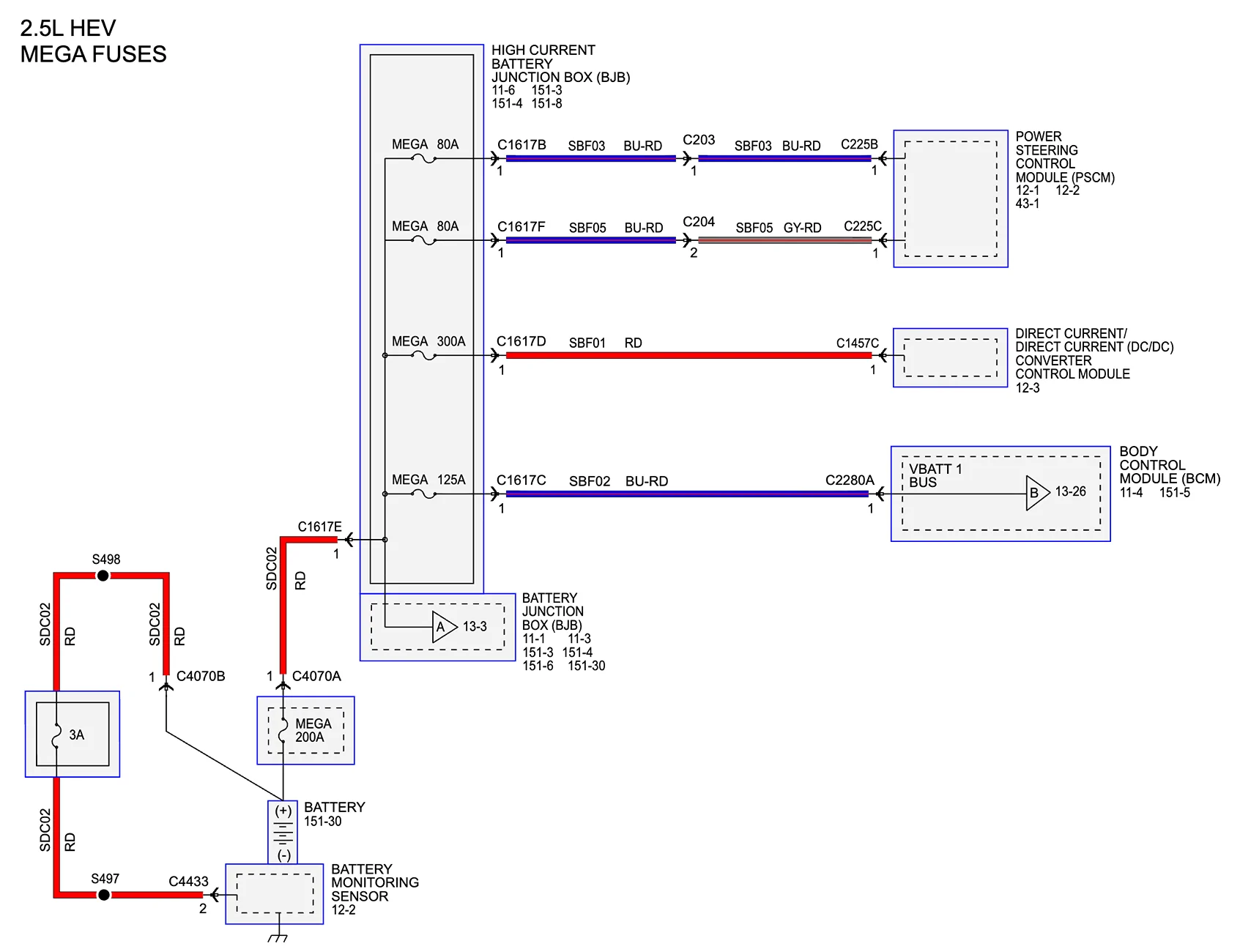
This is the wiring diagram for the 12V high-current junction box on the 2025 Hybrid. Note the fact that there is a 300A fuse connecting the DC/DC stepdown.

Now, if you look closely, you'll notice that there is 2x80A fuses for the power steering, and 125A going to the BCM (and the main 12V fusebox).

Presumably, if you're not whaling on the power steering, it's going to be drawing nowhere near the full 160A (and probably 0A if you're parked).

160A*14V is 2.2kW, which means that a 2kW inverter should be perfectly accounted for when parked because it takes up less than is reserved for the power steering.
Not to mention almost all of the other large loads on the 12V bus will similarly be absent when parked.

Now, I *probably* wouldn't recommend drawing a large amount of power while actively driving, simply because if you did somehow manage to blow the fuses you might break your power steering, but when parked you should be fine.

You can monitor power draw over OBD-II, and I've done so while drawing 1.7kW for over an hour, and it was nowhere near full load. It was cycling the engine on and off intervals because it didn't even need to idle all the time.
Sponsored


Top