
Sponsored

Suspicions about Maverick dc-to-dc charging operations

Bob_K

2.5L Hybrid
New member
First Name
Bob
Joined
Nov 5, 2025
Threads
1
Messages
3
Reaction score
7
Location
N Kingstown, RI
Vehicle(s)
2025 Ford Maverick XLT
Engine
2.5L Hybrid
My 2025 Maverick XLT is my first venture into the electric/hybrid vehicle space. However, I have been dealing with battery technology for over forty years in the marine environment and have a few thoughts on the subject

Most of the posts I have reviewed discuss AGM vs lead-acid battery replacement for the deep sleep problem and seem to offer mixed results. While AGM are more rugged in harsh environments, offer low maintenance and better recovery from deep discharge, in operation they are not that much different from lead-acid. More important is what kind of battery they are. Common to both are three types:

  • Deep cycle – made for constant, lower drain, long term loads. Not good for short, high amperage draws, like starting an engine. Physically, the plates are heavier duty.
  • Start - Good for short high amperage loads, not good for long term parasitic draws.
  • Combination – designed and manufactured to meet both needs
Charging characteristics for lead-acid and AGM are similar. A three-stage charger should be employed (lead-acid are more forgiving without it) that provides bulk, absorption and float charging stages. The specific charging voltages for each stage differ between the two and parameters need to be adjusted accordingly or the AGM battery could be damaged.

Also common to each is how the lifespan can be shortened:

Over charging – typically caused by not using a three-stage charger or a bad voltage regulator/charger

Constant drawing battery below 50% capacity, thereby reducing the overall life-cycles available.

If you suspect the battery low State of Charged (SoC) or damage to the battery is caused by parasitic power drain, for starters it would make sense to put a combination type, either AGM or lead-acid, battery when replacing.

This leads to the question of what the dc-to-dc system is doing. Does it support a three-stage charger for the 12-volt system? If not and just applies a steady voltage to the battery, question answered, the battery will not last very long. One clue would be when changing between a lead-acid and AGM battery, does it require any software adjustments to accommodate the different charging voltages? If not, the higher charge voltages that lead-acid batteries take will certainly damage the AGM battery. Another possible reason why there seems to be a mixed bag of results. It might be the charging, not the parasitic power drains that are the issue. Other questions that I have are: Has anyone actually been able to determine what the 12-volt battery voltage is when the vehicle goes into deep sleep mode? If so, can it be easily replicated?

I have not yet experienced the issue with my two-month-old Maverick, so it is still an academic issue to me.
Sponsored

 

HeyBales

2.5L Hybrid
Well-known member
First Name
Mike
Joined
May 3, 2024
Threads
4
Messages
4,947
Reaction score
4,549
Location
KC Metro area
Vehicle(s)
2005 Toyota RAV4, 2024 XLT Hybrid
Engine
2.5L Hybrid
The Battery Management System (which decides how many Volts & Amps are sent from the DCDCConv) is like a typical charger I've decided, except poorly done.

I get that you have a battery sitting in the occupant space - so overcharging and off-gassing are big no-no. Because who knows what goofball put in a wrong sized battery and didn't reconnect the vent tubes.

It has a temp sensor - so it doesn't do higher Amp charging when really cold. That's appropriate.

It seems to have a resistance tester during BMS Relearn as it backs off the higher Amps when it seems the battery is going bad, so as not to overcharge what's still good in it. Of course it caused the bad battery ...

The Ford SOC scale seems to be 85% as max charge - every blue moon someone with a scanner has a higher value, when they mess with settings and increase the potential.
With 85% as max - it does go to float level charge at 80% SOC. Until it keeps decreasing that goal.

If you drive long enough daily (upwards of 2 hrs it seems) - you can keep charged up, without issues.
Barring any problems on the parasitic drain side of it - which from comments is usually rare.

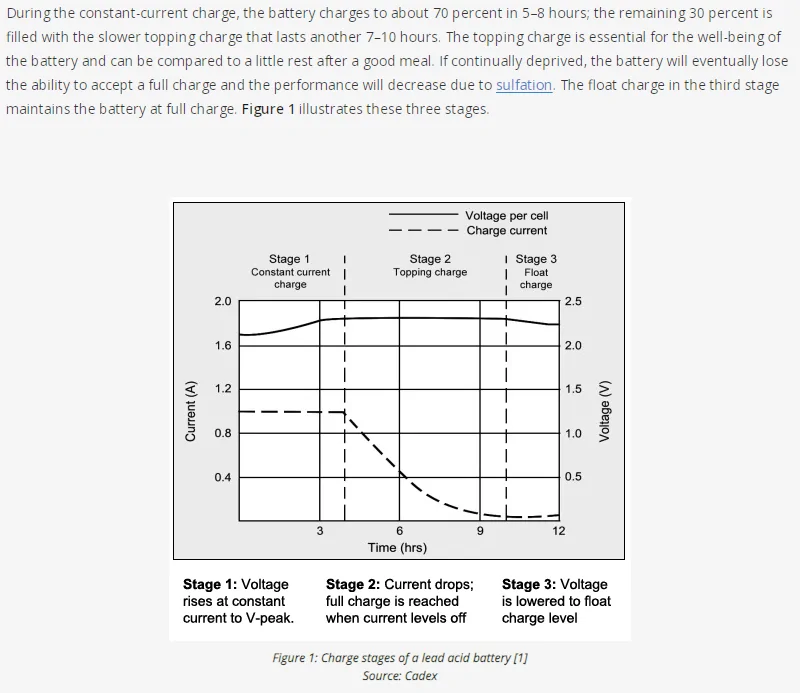
The charging cycles are super abbreviated, but all 3 seem to be there.
In 10-15 min of a drive those with scanners seem to see the same thing - down to 1A or below current supplied.
6-8 A bulk/constant charge seems to last upwards of a few minutes.
2-5 A absorption/topping charge dropping lower seems to last more minutes as well. (sometimes I've seen it inspired to keep the 2A going up to my 15 min trip to work, usually not though)
1-0 A float charge usually happens at 10 min, maybe up to 15. The PID reading for Amps is whole number with rounding, but you can tell from the bouncing it's around 0.5A rounding to 1 or 0.

It's like one of the engineers saw this and misunderstood hours as minutes.
https://www.batteryuniversity.com/article/bu-403-charging-lead-acid
1767220784742-16.webp


The BMS also tracks Amp hours in different states of discharge, and charging time.
Likely for calculating that Ford SOC scale, used to make decisions.

Sadly either the sensors are off, or obviously the strategy is.
Because it can show more charging Ah than discharge - on a battery that has a daily dropping Voltage reading.
Therefore it's impossible it's charging more.
And then it seems to give up and allow discharge to win.

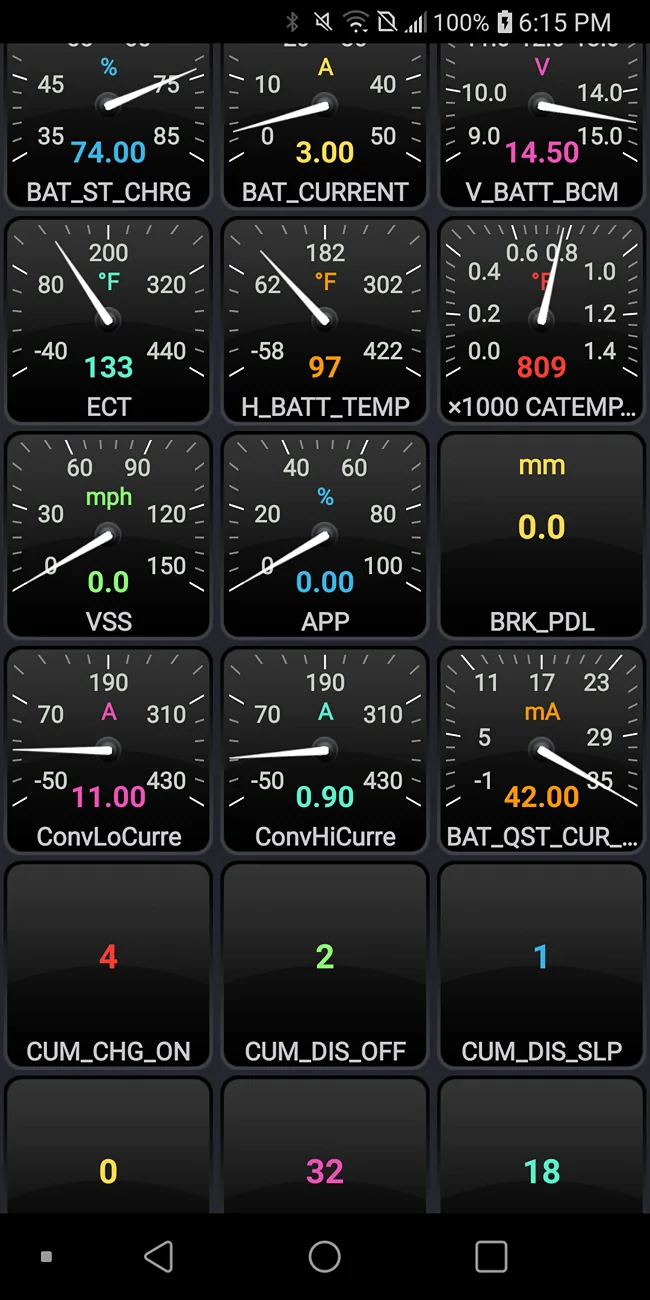
Here's 32 days after a new warranty battery was installed - this was at 85% the day after install. Here it's down to 74%. Cumulative 4 Ah charging, combined 3 Ah discharging - it thinks it logged. If that was true - wouldn't have dropped 11% SOC.
Screenshot_20250827-181536.webp


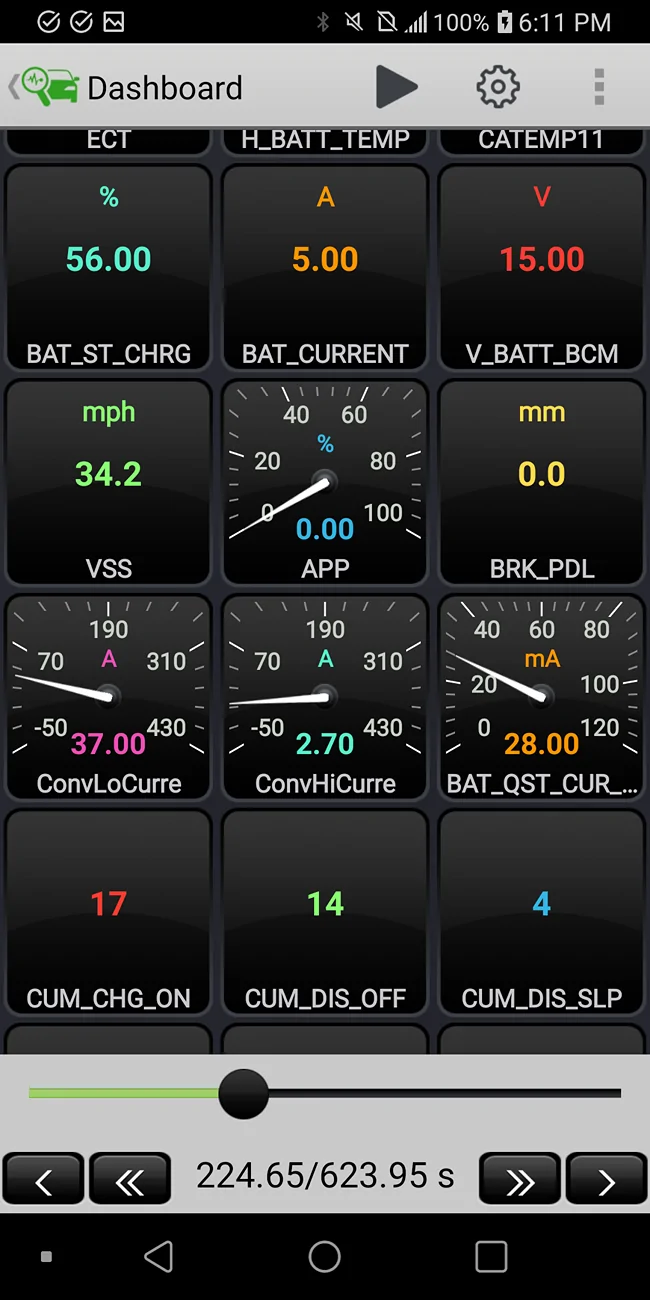
And more recent, now 140 days - now correctly showing more discharge than charging Ah's, in which case why isn't it charging higher Amps to get better than 56% SOC, I think because battery is bad. Currently at 48% and 11.6V resting in morning:
Screenshot_20251208-181156.webp


In both those examples - you'll notice the Quiescent Battery Current (42 & 28 mA) during the Sleep Mode time (after the max 75 / 60 min modules off time) is correctly between 25-50 mA avg, sometimes I'll be just slightly above, but almost always under avg 70 mA, depending on how long the sleep period was. Besides, it's still part of the tracking Cumulative Discharge while Sleeping that is logged.

Pre-25MY hybrids do NOT have the same instructions as the EB or the 25MY hybrids - those other models Spec's section says battery info needs to be entered correctly if you don't get exactly matching battery.
22-24 hybrid though, we get a BMS Relearn process every so often - where the same values the others get entered, are instead discerned thru testing, and hopefully correctly, but probably not as the evidence suggests. There is a setting for Battery type, already set to AGM when viewed on computer Forscan. My Forscan Lite though - shows that PID and all the others with battery specs as nothing selected.

Deep Sleep Mode per a Ford SSM is ONLY when the modem is disabled - that prevents a 1 time/hr blip of power to bring up the modem and make sure the network connection will remain. Not really a lot of power saved - but obviously a potential process that could go off the rails - and some have had work done on the TCU because it did as a parasitic draw.
Again - that blip falls with the 25-50 mA draw, so I'm guessing it's about 25 mA.
There have been posted logs of voltage reading compares with Fuse 11 pulled - which duplicates DSM as the modem receives no power. No difference except the hourly blips in their graphs.
When does it goes into DSM? 3 criteria - 14 days no start, Voltage <9.5, or Ford SOC <40%.
It's the last one that gets most people. I've yet to see a post where someone measured V and it was below 9.5 on initial DSM alert.
Now - some do get the DSM alert during a parasitic draw event - and voltage is just dropping, and well past 9.5 eventually. They get low V reading the next morning!

Power Saver mode when truck is off conserves nothing, as no lights on anyway after the 60 - 75 min. That's about saving power during the periods of use, or after truck shutoff during that 60-75 min being shortened.

I've yet to see someone with 25MY and scanner give reports off all these things that occur.
But some have been reported - and no changes, but it does seem to charge better with included AGM's in 25MY. The fact battery info is supposed to be used - perhaps helps.
 

scharris99

2.0L EcoBoost
Well-known member
Joined
Mar 31, 2025
Threads
0
Messages
129
Reaction score
201
Location
Daytona Beach
Vehicle(s)
2025 Maverick XLT
Engine
2.0L EcoBoost
My wife's vehicle is a 2020 hybrid Escape. The original battery lasted 4 years and 60k miles. It was regular lead acid with a vent/drain from it's placement under the spare tire inside the passenger compartment. How did that battery last so long? Did they forget how to charge batteries? Isn't it basically the same vehicle?
 

skinnyboy

2.5L Hybrid
Well-known member
First Name
Andy
Joined
Jan 20, 2022
Threads
7
Messages
476
Reaction score
526
Location
Ontario, Canada
Vehicle(s)
'24 Corolla hatch, '25 Mazda 3
Engine
2.5L Hybrid
The Battery Management System (which decides how many Volts & Amps are sent from the DCDCConv) is like a typical charger I've decided, except poorly done.
Outstanding post, thank you!

Cheers.
 

HeyBales

2.5L Hybrid
Well-known member
First Name
Mike
Joined
May 3, 2024
Threads
4
Messages
4,947
Reaction score
4,549
Location
KC Metro area
Vehicle(s)
2005 Toyota RAV4, 2024 XLT Hybrid
Engine
2.5L Hybrid
My wife's vehicle is a 2020 hybrid Escape. The original battery lasted 4 years and 60k miles. It was regular lead acid with a vent/drain from it's placement under the spare tire inside the passenger compartment. How did that battery last so long? Did they forget how to charge batteries? Isn't it basically the same vehicle?
Unless safety concerns caused Ford to be more careful about overcharging, like lawsuits occurred when bad things happened - I'm chalking up the desire to toe a line (on the wrong side for many it appears) as being related to saving some fraction of a MPG during the standard tests.

If the system pulls just a tad less power from the HVB to charge the 12VB, then there is just a tad less time for the ICE to run.
I'd think normal usage variability would be all over the road - so about a useless attempt. And harmful in winter!
But maybe they got things tweaked for only the test to show better MPG.
 

Sponsored

Robot-Wrangler

2.5L Hybrid
Well-known member
First Name
Brian
Joined
Dec 9, 2024
Threads
11
Messages
480
Reaction score
466
Location
Kentucky
Vehicle(s)
2025 Maverick Hybrid Lariat AWD, 2022 F-350 SCLB 6.7, 1997 Suburban K-2500
Engine
2.5L Hybrid
My '25 hybrid is driven nearly 100+ miles daily yet the first day of 32°F the truck 12v battery voltage dropped to 6.3v overnight and the truck was bricked. Nothing worked at all. I charged the battery starting at at 6.0 amps, trickling down automatically until the battery was at 100% charge many hours later.

The next below freezing night was the same but once connected to a battery charger it started within a half hour.

Since then I programed starts at 1am and 5am and have not been stranded. Two local Ford dealer's are clueless and useless.
 
OP
OP

Bob_K

2.5L Hybrid
New member
First Name
Bob
Joined
Nov 5, 2025
Threads
1
Messages
3
Reaction score
7
Location
N Kingstown, RI
Vehicle(s)
2025 Ford Maverick XLT
Engine
2.5L Hybrid
The Battery Management System (which decides how many Volts & Amps are sent from the DCDCConv) is like a typical charger I've decided, except poorly done.

I get that you have a battery sitting in the occupant space - so overcharging and off-gassing are big no-no. Because who knows what goofball put in a wrong sized battery and didn't reconnect the vent tubes.

It has a temp sensor - so it doesn't do higher Amp charging when really cold. That's appropriate.

It seems to have a resistance tester during BMS Relearn as it backs off the higher Amps when it seems the battery is going bad, so as not to overcharge what's still good in it. Of course it caused the bad battery ...

The Ford SOC scale seems to be 85% as max charge - every blue moon someone with a scanner has a higher value, when they mess with settings and increase the potential.
With 85% as max - it does go to float level charge at 80% SOC. Until it keeps decreasing that goal.

If you drive long enough daily (upwards of 2 hrs it seems) - you can keep charged up, without issues.
Barring any problems on the parasitic drain side of it - which from comments is usually rare.

The charging cycles are super abbreviated, but all 3 seem to be there.
In 10-15 min of a drive those with scanners seem to see the same thing - down to 1A or below current supplied.
6-8 A bulk/constant charge seems to last upwards of a few minutes.
2-5 A absorption/topping charge dropping lower seems to last more minutes as well. (sometimes I've seen it inspired to keep the 2A going up to my 15 min trip to work, usually not though)
1-0 A float charge usually happens at 10 min, maybe up to 15. The PID reading for Amps is whole number with rounding, but you can tell from the bouncing it's around 0.5A rounding to 1 or 0.

It's like one of the engineers saw this and misunderstood hours as minutes.
https://www.batteryuniversity.com/article/bu-403-charging-lead-acid
1767220784742-16.webp


The BMS also tracks Amp hours in different states of discharge, and charging time.
Likely for calculating that Ford SOC scale, used to make decisions.

Sadly either the sensors are off, or obviously the strategy is.
Because it can show more charging Ah than discharge - on a battery that has a daily dropping Voltage reading.
Therefore it's impossible it's charging more.
And then it seems to give up and allow discharge to win.

Here's 32 days after a new warranty battery was installed - this was at 85% the day after install. Here it's down to 74%. Cumulative 4 Ah charging, combined 3 Ah discharging - it thinks it logged. If that was true - wouldn't have dropped 11% SOC.
Screenshot_20250827-181536.webp


And more recent, now 140 days - now correctly showing more discharge than charging Ah's, in which case why isn't it charging higher Amps to get better than 56% SOC, I think because battery is bad. Currently at 48% and 11.6V resting in morning:
Screenshot_20251208-181156.webp


In both those examples - you'll notice the Quiescent Battery Current (42 & 28 mA) during the Sleep Mode time (after the max 75 / 60 min modules off time) is correctly between 25-50 mA avg, sometimes I'll be just slightly above, but almost always under avg 70 mA, depending on how long the sleep period was. Besides, it's still part of the tracking Cumulative Discharge while Sleeping that is logged.

Pre-25MY hybrids do NOT have the same instructions as the EB or the 25MY hybrids - those other models Spec's section says battery info needs to be entered correctly if you don't get exactly matching battery.
22-24 hybrid though, we get a BMS Relearn process every so often - where the same values the others get entered, are instead discerned thru testing, and hopefully correctly, but probably not as the evidence suggests. There is a setting for Battery type, already set to AGM when viewed on computer Forscan. My Forscan Lite though - shows that PID and all the others with battery specs as nothing selected.

Deep Sleep Mode per a Ford SSM is ONLY when the modem is disabled - that prevents a 1 time/hr blip of power to bring up the modem and make sure the network connection will remain. Not really a lot of power saved - but obviously a potential process that could go off the rails - and some have had work done on the TCU because it did as a parasitic draw.
Again - that blip falls with the 25-50 mA draw, so I'm guessing it's about 25 mA.
There have been posted logs of voltage reading compares with Fuse 11 pulled - which duplicates DSM as the modem receives no power. No difference except the hourly blips in their graphs.
When does it goes into DSM? 3 criteria - 14 days no start, Voltage <9.5, or Ford SOC <40%.
It's the last one that gets most people. I've yet to see a post where someone measured V and it was below 9.5 on initial DSM alert.
Now - some do get the DSM alert during a parasitic draw event - and voltage is just dropping, and well past 9.5 eventually. They get low V reading the next morning!

Power Saver mode when truck is off conserves nothing, as no lights on anyway after the 60 - 75 min. That's about saving power during the periods of use, or after truck shutoff during that 60-75 min being shortened.

I've yet to see someone with 25MY and scanner give reports off all these things that occur.
But some have been reported - and no changes, but it does seem to charge better with included AGM's in 25MY. The fact battery info is supposed to be used - perhaps helps.
Ok, this begs the question: how is the Maverick SoC calculated? In my experience typical marine battery monitoring systems use Coulomb Counting (Current Integration). Start with a known battery amp hour capacity, bring it to full charge and monitor the current going in and out. It requires periodic recalibration by bringing the battery back to 100% and resetting the calculations. Measuring just the voltage in an installed battery is notoriously inaccurate, unless the battery is completely disconnected and has been at “rest” for a period of time.

If the battery type and capacity is unknown, how do you determine the effects of a 50mA parasitic current drain over time?
 

HeyBales

2.5L Hybrid
Well-known member
First Name
Mike
Joined
May 3, 2024
Threads
4
Messages
4,947
Reaction score
4,549
Location
KC Metro area
Vehicle(s)
2005 Toyota RAV4, 2024 XLT Hybrid
Engine
2.5L Hybrid
My '25 hybrid is driven nearly 100+ miles daily yet the first day of 32°F the truck 12v battery voltage dropped to 6.3v overnight and the truck was bricked. Nothing worked at all. I charged the battery starting at at 6.0 amps, trickling down automatically until the battery was at 100% charge many hours later.

The next below freezing night was the same but once connected to a battery charger it started within a half hour.

Since then I programed starts at 1am and 5am and have not been stranded. Two local Ford dealer's are clueless and useless.
That would be a parasitic draw then, or a bad battery that can't hold a charge. Some posters have reported a bad AGM battery that was tested bad mere months into ownership - that can happen.

Does the battery charger report 100% based on the battery isn't taking anymore charge (bad battery would stop early), or what it thinks the Voltage must be (can't be accurate with that while charging)?

Oh - it's not mileage for BMS charging - it's time.
If that's highway miles - does that mean 1.5 hrs daily except weekends perhaps?

You should search the threads for SSM AC module - your mfg date may benefit from an update.
 

HeyBales

2.5L Hybrid
Well-known member
First Name
Mike
Joined
May 3, 2024
Threads
4
Messages
4,947
Reaction score
4,549
Location
KC Metro area
Vehicle(s)
2005 Toyota RAV4, 2024 XLT Hybrid
Engine
2.5L Hybrid
Ok, this begs the question: how is the Maverick SoC calculated? In my experience typical marine battery monitoring systems use Coulomb Counting (Current Integration). Start with a known battery amp hour capacity, bring it to full charge and monitor the current going in and out. It requires periodic recalibration by bringing the battery back to 100% and resetting the calculations. Measuring just the voltage in an installed battery is notoriously inaccurate, unless the battery is completely disconnected and has been at “rest” for a period of time.

If the battery type and capacity is unknown, how do you determine the effects of a 50mA parasitic current drain over time?
Not figured that out, but exactly as you point out is likely - since they have the tracking PID's to accomplish most of that.

BMS Relearn says some system will be temporarily disabled, and it needs 8 hrs sleep mode - when already at 25-50 mA normally then. So it's going for even less. Just saw 21 mA avg for 3 days turned off - pretty sure it did a relearn.

The kicker is indeed the not having a known starting point, Ah - in at least 1 case.

The manual listed BMS Relearn is shown for hybrid and EB, but the manual info on Spec's and Battery - only the pre-25MY hybrids have NO comment about entering battery specs if a different sized battery is used.
All the others do. They are given Ah, CCA, CA, ect, or it's expected to be the same as the OEM battery.

So to your point - math on a starting Ah, and confirming that in a Relearn from time to time - great!

Try to figure that out from some known micro-draw and estimate how much the battery went down - ugh.

The result of that latter attempt is why you get what so many of us see - Voltage and SOC% has gone down over time. From last full charge, new battery, whatever.

Even at the same time it thinks cumulative charging is higher than discharging, by just a slight margin. If charging equaled discharging - then voltage & SOC would not lower.

So while their calculated SOC sucks, their obvious charging logic also sucks - because if the morning Voltage and SOC% are going down - then obviously the tracking is wrong - charge more!
 

Robot-Wrangler

2.5L Hybrid
Well-known member
First Name
Brian
Joined
Dec 9, 2024
Threads
11
Messages
480
Reaction score
466
Location
Kentucky
Vehicle(s)
2025 Maverick Hybrid Lariat AWD, 2022 F-350 SCLB 6.7, 1997 Suburban K-2500
Engine
2.5L Hybrid
That would be a parasitic draw then, or a bad battery that can't hold a charge. Some posters have reported a bad AGM battery that was tested bad mere months into ownership - that can happen.

Does the battery charger report 100% based on the battery isn't taking anymore charge (bad battery would stop early), or what it thinks the Voltage must be (can't be accurate with that while charging)?

Oh - it's not mileage for BMS charging - it's time.
If that's highway miles - does that mean 1.5 hrs daily except weekends perhaps?

You should search the threads for SSM AC module - your mfg date may benefit from an update.
Manufactured in either late 12/24 or early 1/25, held in inspect for a week, shipped 12 days and delivered 2/7/25.

Two Ford dealer's tested the AGM battery as good. I work 3-2-2-3 with a 52mi commute each way. It's close to two hours per day charging while driving. I often run errands as well.

The only updates that I've received are the OTA and somehow that was turned off in my Fordpass app. I turned it back on a few weeks ago.

So far so good and no more dead battery. On cold 12hr shifts, I program the truck to start twice through the night. At 1am and 5am. When I used my 6 amp slow charger I remember the SOC was single digits at 6.3v and then after all day I checked it and it was 100% at 14.7v.

The first time I removed the dead battery and had O'Reilly's charge it for 30 minutes and it load tested at 600cca, higher than spec. Though it still needed charging.
 

HeyBales

2.5L Hybrid
Well-known member
First Name
Mike
Joined
May 3, 2024
Threads
4
Messages
4,947
Reaction score
4,549
Location
KC Metro area
Vehicle(s)
2005 Toyota RAV4, 2024 XLT Hybrid
Engine
2.5L Hybrid
Manufactured in either late 12/24 or early 1/25, held in inspect for a week, shipped 12 days and delivered 2/7/25.

Two Ford dealer's tested the AGM battery as good. I work 3-2-2-3 with a 52mi commute each way. It's close to two hours per day charging while driving. I often run errands as well.

The only updates that I've received are the OTA and somehow that was turned off in my Fordpass app. I turned it back on a few weeks ago.

So far so good and no more dead battery. On cold 12hr shifts, I program the truck to start twice through the night. At 1am and 5am. When I used my 6 amp slow charger I remember the SOC was single digits at 6.3v and then after all day I checked it and it was 100% at 14.7v.

The first time I removed the dead battery and had O'Reilly's charge it for 30 minutes and it load tested at 600cca, higher than spec. Though it still needed charging.
Ok - early enough you need the dealer to check into SSM 53801 ACCM software update.
https://www.mavericktruckclub.com/f...5-latest-info-from-a-techs-perspective.75323/

Plenty of drive time to charge, so not that side of equation, and battery tested (hopefully complete not quickie test), so only the extra discharge side of equation remains.

Sounds like the issue is at least already registered with dealer - in case that SSM is NOT the parasitic draw, and they need Ford's help/permission to keep going.
Because starting twice isn't solution either.
At least the first 15 min is the highest charge rate period.
Sponsored


Top