
Sponsored


How about the trip back? Going mostly up hill. What driving mode going down hill? Normal, Slippery, Eco? Did you use Low for any stretches?Admittedly, it was mostly downhill

I drove down a mountain recently in NC and GA from about 4,100 to 1,900 ft. Not really a mountain by Western US and Canadian standards. There were a lot of sharp turns. Got about 60 mpg as i recall. Must have felt good to register 100 mpg.
Last edited:
- Thread starter
- #3
I made the trip twice. While I don't recall specific MPG, uphill in Eco mode it was in the low 20s, and in Normal mode it was in the high 20s. Normal appears to be the better mode when climbing hills, imo.How about the trip back?
Spectacular miles per gallon round trip:I made the trip twice. While I don't recall specific MPG, uphill in Eco mode it was in the low 20s, and in Normal mode it was in the high 20s. Normal appears to be the better mode when climbing hills, imo.
(100 + 20) / 2 = 60 mpg or
(100 + 30) / 2 = 65 mpg
Do you know what elevation you started and ended at? You can easily Google this.
And thanks for your opinion on driving up hills.
- Thread starter
- #5
Beginning elevation roughly 5000 feet, ending 433.Spectacular miles per gallon round trip:
(100 + 20) / 2 = 60 mpg or
(100 + 30) / 2 = 65 mpg
Do you know what elevation you started and ended at? You can easily Google this.
And thanks for your opinion on driving up hills.
Sponsored
Correction on the math:Spectacular miles per gallon round trip:
(100 + 20) / 2 = 60 mpg or
(100 + 30) / 2 = 65 mpg
Do you know what elevation you started and ended at? You can easily Google this.
And thanks for your opinion on driving up hills.
The way to calculate combined mpg is to add up the total number of miles and the total fuel consumed. Because the variable amount, fuel consumed in gallons, is in the denominator, you cannot simply average the two mpg values together.
To determine how much fuel was consumed on each segment, divide the distance traveled by mpg. Let's just assume each leg was the same length, though inevitably it was off by at least a fraction of a mile. Let's further assume 25.0 mpg for the uphill segment.
Estimated total distance: 34.0 mi * 2 == 68.0 mi
Estimated downhill fuel consumption: 34.0 mi / 105.1 mpg ~= 0.3235 gal
Estimated uphill fuel consumption: 34.0 mi / 25.0 mpg ~= 1.36 gal
Estimated average fuel efficiency: (34.0 mi * 2) / (0.3235 gal + 1.36 gal) ~= 40.392 mpg
So it's actually more like 40.4 mpg combined, which is still impressive for some hill climbing in a mini brick of a compact pickup truck.
Thoughts on impact of elevation changes and hilly, congested interstates (I/S’s) on Mav hybrid mpg’s:
Facts: Atlanta area. 28 mi one way, 56 mi RT. 11 miles of generally down hill, congested I/S. Elevation drop from 1,100 to 950 ft. Followed by 18 miles of generally up hill driving on congested I/S back up to about 1,100 ft elevation. Trip home reversed.
Was able to drive in electric mode quite a bit of the trip. Stayed in right lane and used cruise as much as possible. Tried not to go over 60 mph. This was not hard — rush hour traffic. Temp about 80F.
Results: avg mpg’s 52.5:
trip out — 11 miles + 18 mi — 51.0 mpg when i turned the vehicle off. Per cent electric miles 49%. Avg speed 25 mph.
trip back — 18 mi + 11 mi — 53.9 mpg. Percent electric mi 44%. Avg speed 29 mph.
Notes: I have made this trip 4 or 5 times, but not in rush hour traffic. I normally get 40 mpg’s out and 45 mpg’s back home. Traffic is still congested but not as bad as at rush hour.
Conclusion: hills (changes in elevation) and slow speeds on congested I/S’s yielded unexpectedly high mpg’s, much higher than EPA highway rating.
I would welcome any comments and your experienced on driving interstates in your Mav hybrid. It surprised me that higher percent electric did not correlate with higher mpg’s.
Facts: Atlanta area. 28 mi one way, 56 mi RT. 11 miles of generally down hill, congested I/S. Elevation drop from 1,100 to 950 ft. Followed by 18 miles of generally up hill driving on congested I/S back up to about 1,100 ft elevation. Trip home reversed.
Was able to drive in electric mode quite a bit of the trip. Stayed in right lane and used cruise as much as possible. Tried not to go over 60 mph. This was not hard — rush hour traffic. Temp about 80F.
Results: avg mpg’s 52.5:
trip out — 11 miles + 18 mi — 51.0 mpg when i turned the vehicle off. Per cent electric miles 49%. Avg speed 25 mph.
trip back — 18 mi + 11 mi — 53.9 mpg. Percent electric mi 44%. Avg speed 29 mph.
Notes: I have made this trip 4 or 5 times, but not in rush hour traffic. I normally get 40 mpg’s out and 45 mpg’s back home. Traffic is still congested but not as bad as at rush hour.
Conclusion: hills (changes in elevation) and slow speeds on congested I/S’s yielded unexpectedly high mpg’s, much higher than EPA highway rating.
I would welcome any comments and your experienced on driving interstates in your Mav hybrid. It surprised me that higher percent electric did not correlate with higher mpg’s.
Ok. Thanks.Correction on the math:
The way to calculate combined mpg is to add up the total number of miles and the total fuel consumed. Because the variable amount, fuel consumed in gallons, is in the denominator, you cannot simply average the two mpg values together.
To determine how much fuel was consumed on each segment, divide the distance traveled by mpg. Let's just assume each leg was the same length, though inevitably it was off by at least a fraction of a mile. Let's further assume 25.0 mpg for the uphill segment.
Estimated total distance: 34.0 mi * 2 == 68.0 mi
Estimated downhill fuel consumption: 34.0 mi / 105.1 mpg ~= 0.3235 gal
Estimated uphill fuel consumption: 34.0 mi / 25.0 mpg ~= 1.36 gal
Estimated average fuel efficiency: (34.0 mi * 2) / (0.3235 gal + 1.36 gal) ~= 40.392 mpg
So it's actually more like 40.4 mpg combined, which is still impressive for some hill climbing in a mini brick of a compact pickup truck.

- Banned
- #9
I've been in a hybrid since my 2005 Escape Hybrid.
I've always found GENTLE hills helpful. More so than most would expect. Most expect hills to be worse.
If it's too steep it's literal hell going uphill. If it's too steep downhill; the battery is full in 1 or 2 minutes and the rest of the hill is no advantage.
Repeated camel humps where you can use power / regen / use power / regen are ideal.
Also even a 1% downslope will double your EV range.
I've always found GENTLE hills helpful. More so than most would expect. Most expect hills to be worse.
If it's too steep it's literal hell going uphill. If it's too steep downhill; the battery is full in 1 or 2 minutes and the rest of the hill is no advantage.
Repeated camel humps where you can use power / regen / use power / regen are ideal.
Also even a 1% downslope will double your EV range.
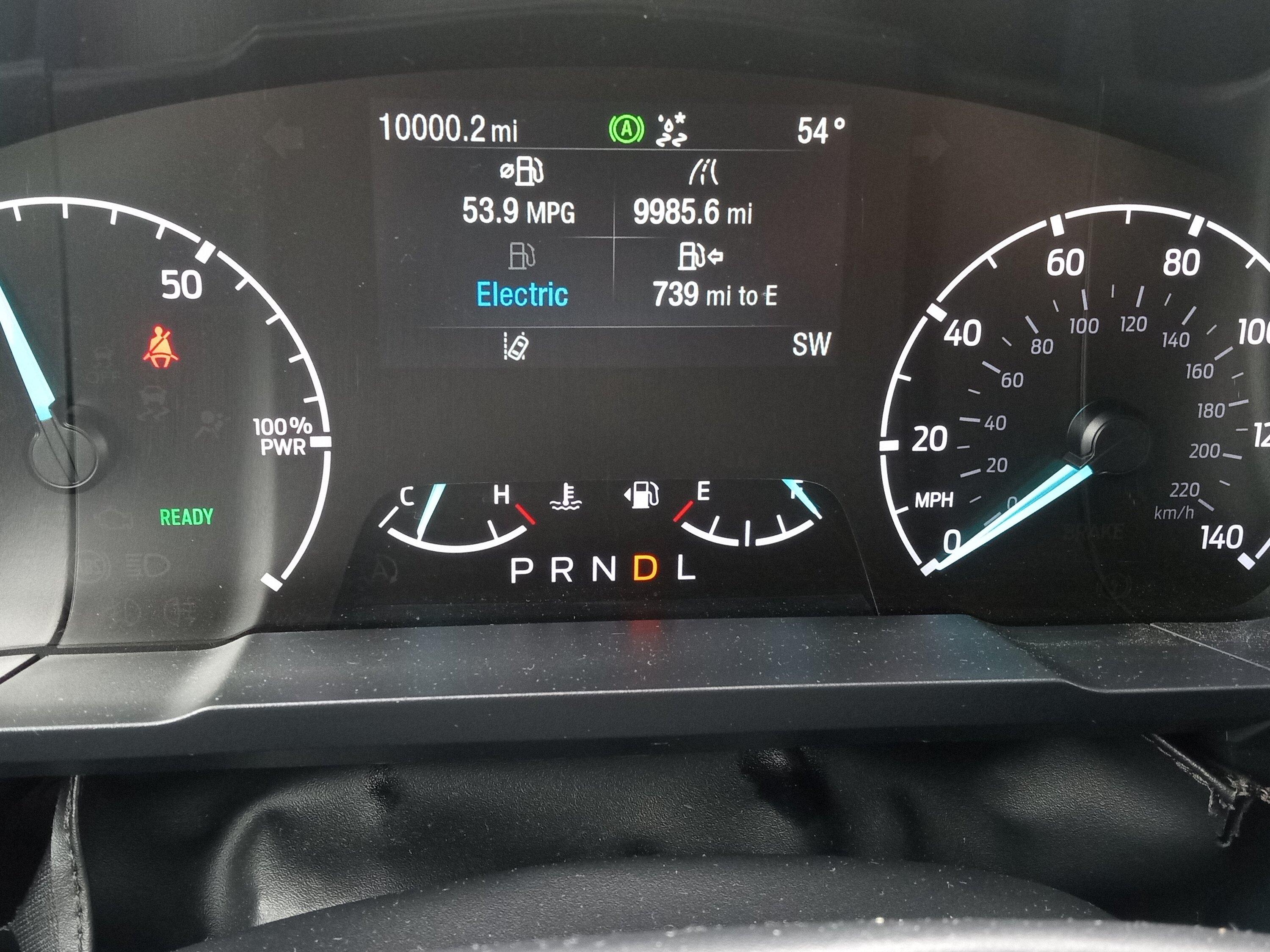
Just rolled over 10,000 miles, interstate really makes my mpg drop.Thoughts on impact of elevation changes and hilly, congested interstates (I/S’s) on Mav hybrid mpg’s:
Facts: Atlanta area. 28 mi one way, 56 mi RT. 11 miles of generally down hill, congested I/S. Elevation drop from 1,100 to 950 ft. Followed by 18 miles of generally up hill driving on congested I/S back up to about 1,100 ft elevation. Trip home reversed.
Was able to drive in electric mode quite a bit of the trip. Stayed in right lane and used cruise as much as possible. Tried not to go over 60 mph. This was not hard — rush hour traffic. Temp about 80F.
Results: avg mpg’s 52.5:
trip out — 11 miles + 18 mi — 51.0 mpg when i turned the vehicle off. Per cent electric miles 49%. Avg speed 25 mph.
trip back — 18 mi + 11 mi — 53.9 mpg. Percent electric mi 44%. Avg speed 29 mph.
Notes: I have made this trip 4 or 5 times, but not in rush hour traffic. I normally get 40 mpg’s out and 45 mpg’s back home. Traffic is still congested but not as bad as at rush hour.
Conclusion: hills (changes in elevation) and slow speeds on congested I/S’s yielded unexpectedly high mpg’s, much higher than EPA highway rating.
I would welcome any comments and your experienced on driving interstates in your Mav hybrid. It surprised me that higher percent electric did not correlate with higher mpg’s.

- First Name
- Ray
- Joined
- Sep 27, 2021
- Threads
- 33
- Messages
- 692
- Reaction score
- 1,054
- Location
- Tacoma, Washington
- Vehicle(s)
- Alto Blue Lariat Lux Hybrid
- Engine
- 2.5L Hybrid
I live near Mt. Rainer in the great and wonderful state of Washington and one of these days I'm going to drive up to "Sunrise" (@7,000' elevation), hike around for a bit, and then basically coast the 85 miles back to my home in Tacoma (@350' evaluation) just to see what sort of crazy MPG number I can record.
Sponsored
Similar threads

- Replies
- 37
- Views
- 4,925


