
Sponsored

87 verses 91/93 octain gas

Surly Old Bill

2.5L Hybrid
Well-known member
First Name
bill
Joined
Apr 30, 2025
Threads
11
Messages
823
Reaction score
1,254
Location
Richmond, CA
Vehicle(s)
2024 Maverick XL
Engine
2.5L Hybrid
I bet if there was a blind test of octanes in the same vehicle, almost no drivers would guess which is which better than random (50%) of the time. Kind of like vinyl album vs CD listeners; even the self proclaimed audiophiles guess wrong between the two half the time (played on identical high-end equipment).

The exception would be the aforementioned vehicles designed to identify detonation differences and adapt to take advantage instead of regulate to the desired lower octane profile.

Just switch the stickers on a fuel pump and see if anyone notices a difference! :like:
Sponsored


Packer Bill

2.0L EcoBoost
Well-known member
First Name
Bill
Joined
Jun 21, 2021
Threads
10
Messages
1,928
Reaction score
2,586
Location
South Dakota
Vehicle(s)
2019 Mazda CX-5, 2025 Ford Maverick
Engine
2.0L EcoBoost
I bet if there was a blind test of octanes in the same vehicle, almost no drivers would guess which is which better than random (50%) of the time. Kind of like vinyl album vs CD listeners; even the self proclaimed audiophiles guess wrong between the two half the time (played on identical high-end equipment).

The exception would be the aforementioned vehicles designed to identify detonation differences and adapt to take advantage instead of regulate to the desired lower octane profile.

Just switch the stickers on a fuel pump and see if anyone notices a difference! :like:
When driving in the the city, I get 1-2 mpg more with 91 octane. This is based on real data, calculating by hand after I fill up nat the gas station. This is an objective observation, not subjective.
 

Tbone289

2.0L EcoBoost
Well-known member
First Name
Terry
Joined
Jul 18, 2024
Threads
0
Messages
2,079
Reaction score
3,545
Location
MO
Vehicle(s)
'24 Mav FX4, '12 Focus SE Sport, '01 Focus ZX3, '00 Jeep XJ, '67 Bronco
Engine
2.0L EcoBoost
These are not 1960's engines where tweaks to octane or carburetor jets WILL improve performance; all systems are loaded with sensors, monitors, and computer adjusted with millisecond changes in fuel pressure, detonation, and other aspects of function to have the engine perform optimally.
You're right, they aren't 60s engines. They adjust timing and air/fuel ratio in milliseconds, will get the best performance from 91-93 octane due to advanced timing, and will retard timing if running lower octane and knock is sensed, thus reducing performance. Yes, they will perform "optimally" at any octane from 87-93, but more advanced timing at 93 results in slightly better performance and efficiency than the relatively retarded timing at 87, just as it did in the 60s.

The ability to adjust timing on-the-fly does not "negate extra octane" as you claim. In fact, it does the opposite, and provides the extra performance on-the-fly rather than having to manually adjust the optimal ignition timing for the octane you're running as we used to. It is up to you if the extra performance gained from the advanced timing is a waste of money or not.
 
Last edited:

DSalisbury

2.5L Hybrid
Member
First Name
David
Joined
Mar 5, 2025
Threads
1
Messages
23
Reaction score
29
Location
Missouri
Vehicle(s)
2024 Ford Maverick Lariat Hybrid 2.5
Engine
2.5L Hybrid
We only use 87. Had a 2016 Acura that they recommended 91 but they (sales and service)said 87 worked fine and we had no problems the 5 yrs we owned it.
 

Cougar70

2.5L Hybrid
Banned
Banned
First Name
Brian
Joined
Apr 25, 2025
Threads
3
Messages
120
Reaction score
305
Location
Glen Burnie MD
Vehicle(s)
2024 Maverick XLT Hybrid
Engine
2.5L Hybrid
I think the key is that the vehicle's computer has to be programmed to take advantage of the grade of fuel being used.

I had a Fiesta and it was recommended to use regular 87 octane, but it was also 10 to 1 compression ratio. So I decided to do a test and used 93 octane for 3 tank loads and noticed no difference in mpg, so went back to 87.

While looking at the Fiesta, out of curiosity I was checking out used Fiat 500s and Mini Coopers, both of which state that they need premium fuel, which was a no go for me.
I bought the Fiesta to save money on gas, not spend more on premium.

On the Mini Cooper, I had a friend who had one where he used regular and it actually caused engine problems, which for him, luckily it was covered under warranty. After that he always used premium.

So some cars will require a specific grade and won't adjust to a different grade, while other vegicles can adjust to match the fuel grade being used.

Another friend bought a Laguna Seca Boss 302 Mustang that has separate keys, with one to put it into track mode, which I includes allowing for or requiring a higher grade octane. The track key changes over 200 parameters in the car and it's supposed to be for "track use" only! Lol!
 

Sponsored

Tbone289

2.0L EcoBoost
Well-known member
First Name
Terry
Joined
Jul 18, 2024
Threads
0
Messages
2,079
Reaction score
3,545
Location
MO
Vehicle(s)
'24 Mav FX4, '12 Focus SE Sport, '01 Focus ZX3, '00 Jeep XJ, '67 Bronco
Engine
2.0L EcoBoost
I think the key is that the vehicle's computer has to be programmed to take advantage of the grade of fuel being used.
It doesn't have to be programmed to a specific octane if it can "listen" to the knock sensor and retard the timing for lower octane. I suppose that's what you're saying.

So some cars will require a specific grade and won't adjust to a different grade, while other vegicles can adjust to match the fuel grade being used.
The Maverick and pretty much anything with variable valve timing and a knock sensor is the latter these days.
 

Surly Old Bill

2.5L Hybrid
Well-known member
First Name
bill
Joined
Apr 30, 2025
Threads
11
Messages
823
Reaction score
1,254
Location
Richmond, CA
Vehicle(s)
2024 Maverick XL
Engine
2.5L Hybrid
You're right, they aren't 60s engines. They adjust timing and air/fuel ratio in milliseconds, will get the best performance from 91-93 octane due to advanced timing, and will retard timing if running lower octane and knock is sensed, thus reducing performance. Yes, they will perform "optimally" at any octane from 87-93, but more advanced timing at 93 results in slightly better performance and efficiency than the relatively retarded timing at 87, just as it did in the 60s.

The ability to adjust timing on-the-fly does not "negate extra octane" as you claim. In fact, it does the opposite, and provides the extra performance on-the-fly rather than having to manually adjust the optimal ignition timing for the octane you're running as we used to. It is up to you if the extra performance gained from the advanced timing is a waste of money or not.
Can you provide links to this new technology to utilize higher octane gas effectively at an advantage in an engine designed for lower octane gas? I am completely unaware of it. My quick websearch turned up nothing.
Very cool news if true, sort of like the Flex Fuel system in some Fords.
 

Tbone289

2.0L EcoBoost
Well-known member
First Name
Terry
Joined
Jul 18, 2024
Threads
0
Messages
2,079
Reaction score
3,545
Location
MO
Vehicle(s)
'24 Mav FX4, '12 Focus SE Sport, '01 Focus ZX3, '00 Jeep XJ, '67 Bronco
Engine
2.0L EcoBoost
Can you provide links to this new technology to utilize higher octane gas effectively at an advantage in an engine designed for lower octane gas? I am completely unaware of it. My quick websearch turned up nothing.
Very cool news if true, sort of like the Flex Fuel system in some Fords.
I never said anything about an engine being "designed for lower octane gas". If a modern engine like the Ecoboost can set optimal timing for a range of octane, what octane is it designed for?

Would you rather I say that the Ecoboost is designed for 91+ octane gas, but will retard timing so that it doesn't knock at 87? I suppose that's another way to put it, but not entirely accurate. Stating that a modern engine with computer controlled ignition timing and variable valve timing is designed for a specific octane really is coming at it from the wrong mindset in my opinion.

Connect an OBD II data logger to one of these vehicles, or even a vehicle as far back as a 2012 Ford Focus with a Duratec 20, the Ford/Mazda-designed predecessor to the Ecoboost, and you will see that timing is more advanced with higher octane fuels than with 87 octane. You could go further and log when each knock event occurred that caused the computer to pull (retard) timing. I wouldn't say those engines were designed for low octane either, as they run optimally with a range of octanes.

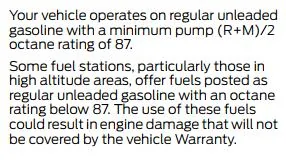
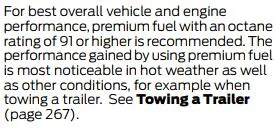
This is not new technology. The owner's manuals for both of these vehicles (Maverick and 2012 Focus) state that 87 is the minimum octane rating, and that the use of higher octanes will increase performance.

From the 2024 Maverick owner's manual:

Ford Maverick 87 verses 91/93 octain gas 1747986769148-h

Ford Maverick 87 verses 91/93 octain gas 1747986799467-8a
 
Last edited:

Cherokee

2.0L EcoBoost
Well-known member
Joined
Jan 3, 2025
Threads
51
Messages
3,805
Reaction score
7,213
Location
North Carolina
Vehicle(s)
2004 Ford Escape Platinum, 2024 Ford Maverick Lariat 2.0L AWD
Engine
2.0L EcoBoost
$2.79 for 87 here,
$3.15 for 89 octane,
$3.59 for 93
$3.49 for NON Ethanol 93 octane,
I call this flavor, ‘Real Gas’ It’ll make your head spin if you get a whiff of it. Oddly it smells like gas. Imagine that !

I don’t ever need or drive into the top 20% of
My power output but I can feel a difference at half throttle.
My Eco likes ethanol free premium.
As for cost the extra .70 cents per gallon is not offset by the extra 1.5-2.0 mpg’s. I’d have to gain 4-4.5 mpg to get close to breaking even.

But it feels in the seat of my pants like it runs smoother and quicker. Just by watching the tach climb it seems to climb faster.

Could it all be in my head ? Like the K&N drop in filter thing ?
Yep it could be.
I’ll burn regular 87 octane in the winter and cooler months but this Non Ethanol goes in when it’s hot weather.
 

Cougar70

2.5L Hybrid
Banned
Banned
First Name
Brian
Joined
Apr 25, 2025
Threads
3
Messages
120
Reaction score
305
Location
Glen Burnie MD
Vehicle(s)
2024 Maverick XLT Hybrid
Engine
2.5L Hybrid
It doesn't have to be programmed to a specific octane if it can "listen" to the knock sensor and retard the timing for lower octane. I suppose that's what you're saying.
I fully understand that the computer uses the various sensors, including the knock sensor, what I'm saying is that in the case of my Fiesta, the computer was tuned for the lower octane gas and that using higher octane made no noticeable difference in fuel economy and if there was a power difference, I didn't notice it. So the only benefit for my Fiesta could have been additives in the fuel to allow the engine to run cleaner.

Versus a friends Mini Cooper, it was tuned for premium and while the knock sensor would retard timing as needed, using regular gas actually hurt the Mini Cooper engine.

The Maverick and pretty much anything with variable valve timing and a knock sensor is the latter these days.
That's why I like just about any kind of fuel injection with the various sensors to take advantage of every aspect of the fuel and of the engine.

When I had my Cougar Eliminator, it had 12.25 to 1 compression ratio and I used a mix of 100 and 93 octane when driving on the street and if I still had it, I would put on a throttle body injection and better utilize the compression and the fuel.
 
Sponsored

carcrasher89

2.5L Hybrid
Well-known member
First Name
John
Joined
Dec 12, 2024
Threads
14
Messages
71
Reaction score
47
Location
Maryland
Vehicle(s)
24 maverick
Engine
2.5L Hybrid
On my hybrid I prefer to use efree but it’s only 89 and I see a slight difference. And it’s about 3.70 a gallon at my Wawa.
 

ripperAZ

2.5L Hybrid
Well-known member
Joined
Sep 19, 2022
Threads
4
Messages
330
Reaction score
353
Location
AZ
Vehicle(s)
2022 Mustang MachE 2021 Genesis G90 2032 Mav
Engine
2.5L Hybrid
Has anyone noticed a performance or MPG improvement using the 91/93 octane gas in their stock 2.0 EB?
I don’t think the octane is as important as getting top-tier gasoline with some detergent
I always go to Costco, which is top tier here always the cheapest and I usually go 87 one week and 91 the next week creating my own blend
 

Surly Old Bill

2.5L Hybrid
Well-known member
First Name
bill
Joined
Apr 30, 2025
Threads
11
Messages
823
Reaction score
1,254
Location
Richmond, CA
Vehicle(s)
2024 Maverick XL
Engine
2.5L Hybrid
Unless someone can provide a link to a verifiable, numerical study of higher octane than the engine was designed ("tuned") for providing some sort of increased performance, I'll continue to see it as an Old Owner's Tale; similar to changing oil every 2500 miles making the engine last longer or K&N filters being "better". Feelings do not supplant statistics.
A lot of these vehicular maintenance/care stories came from way back before CAD/CAM and ECU systems, when they were actually beneficiary, and often very noticeable. The advent of CAD/CAM, synthetic oils, and engine control systems in the last couple decades have taken the wind out of these particular sails. I still go old school in the '69 Nova SS, though.
 

Tbone289

2.0L EcoBoost
Well-known member
First Name
Terry
Joined
Jul 18, 2024
Threads
0
Messages
2,079
Reaction score
3,545
Location
MO
Vehicle(s)
'24 Mav FX4, '12 Focus SE Sport, '01 Focus ZX3, '00 Jeep XJ, '67 Bronco
Engine
2.0L EcoBoost
Unless someone can provide a link to a verifiable, numerical study of higher octane than the engine was designed ("tuned") for providing some sort of increased performance, I'll continue to see it as an Old Owner's Tale; similar to changing oil every 2500 miles making the engine last longer or K&N filters being "better". Feelings do not supplant statistics.
A lot of these vehicular maintenance/care stories came from way back before CAD/CAM and ECU systems, when they were actually beneficiary, and often very noticeable. The advent of CAD/CAM, synthetic oils, and engine control systems in the last couple decades have taken the wind out of these particular sails. I still go old school in the '69 Nova SS, though.
So, you're saying that the Ecoboost is tuned for a specific octane. What octane is it tuned for, and what is your evidence and statistics showing that it is tuned for that octane? Or, is that just a "feeling"?

You can easily log your own data to show that higher octanes have more advanced timing than 87 in an Ecoboost Maverick. Or, you could also just keep believing that it's tuned to only work optimally with a specific octane since that seems easier for your old school tendencies.

Another option is to start at the links below and do your own research, which will begin to reveal how the Ecoboost's Octane Adjust Ratio works:

https://www.motorsport-developments.co.uk/Understanding-Ford-Ecoboost-OAR-Systems.html

https://www.cobbtuning.com/ford-ecoboost-and-the-octane-adjust-ratio-monitor/
 
Last edited:
OP
OP
Buggy Man

Buggy Man

2.0L EcoBoost
Well-known member
First Name
Mike
Joined
Apr 28, 2025
Threads
20
Messages
244
Reaction score
292
Location
Summerfield Fl
Vehicle(s)
2025 Maverick Lobo, Meyers Manx clone dune buggy
Engine
2.0L EcoBoost
Clubs
 
Unless someone can provide a link to a verifiable, numerical study of higher octane than the engine was designed ("tuned") for providing some sort of increased performance, I'll continue to see it as an Old Owner's Tale; similar to changing oil every 2500 miles making the engine last longer or K&N filters being "better". Feelings do not supplant statistics.
A lot of these vehicular maintenance/care stories came from way back before CAD/CAM and ECU systems, when they were actually beneficiary, and often very noticeable. The advent of CAD/CAM, synthetic oils, and engine control systems in the last couple decades have taken the wind out of these particular sails. I still go old school in the '69 Nova SS, though.
Every automobile engine produced today has knock sensors that can, through the computer, retard the ignition timing to prevent pre-ignition. Higher octane gasoline can/will allow more ignition timing and generate more horsepower and torque. Something you might want on a track day.
Whether it's more economical MPG wise .........probably not.

About changing oil every 2500 miles: Oil is much better than it was 50 or 75 years ago and so are the bearings in todays engines, some of which have been replaced with roller bearings. They don't require as much anti scuffing additives like ZDDP.
Sponsored


Top