
Sponsored

2.5 Hybrid: P0811 code OBD2

Chris_G

2.5L Hybrid
Well-known member
First Name
Chris
Joined
Jul 15, 2021
Threads
17
Messages
1,831
Reaction score
2,694
Location
NOVA
Vehicle(s)
C-6 Corvette
Engine
2.5L Hybrid
A damper works to take out/smooth out the torque spikes from the ICE engine (not continuous but lots of little explosions!). so as we think of input shaft to damper to output shaft configuration, There will be a small expected difference between input and output shafts as the damper actually smooths out the output shaft speed. if there is something wrong with the damper, it will allow too much difference between the input shaft and output. If I had to guess, the sensors measuring shaft speed are picking that up. THink about 'flooring it' - worst case as the damper has to work the hardest to keep up to the torque change and handle the largest torque spikes. my guess is not a critical issue that will result in cascading failures, but rather a 'out of boundary'. Only risk (assuming some form of rubber) is damper is being worked at higher levels and could fail early. Unless Ford knows of critical failure that requires parking the vehicle until fixed, I would keep the car myself until parts are in - and ease off the flooring until fixed.
Is this the same as old school harmonic balancer?
Sponsored


stick

Well-known member
First Name
Chris
Joined
Jul 21, 2021
Threads
6
Messages
178
Reaction score
236
Location
61525
Vehicle(s)
2021 Jeep wrangler 4xe; 13 vw gli; 21 maverick xlt
Is this the same as old school harmonic balancer?
kindof, but harmonic balance is for the belt driven stuff on the front of the engine. Damper protects what the engine is connected to. Because that is where all the power is going, much more heavy duty
 

Chris_G

2.5L Hybrid
Well-known member
First Name
Chris
Joined
Jul 15, 2021
Threads
17
Messages
1,831
Reaction score
2,694
Location
NOVA
Vehicle(s)
C-6 Corvette
Engine
2.5L Hybrid
kindof, but harmonic balance is for the belt driven stuff on the front of the engine. Damper protects what the engine is connected to. Because that is where all the power is going, much more heavy duty
Thank you!
 

projectvortex

Well-known member
Joined
Oct 19, 2021
Threads
2
Messages
880
Reaction score
1,597
Location
.
Vehicle(s)
.
Engine
Undecided
😭 like you I can't understand how Ford didn't plan ahead for a world wide pandemic AND WWIII :eek:


Hope they figure it out before the middle of the month (I have a buid week just no build day :sleep: because I will be going WOT a lot :love:
I still have a build to be made, eventually, so I am with you there. While this sounds problematic it does not sound “fatal”. Ford needs to figure it out though, and sooner would be very very good.
 
OP
OP
mav47

mav47

2.5L Hybrid
Well-known member
Joined
Apr 4, 2022
Threads
7
Messages
130
Reaction score
426
Location
Carlsbad, California
Vehicle(s)
Ford Maverick Hybrid, Toyota Highlander Hybrid
Engine
2.5L Hybrid
I have a friend who's an experienced powertrain automotive engineer, and he said: "My guess is the ECM contains some elements from an original application or was not properly coded to the characteristic of the drive."

That's quite possible and would mean that "out of bounds" situation that a previous poster mentioned too, and that's not really a big deal technically (but should be resolved of course).

Then I looked at some images of earlier Ford Hybrid dampers for the Escape and Fusion models which used the HF35 transmission, which is mostly identical to the HF45 in the Maverick Hybrid.

It appears that there is a radial spring arrangement in there (which would be for the damper function), and the overall shape indicates it may house an internal friction plate. This would be that safety clutch that several posters in this thread talked about. Actually, the whole assembly bears similarities to a typical manual transmission clutch arrangement with a friction plate, a pressure plate, minus the throw-out bearing, and the spring "fingers". I would then also assume that there is an internal pressure spring or set of springs with a fixed spring rate clamping the friction plate.

If that is a correct assumption, then this clutch could slip a bit under torque loads within the operating range of the ICE. The cause could be as simple as production tolerance in the spring(s) that clamp the friction plate, or variations in the friction material or thickness. Again: all this is a guess, but kind of fun to think through.

Let's see what Ford comes up with, and I'm curious what the problem ends up being. In the meantime, I'm driving the truck and just taking it easy.

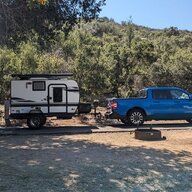
Either way, I'd love to have it resolved not too far into the future as right now I cannot tow our little teardrop camp trailer with the Maverick.
 

Sponsored

JRockett

New member
First Name
John
Joined
Oct 28, 2021
Threads
0
Messages
3
Reaction score
8
Location
83646
Vehicle(s)
Ford Maverick Hybrid
I took delivery of a Hybrid Maverick Lariat two weeks ago. After driving a Prius for ten years (270k reliable miles) I love driving my new truck and the practicality it offers. In busy SoCal traffic, I can attest to the usefulness of the Lane Centering and Adaptive Cruise features, it is very helpful. On my daily 60 mile+ freeway commute, I am also getting truly stellar fuel economy: consistently 40-41 mpg door to door doing 71-73 mph on the freeway with a few miles of city traffic on each end.

However: at around 600 miles on the ODO, I got a check engine light after "stepping on it" a bit more than typical when merging onto the freeway. The light stayed on for a few stop/start cycles and the next day the light turned off. I had the Ford dealer scan the car and it reported:

P0811 - $7EE "Generic" - Excessive Clutch A Slippage

They cleared the code told me to report back if it returns. The service manager had not seen this particular code on the Maverick before.

Several days later, now with 1,500 miles on the odometer, I step on it again when merging uphill (close to 100% engine load) and the light comes on again. And a few start/stop cycles later it disappears. What I did notice is that when the light is on, engine power seems to be limited to 70-75%. I have not had the car scanned, but I assume it is the same code.

This P0811 code is generic of course, and it does not seem to be directly applicable to this Ford Hybrid drivetrain because it lacks any clutches. I read (courtesy www.dtcdecode.com) that this code comes on when there is a difference between the PCM measured engine speed and the transmission speed. Possible causes listed: Damaged Crank Position Sensor, Damaged transmission damper, or damaged engine shaft. All these are not specific to the hybrid so may or may not be applicable.

I will go back to the dealer and they may have to check with Ford, but thought it wise to check in with the community to see if someone else has had this P0811 error code on a Hybrid?

Thanks for any feedback!
sorry you have issues with your Hybrid. Please keep us informed! I picked mine XL up 3 weeks ago and it has over 1500 miles without any issues so far. I do own Toyota Prius V for almost 7 years without any issues. The Maverick does get excellent gas mileage, I been consistently get better than EPA estimated.
 
OP
OP
mav47

mav47

2.5L Hybrid
Well-known member
Joined
Apr 4, 2022
Threads
7
Messages
130
Reaction score
426
Location
Carlsbad, California
Vehicle(s)
Ford Maverick Hybrid, Toyota Highlander Hybrid
Engine
2.5L Hybrid
Ok, I've been putting miles on my truck (now at 2,600) and taking it easy. I am waiting to see if Ford comes up with a solution of some kind.

But today, I thought I would test to see if the P0811 fault code would come up again. So I did a few full-throttle passes on the freeway to see if it would trigger.

On the first pass initially the engine speed increased (as you would expect), but suddenly the RPMs jumped up very quickly. I did what you would do when something unexpected happens: I let off the throttle. The sudden RPM increase actually felt as if you had a failing clutch in a manual transmission when under load it suddenly starts slipping and increases rpm.

However: I could not repeat this behavior: It only did it once, and only on the first run. Even a couple more full-throttle starts did not trigger it. I did notice that the power meter did not go much above 75% something I'd like to figure out whether that's normal (it may well be).

And today these full-throttle passes did NOT turn on the check engine light either.

Either way: I remember noticing the same unexpected RPM jump a few weeks back when I stepped on it and got my first P0811 code and corresponding check engine light.

Here's a theory: Maybe that safety clutch/damper between ICE and HF45 transaxle slips too soon causing that sudden rpm increase on the ICE that I noticed, and the friction heat generated expands the clutch or heats up the friction material just enough that it doesn't slip a second time?

I'll try it a few more times in the coming days, and see if I can make it do it again. If so, and I keep the throttle on, it may instantly trigger the P0811 code which could be a good indication of where the 2.5 Hybrid P0811 problem lies.
 
Last edited:

Airrun8

2.5L Hybrid
Member
First Name
Aaron
Joined
Mar 9, 2022
Threads
1
Messages
17
Reaction score
45
Location
San Antonio's TX
Vehicle(s)
Ford Maverick XL
Engine
2.5L Hybrid
Just wanted to post an update regarding my Maverick. I have had the P0811 code and my Maverick has been in the shop waiting for the damper for 6 weeks and finally got a call today that the truck is ready! I will update with any new info I get!
 
OP
OP
mav47

mav47

2.5L Hybrid
Well-known member
Joined
Apr 4, 2022
Threads
7
Messages
130
Reaction score
426
Location
Carlsbad, California
Vehicle(s)
Ford Maverick Hybrid, Toyota Highlander Hybrid
Engine
2.5L Hybrid
I have some interesting data to report:

I did some more full-throttle acceleration tests since the last one I described in my previous post. Unlike before I found that the driveline happily increased power to 100% and the Power Gauge needle stayed there (!), without any (noticeable) clutch slippage.

After several tests over several days, I am finding that the driveline performs as it should.

The question is now: why is it suddenly working?

I am cautiously concluding that the damper/clutch located between the internal combustion engine and the HF45 transaxle was likely slipping below its design torque rating.

And I can come up with various possible causes: maybe some slight inconsistencies in the friction material lining on the factory new clutch plate, maybe due to the fresh surface finish on the flywheel or pressure group, or maybe there is simply some remaining grease or oil (corrosion protection?) in the wrong location i.e on the friction surfaces.

Based on my observations it seems that if the Engine Control Module reads a discrepancy between expected ICE and transaxle RPM, it will restrict maximum driveline power. If the difference is significant it may set the OBD2 P0811 code (which it did twice on mine), but on small discrepancies, it may just restrict engine power i.e. my truck not wanting to exceed 70%.

I think that putting some good engine load on this clutch/damper in my truck caused it to slip several times and may have "bedded" the friction surfaces sufficiently that there is no more unwanted slip happening.

Note that this is all theory on my part, but it seems like a reasonable explanation. And If I have it wrong I stand ready to be corrected of course.

I will be monitoring this situation on my truck, but so far it looks like the issue may have resolved itself.

I also reported this issue to Ford, and also how it appears to have been resolved.

I am hoping this information helps some other Maverick Hybrid owners here and I will report back if anything changes on this end.
 
OP
OP
mav47

mav47

2.5L Hybrid
Well-known member
Joined
Apr 4, 2022
Threads
7
Messages
130
Reaction score
426
Location
Carlsbad, California
Vehicle(s)
Ford Maverick Hybrid, Toyota Highlander Hybrid
Engine
2.5L Hybrid
Just wanted to post an update regarding my Maverick. I have had the P0811 code and my Maverick has been in the shop waiting for the damper for 6 weeks and finally got a call today that the truck is ready! I will update with any new info I get!
Great!

I am very interested to hear whether replacing the clutch/damper fixed your P0811 issue (I sure hope it did!), and I'm also interested to hear if you have 100% engine power available under full throttle.

Thanks for any update you can give us.
 
Sponsored

Airrun8

2.5L Hybrid
Member
First Name
Aaron
Joined
Mar 9, 2022
Threads
1
Messages
17
Reaction score
45
Location
San Antonio's TX
Vehicle(s)
Ford Maverick XL
Engine
2.5L Hybrid
Ok so after a full day back with my Maverick I can say that the problem has been fixed!

A quick recap of events. My the CEL came on after accelerating hard, I took it to the dealership and they cleared it, and pushed an update but the CEL came back on after accelerating hard. They stated that they would have to replace the damper and that it was on backorder. Fast forward 6 weeks and they did replace my engine damper with a new one.

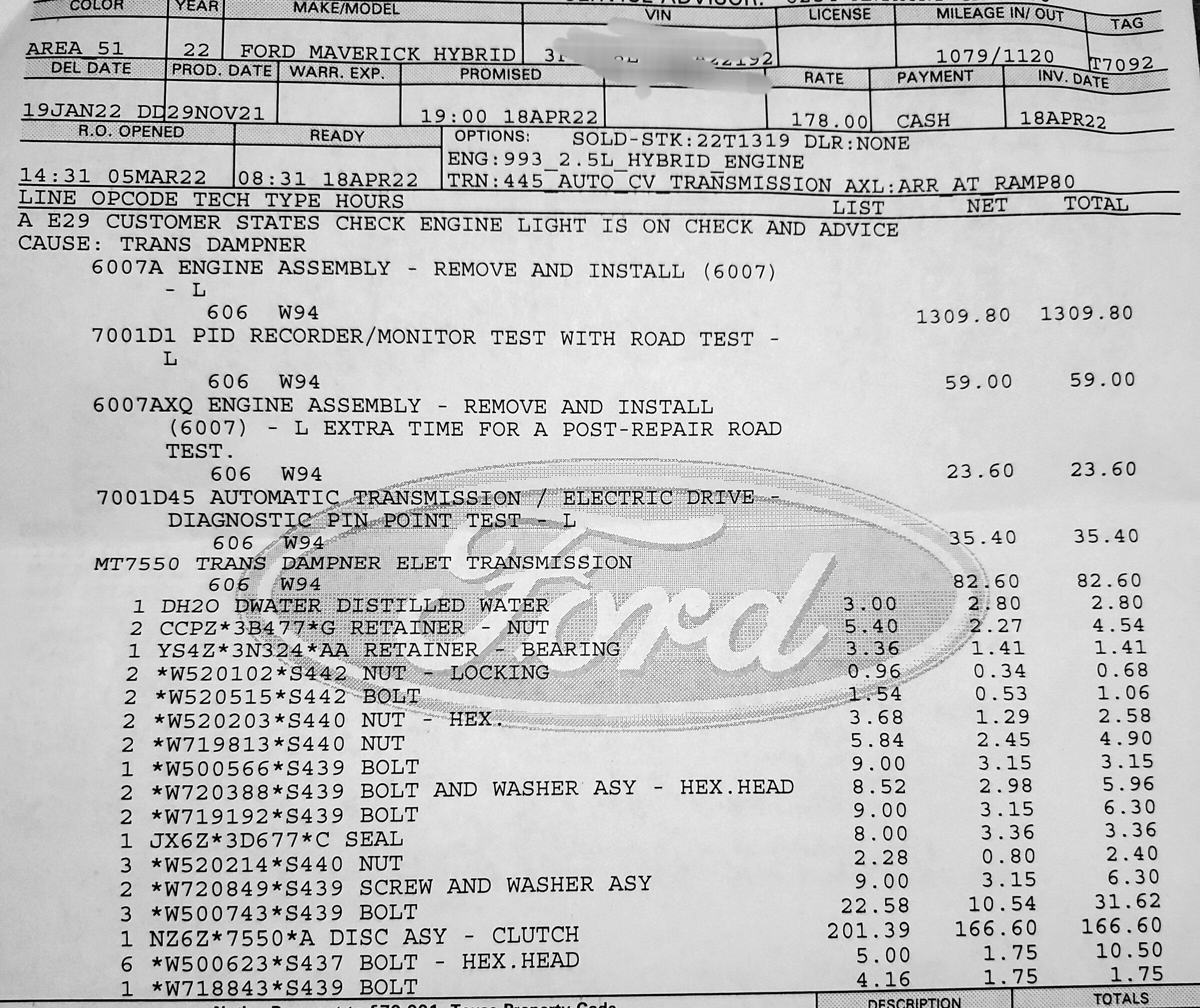
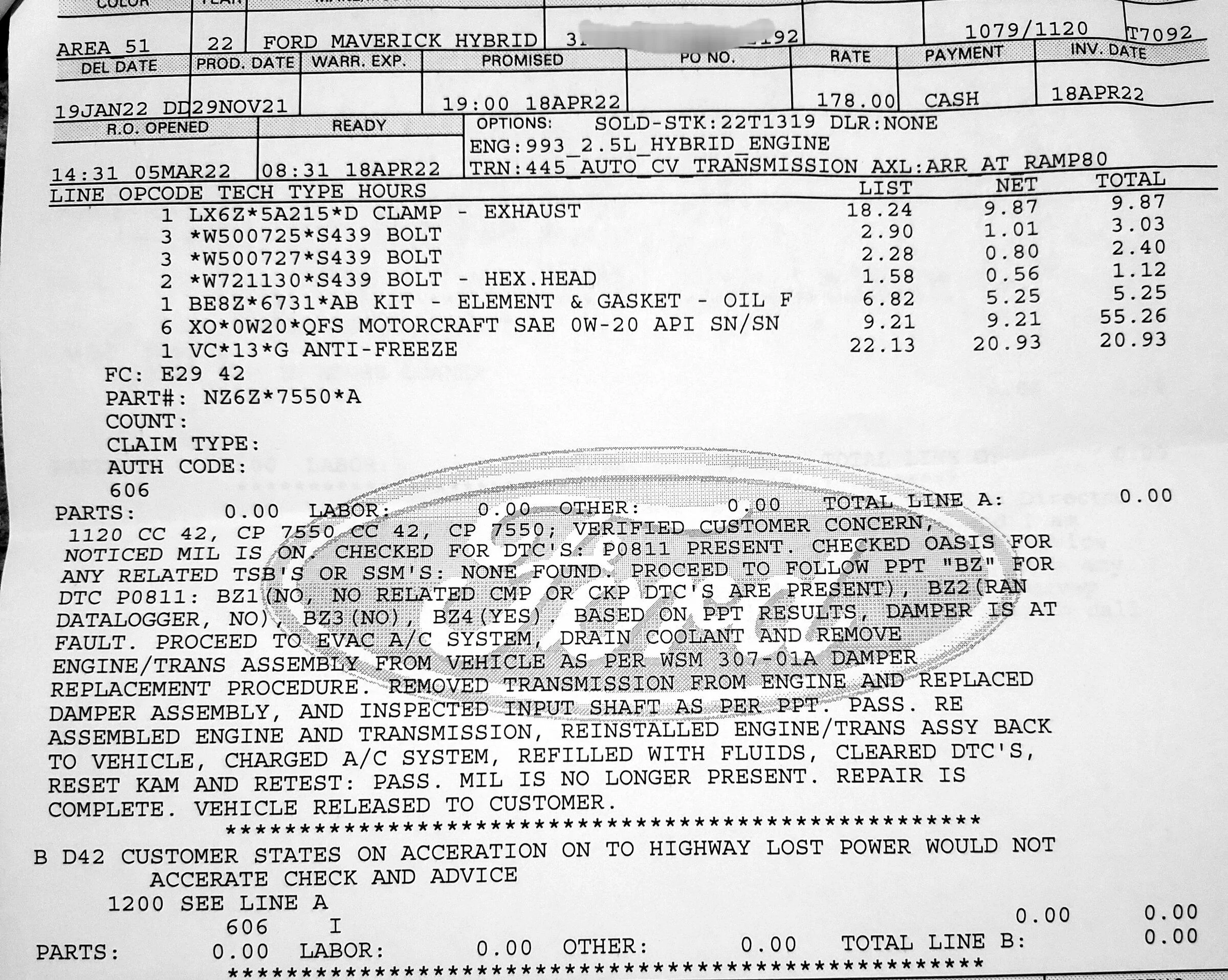
After I picked the Maverick up I floored the gas pedal multiple times. Each time the power gauge went to 100% and it accelerated with no issues. Both from a dead stop and merging onto the highway. Tried it again the next day with no issues. I will attach some pictures of my service order for those that want to see.

Overall it was a frustrating experience having my Maverick away from me for 6 weeks but that is what you get when you buy a first year model vehicle. I'm very happy to get my Maverick back and hope this issue was a one off!

Ford Maverick 2.5 Hybrid: P0811 code OBD2 20220419_213802


Ford Maverick 2.5 Hybrid: P0811 code OBD2 20220419_213629
 
OP
OP
mav47

mav47

2.5L Hybrid
Well-known member
Joined
Apr 4, 2022
Threads
7
Messages
130
Reaction score
426
Location
Carlsbad, California
Vehicle(s)
Ford Maverick Hybrid, Toyota Highlander Hybrid
Engine
2.5L Hybrid
As related to the Maverick 2.5 Hybrid, we can (cautiously) conclude the following:

- The Maverick Hybrid has a transmission damper called "Disk Assembly - Clutch" (Ford p/n NZ6Z*7550*A) located between the Internal Combustion Engine (ICE) and the HF45 transaxle. This clutch is designed to start slipping at a torque setting that is higher than the ICE can deliver i.e. under any engine torque up to 100% indicated it should NEVER slip.

- The Engine Control Unit (ECU) can read when there is a mismatch between the ICE RPM and the transaxle RPM due to said clutch slipping. It will then REDUCE AVAILABLE POWER for a while to prevent this slippage from occurring. This will not necessarily turn on the Check Engine Light (CEL). You may or may not notice this slippage when driving. If you generally drive the vehicle gently you may actually never notice that engine power is reduced (the power gauge won't go to 100%).

- When there is a large enough mismatch (slippage) for a certain amount of time the Check Engine Light will come on with an indicated "P0811 - Excessive Clutch A Slippage" code. This CEL will turn off after a few start/stop cycles. Engine power will be restricted, so you won't be able to see 100% power on the gauge.

- Replacing the Damper/Clutch unit appears to resolve the excessive slippage but is a pretty big job as it requires the engine/transaxle to be removed, and separated before reinstalling.

- A potential less intrusive remedy: Try loading up the clutch assembly under full engine torque a few times, and allow it to slip a few times (before the ECU steps in and reduces power for a while). This may cause the friction surfaces to be "bedded" properly and this may sufficiently raise the clutch slip torque level going forward. Basically: a few full-throttle acceleration runs over a few days may fix it (as it appears to have done on mine). The ECU will actively try to prevent slippage by reducing engine torque, so you may have to give it a few tries with some time in between.

- Ford will need to look carefully at this clutch assembly, the friction surfaces, and the installation procedure when mating the HF45 and the 2.5 Duratec ICE.
 
Last edited:

Decayed

2.0L EcoBoost
Well-known member
First Name
yes
Joined
Oct 18, 2021
Threads
51
Messages
3,358
Reaction score
5,209
Location
Directly above the center of the Earth
Vehicle(s)
a car
Engine
2.0L EcoBoost
I cant help but wonder if there isn't some "learning" going on with the engine and transmission computerized control system. Obviously a bad damper needs to be replaced but these things are designed to learn your driving habits. Maybe a combination of new parts not fully bedded and the computer system not adjusting fast enough to everything wearing in?
 

Airrun8

2.5L Hybrid
Member
First Name
Aaron
Joined
Mar 9, 2022
Threads
1
Messages
17
Reaction score
45
Location
San Antonio's TX
Vehicle(s)
Ford Maverick XL
Engine
2.5L Hybrid
Sounds likely. I saw someone on Reddit report that a simple ecu update fixed their issue.
 
OP
OP
mav47

mav47

2.5L Hybrid
Well-known member
Joined
Apr 4, 2022
Threads
7
Messages
130
Reaction score
426
Location
Carlsbad, California
Vehicle(s)
Ford Maverick Hybrid, Toyota Highlander Hybrid
Engine
2.5L Hybrid
I think the issue is likely related to the clutch friction surfaces, whether the friction plate, the pressure plate or the flywheel surface. It may be that one of the surfaces is too rough causing a lack of contact area between the friction plate and the opposite surface. Or it may be as simple as surface contamination (oil/grease applied to prevent corrosion?) not being cleaned off one of the surfaces before installing that clutch assembly. Or the roughness caused friction surface "glazing" when slipping which would need to be worn off before the clutch works properly.

It is kind of similar to when you install new brake pads (in a non-hybrid!): the first few stops they don't "bite" really well. This clutch assembly is no different, and if it doesn't bite sufficiently, it will likely slip at much lower torque than it's supposed to.

One other reason for this clutch slipping could be the clamping spring tension being out of spec (too low) These are the springs that clamp this clutch pack together. I think that Ford's and their supplier's QC is likely good enough to easily catch that. Plus, I think then that if the springs are the culprit, we're likely looking at many more of these Mavericks Hybrids having this issue.

It is certainly possible that Airrun8's clutch assembly that came out of his truck may have been mechanically fine with all components in spec. His issue could be caused by an oily flywheel surface, or some glazing that occurred on the friction plate, due to the friction plate being just a little too rough from the factory. Replacing the clutch assembly with a fresh one, and carefully doing the installation resolved his issue, which is great of course!

Based on what I experienced with mine: it is also possible that Airrun8's first clutch could have "fixed itself" if left untouched...!

Glazing can behave in weird ways though: sometimes the glazed surface simply wears off, and sometimes it never goes away, which is something I had on an Audi A3: the brakes never felt right from new, until I replaced the glazed (and like new!) front pads at like 15k miles and roughed up the rotors a bit, which restored brake performance.

An ECU update fix is a possibility maybe to "raise the threshold" for reducing power and/or when to set the P0811 CEL code, but wouldn't have worked on my truck: I could tell when my clutch started slipping on at least three occasions. You don't fix that with an ECU update.

However: over time, as this type of friction clutch beds in, it will gain more friction between the surfaces, and will start slipping at a higher torque setting until it doesn't slip at all. It didn't take more than a couple of P0811 CELs and some time at restricted power with some full-throttle runs until mine stopped slipping completely. Fingers crossed that it stays that way, at this point, I'm starting to get confident that it will.
Sponsored


Top