

- Thread starter
- #1
https://fueleconomy.gov/feg/octane.shtml
this seems especially relevant in consideration of never ending "debate" and opinions on what is best for our Mavericks. Enjoy!
Selecting the Right Octane Fuel
What is octane rating?
Gas pump showing octane options
Octane rating is the measure of a fuel's ability to resist "knocking" or "pinging" during combustion, caused by the air/fuel mixture detonating prematurely in the engine.
In the U.S., unleaded gasoline typically has octane ratings of 87 (regular), 88–90 (midgrade), and 91–94 (premium). Gasoline with an octane rating of 85 is available in some high-elevation areas of the U.S. (more about that below).
The octane rating is prominently displayed in large black numbers on a yellow background on gasoline pumps.
What octane fuel should I use in my vehicle?
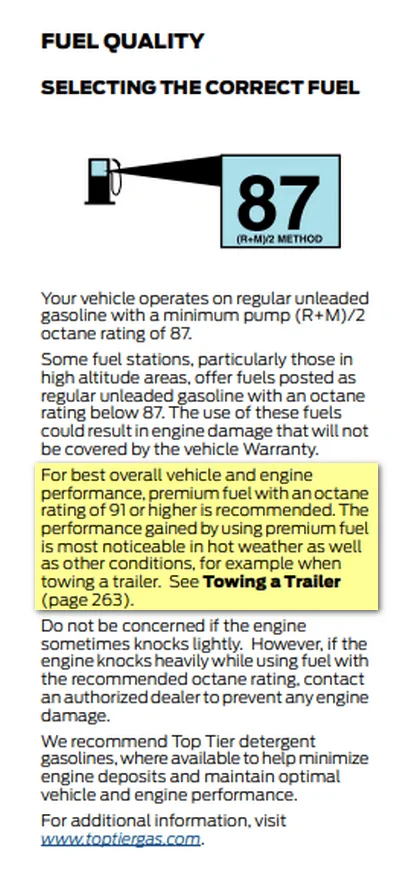
You should use the octane rating required for your vehicle by the manufacturer. So, check your owner's manual. Most gasoline vehicles are designed to run on 87 octane, but others are designed to use higher octane fuel.
Why do some manufacturers require or recommend the use of higher octane gasoline?
Higher octane fuels are often required or recommended for engines that use a higher compression ratio and/or use supercharging or turbocharging to force more air into the engine. Increasing pressure in the cylinder allows an engine to extract more mechanical energy from a given air/fuel mixture but requires higher octane fuel to keep the mixture from pre-detonating. In these engines, high octane fuel will improve performance and fuel economy.
What if I use a lower octane fuel than required for my vehicle?
Using a lower octane fuel than required can cause the engine to run poorly and can damage the engine and emissions control system over time. It may also void your warranty. In older vehicles, the engine can make an audible "knocking" or "pinging" sound. Many newer vehicles can adjust the spark timing to reduce knock, but engine power and fuel economy will still suffer.
Will using a higher octane fuel than required improve fuel economy or performance?
It depends. For most vehicles, higher octane fuel may improve performance and gas mileage and reduce carbon dioxide (CO2) emissions by a few percent during severe duty operation, such as towing a trailer or carrying heavy loads, especially in hot weather. However, under normal driving conditions, you may get little to no benefit.
Why does higher octane fuel cost more?
The fuel components that boost octane are generally more expensive to produce.
Is higher octane fuel worth the extra cost?
If your vehicle requires midgrade or premium fuel, absolutely. If your owner's manual says your vehicle doesn't require premium but says that your vehicle will run better on higher octane fuel, it's really up to you. The cost increase is typically higher than the fuel savings. However, lowering CO2 emissions and decreasing petroleum usage by even a small amount may be more important than cost to some consumers.
What is 85 octane, and is it safe to use in my vehicle?
The sale of 85 octane fuel was originally allowed in high-elevation regions—where the barometric pressure is lower—because it was cheaper and because most carbureted engines tolerated it fairly well. This is not true for modern gasoline engines. So, unless you have an older vehicle with a carbureted engine, you should use the manufacturer-recommended fuel for your vehicle, even where 85 octane fuel is available.
Can ethanol boost gasoline's octane rating?
Yes. Ethanol has a much higher octane rating (about 109) than gasoline. Refiners usually blend ethanol with gasoline to help boost its octane rating—most gasoline in the U.S. contains up to 10% ethanol. Blends of up to 15% ethanol are available in some areas, and several manufacturers approve using this blend in recent-model vehicles.
this seems especially relevant in consideration of never ending "debate" and opinions on what is best for our Mavericks. Enjoy!
Selecting the Right Octane Fuel
What is octane rating?
Gas pump showing octane options
Octane rating is the measure of a fuel's ability to resist "knocking" or "pinging" during combustion, caused by the air/fuel mixture detonating prematurely in the engine.
In the U.S., unleaded gasoline typically has octane ratings of 87 (regular), 88–90 (midgrade), and 91–94 (premium). Gasoline with an octane rating of 85 is available in some high-elevation areas of the U.S. (more about that below).
The octane rating is prominently displayed in large black numbers on a yellow background on gasoline pumps.
What octane fuel should I use in my vehicle?
You should use the octane rating required for your vehicle by the manufacturer. So, check your owner's manual. Most gasoline vehicles are designed to run on 87 octane, but others are designed to use higher octane fuel.
Why do some manufacturers require or recommend the use of higher octane gasoline?
Higher octane fuels are often required or recommended for engines that use a higher compression ratio and/or use supercharging or turbocharging to force more air into the engine. Increasing pressure in the cylinder allows an engine to extract more mechanical energy from a given air/fuel mixture but requires higher octane fuel to keep the mixture from pre-detonating. In these engines, high octane fuel will improve performance and fuel economy.
What if I use a lower octane fuel than required for my vehicle?
Using a lower octane fuel than required can cause the engine to run poorly and can damage the engine and emissions control system over time. It may also void your warranty. In older vehicles, the engine can make an audible "knocking" or "pinging" sound. Many newer vehicles can adjust the spark timing to reduce knock, but engine power and fuel economy will still suffer.
Will using a higher octane fuel than required improve fuel economy or performance?
It depends. For most vehicles, higher octane fuel may improve performance and gas mileage and reduce carbon dioxide (CO2) emissions by a few percent during severe duty operation, such as towing a trailer or carrying heavy loads, especially in hot weather. However, under normal driving conditions, you may get little to no benefit.
Why does higher octane fuel cost more?
The fuel components that boost octane are generally more expensive to produce.
Is higher octane fuel worth the extra cost?
If your vehicle requires midgrade or premium fuel, absolutely. If your owner's manual says your vehicle doesn't require premium but says that your vehicle will run better on higher octane fuel, it's really up to you. The cost increase is typically higher than the fuel savings. However, lowering CO2 emissions and decreasing petroleum usage by even a small amount may be more important than cost to some consumers.
What is 85 octane, and is it safe to use in my vehicle?
The sale of 85 octane fuel was originally allowed in high-elevation regions—where the barometric pressure is lower—because it was cheaper and because most carbureted engines tolerated it fairly well. This is not true for modern gasoline engines. So, unless you have an older vehicle with a carbureted engine, you should use the manufacturer-recommended fuel for your vehicle, even where 85 octane fuel is available.
Can ethanol boost gasoline's octane rating?
Yes. Ethanol has a much higher octane rating (about 109) than gasoline. Refiners usually blend ethanol with gasoline to help boost its octane rating—most gasoline in the U.S. contains up to 10% ethanol. Blends of up to 15% ethanol are available in some areas, and several manufacturers approve using this blend in recent-model vehicles.
Sponsored