
Sponsored
Ford doing something about greedy dealers and flippers?
- Thread starter TacoHolder
- Start date
- Watchers 11

- Banned
- #92
Oh, and BTW- I SOLD cars with large dealer markups/addenda back in 1990s, 1996 911 Turbos for starters. Surely there must have been some AG lawsuits back then?? No?!


- First Name
- Edge
- Joined
- Jul 17, 2021
- Threads
- 5
- Messages
- 1,353
- Reaction score
- 1,827
- Location
- CARBONDALE-Atlanta
- Vehicle(s)
- PORSCHE
- Engine
- 2.5L Hybrid
I sold 11 acres of land yesterday. Within the Closing Contract was a simple sentence that said "the purchaser cannot put a mobile home(s) on the land, ever. And the Closing Statement can not sell to another to do the same. Nor can they subdivide the land in less than 5 acre tracks." Real simple and very enforceable, and I had it placed in the contract to protect my neighbors.Not a lawyer but I think the issue is did Ford present the purchaser with a valid, enforceable contract and did the purchaser sign it without coercion. Otherwise, courts and judges tend to uphold those and punish those who don’t honor their contracts. Ford also refers dealerships to their own counsels to make sure contracts are crafted by subject matter experts on state an local laws, e.g. dealership counsel.
Will Ford run out and get an injunction for every one of those electric F150 sales before they happen, probably not. Will they hire attorneys to troll dmv records and file cases to claw back the money, maybe. Will they ever do that on a low cost maverick, seriously doubt it. They will just crank up production b/c it’s the lower end budget/value vehicle and they intend to make as many as they can sell. Ford probably views the Maverick the same way they did a focus, or an ecosport, entry level.
Last edited:

Let's keep the story straight, shall we?
I've said from the beginning that the real issue is with false advertising, not with selling above MSRP.
Your other links discuss off-target issues about "destination fees" [not a part of MSRP], taxes, finance charges, and used car appraisals. Far afield from MSRP and not worth discussing.
I've said from the beginning that the real issue is with false advertising, not with selling above MSRP.
- Me: "You seem to be mixing the ideas of false advertising and selling over MSRP."
- You: "No not mixing ideas at all, they are one in the same."
The one slightly relevant link you posted says dealers can get in trouble for false advertising, which I of course agree with. What it doesn't say -- doesn't even mention -- is your erroneous idea that the MSRP is the advertised price and thus selling above MSRP is false advertising.I already provided three instances where advertised prices were in dispute, two of which involved manufacturers (MSRP vs Destination), you’ve just ignored them.
Your other links discuss off-target issues about "destination fees" [not a part of MSRP], taxes, finance charges, and used car appraisals. Far afield from MSRP and not worth discussing.
That's a ... stretch. Although you have claimed all along that Ford or the dealer touting the MSRP is the same as advertising the car for that price -- I have said the opposite.Obviously, you’re trying to argue a technicality because you already know that MSRP is the advertised price and market adjustments, inflated fees, and the sausage making at the dealership is something totally different. In fact you’ve said as much in prior posts.
Finally, just to keep us tethered to reality, here's an article about 10 different models that are currently selling over MSRP. You may think market adjustments are a new thing, but they are not. If it were illegal don't you think we would see at least a few articles directly saying so? But we don't, because it's not illegal.But you appear to think that touting MSRP is the same as a dealer advertising a car for a certain price. It's not.
Again you’re trying to pedal this idea that MSRP isn’t an advertised price. If you could just figure out that it is, then you will see that all of your posts are off-topic and completely irrelevant to the letter that was part of my discussion. And if it’s not an advertised price why bother putting starting at and a legal disclosure, right next to it on Ford’s very own website? Why even have a configurator with advertised prices in them at all. I think those things are advertisements and Ford’s trying to sell me something, rightLet's keep the story straight, shall we?
I've said from the beginning that the real issue is with false advertising, not with selling above MSRP.
Your reply, from the beginning, has been that selling over MSRP is false advertising.
- Me: "You seem to be mixing the ideas of false advertising and selling over MSRP."
- You: "No not mixing ideas at all, they are one in the same."
The one slightly relevant link you posted says dealers can get in trouble for false advertising, which I of course agree with. What it doesn't say -- doesn't even mention -- is your erroneous idea that the MSRP is the advertised price and thus selling above MSRP is false advertising.
Your other links discuss off-target issues about "destination fees" [not a part of MSRP], taxes, finance charges, and used car appraisals. Far afield from MSRP and not worth discussing.
That's a ... stretch. Although you have claimed all along that Ford or the dealer touting the MSRP is the same as advertising the car for that price -- I have said the opposite.
Finally, just to keep us tethered to reality, here's an article about 10 different models that are currently selling over MSRP. You may think market adjustments are a new thing, but they are not. If it were illegal don't you think we would see at least a few articles directly saying so? But we don't, because it's not illegal.

Disclosure could have been okay up until the point you have a 25% dealer fee for market adjustments. That’s pretty darned hard for Ford to defend, given we know that GM and Stellantis have lawsuits for inflated destination fees < 10% of MSRP. Keep putting out bad information and I will keep batting it back your way! It’s funny how you keep changing your angle and mine stays pretty darmed consistent throughout. Sure you’re not a dealership employee? I’m guessing Auto Tech, parts or manager at a dealership in the southwest, how close am I?
Last edited:
Sponsored

- First Name
- Rick
- Joined
- Feb 15, 2021
- Threads
- 66
- Messages
- 830
- Reaction score
- 1,243
- Location
- Meridian, ID
- Vehicle(s)
- 2022 Ford Maverick XL Hybrid
- Engine
- 2.5L Hybrid
It's the dealers who need to sign a no resale agreement. Vehicles which are not sold to the original customer who ordered them can only be sold by the dealer at that same price with no additional markup. This would give the dealer no room for jacking up the price and would also prevent dealers from trying to add "Market Adjustment Fees" to vehicles they might acquire via cancelled orders.The no resell clause is a nonstarter.
- First Name
- Hawley
- Joined
- Jul 16, 2021
- Threads
- 11
- Messages
- 699
- Reaction score
- 658
- Location
- Austin, TX
- Vehicle(s)
- Honda Insight, E350, Toyota Sequoia
- Engine
- 2.5L Hybrid
What is "market adjustment" ? How can a dealer know what market adjustment actually is if there is no history in the market for a particular product. What I am saying is that therE is no market analysis to show a dealer what their so called 'market adjustment' should be . It is simply added arbitrary profit that the dealer wishes to hide with phraseology.
When you buy a new iteration of a Corvette the dealer will tell you upfront that they are going to tack on "X" amount of dollar$ to the MSRP. You either accept it or not. THAT IS FAIR!!!
When you buy a new iteration of a Corvette the dealer will tell you upfront that they are going to tack on "X" amount of dollar$ to the MSRP. You either accept it or not. THAT IS FAIR!!!
Let's try it this way...Sure you’re not a dealership employee? I’m guessing Auto Tech, parts or manager at a dealership in the southwest, how close am I?
You know from the article I linked that selling cars for over MSRP has been going on for at least 30 years.
So... Why, in all that time, haven't dealers been sued into submission and forced to sell at MSRP?
Can you answer that question directly? Can you at least try to answer that question?
After all, I can answer it pretty easily. It's because it's legal to sell for over MSRP.
BTW, your guess that I am affiliated with the auto industry is wildly wrong. I've ignored your other personal attacks (about my being so "ignorant," you know), but I thought I'd set your mind at ease on this one.
Because your question much like your point and answer to it are misleading. You try to use a technical name, like oh this is a Marroney sticker, blah, blah, blah so on and so forth missing the main point.Let's try it this way...
You know from the article I linked that selling cars for over MSRP has been going on for at least 30 years.
So... Why, in all that time, haven't dealers been sued into submission and forced to sell at MSRP?
Can you answer that question directly? Can you at least try to answer that question?
After all, I can answer it pretty easily. It's because it's legal to sell for over MSRP.
BTW, your guess that I am affiliated with the auto industry is wildly wrong. I've ignored your other personal attacks (about my being so "ignorant," you know), but I thought I'd set your mind at ease on this one.
Advertised pricing being substantially different between Ford and their dealership network. Market adjustments simply make them more substantial, meaning more money, more bad press, more Attorney General’s getting involved and more cases. Easier and blatant to detect. Now easier to tie to Ford. Easier to take to court and more dollars to go after. More evidence like the email that’s now mysteriously disappeared. The destination fee cases between GM and Stellantis are small percentages. In short, fraud 101 but it takes time to put those cases together.
Sure, I could give you real world cases like the Honda Dealership shut down in the Bronx or any of a number of dealerships that have been closed due to overcharging, fraud but you don’t want to hear it, so why waste the time or the energy explaining it to you? It’s funny you take as insult to be compared to a dealership employee b/c you act just like one. All your answers are in my previous posts. Just re-read them till they make sense.
Last edited:
- Joined
- Nov 2, 2021
- Threads
- 46
- Messages
- 2,003
- Reaction score
- 2,136
- Location
- Orlando, Florida
- Vehicle(s)
- 2023 Ford Maverick Lariat BAP
- Engine
- 2.5L Hybrid
Entering into a contract is fine by me and totally legal. Look at homes or commercial properties. Many commercial properties come with restrictions on what can be used on that property. It is made clear before signing on closing. Of you don't accept them, someone else will. It's only for one year. They aren't asking you to keep it for 5 years before getting rid of it.
Sponsored
The question was pretty straightforward:Because your question much like your point and answer to it are misleading. You try to use a technical name, like oh this is a Marroney sticker, blah, blah, blah so on and so forth missing the main point.
Advertised pricing being substantially different between Ford and their dealership network. Market adjustments simply make them more substantial, meaning more money, more bad press, more Attorney General’s getting involved and more cases. Easier and blatant to detect. The destination fee cases between GM and Stellantis are small percentages.
In short, fraud 101. Sure, I could give you real world cases like the Honda Dealership shut down in the Bronx or any of a number of dealerships that have been closed due to fraud but you don’t want to hear it, so why waste the time or the energy explaining it to you. It’s funny you take as insult to be compared to a dealership employee b/c you act just like one.
- If selling above MSRP is illegal, and dealers have been doing it for 30 years, then why haven't dealers been sued into submission and forced to sell at MSRP?
I didn't really expect an intelligible answer, so I'm not disappointed. It's been fun...

- First Name
- Kip
- Joined
- Oct 26, 2021
- Threads
- 154
- Messages
- 1,382
- Reaction score
- 1,999
- Location
- Atlanta, GA
- Vehicle(s)
- Toyota Rav4
- Engine
- 2.5L Hybrid
So Ford is referring their customer or Purchaser as ‘it’ now?Seems like a step in the right direction.
From the F150 Lightning forum. Link to original post below.
https://www.f150gen14.com/forum/threads/-ford-warns-dealers-against-additional-deposit-reservation-requirements-for-lightning-orders-supports-no-resale-provisions-in-purchase-contracts.7961/
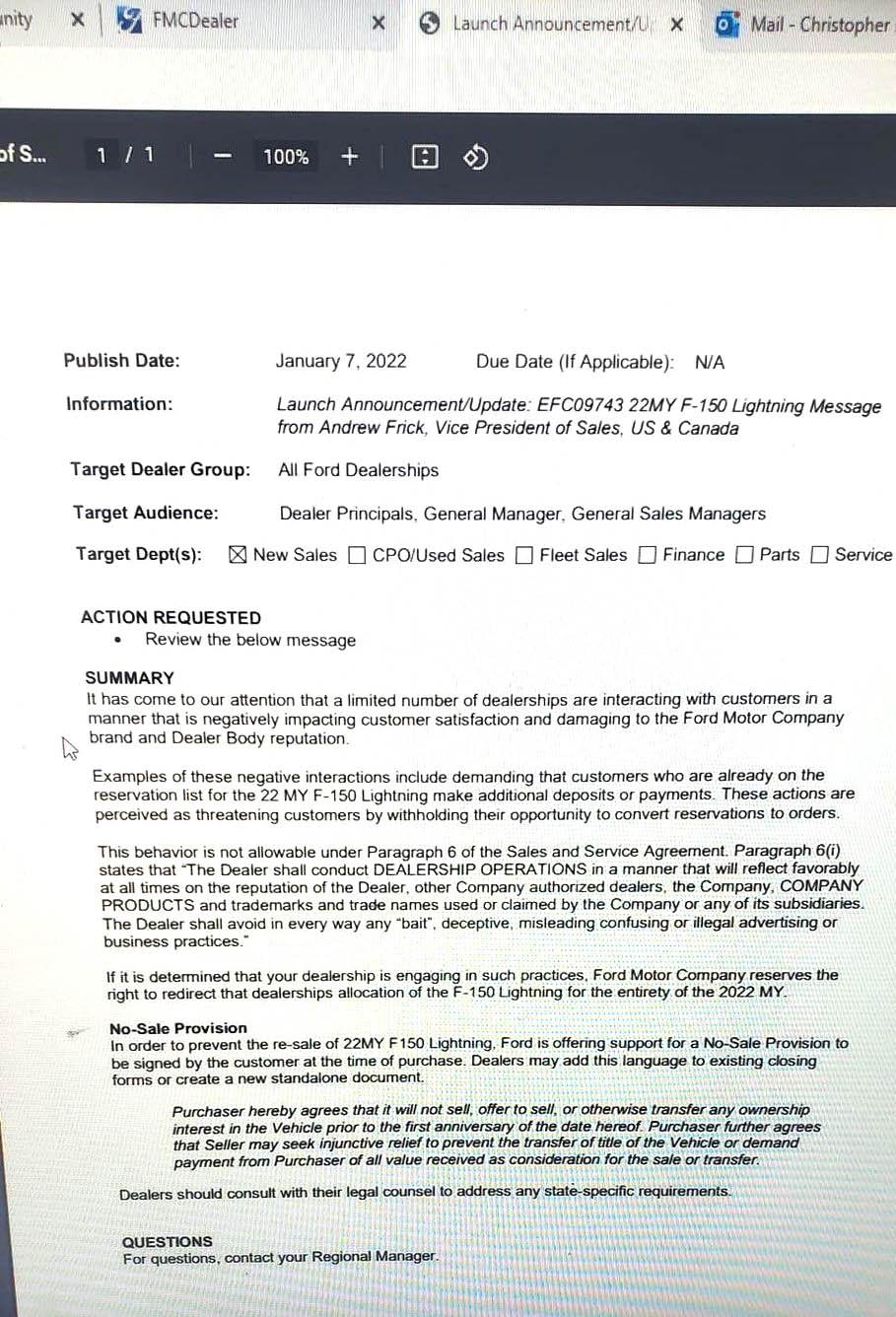
I think that's probably right.And the courts will use any contract that you signed to submit that order and/or take delivery of said vehicle but I’m not an attorney. It is not unconscionable to insert terms and conditions on the sale of a product, no matter how you pay for it. Apple does it all the time.
I also think the actual restriction on transfer -- once we see it in writing -- will probably have some wiggle room in it to make it more palatable.
Often there are provisions that allow transfer when there are extenuating circumstances. For example, if the owner dies the vehicle can be transferred to the heir. Taking the car from the grieving daughter is not something Ford wants to be involved in.


Not disagreeing with your post here, but I hope someone actually proofread the language and corrected "tracks" to read tracts. They are 2 different things and you would want the correct word in legal closing documents. Probably just a dumb spellcheck error that was caught at some pointI sold 11 acres of land yesterday. Within the Closing Contract was a simple sentence that said "the purchaser cannot put a mobile home(s) on the land, ever. And the Closing Statement can not sell to another to do the same. Nor can they subdivide the land in less than 5 acre tracks." Real simple and very enforceable, and I had it placed in the contract to protect my neighbors.

- Banned
- #105
Sigh.
Manufacturer's
Suggested
Retail
Price
Suggested
Got it now?
You're welcome!
Manufacturer's
Suggested
Retail
Price
Suggested
Got it now?
You're welcome!
Again you’re trying to pedal this idea that MSRP isn’t an advertised price.
Sponsored
Similar threads


- Replies
- 4
- Views
- 1,102