
Sponsored

- First Name
- Edge
- Joined
- Jul 17, 2021
- Threads
- 5
- Messages
- 1,353
- Reaction score
- 1,826
- Location
- CARBONDALE-Atlanta
- Vehicle(s)
- PORSCHE
- Engine
- 2.5L Hybrid
I DID NOT WRITE THIS: I SIMPLY FOUND THIS USEFUL.
A member on this site posted it 2, 3 years ago and it has always helped me in getting 40+ mpg. The biggest issue with a Hybrid is when your foot is off the gas, as in coasting down a hill, the ICE motor stops pumping gas and the rotating ICE motor is functioning like a generator to re-charge the battery.
Maximizing Fuel Efficiency in a 2022 Ford Maverick
Overview: This document details the strategies I have utilized to average ~41-42 mpg in a 2022 Ford Maverick Hybrid.
Energy: Hybrid vehicles four main forms of energy.
1 Gasoline.
2. Electrical energy generated by the generator-motor, regenerative brakes stored in battery.
3. Kinetic energy in the engine itself.
4. Heat energy from the brakes.
There's no such physical part called a regenerative brake, it's just the motor acting as a generator and dragging the transmission to recharge the vehicles battery while driving the vehicle.
Guiding Principles: Every energy conversion is imperfect. The least efficient conversion is the conversion to heat in the mechanical brakes. You get nothing out of it besides worn brake pads! Therefore, we can attack efficiency from two prongs.
Minimize use of mechanical friction brakes.
The hybrid drive train will convert your motion into electrical energy to store in the battery by way of regenerative braking. In regenerative braking the engine as when coasting, saved electrical energy in the battery that can later be used to move the vehicle.
Minimize braking! But in the real world, red lights, curves, and other road users exist, so that isn’t always possible. So instead, minimize how much kinetic energy needs to be braked away - go slower and coast when possible! Nobody gains time by getting to a red light faster to sit there. Predict how much throttle you need to coast to the next red light with minimal braking.
Equipment
Tires: I buy and use the stock tires that came with the truck – larger/wider tire will take away 2-7 mpg....been proven time and time again. The weight of tires is a significant factor when choosing new tires. Ford carefully chose the best mpg tires. They rated 35psi pressure – I inflate to 38 psi which saves gas. Manufacturer-recommended tire pressures to optimize soft ride, noise, vibration, harshness over efficiency. I find 38 psi makes no difference in ride, but definitely give a little better mpg. This minimizes rolling resistance.
Tonneau/Bed Cover: Study after study make very minute improvement of MPG, very slight aerodynamic efficiency benefit.
Gasoline: Many gas pumps have 87 octane, I run standard 89+ octane since it provides 2 or 3 extra MPG. I find 87 octane significantly reduces mpg. I frequently add a gallon or 2 of medium grade (89 octane) and better mpg and performance is noticeable.
Climate Control: If mpg is super important minimize use of A/C and heater. On a hybrid both run off of electric battery/electricity requiring more engine power to regenerate both. Vents in the Maverick are the best I've ever seen.
Drive Modes: The Ford Maverick comes with five available few drive modes.
Normal: slight regen-drag on throttle lift with a 5-10 second lag when at zero-throttle before shutting off the gas engine when driving at highway speeds.
Eco Mode: In Eco mode, the vehicle provides a relatively strong regenerative-drag on full throttle lift. While it sometimes does still lag before shutting off the gas engine while giving it just a little bit of throttle to coast freely, a quick lift to zero-throttle will usually engage the full regen-drag enough to stop the gas engine to glide. This provides an easy way to get in and out of pulse-glide cycles.
Slippery Mode: This is almost the opposite of eco mode - minimal regenerative-drag on throttle lift. If you don’t need to slow down or stop, it’s best to utilize zero regen so you can coast freely. But on the highway, it’s useful to have regen-on-lift available in certain scenarios, so I generally avoid this mode.
Sport Mode: only use when needed since it suck gas to probably 35 mpg or worse.
Driver Behavior/Strategy
Choosing a Drive Mode: At lower speeds, on city streets, with traffic lights, I usually use Normal mode. The properties of Eco mode (high regen drag, reduced throttle response) don’t gain me anything at lower speeds and sometimes the regen drag can be too much when I want to coast to a light.
On the highway, many utilize Slippery mode for its low-drag drive. I prefer Eco mode.
EV Coach: The EV Coach display provides driver information about the current drive train energy flow. While raw numbers are not provided, it’s easy to estimate battery state of charge and available electric power from EV Coach display.
City Driving: The key to city hybrid driving efficiency, is to minimize braking. And the way to minimize braking in a world of red lights, cross traffic, parallel parking, and the occasional traffic stops is to minimize unneeded acceleration.
What does “unneeded” throttle mean? If there’s a red light visible ahead with no one behind me, I am off the throttle! As I approach the light, I will gradually begin to apply brake, keeping EV coach firmly in the regen-zone.
Highway Driving: The 1.1 kWh battery in the Maverick in insufficient to rely on as a primary energy source when driving on the highway. If you tried to drive on electric at 55+ MPH, your battery would be out in a about a mile. The key to efficient highway driving is to minimize engine-on time, while also minimizing electrical expenditures, as a flat battery will force the ICE engine to turn on.
Bottom line is the Maverick Hybrid will coast forever on rolling hill roads. I rarely get below 41 or 42 mpg. On long road trips and steep mountains I religiously use the Cruise Control.
A member on this site posted it 2, 3 years ago and it has always helped me in getting 40+ mpg. The biggest issue with a Hybrid is when your foot is off the gas, as in coasting down a hill, the ICE motor stops pumping gas and the rotating ICE motor is functioning like a generator to re-charge the battery.
Maximizing Fuel Efficiency in a 2022 Ford Maverick
Overview: This document details the strategies I have utilized to average ~41-42 mpg in a 2022 Ford Maverick Hybrid.
Energy: Hybrid vehicles four main forms of energy.
1 Gasoline.
2. Electrical energy generated by the generator-motor, regenerative brakes stored in battery.
3. Kinetic energy in the engine itself.
4. Heat energy from the brakes.
There's no such physical part called a regenerative brake, it's just the motor acting as a generator and dragging the transmission to recharge the vehicles battery while driving the vehicle.
Guiding Principles: Every energy conversion is imperfect. The least efficient conversion is the conversion to heat in the mechanical brakes. You get nothing out of it besides worn brake pads! Therefore, we can attack efficiency from two prongs.
Minimize use of mechanical friction brakes.
The hybrid drive train will convert your motion into electrical energy to store in the battery by way of regenerative braking. In regenerative braking the engine as when coasting, saved electrical energy in the battery that can later be used to move the vehicle.
Minimize braking! But in the real world, red lights, curves, and other road users exist, so that isn’t always possible. So instead, minimize how much kinetic energy needs to be braked away - go slower and coast when possible! Nobody gains time by getting to a red light faster to sit there. Predict how much throttle you need to coast to the next red light with minimal braking.
Equipment
Tires: I buy and use the stock tires that came with the truck – larger/wider tire will take away 2-7 mpg....been proven time and time again. The weight of tires is a significant factor when choosing new tires. Ford carefully chose the best mpg tires. They rated 35psi pressure – I inflate to 38 psi which saves gas. Manufacturer-recommended tire pressures to optimize soft ride, noise, vibration, harshness over efficiency. I find 38 psi makes no difference in ride, but definitely give a little better mpg. This minimizes rolling resistance.
Tonneau/Bed Cover: Study after study make very minute improvement of MPG, very slight aerodynamic efficiency benefit.
Gasoline: Many gas pumps have 87 octane, I run standard 89+ octane since it provides 2 or 3 extra MPG. I find 87 octane significantly reduces mpg. I frequently add a gallon or 2 of medium grade (89 octane) and better mpg and performance is noticeable.
Climate Control: If mpg is super important minimize use of A/C and heater. On a hybrid both run off of electric battery/electricity requiring more engine power to regenerate both. Vents in the Maverick are the best I've ever seen.
Drive Modes: The Ford Maverick comes with five available few drive modes.
Normal: slight regen-drag on throttle lift with a 5-10 second lag when at zero-throttle before shutting off the gas engine when driving at highway speeds.
Eco Mode: In Eco mode, the vehicle provides a relatively strong regenerative-drag on full throttle lift. While it sometimes does still lag before shutting off the gas engine while giving it just a little bit of throttle to coast freely, a quick lift to zero-throttle will usually engage the full regen-drag enough to stop the gas engine to glide. This provides an easy way to get in and out of pulse-glide cycles.
Slippery Mode: This is almost the opposite of eco mode - minimal regenerative-drag on throttle lift. If you don’t need to slow down or stop, it’s best to utilize zero regen so you can coast freely. But on the highway, it’s useful to have regen-on-lift available in certain scenarios, so I generally avoid this mode.
Sport Mode: only use when needed since it suck gas to probably 35 mpg or worse.
Driver Behavior/Strategy
Choosing a Drive Mode: At lower speeds, on city streets, with traffic lights, I usually use Normal mode. The properties of Eco mode (high regen drag, reduced throttle response) don’t gain me anything at lower speeds and sometimes the regen drag can be too much when I want to coast to a light.
On the highway, many utilize Slippery mode for its low-drag drive. I prefer Eco mode.
EV Coach: The EV Coach display provides driver information about the current drive train energy flow. While raw numbers are not provided, it’s easy to estimate battery state of charge and available electric power from EV Coach display.
City Driving: The key to city hybrid driving efficiency, is to minimize braking. And the way to minimize braking in a world of red lights, cross traffic, parallel parking, and the occasional traffic stops is to minimize unneeded acceleration.
What does “unneeded” throttle mean? If there’s a red light visible ahead with no one behind me, I am off the throttle! As I approach the light, I will gradually begin to apply brake, keeping EV coach firmly in the regen-zone.
Highway Driving: The 1.1 kWh battery in the Maverick in insufficient to rely on as a primary energy source when driving on the highway. If you tried to drive on electric at 55+ MPH, your battery would be out in a about a mile. The key to efficient highway driving is to minimize engine-on time, while also minimizing electrical expenditures, as a flat battery will force the ICE engine to turn on.
Bottom line is the Maverick Hybrid will coast forever on rolling hill roads. I rarely get below 41 or 42 mpg. On long road trips and steep mountains I religiously use the Cruise Control.
Last edited:

Only the A/C is fully electric. The hybrid still uses the engine heat to heat the cabin. There are supplemental electric heating strips but they draw too much power to be used on their own for for very long.Climate Control: If mpg is super important minimize use of A/C and heater. On a hybrid both run off of electric battery/electricity requiring more engine power to regenerate both. Vents in the Maverick are the best I've ever seen.
Honestly, slippery mode is good because you WANT regen when applying the brakes. You don't want to be using friction brakes that might break your tires loose from the pavement and get them to stop rolling.Slippery Mode: This is almost the opposite of eco mode - minimal regenerative-drag on throttle lift. If you don’t need to slow down or stop, it’s best to utilize zero regen so you can coast freely. But on the highway, it’s useful to have regen-on-lift available in certain scenarios, so I generally avoid this mode.
Actually, I found a use for Sport mode this weekend. There's this local mountain I go to the top of and pick up loads, and on the way down the battery can get WAY overcharged and have to dissipate energy...and you can hear the engine and cooling fans not liking it. Sport mode seems to turn the regen braking down to almost off, which I found very handy in this situation, definitely helped.Sport Mode: only use when needed since it suck gas to probably 35 mpg or worse.
- First Name
- Larry
- Joined
- Jul 20, 2023
- Threads
- 11
- Messages
- 103
- Reaction score
- 150
- Location
- Mulvane, KANSAS
- Vehicle(s)
- 2002 GMC DURAMAX 2500HD, 2024 Maverick LT with extras.
- Engine
- 2.5L Hybrid
- Banned
- #19
Having had the 1st Hyundia Sonata Hybrid back in 2014.. with regenerative braking- I traveled 80,000 in 2 years then traded that crap.. it was supposed to get 40mpg.. never got over 32mpg. Hyundai even gave owners gas money.. (I get 44 mpg in my Maverick)I’ve been going through past threads on this subject but still a little confused on the benefit and why I care about returning energy and what is it teaching me…
#1.. at 80mph (Kansas speed limit is 75) and the gas motor would kick off and the car would go full electric, the steering would pull right and I could feel the electromagnetic field in the car... it would constantly charge and discharge the battery.. felt the hair on my legs would stand up..
#2.. it would regenerate braking.. the 1st half of the brake petal was no brakes but the electric motor back feeding the battery, once you got past 1/2 brake then the hydraulic brakes would activate.. Panic stops were plain scary!!! It was not smooth at all!! So was hard acceleration when the gas and electric motors would both kick in at the same time
I learned with that because OBAMA was in charge, and gas was $$$$$. People called it hyper -milling.. shifting into neutral going down hills, or when the red light a 1/2 mile up the road turned red. Why be "under power"? Coast...
After all you can't go one foot further till that light turns green when why cruise up to it under power then hit the screetchers.. Like wise why be under power exiting an off ramp??
Now gas isn't exactly back town to the end of 45's 1st regime.. But it should get there in 6-9 months...
Now when I off loaded that Hyundai at 80K miles it had good brakes.. My 2013 Mercedes with 152K miles has original brakes on it and my 2002 GMC diesel with 235 K miles is on it's 2nd set of brakes still clutch #1.. So I use my brakes sparingly..
Coast sparingly, kick off the cruise control when you see a red light ahead you your exit ramp of your turn..
Why get to the red light so fast you have to wait for it to turn green??
Down shifting worked great in my Mercedes 7 speed and my GMC diesel manual 6 speed..
Don't forget drive with only 1 foot. Women (sorry) ride the brake and wear them out at 22K miles. We have all followed someone brake lights going off and all for miles. All cars start slowing down when you come off the gas..
Anyone notice the speed ramp down on the Maverick hybrid is greater in ECO mode than not?
Finally, what ever warranty you have --even extended; brake pads and rotors are not covered, The more you use, the more you pay...

Okay, I have to admit I'm a bit confused now. I always try to use regen braking as much as possible but in this thread people are talking about using the brakes lightly to slow down to capture more energy and recharge the Hybrid battery. If that's the best way to do it then okay but if you're applying the brake's more then how is that saving the brake pads?Most people coming from a gas-only drivetrain tend to brake much harder than they should. Its a training tool to get you to brake in a way that stores energy instead of losing it. If you use the braking the way that it trains you to, you can probably double your fuel mileage in normal city driving. The returned-energy braking only works up to a certain point, after which the friction brakepads are used for the harder braking. So if you brake harder than what the returned-energy mechanism can take, you end up losing much of the energy to heating up the friction brakes and wearing them out early. I expect to get 200k out of the friction brakes on my Hybrid, whereas people with EcoBoost drivetrains will be changing them every (say) 50k.
Also what process is better for adding more of charge to the Hybrid battery, applying the brakes or regen braking?
Sponsored

- Joined
- Jan 8, 2025
- Threads
- 12
- Messages
- 454
- Reaction score
- 966
- Location
- Midwest USA
- Vehicle(s)
- '25 Lariat Eruption Green, 4k, BAP
- Engine
- 2.5L Hybrid
Amen!Nobody gains time by getting to a red light faster to sit there.

- First Name
- John
- Joined
- Oct 31, 2024
- Threads
- 12
- Messages
- 622
- Reaction score
- 1,145
- Location
- Pacific Northwest
- Vehicle(s)
- 24 Maverick XLT CG, 92 Ranger
- Engine
- 2.5L Hybrid
Applying the brakes lightly is regen braking! You can just look at your power meter when slowing down. If the needle is in the green you are recharging (not sure what happens when the battery if full), when the needle dips into the white you are using friction brakes. Keep it in the green and you are going to recover 100% of what is possible to recover.Okay, I have to admit I'm a bit confused now. I always try to use regen braking as much as possible but in this thread people are talking about using the brakes lightly to slow down to capture more energy and recharge the Hybrid battery. If that's the best way to do it then okay but if you're applying the brake's more then how is that saving the brake pads?
Also what process is better for adding more of charge to the Hybrid battery, applying the brakes or regen braking?

- Joined
- Oct 2, 2024
- Threads
- 9
- Messages
- 299
- Reaction score
- 509
- Location
- Minnesota, USA
- Vehicle(s)
- Tesla Model 3, Stinger GT2, 2025 Maverick Lariat
- Engine
- 2.5L Hybrid
That's the reason:Brake Coach - Why Do I Need This?
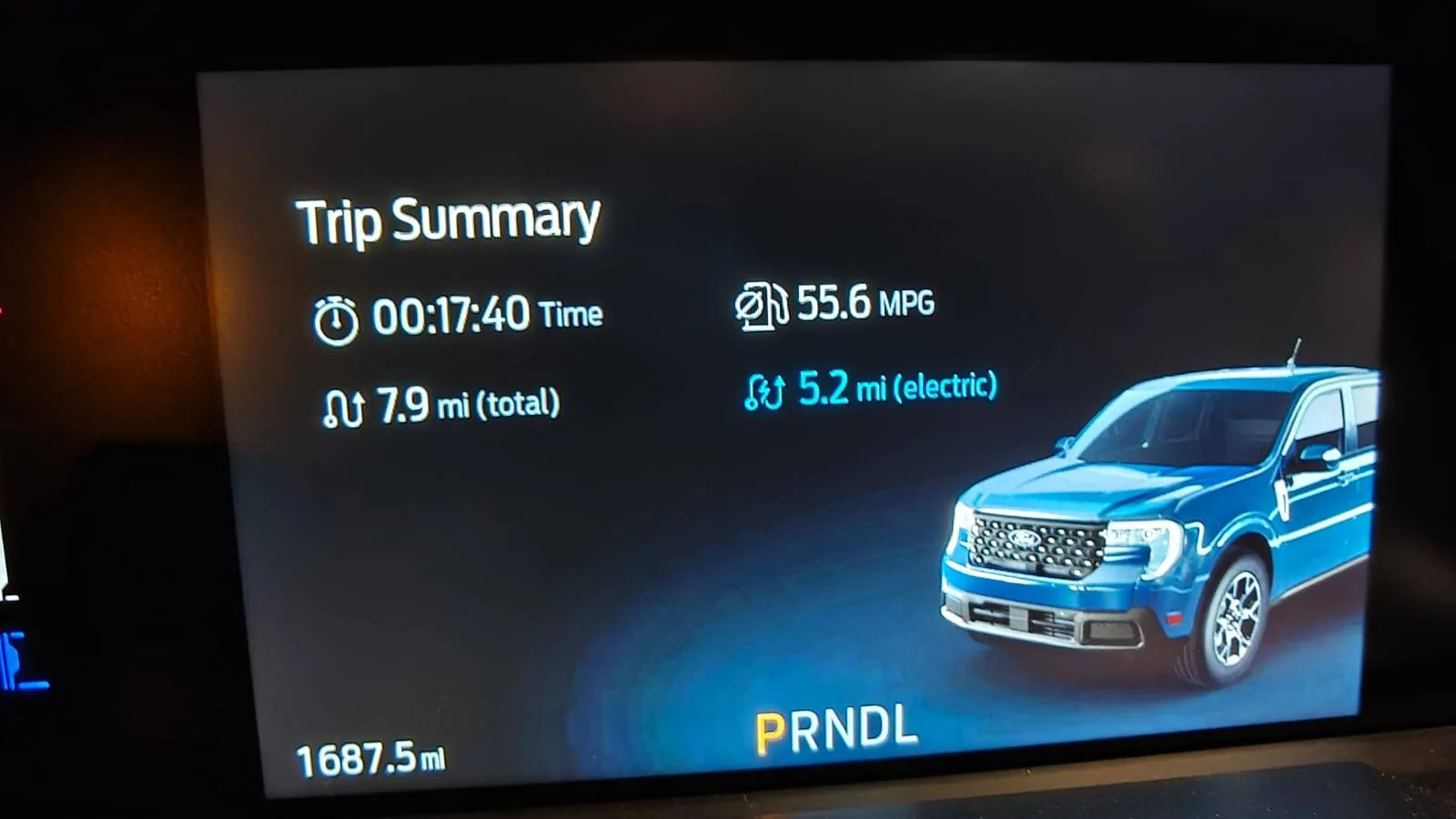
I took this photo yesterday.
Dang. I need some practice.That's the reason:
I took this photo yesterday.
If when coasting downhill in normal, econ, or slippery if you press the "L" button the Regen brake will go up to but not exceed 100% Regen. When the HVB gets to 72%(+/-) the ice will engine brake. You can manually apply hydraulic brakes or set cruise control so it can apply hydraulic brakes to just enough to hold desired speed. This is the main design function of the "L" button. If you have a hitch receiver you could diy a drag chute for help if desired.Applying the brakes lightly is regen braking! You can just look at your power meter when slowing down. If the needle is in the green you are recharging (not sure what happens when the battery if full), when the needle dips into the white you are using friction brakes. Keep it in the green and you are going to recover 100% of what is possible to recover.

Sponsored
- First Name
- Par
- Joined
- Feb 26, 2025
- Threads
- 2
- Messages
- 122
- Reaction score
- 130
- Location
- California
- Vehicle(s)
- 2025 Maverick Lariat AWD
- Engine
- 2.5L Hybrid
Thanks. Do i read this right? Pushing the brake pedal does not use friction braking 100% of the time. Brake pedal will try to use Regen braking while the meter is inside the green box....once lines leave the green box and turn gray, that means the gray is the friction brake pads at work.Applying the brakes lightly is regen braking! You can just look at your power meter when slowing down. If the needle is in the green you are recharging (not sure what happens when the battery if full), when the needle dips into the white you are using friction brakes. Keep it in the green and you are going to recover 100% of what is possible to recover.
I've owned the truck for almost two years and I never knew that. I always tried to use coasting for braking whenever I could. It feels like the friction brakes are being applied even when the brake coach is in the green zone. That is some really good information, thank you for explaining.Applying the brakes lightly is regen braking! You can just look at your power meter when slowing down. If the needle is in the green you are recharging (not sure what happens when the battery if full), when the needle dips into the white you are using friction brakes. Keep it in the green and you are going to recover 100% of what is possible to recover.

OK, everyone pony up.I like mine because I can prove my wife is a bad driver
I'll toss n the first five bucks for the fund to by @Alwright aheater for the doghouse . . .

- First Name
- John
- Joined
- Oct 31, 2024
- Threads
- 12
- Messages
- 622
- Reaction score
- 1,145
- Location
- Pacific Northwest
- Vehicle(s)
- 24 Maverick XLT CG, 92 Ranger
- Engine
- 2.5L Hybrid
Yep, pretty sure that is the way it works.Thanks. Do i read this right? Pushing the brake pedal does not use friction braking 100% of the time. Brake pedal will try to use Regen braking while the meter is inside the green box....once lines leave the green box and turn gray, that means the gray is the friction brake pads at work.

- First Name
- Mike
- Joined
- May 3, 2024
- Threads
- 4
- Messages
- 4,832
- Reaction score
- 4,379
- Location
- KC Metro area
- Vehicle(s)
- 2005 Toyota RAV4, 2024 XLT Hybrid
- Engine
- 2.5L Hybrid
They know how much energy could be gotten from a certain speed coasting/braking.it's kind of an arbitrary number from ford. you aren't regaining 100% of the energy put into acceleration (physics). it isn't a % of the battery either. it's just some percentage ford uses. i'm sure the formula is out there somewhere (since it's computed for the display). just work with the goal of a higher number is better.
It is indeed merely a measure of you got this % of what we calculated was potential.
Or maybe easier - measure how much the real brakes were engaged robbing from the recharge rate. But I don't think that happens since some recharge still possible laying into the real brakes.
Only reason I've left mine on is curiosity after some needed short stop which I was never in to anyway. I had to change my braking style barely any.
Though going to Slippery mode always gets me - very hard to adjust to that potentially longer stop for me not doing it in awhile.
Sponsored


