
Sponsored

I Haven't caught a thing. Not a drop. Catch Can

Ecorydr

2.5L Hybrid
Well-known member
First Name
Jim
Joined
Mar 16, 2026
Threads
0
Messages
167
Reaction score
218
Location
MO (Missery - home to those who voted for it!)
Vehicle(s)
2026 Maverick Lariat AWD
Engine
2.5L Hybrid
Mine was also cut and paste. Dont think I put in more effort then you did.

Again, heat is not scary. Why would the turbo hitting a temp a fraction of the inside of the engine be a problem? Do you know what metallurgy is? Do you understand what heat resistent metal is?

It's not the 1980s anymore. Turbo heat soak isnt a problem for 99% of drivers. Nor do turbos die just because they get warm. It's OK to evolve past technophobic misinformation and embrace modern technology.
enjoy your toys.....
Sponsored


Tbone289

2.0L EcoBoost
Well-known member
First Name
Terry
Joined
Jul 18, 2024
Threads
0
Messages
2,183
Reaction score
3,763
Location
MO
Vehicle(s)
'24 Mav FX4, '12 Focus SE Sport, '01 Focus ZX3, '00 Jeep XJ, '67 Bronco
Engine
2.0L EcoBoost
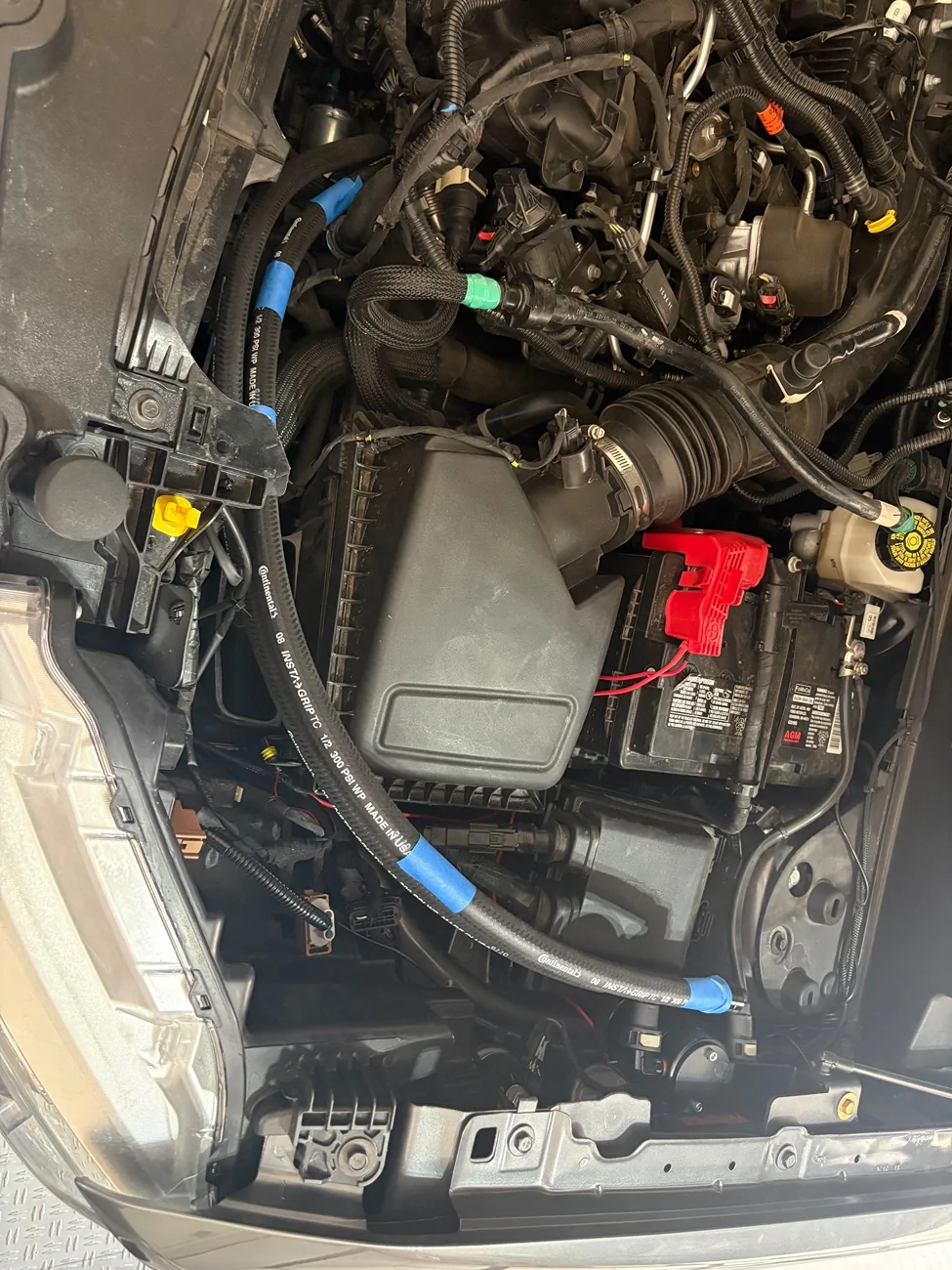
Here is a picture of my installation. I marked the PCV hose with blue tape so you can see it better. This hose is connected to the PCV on the block. It’s the fitting that moves and swivels. The other is connected to the intake manifold. It doesn’t move or swivel
IMG_1334.webp
This is correct routing. The only difference between your installation and mine is that I have a check valve inline with the manifold-side hose to supplement the PCV valve. That's not required.
 
OP
OP
gjallen3

gjallen3

2.0L EcoBoost
Well-known member
First Name
Jerry
Joined
May 25, 2025
Threads
22
Messages
367
Reaction score
552
Location
Arizona
Vehicle(s)
2024 Maverick XLT
Engine
2.0L EcoBoost
This is correct routing. The only difference between your installation and mine is that I have a check valve inline with the manifold-side hose to supplement the PCV valve. That's not required.
Thanks. I was pretty sure it was installed correctly. I know it's "breathing" because I can at least smell something like typical engine odor in the cannister, but it's dry as a bone. Maybe this winter will produce something. Maybe some of us just have exceptionally clean running engines.
 

Tbone289

2.0L EcoBoost
Well-known member
First Name
Terry
Joined
Jul 18, 2024
Threads
0
Messages
2,183
Reaction score
3,763
Location
MO
Vehicle(s)
'24 Mav FX4, '12 Focus SE Sport, '01 Focus ZX3, '00 Jeep XJ, '67 Bronco
Engine
2.0L EcoBoost
Thanks. I was pretty sure it was installed correctly. I know it's "breathing" because I can at least smell something like typical engine odor in the cannister, but it's dry as a bone. Maybe this winter will produce something. Maybe some of us just have exceptionally clean running engines.
There's no doubt that the dirty side catches more when the engine is cold. This is due to crankcase condensation and rings not sealing well until fully up to temperature. Current engine technology is relatively very clean when maintained properly and running at proper operating temperature. Evidence of that is that we don't catch much of anything in warmer temperatures. As also mentioned above, arid conditions will reduce the amount caught due to reduction of condensation in the crankcase.
 

Chops

2.0L EcoBoost
Well-known member
First Name
Gary
Joined
Jun 15, 2025
Threads
72
Messages
2,628
Reaction score
3,980
Location
USA
Vehicle(s)
Lobo
Engine
2.0L EcoBoost
Clubs
 
Your comment shows a fundamental misunderstanding of the PCV system and how the catch cans are routed.
Thank you for this explanation. It deserves a reread or two on my part!

One of my misunderstandings was that catch cans compromise the factory separators.

Again, thanks for taking the time to explain the mechanics of the catch can. Seems I need to learn from the catch can threads instead of piping in!
 

Sponsored

CajunMick

2.0L EcoBoost
Well-known member
First Name
Heman
Joined
Oct 15, 2023
Threads
48
Messages
1,002
Reaction score
729
Location
Houston, Texas
Vehicle(s)
2023 XLT Maverick
Engine
2.0L EcoBoost
Blower or turbo. No difference in a need. Since EPA/govt gets involved, vehicle mfrs put in small engines to meet fuel mileage goals. Resulting in motorcycle size engines in vehicles, and boosted, makes engines on steroids, so to speak. Govt created a mess.

I be happy with naturally aspirated larger engines, for power. It’s not a smog thing, IMHO, but rather MPG for less fuel burn. These modern engines can meet smog requirements. EPA has that MPG goal as principally unreachable.

My old diesel F250 with all its smog tech burns clean. And with good MPG to boot. Yes it has a turbo, but diesel requires it to compress, burn the fuel. Gasoline engines have spark plugs to ignite fuel.
 
OP
OP
gjallen3

gjallen3

2.0L EcoBoost
Well-known member
First Name
Jerry
Joined
May 25, 2025
Threads
22
Messages
367
Reaction score
552
Location
Arizona
Vehicle(s)
2024 Maverick XLT
Engine
2.0L EcoBoost
There's no doubt that the dirty side catches more when the engine is cold. This is due to crankcase condensation and rings not sealing well until fully up to temperature. Current engine technology is relatively very clean when maintained properly and running at proper operating temperature. Evidence of that is that we don't catch much of anything in warmer temperatures. As also mentioned above, arid conditions will reduce the amount caught due to reduction of condensation in the crankcase.
You certainly know a lot about PCV and catch cans. I really appreciate your advice and suggestions. I'll still check the canister regularly and especially when winter/cooler temps are here. If I see a fair amount of oil and or condensation, then maybe I'll install the clean side can next spring. But at this point I don't think it will be necessary.
 

F150 2.7 TT user

2.0L EcoBoost
Well-known member
First Name
Kenneth
Joined
Jun 10, 2026
Threads
3
Messages
104
Reaction score
156
Location
SE WI
Vehicle(s)
2026 Maverick Tremor, 2017 F150 XL 2.7
Engine
2.0L EcoBoost
My first turbo vehicle was bought in 1970 a 1966 Corvair Monza Turbo. Worked on Doge, Buick, Saab, turbo vehicles. They do not bother me at all.
No one has mentioned the role of VVT as used to prevent carbon buildup except the links I posted earlier. Or that the clean side goes to the inter-cooler, the biggest CC on the vehicle. Another is driver habits that will limit most of the problem, short trips that never get oil temps to operational levels. Most Crankcase bypass is created at low operating RPM and temperatures.
 

Rparry

2.5L Hybrid
Well-known member
First Name
Bob
Joined
Feb 19, 2025
Threads
9
Messages
109
Reaction score
173
Location
Chilliwack BC Canada
Vehicle(s)
2018 Nissan Leaf, 2018 Toyota Rav4, 2025 Maverick Lariat AWD
Engine
2.5L Hybrid
I was a mechanic through the 70s and 80s. There were very few injected cars of any kind, almost all were carbs. We got that muck on the back of intake valves all the time. I spent a lot of my apprenticeship cleaning that crap and the “ carbon” out of heads. No body made a big deal out of it then. All that crud came through the valve guides under high vacuum, sure some came through the PCV, no one cared much and I suppose it effected performance to some degree. Most automotive engines spend the majority of their time at power outputs between 10% and 50% maybe? Not sure I would worry that much about it.

Buy the Snake Oil if it makes you feel better. I have found that the vast majority of these fixes for the short comings of vehicles at best do nothing. The Engineers despite what many think do know what they are doing.

BP
 

SierraMike

2.0L EcoBoost
Member
First Name
Steve
Joined
Nov 25, 2024
Threads
0
Messages
13
Reaction score
43
Location
Meridain,ID
Vehicle(s)
2024 iconic silver
Engine
2.0L EcoBoost
Clubs
 
I have the UPR clean side catch can. Installed it in November at about 11k miles. Caught about an ounce over the winter. It's at 16k miles now and nothing in the can. I have been using 89 Chevron and moved away from the 89 Maverick gas. I have a 800 mile trip coming up. We'll see if that produces anything. I'll see if I get anything this winter. I use the truck to commute. So it see's stop and go traffic and 75 down the freeway when it can.
 
Sponsored

Chops

2.0L EcoBoost
Well-known member
First Name
Gary
Joined
Jun 15, 2025
Threads
72
Messages
2,628
Reaction score
3,980
Location
USA
Vehicle(s)
Lobo
Engine
2.0L EcoBoost
Clubs
 
Can I ask the experts here - What would be the best catch can setup to keep my intercooler clean? Like the OP, I drive in “it’s a dry heat” Arizona. Lots of short trips though. Have the latest version EB in my MY25.

Do folks ever have to clean their intercoolers of built up crud?
 

Tbone289

2.0L EcoBoost
Well-known member
First Name
Terry
Joined
Jul 18, 2024
Threads
0
Messages
2,183
Reaction score
3,763
Location
MO
Vehicle(s)
'24 Mav FX4, '12 Focus SE Sport, '01 Focus ZX3, '00 Jeep XJ, '67 Bronco
Engine
2.0L EcoBoost
My first turbo vehicle was bought in 1970 a 1966 Corvair Monza Turbo. Worked on Doge, Buick, Saab, turbo vehicles. They do not bother me at all.
No one has mentioned the role of VVT as used to prevent carbon buildup except the links I posted earlier. Or that the clean side goes to the inter-cooler, the biggest CC on the vehicle. Another is driver habits that will limit most of the problem, short trips that never get oil temps to operational levels. Most Crankcase bypass is created at low operating RPM and temperatures.
You must have missed it. It has been covered in this thread that the clean side helps keep the intercooler and turbo clean, and that short trips and low temperatures contribute to bypass and condensation.

As far as VVT goes, I've walnut blasted plenty of intake valves in VVT-equipped engines. So, though it does help the issue, it's not a cure. Then again, none of these solutions are cures for DI carbon buildup.
 
Last edited:

Tbone289

2.0L EcoBoost
Well-known member
First Name
Terry
Joined
Jul 18, 2024
Threads
0
Messages
2,183
Reaction score
3,763
Location
MO
Vehicle(s)
'24 Mav FX4, '12 Focus SE Sport, '01 Focus ZX3, '00 Jeep XJ, '67 Bronco
Engine
2.0L EcoBoost
Can I ask the experts here - What would be the best catch can setup to keep my intercooler clean? Like the OP, I drive in “it’s a dry heat” Arizona. Lots of short trips though. Have the latest version EB in my MY25.

Do folks ever have to clean their intercoolers of built up crud?
The clean side catch can is the only one that will catch fluids headed for your intercooler and turbo. The PCV system will only pass fluids that route while the intake manifold is pressurized under boost.

Build up in an intercooler is not a common problem, but it does happen. It's usually just a slow buildup over time that reduces the cooling efficiency of the intercooler that goes unnoticed. I have seen a mentions on forums where F150 owners have drilled their intercoolers to drain out fluid.
 
Last edited:

Tbone289

2.0L EcoBoost
Well-known member
First Name
Terry
Joined
Jul 18, 2024
Threads
0
Messages
2,183
Reaction score
3,763
Location
MO
Vehicle(s)
'24 Mav FX4, '12 Focus SE Sport, '01 Focus ZX3, '00 Jeep XJ, '67 Bronco
Engine
2.0L EcoBoost
I have the UPR clean side catch can. Installed it in November at about 11k miles. Caught about an ounce over the winter. It's at 16k miles now and nothing in the can. I have been using 89 Chevron and moved away from the 89 Maverick gas. I have a 800 mile trip coming up. We'll see if that produces anything. I'll see if I get anything this winter. I use the truck to commute. So it see's stop and go traffic and 75 down the freeway when it can.
There is a reason it's called the clean side... It's not going to catch much on a daily driver that isn't frequently run at boost pressures. I would estimate my clean side can catches about 1/5 of the amount or less that the dirty side does.
 
Last edited:
OP
OP
gjallen3

gjallen3

2.0L EcoBoost
Well-known member
First Name
Jerry
Joined
May 25, 2025
Threads
22
Messages
367
Reaction score
552
Location
Arizona
Vehicle(s)
2024 Maverick XLT
Engine
2.0L EcoBoost
I have the UPR clean side catch can. Installed it in November at about 11k miles. Caught about an ounce over the winter. It's at 16k miles now and nothing in the can. I have been using 89 Chevron and moved away from the 89 Maverick gas. I have a 800 mile trip coming up. We'll see if that produces anything. I'll see if I get anything this winter. I use the truck to commute. So it see's stop and go traffic and 75 down the freeway when it can.
I'm reluctant to go down this rabbit hole because I know it has been discussed extensively, or to even hijack my own post, but I mentioned in my Original Post that I was not using High Tier Gasoline such as Chevron. The fact is I have never used it on any of my numerous vehicles in over 50 years of driving. In a DI engine such as the MY24 and earlier EcoBoost, besides the injectors, what else would these detergent additives help clean?
Sponsored


Top