

- First Name
- rslilly76
- Joined
- Apr 20, 2022
- Threads
- 26
- Messages
- 281
- Reaction score
- 402
- Location
- Corpus Christi Texas
- Vehicle(s)
- 2025 Maverick XL Hybrid Fwd
- Engine
- 2.5L Hybrid
- Thread starter
- #1
Well thanks to @HeyBales and @Mavster Mechanic I have gone down a rabbit hole with the whole 12v battery issues in the Hybrids. Thanks guys! LOL
So I will start off with an old ICE and a 12v battery to help educate anyone that needs it. That setup typically consists of a 12v battery that will power lights, radio, starter, etc. until the engine is started. At this point in time the alternator is supposed to take over powering everything. The battery sitting idle not being used should read 12.6 - 12.8v typically. This goes for a standard lead acid battery or as some people call a flooded battery. It also holds true for an AGM battery (you can research batteries yourself). When the alternator takes over the battery typically reads 13.5 - 14.5 voltage because the alternator is charging the battery. The regulator on the alternator typically adjust based on what all is being used on the 12v system of the vehicle, and adjust accordingly. The idea is to charge the battery to 100% at which point the alternator will adjust the regulator to not overcharge the battery. FYI most alternators provide 1 - 50amps of charging to a 12v battery depending on the need. This is why if you don't drive much batteries die prematurely cause they never reach full 100% charging capacity.
A quick google search will tell you that 12v SLA or 12v AGM battery should be at 100% charge and avoid being drained for prolong periods to ensure the maximum life of the battery. If you look at standard battery chargers they go from 1 amp - 75 amps. 1 amp being a trickle charger and 75 amp being a very fast charger. (you will see why I bring this up momentarily).
So Ford has stated that the deep sleep issues on the Hybrid model Maverick is due to parasitic draw and needing revised software. Which don't get me wrong, I think that is one part of the problem for sure. Two very known software updates are the ACCM update and the ABS update that is supposed to resolve the deep sleep battery issues everyone is having. However, none of these actually fixed the problem as you can search forums and also FB groups and see tons of 12v battery issues on the 22-25 Mavericks. (I am assuming nothing has changed on the 26, but I guess we will see).
Ford's initial fix before software upgrades was moving from an SLA battery to AGM battery, but that didn't fix anything because essentially these batteries both work the same. The AGM has slightly better stats and reserve time. Many people saw this fix and decided to upgrade to a bigger AGM thinking that this would solve the problem. Keep in mind the thought was the parasitic draw was the problem, and by going to a bigger AGM essentially they were buying more reserve time on the battery. A noble train of thought and a good idea, but it literally isn't solving the problem to this date.
Another train of thought was to use Forscan and increase the maximum charge setting of the 12v from 80% to 95%, why not change it to 100%? I have no idea everyone's train of thought on this, but some users reported this fixed their problem. There was never any real testing that showed or that I saw anywhere that confirms this actually does anything to fix the problem.
Now fast forward to @Mavster Mechanic findings. This one threw me for a loop until I started testing. There is a whole thread with lots of good reading material if you want to go down this rabbit hole. He is way more versed and way more knowledgeable in this matter and I suggest you read his findings. https://www.mavericktruckclub.com/forum/threads/hybrid-12v-battery-mystery-solved.81553/
I will try to summarize the findings. The 12v SLA battery will charge to 85% and a 12v AGM battery will charge to 92% in the Hybrid. At this point and time some programing in the vehicle tells the DC/DC converter to stop charging the battery and actually the 12v battery starts draining at this point and time. I don't mean draining naturally, I mean the vehicle starts draining the battery on purpose. However, if you do one of these things you can make the vehicle start charging the battery again until the battery hits full charge of 100%. (1. turn on the headlights, 2. turn on the parking lights, 3. turn the hvac fan to 6 or 7 speed, 4. plug in trailer lights). If you do one of these four things, it doesn't matter which one of the four methods, the vehicle turns the charging back on to the 12v and will actually let the 12v charge to 100%. Now keep in mind if you charge the battery to 100% the minute you start the vehicle again it will go into drain mode again because it's over the 85% for SLA or 92% for AGM.
Now while I will agree with parasitic draw being an issue that will drain the 12v battery, I also believe not allowing the 12v battery to be at 100% more times than not also contribute to a battery failing prematurely. Reading all the forums and FB posts you will see it doesn't matter if it is SLA, AGM, or even a bigger battery these batteries are failing prematurely because of the programming of how it charges mixed with parasitic draw. The people that aren't having these problems with theirs, I wonder how many of them pull trailers, drive a lot a night, have the ac or heater on high a lot, or turn their parking lights on to be seen in traffic?
Think about it like this, your battery is only 80% charged will typically read 12.5 volts while a battery at 100% reads 12.6-12.8. You leave the vehicle parked for a week when it's 100% charged and come back it's been drained to 80% because of parasitic draw and now the vehicle still starts. But if you leave an 80% battery for a week and because of parasitic draw it's down to 60% and won't start.
It's really perplexing to me why Ford wouldn't allow the battery to charge to 100% no matter what the conditions are if the vehicle is running, but I am not a Ford engineer. You would also think that they would want to come up with a solution to prevent class action, or loosing customers in general. Plus I can't imagine how much has been spent on this issue from Ford's perspective.
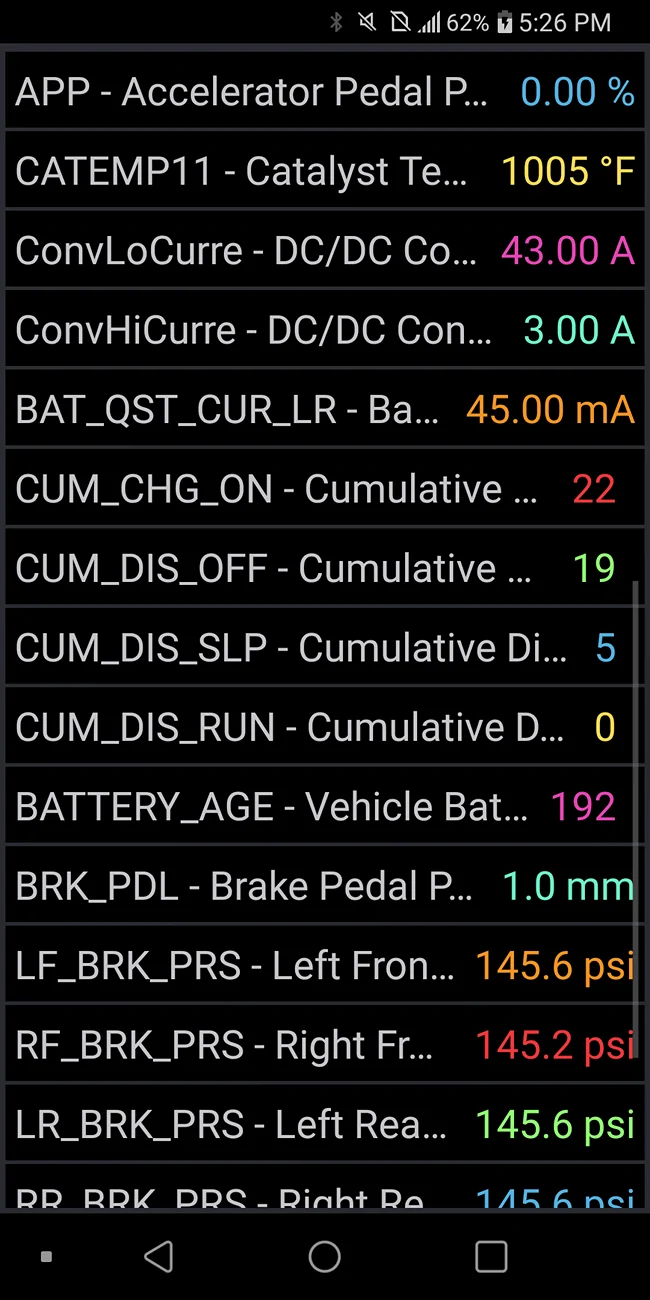
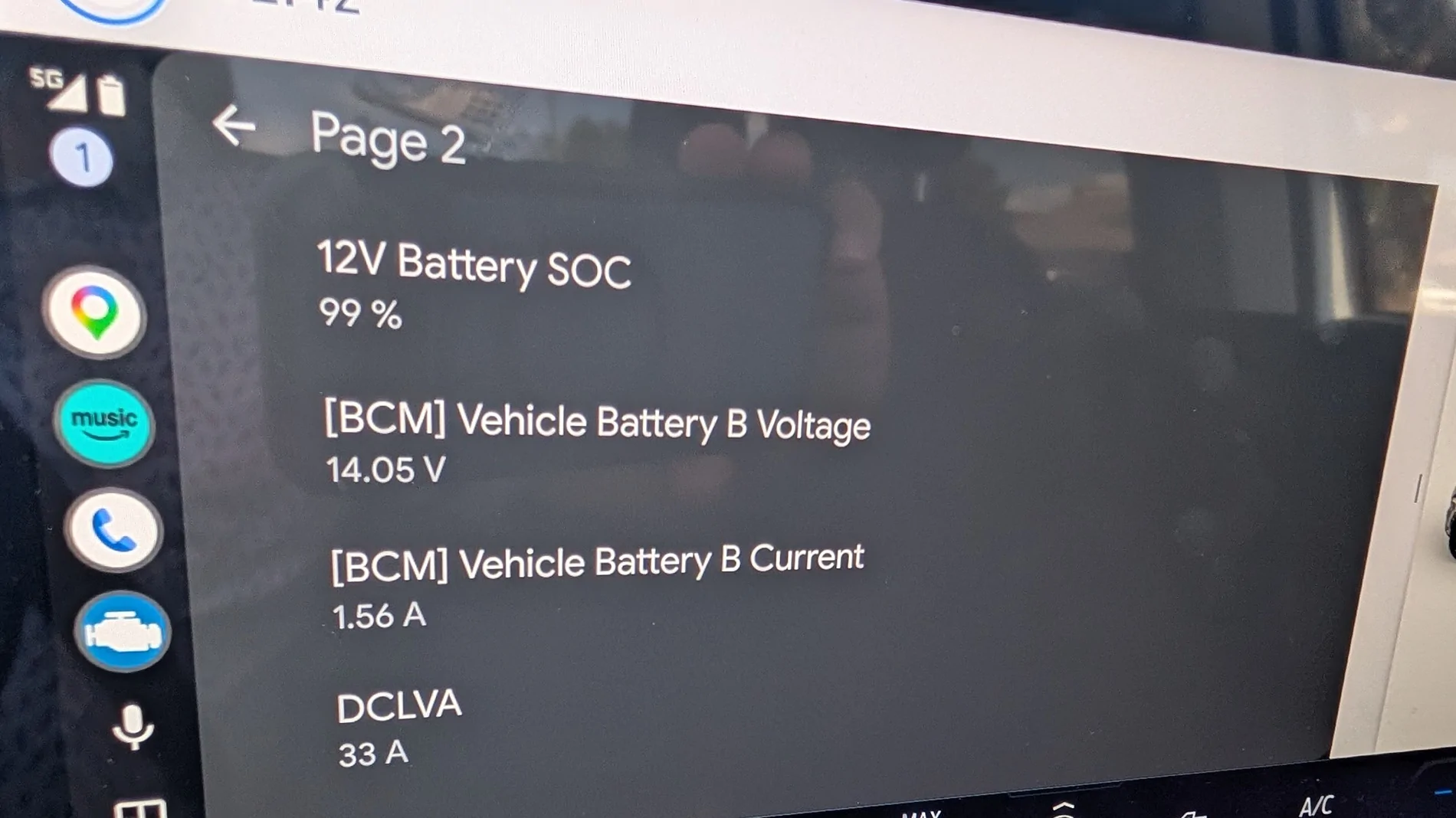
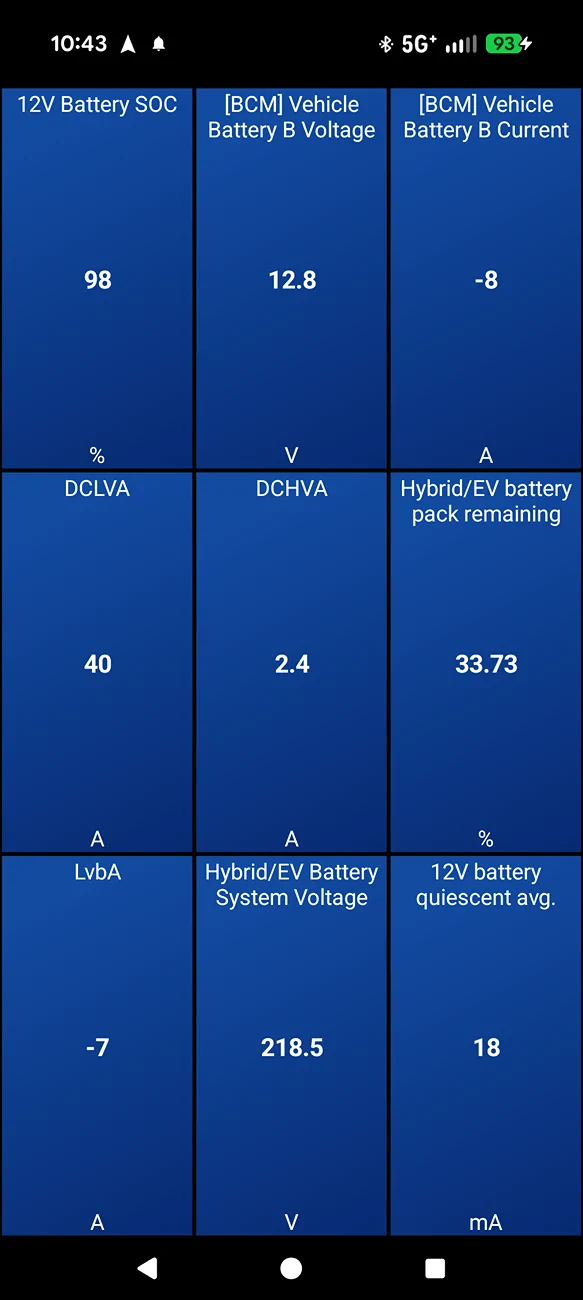
So now I will show my screen shots and try to describe what you are seeing.
12v SOC = 12 volt battery state of charge
Vehicle B battery Voltage = 12 volt battery reading in volts
Vehicle B battery Current = 12 volt battery amps (the amount of charge being sent to battery)
DCLA = DC/DC converter amp output to the 12 volt system of vehicle (this is like your alternator powering everything in the vehicle while running)
12 v battery quiescent avg = this is how much parasitic draw is while the vehicle is off
So to give you an idea my truck is a 2025 Hybrid fwd XL. It has had all the software updates by Ford including ACCM and ABS. It has an AGM battery from Ford OEM. My parasitic draw is between 12 - 18 mA which if you look up on google is outstanding for any vehicle 12 volt discharge while the engine is off.
The first picture is with my headlights on (it's daytime here) and the battery is 99% SOC, Battery voltage is 14.05v, the charging amps are 1.56A (trickle charge) and the DCLVA is 33A due to the truck's needs.
The second picture when I started my vehicle you can see the truck went into immediate discharge of the battery and headlights are off. SOC is 98%, battery voltage is 12.8v, charging amps are -8A, and the DCLVA is 40A due to the truck requiring that much to run the 12v system.
(See how the dc/dc converter is supplying more Amps, but the truck isn't charging the battery but instead it is draining the battery on purpose. Once I turned on the headlights the battery started to charge.)
Just FYI I also changed the maximum state of charge from 80% to 95% in Forscan, and this did not change anything at all to how the truck performs on charging the AGM battery.
Anyway, I thought this was good info for people out there, and if anyone wants to test theirs they know more about how to do it.
I am using Car Scanner Pro (it's like $8 for a lifetime membership)
I am using Vgate vLinker BT OBD2 scanner from Amazon
So I will start off with an old ICE and a 12v battery to help educate anyone that needs it. That setup typically consists of a 12v battery that will power lights, radio, starter, etc. until the engine is started. At this point in time the alternator is supposed to take over powering everything. The battery sitting idle not being used should read 12.6 - 12.8v typically. This goes for a standard lead acid battery or as some people call a flooded battery. It also holds true for an AGM battery (you can research batteries yourself). When the alternator takes over the battery typically reads 13.5 - 14.5 voltage because the alternator is charging the battery. The regulator on the alternator typically adjust based on what all is being used on the 12v system of the vehicle, and adjust accordingly. The idea is to charge the battery to 100% at which point the alternator will adjust the regulator to not overcharge the battery. FYI most alternators provide 1 - 50amps of charging to a 12v battery depending on the need. This is why if you don't drive much batteries die prematurely cause they never reach full 100% charging capacity.
A quick google search will tell you that 12v SLA or 12v AGM battery should be at 100% charge and avoid being drained for prolong periods to ensure the maximum life of the battery. If you look at standard battery chargers they go from 1 amp - 75 amps. 1 amp being a trickle charger and 75 amp being a very fast charger. (you will see why I bring this up momentarily).
So Ford has stated that the deep sleep issues on the Hybrid model Maverick is due to parasitic draw and needing revised software. Which don't get me wrong, I think that is one part of the problem for sure. Two very known software updates are the ACCM update and the ABS update that is supposed to resolve the deep sleep battery issues everyone is having. However, none of these actually fixed the problem as you can search forums and also FB groups and see tons of 12v battery issues on the 22-25 Mavericks. (I am assuming nothing has changed on the 26, but I guess we will see).
Ford's initial fix before software upgrades was moving from an SLA battery to AGM battery, but that didn't fix anything because essentially these batteries both work the same. The AGM has slightly better stats and reserve time. Many people saw this fix and decided to upgrade to a bigger AGM thinking that this would solve the problem. Keep in mind the thought was the parasitic draw was the problem, and by going to a bigger AGM essentially they were buying more reserve time on the battery. A noble train of thought and a good idea, but it literally isn't solving the problem to this date.
Another train of thought was to use Forscan and increase the maximum charge setting of the 12v from 80% to 95%, why not change it to 100%? I have no idea everyone's train of thought on this, but some users reported this fixed their problem. There was never any real testing that showed or that I saw anywhere that confirms this actually does anything to fix the problem.
Now fast forward to @Mavster Mechanic findings. This one threw me for a loop until I started testing. There is a whole thread with lots of good reading material if you want to go down this rabbit hole. He is way more versed and way more knowledgeable in this matter and I suggest you read his findings. https://www.mavericktruckclub.com/forum/threads/hybrid-12v-battery-mystery-solved.81553/
I will try to summarize the findings. The 12v SLA battery will charge to 85% and a 12v AGM battery will charge to 92% in the Hybrid. At this point and time some programing in the vehicle tells the DC/DC converter to stop charging the battery and actually the 12v battery starts draining at this point and time. I don't mean draining naturally, I mean the vehicle starts draining the battery on purpose. However, if you do one of these things you can make the vehicle start charging the battery again until the battery hits full charge of 100%. (1. turn on the headlights, 2. turn on the parking lights, 3. turn the hvac fan to 6 or 7 speed, 4. plug in trailer lights). If you do one of these four things, it doesn't matter which one of the four methods, the vehicle turns the charging back on to the 12v and will actually let the 12v charge to 100%. Now keep in mind if you charge the battery to 100% the minute you start the vehicle again it will go into drain mode again because it's over the 85% for SLA or 92% for AGM.
Now while I will agree with parasitic draw being an issue that will drain the 12v battery, I also believe not allowing the 12v battery to be at 100% more times than not also contribute to a battery failing prematurely. Reading all the forums and FB posts you will see it doesn't matter if it is SLA, AGM, or even a bigger battery these batteries are failing prematurely because of the programming of how it charges mixed with parasitic draw. The people that aren't having these problems with theirs, I wonder how many of them pull trailers, drive a lot a night, have the ac or heater on high a lot, or turn their parking lights on to be seen in traffic?
Think about it like this, your battery is only 80% charged will typically read 12.5 volts while a battery at 100% reads 12.6-12.8. You leave the vehicle parked for a week when it's 100% charged and come back it's been drained to 80% because of parasitic draw and now the vehicle still starts. But if you leave an 80% battery for a week and because of parasitic draw it's down to 60% and won't start.
It's really perplexing to me why Ford wouldn't allow the battery to charge to 100% no matter what the conditions are if the vehicle is running, but I am not a Ford engineer. You would also think that they would want to come up with a solution to prevent class action, or loosing customers in general. Plus I can't imagine how much has been spent on this issue from Ford's perspective.
So now I will show my screen shots and try to describe what you are seeing.
12v SOC = 12 volt battery state of charge
Vehicle B battery Voltage = 12 volt battery reading in volts
Vehicle B battery Current = 12 volt battery amps (the amount of charge being sent to battery)
DCLA = DC/DC converter amp output to the 12 volt system of vehicle (this is like your alternator powering everything in the vehicle while running)
12 v battery quiescent avg = this is how much parasitic draw is while the vehicle is off
So to give you an idea my truck is a 2025 Hybrid fwd XL. It has had all the software updates by Ford including ACCM and ABS. It has an AGM battery from Ford OEM. My parasitic draw is between 12 - 18 mA which if you look up on google is outstanding for any vehicle 12 volt discharge while the engine is off.
The first picture is with my headlights on (it's daytime here) and the battery is 99% SOC, Battery voltage is 14.05v, the charging amps are 1.56A (trickle charge) and the DCLVA is 33A due to the truck's needs.
The second picture when I started my vehicle you can see the truck went into immediate discharge of the battery and headlights are off. SOC is 98%, battery voltage is 12.8v, charging amps are -8A, and the DCLVA is 40A due to the truck requiring that much to run the 12v system.
(See how the dc/dc converter is supplying more Amps, but the truck isn't charging the battery but instead it is draining the battery on purpose. Once I turned on the headlights the battery started to charge.)
Just FYI I also changed the maximum state of charge from 80% to 95% in Forscan, and this did not change anything at all to how the truck performs on charging the AGM battery.
Anyway, I thought this was good info for people out there, and if anyone wants to test theirs they know more about how to do it.
I am using Car Scanner Pro (it's like $8 for a lifetime membership)
I am using Vgate vLinker BT OBD2 scanner from Amazon
Sponsored