

Sponsored

UPR Billet Catch Can for Ford Maverick

RLmesc

2.0L EcoBoost
Well-known member
First Name
Randy
Joined
Apr 15, 2022
Threads
6
Messages
481
Reaction score
604
Location
Dubuque, Ia
Vehicle(s)
18 Kia Sportage, 05 Porsche Boxster S, 85 Kawasaki
Engine
2.0L EcoBoost
That is partially incorrect. Catch cans and oil separators are designed to do the same thing, but the catch can comes after the oil separator, therefore, the fact that people have to empty their catch cans proves that the two work together better than just relying on the the stock oil separator.

Stock crank case vapor flow travels in this direction:

crank case > oil separator > PCV valve > PCV tube > intake (your exploded diagram shows this)

The direction of travel with a dirty side catch can is as follows:

crank case > oil separator > PCV valve > catch can > intake

The PCV valve is a check valve attached to the oil separator outlet and only allows crankcase vapors to travel out of the separator. In other words, it allows pressure to be released from the crank case through the oil separator into the intake, but doesn't allow the reverse. That is why it is called PCV, or Positive Crankcase Ventilation, as it only flows when the crankcase pressure is positive in relation to intake pressure.

Some users have asked about the check valve offered by UPR. The UPR valve acts as a secondary, higher-quality, check valve in addition to the PCV valve. If your PCV valve ever fails to valve properly, you won't need to replace it if the UPR check valve is still operational, and the UPR is much easier to replace than the PCV valve.
I hope you have checked your opinion out with a certified mechanic at ford because that was how I found out about it when I inquired about it (after I bought two cans). There is an exploded view of the engine in shop manuals that shows where the “in” pipe to the can is at the top where the crankcase exhausts it’s vapors and reenters the separator from the “out” pipe of the can.
Sponsored


Tbone289

2.0L EcoBoost
Well-known member
First Name
Terry
Joined
Jul 18, 2024
Threads
0
Messages
2,054
Reaction score
3,502
Location
MO
Vehicle(s)
'24 Mav FX4, '12 Focus SE Sport, '01 Focus ZX3, '00 Jeep XJ, '67 Bronco
Engine
2.0L EcoBoost
It's not my opinion at all, it's how PCV systems have worked for years. Nothing ever exits a PCV valve and goes back into the crankcase. Again, PCV is Positive Crankcase Ventilation, meaning vapor can only exit the PCV valve, because it's a check valve. You may have had it explained to you by a certified mechanic, but either he didn't understand the system or you didn't fully understand the explanation.

The "in" pipe to the can is from the output of the PCV valve, which is on the output of the oil separator. The output of the can goes into the intake, just as the output of the PCV does without the can.

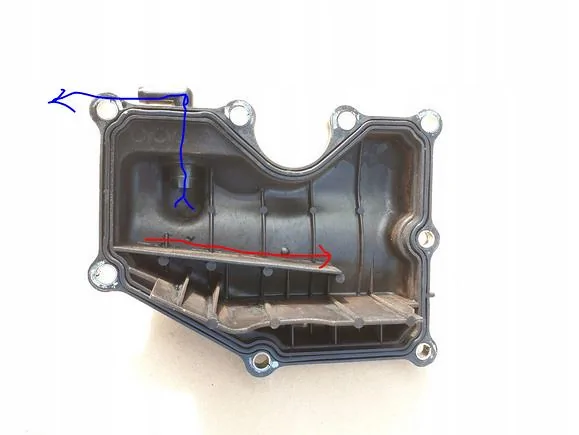
Here is a photo of the internals of a typical Ford oil separator. Blue is travel of vapor through the PCV valve at the top, and red is the travel of oil (gravity separated) back into the crankcase. That blue line goes to the input of the catch can. The idea behind the separator is that fluids will drop out through the baffles under gravity and flow back into the crankcase, but that solution is not ideal. A catch can further separates fluid and particles that the oil separator passed.

Ford Maverick UPR Billet Catch Can for Ford Maverick 53919639935_f3f64eef70_z
 
Last edited:

Tbone289

2.0L EcoBoost
Well-known member
First Name
Terry
Joined
Jul 18, 2024
Threads
0
Messages
2,054
Reaction score
3,502
Location
MO
Vehicle(s)
'24 Mav FX4, '12 Focus SE Sport, '01 Focus ZX3, '00 Jeep XJ, '67 Bronco
Engine
2.0L EcoBoost
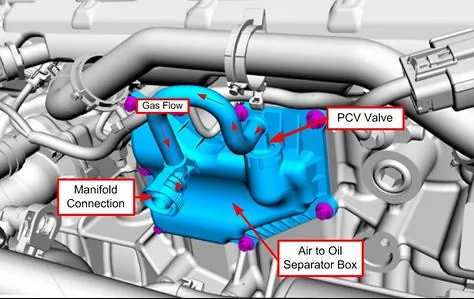
Here is an external diagram from a manual showing the mounted oil separator and direction of travel of gasses. Note that gasses flow only out of the PCV and into the manifold. Oil is trapped by the baffles in the oil separator and drain back into the crankcase as the gasses leave the PCV valve. The catch can goes between the output of the PCV valve and the manifold connection, replacing the tube labelled "gas flow" in the diagram.

Ford Maverick UPR Billet Catch Can for Ford Maverick 53919483498_7a47f651
 
Last edited:
OP
OP
Bohefus

Bohefus

2.0L EcoBoost
Banned
Banned
First Name
Joe
Joined
Sep 11, 2023
Threads
8
Messages
331
Reaction score
263
Location
Mesa Az
Vehicle(s)
2024 Maverick Lariat BAP, 2016 Mazda 3
Engine
2.0L EcoBoost
It's not my opinion at all, it's how PCV systems have worked for years. Nothing ever exits a PCV valve and goes back into the crankcase. Again, PCV is Positive Crankcase Ventilation, meaning vapor can only exit the PCV valve, because it's a check valve. You may have had it explained to you by a certified mechanic, but either he didn't understand the system or you didn't fully understand the explanation.

The "in" pipe to the can is from the output of the PCV valve, which is on the output of the oil separator. The output of the can goes into the intake, just as the output of the PCV does without the can.

Here is a photo of the internals of a typical Ford oil separator. Blue is travel of vapor through the PCV valve at the top, and red is the travel of oil (gravity separated) back into the crankcase. That blue line goes to the input of the catch can. The idea behind the separator is that fluids will drop out through the baffles under gravity and flow back into the crankcase, but that solution is not ideal. A catch can further separates fluid and particles that the oil separator passed.

53919639935_f3f64eef70_z.webp
Very nice explanation! It's also logical that people who have installed catch cans & have emptied fluid from them proves that they do at the very least, help in preventing said fluid (at least partially) from reaching the intake.
 

Tbone289

2.0L EcoBoost
Well-known member
First Name
Terry
Joined
Jul 18, 2024
Threads
0
Messages
2,054
Reaction score
3,502
Location
MO
Vehicle(s)
'24 Mav FX4, '12 Focus SE Sport, '01 Focus ZX3, '00 Jeep XJ, '67 Bronco
Engine
2.0L EcoBoost
Very nice explanation! It's also logical that people who have installed catch cans & have emptied fluid from them proves that they do at the very least, help in preventing said fluid (at least partially) from reaching the intake.
Right, but for @RLmesc it wasn't logical, because it had been incorrectly explained to him that somehow the output of the catch can was finding its way back to the oil separator instead of the intake manifold where it actually goes.
 

Sponsored

RLmesc

2.0L EcoBoost
Well-known member
First Name
Randy
Joined
Apr 15, 2022
Threads
6
Messages
481
Reaction score
604
Location
Dubuque, Ia
Vehicle(s)
18 Kia Sportage, 05 Porsche Boxster S, 85 Kawasaki
Engine
2.0L EcoBoost
Right, but for @RLmesc it wasn't logical, because it had been incorrectly explained to him that somehow the output of the catch can was finding its way back to the oil separator instead of the intake manifold where it actually goes.
The the lower catch can does not get routed to the intake as does the upper catch can. The crack case is vented into the oil separator which redirects the vapor condensation back to the bottom of the oil sump. It stays there because oil is lighter than the mixture of condensation.
 

Tbone289

2.0L EcoBoost
Well-known member
First Name
Terry
Joined
Jul 18, 2024
Threads
0
Messages
2,054
Reaction score
3,502
Location
MO
Vehicle(s)
'24 Mav FX4, '12 Focus SE Sport, '01 Focus ZX3, '00 Jeep XJ, '67 Bronco
Engine
2.0L EcoBoost
The the lower catch can does not get routed to the intake as does the upper catch can.
Wrong again.

You really should educate yourself on how the PCV system and catch cans work before you spout off more false information. Look at the diagrams I posted and try to make sense of them. The crank case vents through the oil separator and then through the PCV valve, then through the PCV hose to the intake manifold.

Here's my final attempt to help you understand this. This is the installation video of the lower, dirty side, UPR catch can. Note the part at 1:41 were he says, "this is your PCV hose, so it runs from your PCV valve on the block to your intake manifold". This is the hose in the exploded diagram you posted. The lower catch can replaces that hose. Logic follows that the lower catch can routes from the PCV valve to the intake manifold just as I've been trying to explain to you.

Please watch this and let it sink in.

 
Last edited:

RLmesc

2.0L EcoBoost
Well-known member
First Name
Randy
Joined
Apr 15, 2022
Threads
6
Messages
481
Reaction score
604
Location
Dubuque, Ia
Vehicle(s)
18 Kia Sportage, 05 Porsche Boxster S, 85 Kawasaki
Engine
2.0L EcoBoost
Wrong again. You really should educate yourself on how the PCV system and catch cans work before you spout off more false information. Look at the diagrams I posted and try to make sense of them. The crank case vents through the oil separator and then through the PCV valve.

Here's my final attempt to help you understand this. This is the installation video of the lower, dirty side, HPR catch can. Note the part at 1:41 were he says, "this is your PCV hose, so it runs from your PCV valve on the block to your intake manifold". This is the hose in the exploded diagram you posted. The lower catch can replaces that hose. Logic follows that the lower catch can routes from the PCV valve to the intake manifold.

Please watch this and let it sink in.

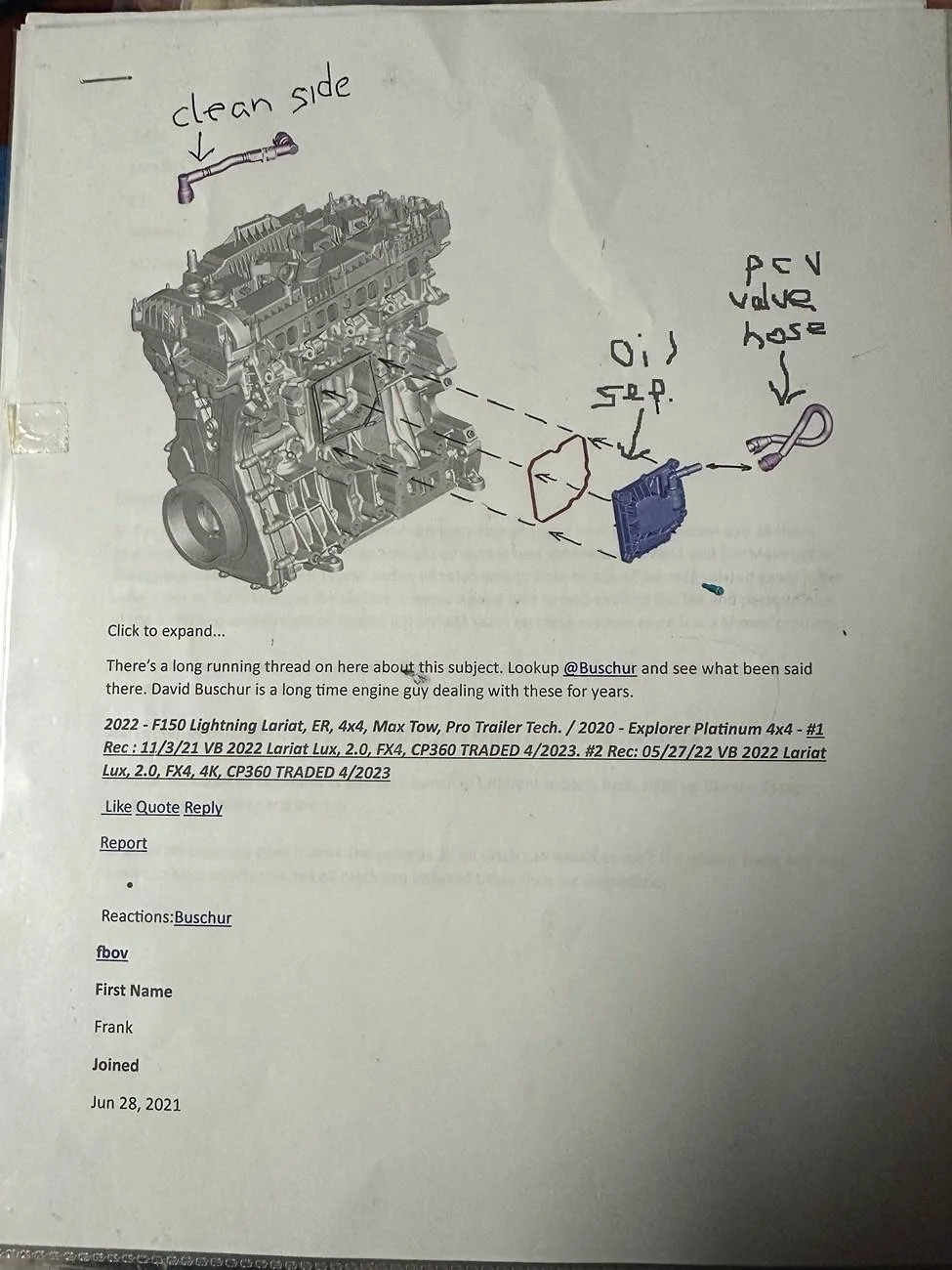
It’s not nice to be rude. But nothing that you showed me disproves what I have said. This has been covered before, long ago and an exploded view of the engine was posted by Buschur on this site. Its what I took out to the dealers mechanic who confirmed the PCV tube is connected to the oil separator.

Ford Maverick UPR Billet Catch Can for Ford Maverick IMG_5367
 

Tbone289

2.0L EcoBoost
Well-known member
First Name
Terry
Joined
Jul 18, 2024
Threads
0
Messages
2,054
Reaction score
3,502
Location
MO
Vehicle(s)
'24 Mav FX4, '12 Focus SE Sport, '01 Focus ZX3, '00 Jeep XJ, '67 Bronco
Engine
2.0L EcoBoost
That's correct. The PCV tube connects to the PCV valve at the top of the oil separator. The other end connects to the intake manifold. The part that you're not understanding is that, on a stock engine, gasses are exiting the oil separator through the PCV valve, and entering the intake manifold. The PCV valve is a check valve that keeps gasses from going back into the crank case. The only part missing from the diagram you provided is the intake manifold on the exit end of the PCV hose.

The upper "clean" side takes care of allowing fresh air into the crank case. The crankcase pulls fresh air from the intake on the clean side and, on the dirty side, expels gasses through the PCV valve on the oil separator and into the intake manifold. This is how it "breathes" and attempts to maintain atmospheric pressure.

With the catch can in place instead of the PCV hose, gases route through the oil separator, through the PCV valve, through the catch can, then into the intake manifold. Can I assume that somehow you think the PCV hose is just a loop that starts at the oil separator and ends at the crankcase? That is not true, and I don't know how you would conclude that from the diagram.
 
Last edited:
Sponsored

Tbone289

2.0L EcoBoost
Well-known member
First Name
Terry
Joined
Jul 18, 2024
Threads
0
Messages
2,054
Reaction score
3,502
Location
MO
Vehicle(s)
'24 Mav FX4, '12 Focus SE Sport, '01 Focus ZX3, '00 Jeep XJ, '67 Bronco
Engine
2.0L EcoBoost
If it wasn't connected to the intake, there would be zero reason to have a catch can connected to it.
Absolutely, and that's the reason @RLmesc seems to think the lower catch can is useless--because he doesn't think it connects to the intake manifold:

The the lower catch can does not get routed to the intake as does the upper catch can.
 

RLmesc

2.0L EcoBoost
Well-known member
First Name
Randy
Joined
Apr 15, 2022
Threads
6
Messages
481
Reaction score
604
Location
Dubuque, Ia
Vehicle(s)
18 Kia Sportage, 05 Porsche Boxster S, 85 Kawasaki
Engine
2.0L EcoBoost
Absolutely, and that's the reason @RLmesc seems to think the lower catch can is useless--because he doesn't think it connects to the intake manifold:
What I was passing on was what I was told. You know to be helpful, same as you. I went on line just now and asked the internet, “What does the PCV oil separator do?” This is their reply… “To solve the oil mist problems oil separators are now fitted to many vehicles. Before the gasses are returned to the inlet it is channelled thru a series of baffles or filters slowing the speed of the gas and allowing the oil mist to condense. The oil droplets are then returned to the crankcase.

I don’t know you or your expertise but this is what I learned today and a year and a half ago. I’m not a mechanic but I consulted Ford’s and was just acting as a messenger. There is no reason for you to be dismissive and rude on this kind of web site. I may be wrong but my research differs from yours. Do you by chance work for the OCC industry?
 

Tbone289

2.0L EcoBoost
Well-known member
First Name
Terry
Joined
Jul 18, 2024
Threads
0
Messages
2,054
Reaction score
3,502
Location
MO
Vehicle(s)
'24 Mav FX4, '12 Focus SE Sport, '01 Focus ZX3, '00 Jeep XJ, '67 Bronco
Engine
2.0L EcoBoost
What I was passing on was what I was told. You know to be helpful, same as you. I went on line just now and asked the internet, “What does the PCV oil separator do?” This is their reply… “To solve the oil mist problems oil separators are now fitted to many vehicles. Before the gasses are returned to the inlet it is channelled thru a series of baffles or filters slowing the speed of the gas and allowing the oil mist to condense. The oil droplets are then returned to the crankcase.
AI is correct. That is what an oil separator does, but not with 100% efficiency. It allows oil mist to drain back into the crankcase as crank case gases and oil vapor exit the crankcase through the PCV valve. These gases are what are routed through the dirty side catch can, and then to the intake manifold. Particles in these gases are what builds up on the back side of the intake valves, and are what the catch can reduces on the way to the intake manifold. Contrary to your belief, "Dirty side" catch cans are effective at catching particles and oil vapors that the oil separator did not catch and send back to the sump.

My apologies for coming off as rude. I don't tolerate false information being spread in public forums well, especially when it is to the detriment of suppliers who are providing effective products to the community which that forum represents. I want suppliers with effective products like UPR to thrive so that I have a supply and support of those products available to me for as many years as I own a Maverick.

It is false to state that the catch can comes before the oil separator. The oil separator is the very first part that the crankcase gases route through, then the PCV valve, then PCV tube (or catch can if you have one), then the intake manifold.

It is false to state that the catch can doesn't connect to the intake manifold. That is exactly where the output of the catch can connects.

I do not work for the OCC industry. I'm just an engineer that has been working on vehicles for over 30 years. To effectively work on modern vehicles, these systems must be understood. Frankly, it saddens me that the certified mechanic you relied on to explain the PCV system to you doesn't understand them.
 
Last edited:
OP
OP
Bohefus

Bohefus

2.0L EcoBoost
Banned
Banned
First Name
Joe
Joined
Sep 11, 2023
Threads
8
Messages
331
Reaction score
263
Location
Mesa Az
Vehicle(s)
2024 Maverick Lariat BAP, 2016 Mazda 3
Engine
2.0L EcoBoost
What I was passing on was what I was told. You know to be helpful, same as you. I went on line just now and asked the internet, “What does the PCV oil separator do?” This is their reply… “To solve the oil mist problems oil separators are now fitted to many vehicles. Before the gasses are returned to the inlet it is channelled thru a series of baffles or filters slowing the speed of the gas and allowing the oil mist to condense. The oil droplets are then returned to the crankcase.

I don’t know you or your expertise but this is what I learned today and a year and a half ago. I’m not a mechanic but I consulted Ford’s and was just acting as a messenger. There is no reason for you to be dismissive and rude on this kind of web site. I may be wrong but my research differs from yours. Do you by chance work for the OCC industry?
The answer you received from "the internet" was probably combining 2 different things. It's not really a "PCV oil separator" It's the oil separator with a PCV valve attached. The oil separator pretty much just provides a gravity hindrance to the oil/fluid trying to exit through the PCV valve. This gravity hindrance doesn't work as well on vapor so it makes it's way passed the separator & through the PCV & into the intake. That's why engines with direct injection end up with carbon build up on the intake valves. Installing a catch can in between the PCV and the intake reduces the vapors & fluids entering the intake.
 

yamahaSHO

2.0L EcoBoost
Well-known member
First Name
Jason
Joined
Sep 15, 2022
Threads
1
Messages
285
Reaction score
425
Location
Greenwood, AR
Vehicle(s)
22 Ranger, 07 Sky RL, 04 S2000, 07 Jeep CRD
Engine
2.0L EcoBoost
What I was passing on was what I was told. You know to be helpful, same as you. I went on line just now and asked the internet, “What does the PCV oil separator do?” This is their reply… “To solve the oil mist problems oil separators are now fitted to many vehicles. Before the gasses are returned to the inlet it is channelled thru a series of baffles or filters slowing the speed of the gas and allowing the oil mist to condense. The oil droplets are then returned to the crankcase.

I don’t know you or your expertise but this is what I learned today and a year and a half ago. I’m not a mechanic but I consulted Ford’s and was just acting as a messenger. There is no reason for you to be dismissive and rude on this kind of web site. I may be wrong but my research differs from yours. Do you by chance work for the OCC industry?


Internal oil baffles/separators have been present in many engines for decades. As stated above, they're not 100% efficient, but neither are catch can/separators that go back into the intake (though I prefer a closed system). The only way to be certain the oily mist stays out of the intake is to vent to atmosphere (not recommending this).

I actually bought a dual valve UPR catch can for my Ranger as I like to lessen the amount of gunk getting sucked into the intake, especially on a DI motor. I decided I didn't want to have another maintenance item of draining the catch can, so I sold it without installing.

I do run an Crawford AOS on my turbo S2000 and I do not drain it back into the engine, so I do have to drain the long hose I have attached to it and plugged.
Sponsored


Top