
Sponsored

Probity

2.5L Hybrid
Well-known member
Joined
Jul 6, 2021
Threads
9
Messages
329
Reaction score
551
Location
Covington LA
Vehicle(s)
'24 Silverado CCSB 2.7 (a Mav. Hybrid next time?)
Engine
2.5L Hybrid
Ok, I'm having trouble figuring this out I order a XLT hybrid lux package. I have a 1,450lb(dry weigh) pop-up camper, 4 people(let's say 800lb) going camping, with(let's say 600lb of gear). Will I be ok? Or will I need a AWD Ecoboost. The numbers are making my head go đŸ˜”â€đŸ’«
Starting to see more questions around the topic of “how much can I tow?”. Perhaps a better question is “how much can I (safely) tow?”. You get to determine how you define safe. If you’re someone who wants to stay between the lines regards established guidelines (GVWR, GAWR’s, payload) this is fairly straightforward to figure out. If you think in terms of adding (or subtracting) safety margins from established guidelines then you’re on your own. There are exactly zero people out there that can tell us “well I know Ford has over-designed the Maverick (or any vehicle) GVWR/payload/whatever by x% therefore I’m good to pull a load (trailer, extra payload, whatever) that’s xx lbs above established calculated guidelines”. The other side of this is “well to be safe I always base my towing plans on using only 80% (or 91.7% or whatever) of my calculated loads”.

If you’re hoping or planning to tow loads approaching those magic 2000 lb (Hybrid) or 4000 lb (4K tow package) numbers, you should do your sums and go from there. I’m not trying to be the weight police. People overload their cars and trucks all the time and get away with it. What you definitely need to do is figure out ahead of time how much under or over loaded you’ll likely be and then go from there. Ignorance is not bliss if you’re seriously overloaded.

Some towing truisms from Ford F150 owners are here:
(19) Towing Ramblings | MaverickTruckClub.com - 2022+ Ford Maverick Pickup Forum, News, Info
The Maverick is not an F150 by any stretch of the imagination but the towing truisms apply regardless of what your tow vehicle actually is. Most times you end up being payload limited for one reason or another.

Have a look at page 43 and 44 of the Ford 2021 RV and Trailer Towing Guide, familiarize yourself with the various definitions. The 2022 Guide in this forum is preliminary and incomplete, it will get fleshed out later this year.
2021 Ford RV & Trailer Towing Guide

There is one surefire method for determining how much you can tow according to established guidelines. However very few people will actually do this because it’s a PITA and we all think we can accurately estimate all of our weights and applied loads in a towing situation. So for looking at a travel trailer:

1) Load the truck with everybody and everything that will be in it when towing - kids, pets, toys, firewood, any aftermarket truck stuff you’ve added, everything.
2) Drive to a truck stop that has a Certified Automated Truck (CAT) scale and fill up with gas.
3) Weigh the wet and loaded truck.
4) Subtract the weight of the wet and loaded truck from the GVWR of the truck. Your GVWR is located on the white driver’s side door jamb sticker. The answer is the payload capacity available for weight placed on the hitch ball (aka trailer tongue weight or TTW). If you have a Maverick with 4K tow package, this is 400 lbs. If you have the Hybrid, we all think this might be either 200 lbs or 400 lbs, we don’t yet know for sure until someone crawls under the back and snaps a pic of the hitch receiver weight rating on the Hybrid.
5a) For the Maverick, you shouldn’t need a weigh distributing hitch (WDH) because your limited to 4000 lbs towing (2.0l EB with 4K tow package) or 2000 lbs (Hybrid), so you can ignore this step and go to 5b. However, if you have a body-on-frame PU truck and can go over 5000 lbs, then subtract another 100 pounds from the payload capacity available for hitch ball weight to get payload capacity available for trailer tongue weight (TTW). (That ~100 pounds is the weight of a good WDH with built-in sway control, such as an Equal-I-Zer.)
5b) Divide the payload capacity available for trailer tongue weight (TTW) by 13% and the answer is the max GVWR of any travel trailer you want to consider towing. In other words, your real-world tow rating or max towing capacity.

Someone who’s read the trailer tow guide will say “hey, you talk about using 13% but the Ford Tow Guide says 10%, what gives?”. The actual range you’ll note in the Tow Guide is 10%-15%. In the real world, when we try and balance our trailer loads, how often do you know for sure that your TTW is going to be exactly 10% of that 3963.7 lb small travel trailer unless you measure it? Most times we just make an educated guess. Just as U-Haul rightly recommends, you aim to put most (~60%) of the weight in the forward part of their trailer to aid in sway stability (watch that little video clip they have regarding preventing trailer sway). Using 13% instead of 10% may be a safety margin, or maybe not, it all depends on how accurately you know what actual trailer tongue weight/load is. Most regular towers use ~13% for that reason.

For those of you planning on towing a boat, you may think “hey I know that boats typically have most of their weight rearward on a boat trailer and that TTW can sometimes be less than 10%, so what do I do?”. The answer is, it depends. In general, if you can, try to get TTW in the 10%-15% range. But you’re likely to be OK with something less than 10% for boats you’re looking at.

What Bass Pro has to say about this (probably the size boat Maverick owners are looking at):
How to Measure Boat Trailer Tongue Weight | Bass Pro Shops
What Boston Whalers has to say (look under Tongue Weight section):
Classic Whaler: Boston Whaler: Reference: Trailering: Trailer Set Up (continuouswave.com)

For those of you who won’t be going to a CAT scale (i.e. most of you), play around with some numbers (either hand calculated or using a simple online calculator like this - TowCalculator.com ) and see what gets you in the ballpark regards what you can tow and still stay within recommended guidelines. Note: the online calculator uses 12.5% for tongue weight vs. 13%, just so you’re aware.

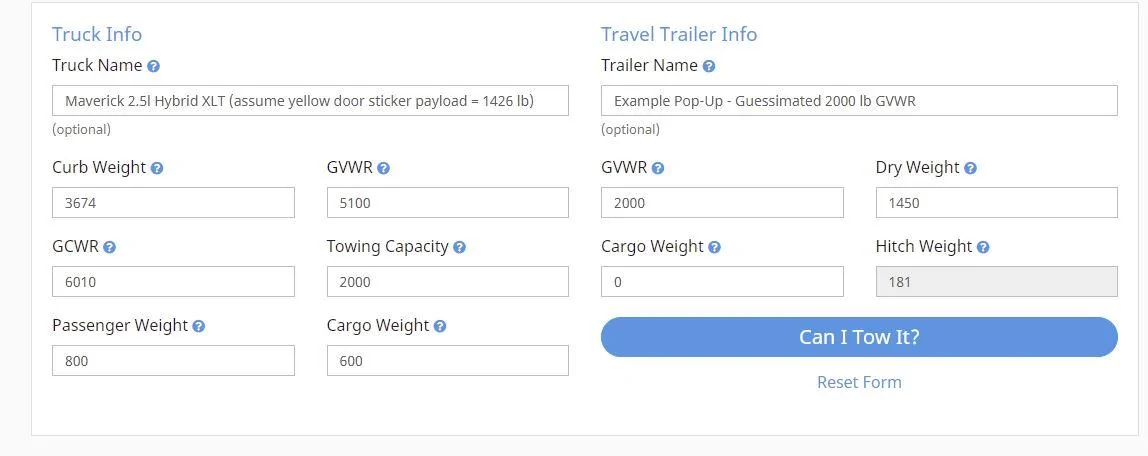
So, using your example, and what we think we know about the Maverick XLT Hybrid - base curb weight ~3674 lbs, GCWR 6010 lb, actual door sticker payload rating ~1436 lb (got this from an actual XLT Hybrid payload sticker pic), GVWR ~5100 lb (base curb weight + actual door sticker payload rating), the simple calculator spits out the following (note: I assumed a GVWR of 2000 lb for your pop-up trailer and that you really do tow it dry, i.e. no cargo whatsoever in it):
Ford Maverick 2022 Maverick Trailer Towing & GVWR / GCWR Guide tow ex

Ford Maverick 2022 Maverick Trailer Towing & GVWR / GCWR Guide tow result


So in general Darnon is right, you’re over quite a bit on GCWR (~500+ lbs) and a little (~155 lbs) on payload.
Sponsored


A Dodge that drives Fords

2.0L EcoBoost
Well-known member
Joined
Jul 30, 2021
Threads
26
Messages
777
Reaction score
876
Location
Wisconsin
Vehicle(s)
Ford Taurus Ford Ranger
Engine
2.0L EcoBoost
Starting to see more questions around the topic of “how much can I tow?”. Perhaps a better question is “how much can I (safely) tow?”. You get to determine how you define safe. If you’re someone who wants to stay between the lines regards established guidelines (GVWR, GAWR’s, payload) this is fairly straightforward to figure out. If you think in terms of adding (or subtracting) safety margins from established guidelines then you’re on your own. There are exactly zero people out there that can tell us “well I know Ford has over-designed the Maverick (or any vehicle) GVWR/payload/whatever by x% therefore I’m good to pull a load (trailer, extra payload, whatever) that’s xx lbs above established calculated guidelines”. The other side of this is “well to be safe I always base my towing plans on using only 80% (or 91.7% or whatever) of my calculated loads”.

If you’re hoping or planning to tow loads approaching those magic 2000 lb (Hybrid) or 4000 lb (4K tow package) numbers, you should do your sums and go from there. I’m not trying to be the weight police. People overload their cars and trucks all the time and get away with it. What you definitely need to do is figure out ahead of time how much under or over loaded you’ll likely be and then go from there. Ignorance is not bliss if you’re seriously overloaded.

Some towing truisms from Ford F150 owners are here:
(19) Towing Ramblings | MaverickTruckClub.com - 2022+ Ford Maverick Pickup Forum, News, Info
The Maverick is not an F150 by any stretch of the imagination but the towing truisms apply regardless of what your tow vehicle actually is. Most times you end up being payload limited for one reason or another.

Have a look at page 43 and 44 of the Ford 2021 RV and Trailer Towing Guide, familiarize yourself with the various definitions. The 2022 Guide in this forum is preliminary and incomplete, it will get fleshed out later this year.
2021 Ford RV & Trailer Towing Guide

There is one surefire method for determining how much you can tow according to established guidelines. However very few people will actually do this because it’s a PITA and we all think we can accurately estimate all of our weights and applied loads in a towing situation. So for looking at a travel trailer:

1) Load the truck with everybody and everything that will be in it when towing - kids, pets, toys, firewood, any aftermarket truck stuff you’ve added, everything.
2) Drive to a truck stop that has a Certified Automated Truck (CAT) scale and fill up with gas.
3) Weigh the wet and loaded truck.
4) Subtract the weight of the wet and loaded truck from the GVWR of the truck. Your GVWR is located on the white driver’s side door jamb sticker. The answer is the payload capacity available for weight placed on the hitch ball (aka trailer tongue weight or TTW). If you have a Maverick with 4K tow package, this is 400 lbs. If you have the Hybrid, we all think this might be either 200 lbs or 400 lbs, we don’t yet know for sure until someone crawls under the back and snaps a pic of the hitch receiver weight rating on the Hybrid.
5a) For the Maverick, you shouldn’t need a weigh distributing hitch (WDH) because your limited to 4000 lbs towing (2.0l EB with 4K tow package) or 2000 lbs (Hybrid), so you can ignore this step and go to 5b. However, if you have a body-on-frame PU truck and can go over 5000 lbs, then subtract another 100 pounds from the payload capacity available for hitch ball weight to get payload capacity available for trailer tongue weight (TTW). (That ~100 pounds is the weight of a good WDH with built-in sway control, such as an Equal-I-Zer.)
5b) Divide the payload capacity available for trailer tongue weight (TTW) by 13% and the answer is the max GVWR of any travel trailer you want to consider towing. In other words, your real-world tow rating or max towing capacity.

Someone who’s read the trailer tow guide will say “hey, you talk about using 13% but the Ford Tow Guide says 10%, what gives?”. The actual range you’ll note in the Tow Guide is 10%-15%. In the real world, when we try and balance our trailer loads, how often do you know for sure that your TTW is going to be exactly 10% of that 3963.7 lb small travel trailer unless you measure it? Most times we just make an educated guess. Just as U-Haul rightly recommends, you aim to put most (~60%) of the weight in the forward part of their trailer to aid in sway stability (watch that little video clip they have regarding preventing trailer sway). Using 13% instead of 10% may be a safety margin, or maybe not, it all depends on how accurately you know what actual trailer tongue weight/load is. Most regular towers use ~13% for that reason.

For those of you planning on towing a boat, you may think “hey I know that boats typically have most of their weight rearward on a boat trailer and that TTW can sometimes be less than 10%, so what do I do?”. The answer is, it depends. In general, if you can, try to get TTW in the 10%-15% range. But you’re likely to be OK with something less than 10% for boats you’re looking at.

What Bass Pro has to say about this (probably the size boat Maverick owners are looking at):
How to Measure Boat Trailer Tongue Weight | Bass Pro Shops
What Boston Whalers has to say (look under Tongue Weight section):
Classic Whaler: Boston Whaler: Reference: Trailering: Trailer Set Up (continuouswave.com)

For those of you who won’t be going to a CAT scale (i.e. most of you), play around with some numbers (either hand calculated or using a simple online calculator like this - TowCalculator.com ) and see what gets you in the ballpark regards what you can tow and still stay within recommended guidelines. Note: the online calculator uses 12.5% for tongue weight vs. 13%, just so you’re aware.

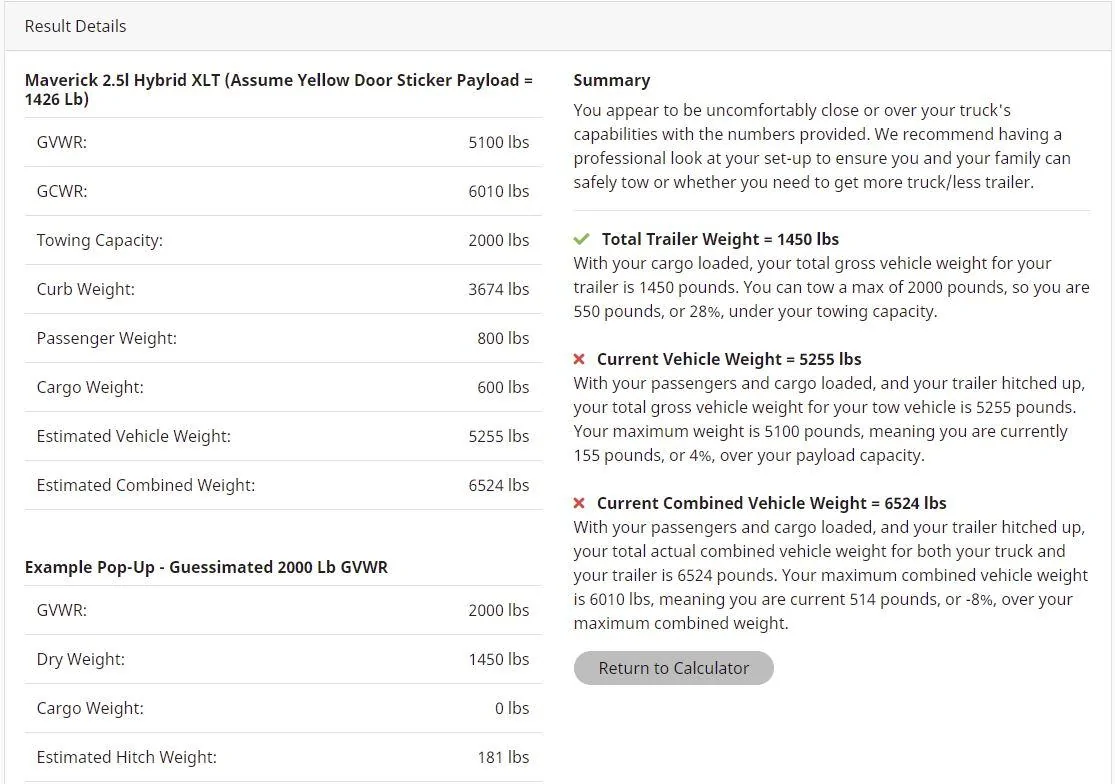
So, using your example, and what we think we know about the Maverick XLT Hybrid - base curb weight ~3674 lbs, GCWR 6010 lb, actual door sticker payload rating ~1436 lb (got this from an actual XLT Hybrid payload sticker pic), GVWR ~5100 lb (base curb weight + actual door sticker payload rating), the simple calculator spits out the following (note: I assumed a GVWR of 2000 lb for your pop-up trailer and that you really do tow it dry, i.e. no cargo whatsoever in it):
tow ex..JPG

tow result.JPG


So in general Darnon is right, you’re over quite a bit on GCWR (~500+ lbs) and a little (~155 lbs) on payload.
WoW thank you! I was looking for more a yes or no answer LoL 🙂 but this is a really good read. I will be switching from the hybrid to the EcoBoost all-wheel drive 4K package. I guess I was thinking because the hybrid can tow 2000 lb and the Maverick can haul 1500 lb that's 3,500 lb so I thought I was good with the hybrid.
 

CLH917

2.0L EcoBoost
Well-known member
First Name
Travis
Joined
Jun 21, 2021
Threads
18
Messages
775
Reaction score
1,920
Location
Madisonville, LA
Vehicle(s)
2022 Ford Maverick
Engine
2.0L EcoBoost
WoW thank you! I was looking for more a yes or no answer LoL 🙂 but this is a really good read. I will be switching from the hybrid to the EcoBoost all-wheel drive 4K package. I guess I was thinking because the hybrid can tow 2000 lb and the Maverick can haul 1500 lb that's 3,500 lb so I thought I was good with the hybrid.
Nope. You are making the right choice by switching.
 

Probity

2.5L Hybrid
Well-known member
Joined
Jul 6, 2021
Threads
9
Messages
329
Reaction score
551
Location
Covington LA
Vehicle(s)
'24 Silverado CCSB 2.7 (a Mav. Hybrid next time?)
Engine
2.5L Hybrid
WoW thank you! I was looking for more a yes or no answer LoL 🙂 but this is a really good read. I will be switching from the hybrid to the EcoBoost all-wheel drive 4K package. I guess I was thinking because the hybrid can tow 2000 lb and the Maverick can haul 1500 lb that's 3,500 lb so I thought I was good with the hybrid.

To muddy the water a little bit, by “upgrading” to a 2.0l EB AWD you will definitely increase the max. trailer weight you can pull/tow (your GCWR just went up from 6010 lbs to 8145 lbs). But if you want to “stay between the lines” wrt towing and payload calcs, you still may have a payload issue. As stated, most times it’s payload that ends up being the limiting factor for “what can I tow (safely, within guidelines, etc)”.

Actual payload capacity for a given vehicle (that yellow door sticker on Fords) is what it is. The GVWR for a particular vehicle (that white door jamb sticker) also is what it is. Other than physically lightening what the truck actually weighs once it left the factory or stiffening the frame/unibody/whatever, there is nothing you can do to increase its actual payload capacity or GVWR. The door stickers are the final word. Our Canadian friend posted the actual door jamb sticker (1426 lbs) for the XLT Hybrid he reviewed.

Ford has repeatedly told us Mavericks will have a “maximum” payload capacity of ~1500 lbs. That 2.0l EB AWD likely will not have an actual payload capacity significantly higher than the Hybrid. If I was a betting man (I am), I’d wager that the 2.0l EB AWD payloads are definitely not above 1500 lbs, and may well be slightly less than the 1426 lbs for the XLT Hybrid. Someday soon someone will take a pic of the payload sticker on an AWD to prove that point. Generally, for a given cab/engine/final drive ratio configuration, the higher the trim level (more options) the more the truck will weigh, and generally the more it weighs the less actual payload capacity you’ll have.

Window (Monroney) stickers on F150’s (and Superduties and Transits) show what the GVWR is for that particular truck (for F150’s they can and do vary between above 3500 lbs to less than 1400 lbs and everything in-between). Window stickers for Rangers do not show GVWR (I guess because it’s a single 6050# regardless of configuration or trim). Window stickers for all of Ford’s other vehicles do not show GVWR, even if they have a tow package. No window stickers for any Ford vehicle show what the actual payload rating is (that yellow door jamb sticker). There is no way I know of to know ahead of time what your unique actual payload capacity number is other than looking at the yellow door jamb sticker.

One way to roll this all up (using our Canadian friend’s XLT Hybrid example) – we know the actual payload (yellow sticker) is 1426 lbs. Let’s assume (I don’t know for sure ‘cause I haven’t seen it) the Hybrid GVWR (white sticker) is 5100 lbs. GVWR – (yellow sticker payload) = what the truck should weight when it left the factory with a full tank of gas = 3674 lbs.

Payload is basically everything you have on or in your truck after it left the factory. If it ain’t on the window sticker (ex. – that aftermarket tonneau you added or floor mats or aftermarket Line-X bedliner you had sprayed on or whatever) then it’s not reflected in the yellow sticker actual payload capacity. Another way to roll all this up: Base Curb Weight + “payload” = GVW, and the GVW should not exceed the tow vehicle’s GVWR. “Payload” = any added OEM equipment weight + any aftermarket body and equipment weight + passenger weight + cargo weight (remember that TTW acts as a payload component) = GVW; and GVW should not exceed tow vehicle GVWR or axle GAWR’s.

So getting back to your pop-up trailer example, to “stay between the lines” there are a few things you can and can’t do. You can’t (realistically) increase your actual payload capacity (yellow sticker). You can however lighten your payload either by carrying less “stuff” and/or repositioning some of that “stuff” to your trailer. Or you can upgrade to a 2.0l EB AWD with 4K tow package.

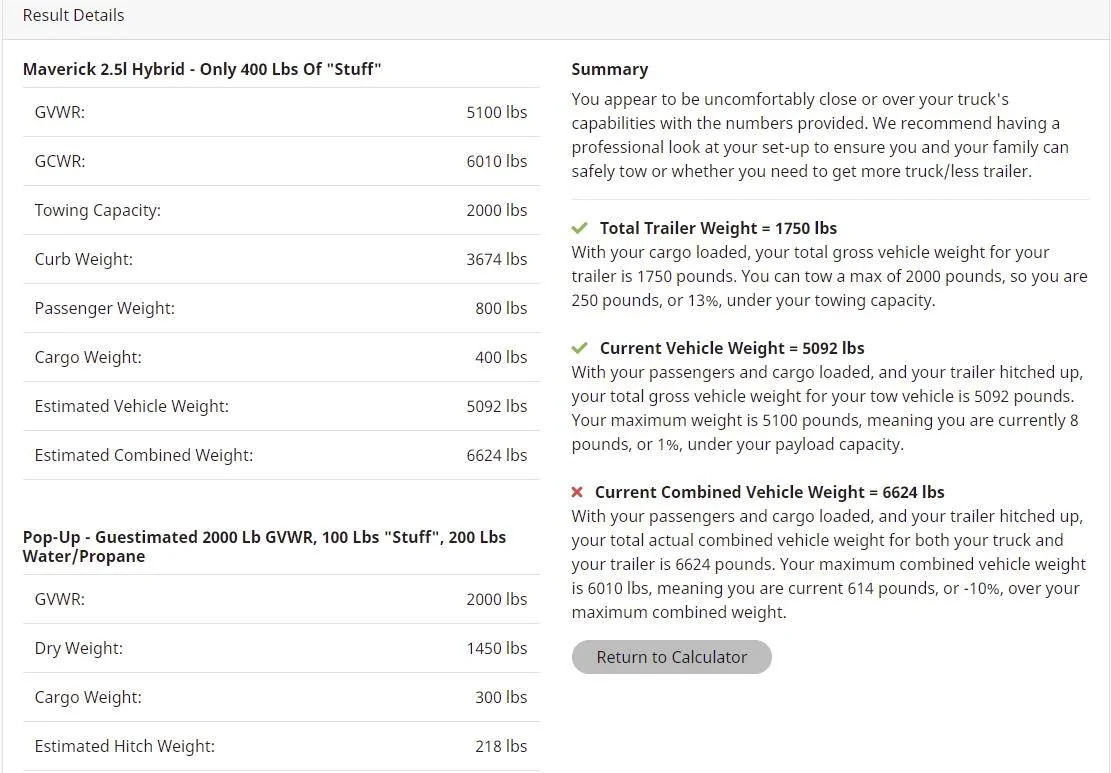
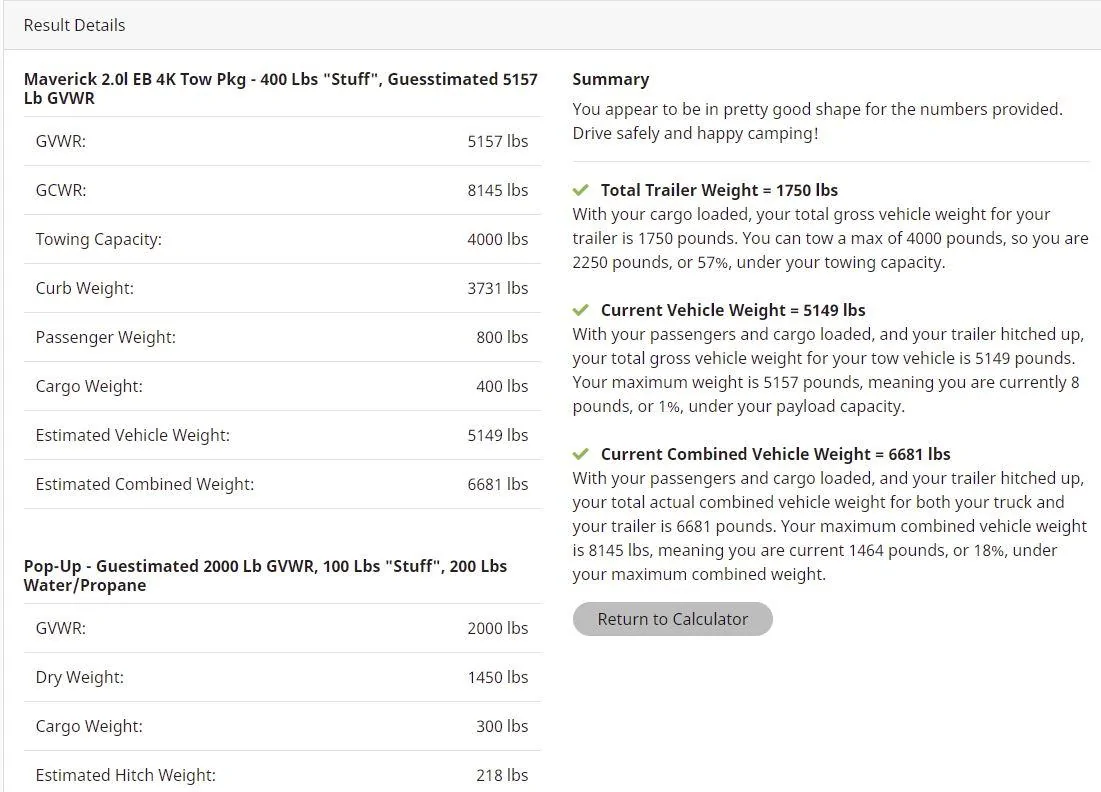
I will assume you will want to take all 3 passengers along with you camping. So that 800 lb passenger weight stays. I will also assume you take a cold hard look at the 600 lbs of “stuff” you want to bring, and decide you can trim that down to 500 lbs. Additionally, I will assume of that remaining 500 lbs of “stuff” you can figure out a way to cram 100 lbs of that into your pop-up (not sure that’s possible, I know nothing about pop-ups, but let’s assume). And I’ll also assume that you decide to carry some water and propane in your trailer tanks that adds another 200 lbs to your trailer weight. If your trailer GVWR really is 2000 lbs (I assumed that, you know what the actual number is), with dry weight of 1450 lbs + 100 lbs of “stuff” + 200 lbs of water/propane, you are still under the 2000 lbs assumed GVWR of the pop-up. So let’s see what happens to both GCWR and payload for the Hybrid:
Ford Maverick 2022 Maverick Trailer Towing & GVWR / GCWR Guide hybrid ex

As expected, with the Hybrid, you are still well above the GCWR so you’re “outside the lines”. But your “payload” problem went away (by only 8 lbs but still
).

Looking at the 2.0l EB AWD with 4K tow package, you’re good all around (note the GVWR assumption I made), although still only 8 lbs of payload margin. But at least with the 4K tow package (4-pin and 7-pin connectors at the hitch receiver) you now also have a trailer brake controller (TBC) for those electric brakes I’m pretty sure your pop-up has, whereas with a Hybrid you’d have to add a TBC after the fact (Hybrid only comes with a 4-pin).
Ford Maverick 2022 Maverick Trailer Towing & GVWR / GCWR Guide awd ex

Once you know your "real" GVWR (white sticker) and "real" payload rating (yellow sticker) you can mess with payload assumptions and see if you can make it work to your satisfaction.
 

A Dodge that drives Fords

2.0L EcoBoost
Well-known member
Joined
Jul 30, 2021
Threads
26
Messages
777
Reaction score
876
Location
Wisconsin
Vehicle(s)
Ford Taurus Ford Ranger
Engine
2.0L EcoBoost
To muddy the water a little bit, by “upgrading” to a 2.0l EB AWD you will definitely increase the max. trailer weight you can pull/tow (your GCWR just went up from 6010 lbs to 8145 lbs). But if you want to “stay between the lines” wrt towing and payload calcs, you still may have a payload issue. As stated, most times it’s payload that ends up being the limiting factor for “what can I tow (safely, within guidelines, etc)”.

Actual payload capacity for a given vehicle (that yellow door sticker on Fords) is what it is. The GVWR for a particular vehicle (that white door jamb sticker) also is what it is. Other than physically lightening what the truck actually weighs once it left the factory or stiffening the frame/unibody/whatever, there is nothing you can do to increase its actual payload capacity or GVWR. The door stickers are the final word. Our Canadian friend posted the actual door jamb sticker (1426 lbs) for the XLT Hybrid he reviewed.

Ford has repeatedly told us Mavericks will have a “maximum” payload capacity of ~1500 lbs. That 2.0l EB AWD likely will not have an actual payload capacity significantly higher than the Hybrid. If I was a betting man (I am), I’d wager that the 2.0l EB AWD payloads are definitely not above 1500 lbs, and may well be slightly less than the 1426 lbs for the XLT Hybrid. Someday soon someone will take a pic of the payload sticker on an AWD to prove that point. Generally, for a given cab/engine/final drive ratio configuration, the higher the trim level (more options) the more the truck will weigh, and generally the more it weighs the less actual payload capacity you’ll have.

Window (Monroney) stickers on F150’s (and Superduties and Transits) show what the GVWR is for that particular truck (for F150’s they can and do vary between above 3500 lbs to less than 1400 lbs and everything in-between). Window stickers for Rangers do not show GVWR (I guess because it’s a single 6050# regardless of configuration or trim). Window stickers for all of Ford’s other vehicles do not show GVWR, even if they have a tow package. No window stickers for any Ford vehicle show what the actual payload rating is (that yellow door jamb sticker). There is no way I know of to know ahead of time what your unique actual payload capacity number is other than looking at the yellow door jamb sticker.

One way to roll this all up (using our Canadian friend’s XLT Hybrid example) – we know the actual payload (yellow sticker) is 1426 lbs. Let’s assume (I don’t know for sure ‘cause I haven’t seen it) the Hybrid GVWR (white sticker) is 5100 lbs. GVWR – (yellow sticker payload) = what the truck should weight when it left the factory with a full tank of gas = 3674 lbs.

Payload is basically everything you have on or in your truck after it left the factory. If it ain’t on the window sticker (ex. – that aftermarket tonneau you added or floor mats or aftermarket Line-X bedliner you had sprayed on or whatever) then it’s not reflected in the yellow sticker actual payload capacity. Another way to roll all this up: Base Curb Weight + “payload” = GVW, and the GVW should not exceed the tow vehicle’s GVWR. “Payload” = any added OEM equipment weight + any aftermarket body and equipment weight + passenger weight + cargo weight (remember that TTW acts as a payload component) = GVW; and GVW should not exceed tow vehicle GVWR or axle GAWR’s.

So getting back to your pop-up trailer example, to “stay between the lines” there are a few things you can and can’t do. You can’t (realistically) increase your actual payload capacity (yellow sticker). You can however lighten your payload either by carrying less “stuff” and/or repositioning some of that “stuff” to your trailer. Or you can upgrade to a 2.0l EB AWD with 4K tow package.

I will assume you will want to take all 3 passengers along with you camping. So that 800 lb passenger weight stays. I will also assume you take a cold hard look at the 600 lbs of “stuff” you want to bring, and decide you can trim that down to 500 lbs. Additionally, I will assume of that remaining 500 lbs of “stuff” you can figure out a way to cram 100 lbs of that into your pop-up (not sure that’s possible, I know nothing about pop-ups, but let’s assume). And I’ll also assume that you decide to carry some water and propane in your trailer tanks that adds another 200 lbs to your trailer weight. If your trailer GVWR really is 2000 lbs (I assumed that, you know what the actual number is), with dry weight of 1450 lbs + 100 lbs of “stuff” + 200 lbs of water/propane, you are still under the 2000 lbs assumed GVWR of the pop-up. So let’s see what happens to both GCWR and payload for the Hybrid:
hybrid ex.webp

As expected, with the Hybrid, you are still well above the GCWR so you’re “outside the lines”. But your “payload” problem went away (by only 8 lbs but still
).

Looking at the 2.0l EB AWD with 4K tow package, you’re good all around (note the GVWR assumption I made), although still only 8 lbs of payload margin. But at least with the 4K tow package (4-pin and 7-pin connectors at the hitch receiver) you now also have a trailer brake controller (TBC) for those electric brakes I’m pretty sure your pop-up has, whereas with a Hybrid you’d have to add a TBC after the fact (Hybrid only comes with a 4-pin).
awd ex.webp

Once you know your "real" GVWR (white sticker) and "real" payload rating (yellow sticker) you can mess with payload assumptions and see if you can make it work to your satisfaction.
Thank you. And thank you ALL. I called my dealer and upgraded to the EcoBoost all wheel drive 4K towing.
 

Sponsored

A Dodge that drives Fords

2.0L EcoBoost
Well-known member
Joined
Jul 30, 2021
Threads
26
Messages
777
Reaction score
876
Location
Wisconsin
Vehicle(s)
Ford Taurus Ford Ranger
Engine
2.0L EcoBoost
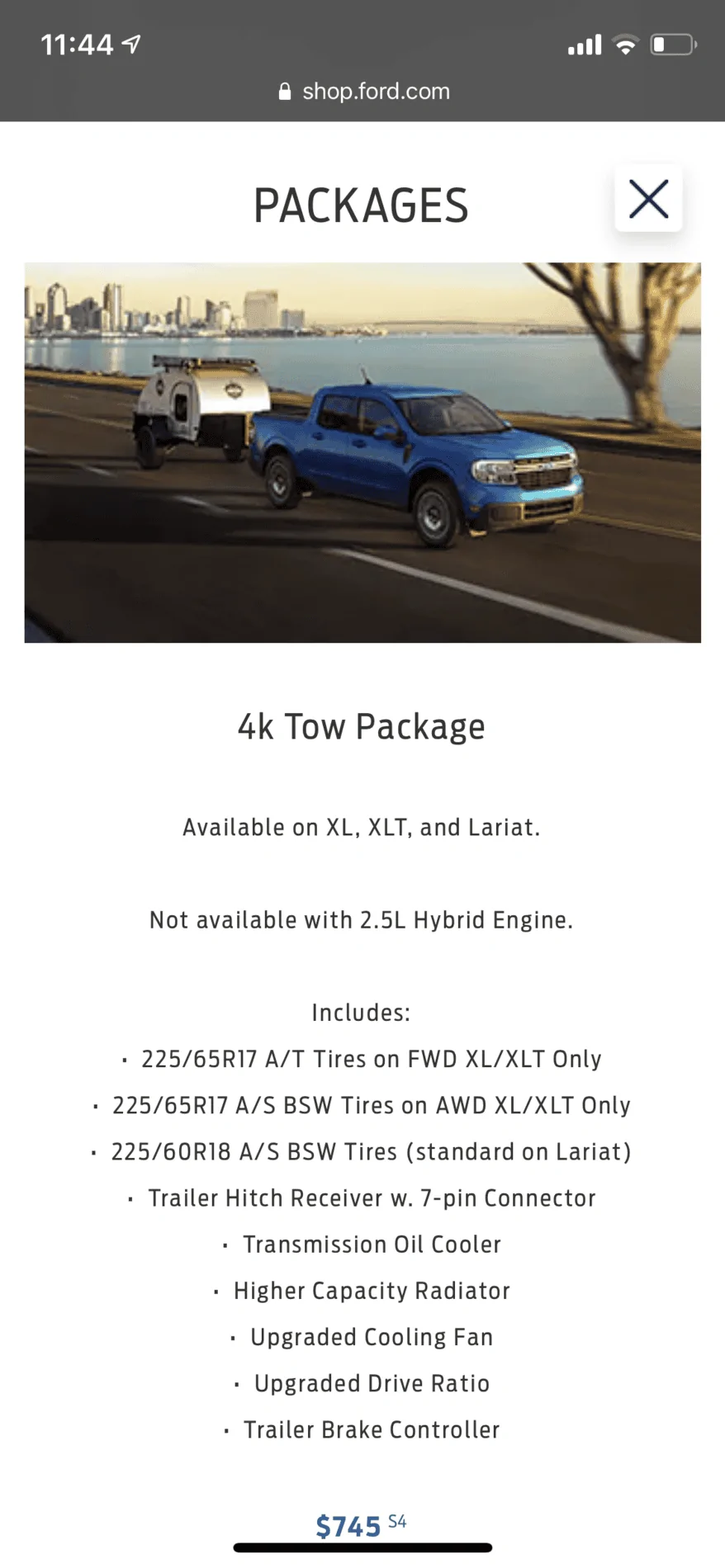
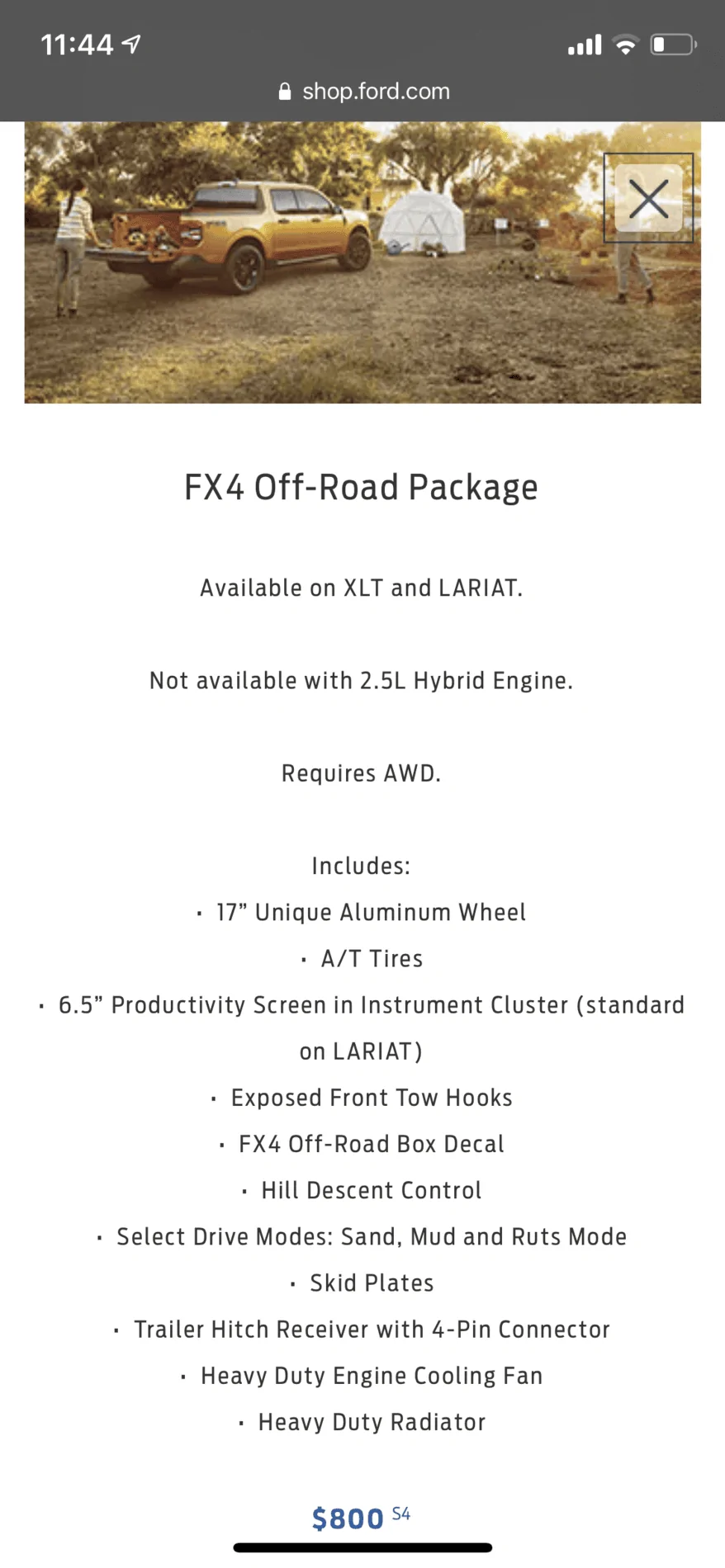
So does the 4K towing package include tow hooks or is that only on the FX4 package?
 
Sponsored

vap0rtranz

2.5L Hybrid
Well-known member
First Name
JP
Joined
Jul 28, 2021
Threads
6
Messages
349
Reaction score
464
Location
Wisconsin
Vehicle(s)
'22 Mav Hybrid XLT, '17 Chevy Colo Z71 diesel
Engine
2.5L Hybrid
The actual range you’ll note in the Tow Guide is 10%-15%. In the real world, when we try and balance our trailer loads, how often do you know for sure that your TTW is going to be exactly 10% of that 3963.7 lb small travel trailer unless you measure it? Most times we just make an educated guess.
To stop guessing, I just ordered a Weigh Safe ball.

For those of you who won’t be going to a CAT scale (i.e. most of you)
Some of us do go to the scales.
 

Deleted member 1370

Guest
I may sound like a noob one may say. But I plan on moving within the next 1-2 years from New England down south So i personally charged the ecoboost with the tow package for that reason. Planning in advance. For such a distance solo even with a U-Haul trailer I dont want the engine and tranny heating up and wanting to melt into itself like a dying star. I get itll rev more regardless but those extra upgraded parts should definitely help. I dont plan on towing boats, huge campers or anything regularly either. It will be nice to have the tow haul mode as well. Having driven old 80s farm trucks it was like buddy you better know what youre doing or get bent. So thatll aid in that be interesting to use. But I wouldnt push this 4k limit either. Have a nice buffer as well just for longevity of the vehicle.
 

hcforde

2.5L Hybrid
Well-known member
First Name
Hawley
Joined
Jul 16, 2021
Threads
11
Messages
699
Reaction score
658
Location
Austin, TX
Vehicle(s)
Honda Insight, E350, Toyota Sequoia
Engine
2.5L Hybrid
I may sound like a noob one may say. But I plan on moving within the next 1-2 years from New England down south So i personally charged the ecoboost with the tow package for that reason. Planning in advance. For such a distance solo even with a U-Haul trailer I dont want the engine and tranny heating up and wanting to melt into itself like a dying star. I get itll rev more regardless but those extra upgraded parts should definitely help. I dont plan on towing boats, huge campers or anything regularly either. It will be nice to have the tow haul mode as well. Having driven old 80s farm trucks it was like buddy you better know what youre doing or get bent. So thatll aid in that be interesting to use. But I wouldnt push this 4k limit either. Have a nice buffer as well just for longevity of the vehicle.

I am assuming you have AWD also - as of Monday they will not build tow package without AWD even if it was already scheduled.
Sponsored


Top