


- Thread starter
- #1
I own a 2025 with the 2.0 and the tow package. During normal driving I can see transmission temperatures around 200F-210F and when towing I see 220F-227F. Ambient temperature doesn't seem to make a difference. I was told from a Ford transmission engineer that the temperatures I am seeing is normal and they don't start heat mitigation until around 250F.
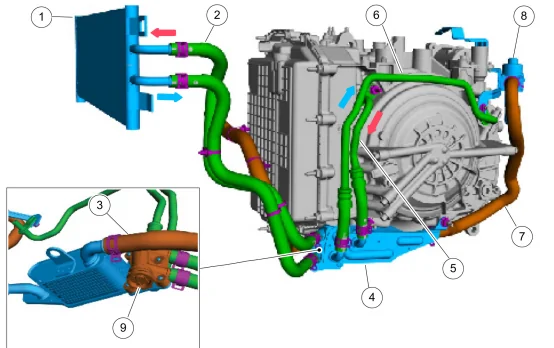
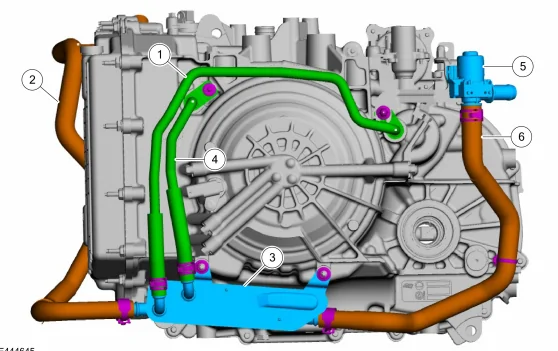
Another recent thread points to the 2025 only relying on the cooler mounted to the transmission and not the additional cooler mounted to the radiator as seen on earlier model years. Wanted to share some info that I have found from the Ford service manuals.
This vehicle is equipped with an external transmission fluid heat exchanger. The transmission fluid heat exchanger is an oil-to-coolant fluid cooler which is mounted to the lower LH side of the transmission. The cooling system also consists of a coolant control valve mounted to the upper rear of the transmission. The transmission fluid flows from the transmission to the transmission fluid heat exchanger and back to the transmission. When the transmission fluid is below normal operating temperature, the coolant control valve closes, stopping coolant flow to the transmission fluid exchanger. When the transmission fluid is at or above normal operating temperature, the coolant control valve opens, allowing engine coolant to flow to the transmission fluid heat exchanger. The transmission fluid heat exchanger transfers heat from the transmission fluid to the engine coolant.
2022 Service Manual
Thermostat Opening Temperatures
2025 Service Manual
Thermostat Opening Temperatures
Another recent thread points to the 2025 only relying on the cooler mounted to the transmission and not the additional cooler mounted to the radiator as seen on earlier model years. Wanted to share some info that I have found from the Ford service manuals.
This vehicle is equipped with an external transmission fluid heat exchanger. The transmission fluid heat exchanger is an oil-to-coolant fluid cooler which is mounted to the lower LH side of the transmission. The cooling system also consists of a coolant control valve mounted to the upper rear of the transmission. The transmission fluid flows from the transmission to the transmission fluid heat exchanger and back to the transmission. When the transmission fluid is below normal operating temperature, the coolant control valve closes, stopping coolant flow to the transmission fluid exchanger. When the transmission fluid is at or above normal operating temperature, the coolant control valve opens, allowing engine coolant to flow to the transmission fluid heat exchanger. The transmission fluid heat exchanger transfers heat from the transmission fluid to the engine coolant.
2022 Service Manual
Thermostat Opening Temperatures
| Starts to open | 80°C-84°C (176°F-183.2°F) |
| Fully open | 97°C (206.6°F) |
2025 Service Manual
Thermostat Opening Temperatures
| Starts to open | 194 °F (90 °C) to 201 °F (93.8 °C) |
| Fully open | 222.7 °F (106 °C) |
Sponsored