

Sponsored

What happens when tuners realize the hybrid HP/TQ numbers?

The Real Maverick

2.5L Hybrid
Banned
Banned
First Name
Jack
Joined
Jan 13, 2024
Threads
31
Messages
2,999
Reaction score
4,143
Location
USA
Vehicle(s)
Maverick Hybrid
Engine
2.5L Hybrid
I think there is money left on the table as far as making a hybrid quicker, I have my doubts on how simple that is since I haven't looked into it since the first gen Prius.
Like the old saying goes...

"If it was easy, everyone would be doing it."

and

"If it was possible, at least one person would have already done it."
Sponsored

 

The Real Maverick

2.5L Hybrid
Banned
Banned
First Name
Jack
Joined
Jan 13, 2024
Threads
31
Messages
2,999
Reaction score
4,143
Location
USA
Vehicle(s)
Maverick Hybrid
Engine
2.5L Hybrid
Except they all do, because that's what is done in the PHEV application when the transaxle is a shared component between a PHEV and a hybrid, which it usually is . The PHEV applications run both higher voltage and current through the exact same motors for much longer duration/duty cycle. This is also why people take the transaxle out of Priuses and use them in full EV conversions with an OpenInverter/ZombieVerterVCU. The non-PHEV Prius Gen2 trans is used for about 93HP continuous and the Gen3 transaxle about 134hp in conversions - Those transaxles never put out that power in a factory Prius install, and also in no way are they at risk of burning up the motors, they've been running such conversions for many years.

Ford and Toyota limits the power for vehicle, and mostly battery, durability. Cooling is way less of a concern than you are imagining, the standard transaxles are more than well enough cooled for normal automotive use at the specificed and published design motor power as they are used in PHEV applications. Motors don't burn up if, and until, you disable the temperature feedback to your motor controller, or you get to the point of pushing insane currents.
Fact:

I actually monitor my motor and generator coil temperature in my Maverick via OBDII.

The generator coil will reach 265°F at the current stock settings with the stock cooling IN ABOUT 3 MINUTES at high output.

How hot do you think it is feasible to withstand?
 
OP
OP
heady

heady

2.5L Hybrid
Well-known member
Joined
May 14, 2025
Threads
4
Messages
328
Reaction score
520
Location
MI
Vehicle(s)
'25 Lariat
Engine
2.5L Hybrid

Escapologist

2.5L Hybrid
Well-known member
Joined
May 26, 2025
Threads
28
Messages
1,061
Reaction score
1,442
Location
Niagara Region, ON
Vehicle(s)
2025 Lariat Hyb AWD 4K, '25 Escape PHEV, Versa, T&C
Engine
2.5L Hybrid
Clubs
 
Obviously you wanna know when your fluids are gonna burn, but was thinking about those random plastic components that all transmissions since the 1990s are afflicted with...

Turns out that most of the high performance plastics are useful to within a hair of 200c when they're useful at all in the 100c+ operating range. However, I notice that their impact strength is very low below 60c, they can shatter I guess when "cold". So whaling on a "cold" transmission can probably mess them up just as easy as whaling on a hot transmission.
 

The Real Maverick

2.5L Hybrid
Banned
Banned
First Name
Jack
Joined
Jan 13, 2024
Threads
31
Messages
2,999
Reaction score
4,143
Location
USA
Vehicle(s)
Maverick Hybrid
Engine
2.5L Hybrid

Sponsored

OP
OP
heady

heady

2.5L Hybrid
Well-known member
Joined
May 14, 2025
Threads
4
Messages
328
Reaction score
520
Location
MI
Vehicle(s)
'25 Lariat
Engine
2.5L Hybrid
Do you have any data on the traction motor/MG2 collected? The conditions of the MG1/generator reaching 130C in your OBDII observations may well be where it was being held at by the controller to maximize regeneration/recharge while holding a conservative motor winding temperature; as the temperature increases, the rate of heat transfer increases as well. It's also hard to accelerate at WOT or regenerate for long periods of time in most vehicles, most of the time. MG1 being held at thermal limits makes more sense than your average motor use case for traction, as it can be held in a state of regeneration by the engine basically perpetually.

In temperature limit, the motors don't stop, they just continue to work at the maximum rate that can be achieved within that limit. When I did my motorcycle conversion I used an HPEVS AC-20, which works great on the street at 90HP, but it was quickly rejected by guys that wanted to race, like Isle of Man TT, because it was an open frame, air cooled induction motor - and it did not have the cooling to maintain the high output required for long duration that road racing requires.
 
Last edited:

Phimosis

2.0L EcoBoost
Well-known member
First Name
Larry
Joined
Jul 18, 2024
Threads
2
Messages
1,180
Reaction score
1,518
Location
Santa Clarita, CA
Vehicle(s)
2024 Maverick Lariat FX4 4K tow
Engine
2.0L EcoBoost
The main thing that holds back the peak power in the hybrid is the relatively small battery; you can only pull so much current out of it safely, based on the C-rate specification of the cells. Adding batteries and capacity to most EVs, PHEVs, and hybrids is relatively easy, you simply tie into the high voltage bus with a matching voltage battery and add a contactor, you can see the examples of this on forums and youtube across the internet, look for range extending trailers, etc - the cars don't actually care where the electrons are coming from or going to on the high voltage bus.

So, that being said, what happens when an enterprising tuner actually realizes that the stock 2025 hybrid is a 393 HP, 376 lb-ft power train bolted to a 405 lb-ft rated transmission?
Your idea won’t work. Phoneguyinpgh explained it on the first page, It’s clear that you’re still not understanding this.

The small motor generator, the one that is like 25 hp, it controls the gear ratios of the eCVT. When at idle, the ice engine is spinning 900 rpm or so, but your wheels are stopped.. the transmission is “in gear”. There is no torque converter. There is no 3rd pedal, old school clutch. Yet the tires aren’t turning at all. Why is that? The answer is because the planetary carrier is spinning freely and that serves as an infinite gear reduction. Then when you let your foot off brake and start to apply the gas, the way the car moves forward is by applying drag on the planetary carrier. That drag is caused by the starter/generator, generating electricity. The more drag on the planetary carrier, the slower it spins. The slower it spins, the higher the gear ratio.

The reason they went to the HF55 transmission instead of the HF45 is because of the 4k towing in hybrids for 2025. This is speculation, but I am confident that this is what happened: they tried towing up hill with the HF45 and the starter generator was not able to provide enough drag on the planetary carrier to get the transmission into higher gear ratios. So what happens when it stays stuck in lower gear ratios? The ice engine comes up to 5,500 rpm, where is makes peak HP and the electronics then start closing the throttle body to keep it from over-revving. If the throttle is part way closed, it is not making its peak 162 hp.

Now, if you went and put a 480V, 70kwh Tesla battery in the bed of your Maverick and hooked it up to the traction motor and gave it the full beans, the same thing would happen, the starter / generator would not be able to change gear ratios fast enough in the eCVT and the transmission input shaft, that is a combination of outputs from the ice engine and the traction motor, would spin up to 5,500 rpm, then throttle back to prevent over-revving.

The new HF55 starter / generator is more powerful than the HF45 and the 2025 Mav hybrid is faster in 0-60 and in the 1/4 mile, even though it has the same combined system output of 191 hp that the 2024 hybrid has. This is likely because the starter / generator was barely up to the task for 191 hp and was delaying the change to higher gear ratios, leading to slower times.

The tl;dr is that if you cranked up the current and the voltage to the traction motor, it would never be able to put the power to the wheels because it would just overpower the starter / generator, leading to a situation analogous to a car sitting on the redline in low gear and not shifting up.
 

Escapologist

2.5L Hybrid
Well-known member
Joined
May 26, 2025
Threads
28
Messages
1,061
Reaction score
1,442
Location
Niagara Region, ON
Vehicle(s)
2025 Lariat Hyb AWD 4K, '25 Escape PHEV, Versa, T&C
Engine
2.5L Hybrid
Clubs
 
IDK about a Tesla batt, but a Leaf battery seems about the right size for a thick bedliner.
 

colinl

2.0L EcoBoost
Well-known member
First Name
Colin
Joined
Jun 21, 2022
Threads
32
Messages
5,440
Reaction score
6,179
Location
ICT
Vehicle(s)
'22 Maverick Lariat AWD, '22 Bronco OBX 2-Door
Engine
2.0L EcoBoost
Clubs
 
The small motor generator, the one that is like 25 hp, it controls the gear ratios of the eCVT. When at idle, the ice engine is spinning 900 rpm or so, but your wheels are stopped.. the transmission is “in gear”. There is no torque converter.
I am super impressed you took the time to explain again. back on post 44 I simply quoted one of his posts with "change gear ratio" and laughed.
 
OP
OP
heady

heady

2.5L Hybrid
Well-known member
Joined
May 14, 2025
Threads
4
Messages
328
Reaction score
520
Location
MI
Vehicle(s)
'25 Lariat
Engine
2.5L Hybrid
Your idea won’t work. Phoneguyinpgh explained it on the first page, It’s clear that you’re still not understanding this.

The small motor generator, the one that is like 25 hp, it controls the gear ratios of the eCVT. When at idle, the ice engine is spinning 900 rpm or so, but your wheels are stopped.. the transmission is “in gear”. There is no torque converter. There is no 3rd pedal, old school clutch. Yet the tires aren’t turning at all. Why is that? The answer is because the planetary carrier is spinning freely and that serves as an infinite gear reduction. Then when you let your foot off brake and start to apply the gas, the way the car moves forward is by applying drag on the planetary carrier. That drag is caused by the starter/generator, generating electricity. The more drag on the planetary carrier, the slower it spins. The slower it spins, the higher the gear ratio.
It's good you understand this part, it will make explaining the rest of the operation of the transmission somewhat easier.
The reason they went to the HF55 transmission instead of the HF45 is because of the 4k towing in hybrids for 2025. This is speculation, but I am confident that this is what happened: they tried towing up hill with the HF45 and the starter generator was not able to provide enough drag on the planetary carrier to get the transmission into higher gear ratios. So what happens when it stays stuck in lower gear ratios? The ice engine comes up to 5,500 rpm, where is makes peak HP and the electronics then start closing the throttle body to keep it from over-revving. If the throttle is part way closed, it is not making its peak 162 hp.
This is where we can take this conjecture and use a tiny amount of math to understand if it's a plausible theory. I can build a spreadsheet tomorrow for this that will outline the entire range of epicyclical torque ratios and angular velocities over the entire range of road speeds from let's say 5 MPH to the speed limiter, and see what the results are. We'll also be able to precisely determine the holding torque and power required by MG1 for each and every combination of road speed and the gear ratio required to keep the engine at its HP peak at those speeds. I have no idea what these numbers will be in advance, so it will be good to get a look at it more closely to test your idea.
Now, if you went and put a 480V, 70kwh Tesla battery in the bed of your Maverick and hooked it up to the traction motor and gave it the full beans, the same thing would happen, the starter / generator would not be able to change gear ratios fast enough in the eCVT and the transmission input shaft, that is a combination of outputs from the ice engine and the traction motor, would spin up to 5,500 rpm, then throttle back to prevent over-revving.

The new HF55 starter / generator is more powerful than the HF45 and the 2025 Mav hybrid is faster in 0-60 and in the 1/4 mile, even though it has the same combined system output of 191 hp that the 2024 hybrid has. This is likely because the starter / generator was barely up to the task for 191 hp and was delaying the change to higher gear ratios, leading to slower times.

The tl;dr is that if you cranked up the current and the voltage to the traction motor, it would never be able to put the power to the wheels because it would just overpower the starter / generator, leading to a situation analogous to a car sitting on the redline in low gear and not shifting up.
This is where you've lost the plot; the traction motor applying any torque to the transfer gear has no bearing on "MG1/starter/generator changing gear ratios fast enough" and the two systems are functionally independent and do not share a power pathway until we get to the differential ring gear. The traction motor putting out it's little 126 HP/173lb-ft via its separate power path through the transfer gear to the differential ring gear would make no difference to MG1, the planetary set, or the engine; no more than rolling down a steep hill does. I can explain the basic physics of this more later with visuals of the power pathways and some basic rate of acceleration explanations to help illustrate the way this side of the transmission works if it would help clear it up.

The massive battery capacities I've seen thrown around are nice if you want some kind of pure EV or uber range plug in hybrid, and I'm not sure if it's hyperbole or just not being sure - but to get the Ford spec motor power that a PHEV application uses, you'd need about a 5-6kwh additional pack with the same ~25 C-rate cells that are in the hybrid 1.1kwh pack to source the ~170kw required, any more would just be for durability or longer plug in range.
 
Sponsored

AutobahnSHO

2.5L Hybrid
Well-known member
First Name
Will
Joined
Oct 11, 2021
Threads
18
Messages
2,113
Reaction score
2,277
Location
S.Carolina
Vehicle(s)
Maverick, Miata
Engine
2.5L Hybrid
Ford and Toyota limits the power for vehicle, and mostly battery, durability. Cooling is way less of a concern than you are imagining, the standard transaxles are more than well enough cooled for normal automotive use at the specificed and published design motor power as they are used in PHEV applications.
ALMOST there..
 
OP
OP
heady

heady

2.5L Hybrid
Well-known member
Joined
May 14, 2025
Threads
4
Messages
328
Reaction score
520
Location
MI
Vehicle(s)
'25 Lariat
Engine
2.5L Hybrid
Planetary Gearing and Torque Ratios, Ford HF(35/45/55) Series Hybrid Power Split Transmissions

Apologies in advance, but due to the depth of the material, I’m going to compose this post over several sessions in spare time throughout the day, so hopefully the train of thought comes through reasonably clearly. Also, if you spot a math error please let me know and I’ll try to correct it as soon as possible. Thank you to Phimosis for inspiring the additional legwork. None of this would be possible without the previous work of countless other people; WeberAuto provides excellent YouTube videos showing exactly how the internals of these transmissions are arranged mechanically from the various manufacturers that make them, sites like diyelectriccar.com and openinverter.org forums provide in-depth technical discussion of how both the mechanical and the motor control systems work on these style transmissions, Maktrans.net makes a parts catalog of internal components of these transmissions readily accessible, as well as providing the tooth count of the gears within the system that they carry in inventory which is necessary for these calculations. Wikipedia and sources like StackExchange were used for the source of equations and explanations of how they are used. There are plenty of others that I’ve read over the years that I’m sure I’ve missed.

Previously I promised to provide a spreadsheet that would demonstrate the calculations and the results of the speed and torque of the starter/generator motor (MG1 in the more well known Toyota terminology) across a range of road speeds and gear ratios. To do this, I need to create a steady state condition to use as a basis for the calculations. Other than the information on the teeth count in the transmission, I need to pick a road speed and an engine output to use as the constants, and calculate the remaining variables from those inputs. Since I do not have a full dyno graph or table of the engine performance at all load points, I can only do these calculations for two known engine values - the peak horsepower, and the peak torque points of the engine. For every other load point, the calculations would be done in the same way, just with different inputs for the torque and RPM value of the engine. You can also do the calculation for any lower torque at the same RPM you have a maximum torque value for; lower torque output is always available by reducing the throttle input.

We can safely ignore the traction motor (MG2 in Toyota) for these calculations; that is a parallel mechanical path system whose output, or lack thereof, does not in any way change either the gear ratios or torque balance requirements in the engine/starter/generator(MG1) planetary. The power that is sent to MG1 to balance the torque ratio must go somewhere however, and will either be used to charge the battery, or the power will be sent to the traction motor in series hybrid mode and then on to the wheels.

There are several caveats that should be spelled out before I carry on further.

First, is that the torque will always be balanced in a planetary gear set; it is not possible to operate in an unbalanced condition. The fixed gear ratios will, if one gear is unable to produce the needed amount of reaction torque to meet any given steady state condition, that gear will be driven to a higher RPM by the stronger torque input - this condition would not last for long, if the RPM rises and the resistance to the torque does not materialize, the torque of the stronger input will fall, this is just like when you bounce your engine off the rev limiter with a full open throttle. In an uncontrolled scenario, you can also overspeed the weaker input, and for example grenade the rotor - these are conditions that must always be accounted for in your VCU or TCM control strategy.

Second, just because you can calculate a given torque balance at a given RPM, does not mean it is possible in practice. As motor RPMs rise, the total power throughput of the starter/generator also increases when it is holding a given torque. This increase in power may be beyond the factory specification for the motor, or it may be possible for short, but not long duration, as all motors have some maximum limit on their power throughput. I will not generate any table value that exceeds the factory published specification for the motor, but those factory specifications do not mean they can be operated indefinitely at that power level, only that they can reach it for some finite period of time.

Third, the gear ratios of the transmission are calculated from tooth count data pulled off of a third party website (maktrans) - if better information comes along and some of those turn out to be incorrect or different from the old model transmissions, we can easily correct the calculations with any updated information as it becomes available. Ford has never changed a planetary sun/ring/planet tooth count in any of them so far, and that is the one that we care most about. The other gears will just change the final drive ratio and the exact road speed values that correlates to each engine/motor information row.

Next, I’ll list all the constants that will be needed to perform the calculations for the planetary. Then I’ll generate two tables, one for the torque peak of the engine, and one for the horsepower peak. Even though publications only give you one of the two values for either torque or horsepower at each RPM on a spec sheet, you can calculate the other one for that RPM, because torque and HP have a fixed relationship.

Engine Horsepower Peak:
162 HP @ 5,600 rpm , 151.93 lb-ft

Engine Torque Peak:
155 lb.-ft. @ 4,000 rpm, 118.05 HP

Starter/Generator Motor Spec:
105 HP, 48 lb-ft. - voltage/torque knee RPM unpublished

Planetary Info:
- Sun: 34 tooth
- Planets: 26 tooth
- Ring: 86 tooth

Transfer Gear Info:
- Planet Ring output Pinion: 61 tooth
- Transfer input Gear: 89 tooth
- Transfer to differential output gear: 19 tooth

Differential helical gear: 64 tooth, 16 bolt

Tire Diameter: 28.5”

One thing that surprised me after having watched older videos and looking at the parts diagram for the other Ford hybrids, is that the transfer/intermediate gear only has one, instead of two, input gears. That’s the first time I’ve seen that on the Ford, assuming I’m looking at the right intermediate/transfer gear. The two input gears were always pretty close in size before, but by making it one single larger one, the teeth are larger/wider, so that was one change that might have helped with the overall increased input torque specification on the HF55 too.

Calculations

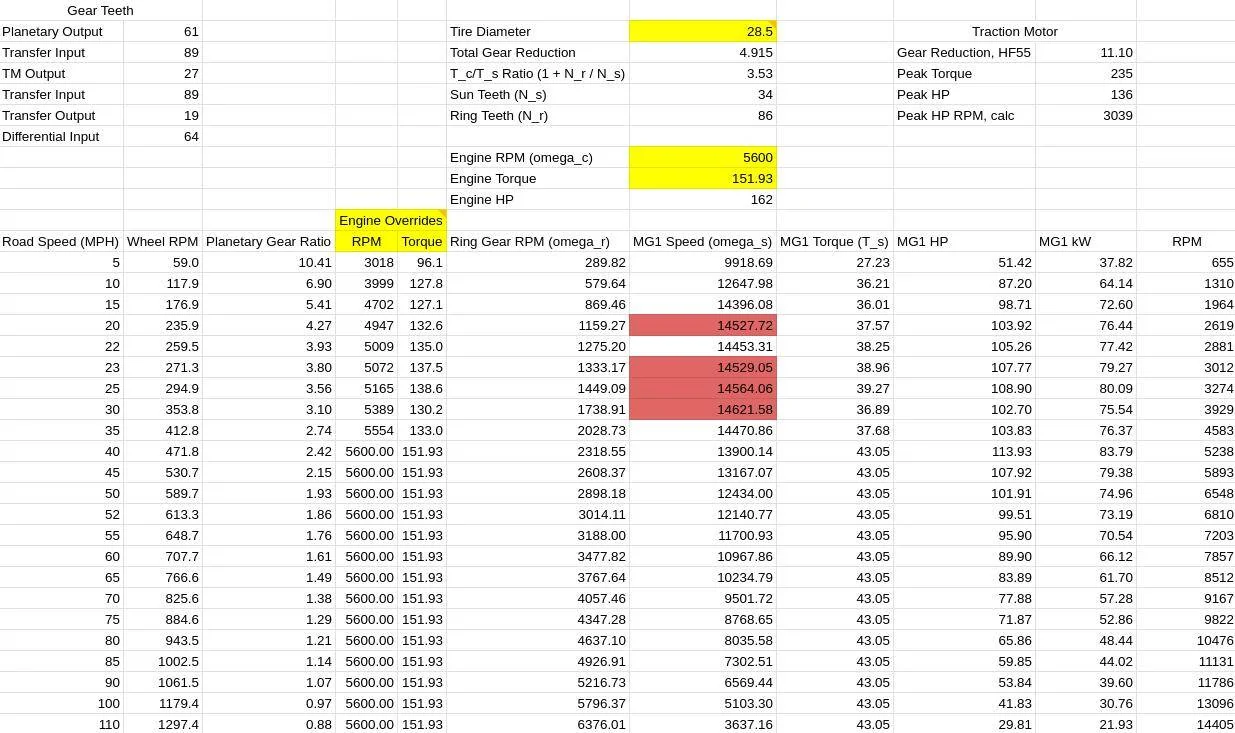
Here’s the output of the spreadsheet I made for the first condition, engine at peak HP output:
Ford Maverick What happens when tuners realize the hybrid HP/TQ numbers? Screenshot_20250713_105153


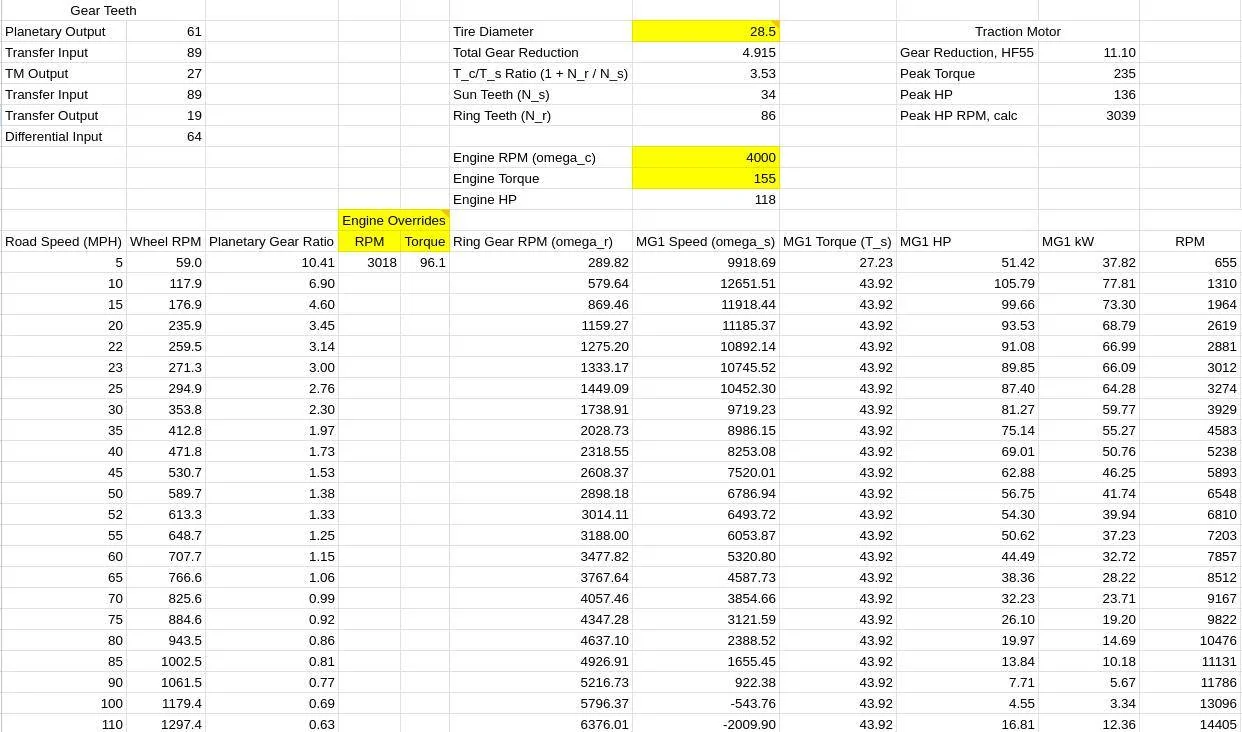
And here’s the output at the torque peak:
Ford Maverick What happens when tuners realize the hybrid HP/TQ numbers? Screenshot_20250713_105300

For calculating the planetary speeds and torques, I used the Willis equation, the derivations are what you find on the Wikipedia page https://en.wikipedia.org/wiki/Epicyclic_gearing - I just converted those into Excel formulas. I put in a few extra road speeds in the center so you could see the crossover point of the starter/generator motor rotation at the HP peak, that point moves depending on engine RPM, I didn't really think about that before.

When the starter/generator speed is high, relatively more energy from the engine gets shuttled through it, either into the battery or sent to the traction motor/MG2. This shuttle is less efficient than direct mechanical drive, for instance if both motors are exceptionally efficient at 95%, and you only lose let's say 2% in the TCM inverter and went directly back into MG2, the losses would be .95 * .95 * .98 = 88.4% efficiency on that energy transfer. Looking at a more extreme example, let's say you're driving at 23 mph and the engine is at 4000 RPM and right at its torque peak. That's 118HP, 70HP sent through MG1/starter/generator and 48 HP mechanically coupled through the planet ring pinion on to the differential; the 70HP portion in that case is subject to the relatively lower series hybrid drive efficiency.

We could add columns to this sheet if we wanted to know things like the planetary ring gear torque, wheel torque, equivalent planetary gear set transmission gear ratio, etc. I can explain any of the equations as needed. Please feel free to check my work, this was just shuffled in between other normal work today.

The last thing I figured out is the planetary set mechanically always has a fixed torque ratio between any two gears based on the number of teeth on each, but the interesting thing is it can be used to split power (send power from the engine to the starter/generator and planetary ring gear) or combine power (send power from the engine and starter generator to the ring gear) - nothing changes with the torque values, just in the first case the starter/generator is in regeneration, and in the second case, the starter/generator acts like a motor drawing the energy from a battery source. The torque and kw value are identical in each case for MG1/starter/generator and must always be balanced with the engine torque according to the torque ratio, just the direction of the power flow changes and the torque still remains equally balanced in the planetary. I do not have any information on if the Ford default control strategy uses MG1 as a motor at any time the engine is on, I've not heard anyone say so from monitoring OBDII data if it does.

This entire spreadsheet, for the two engine states we have power data for, is at the very extreme end of both engine load and starter/generator load (especially when generator RPM is high.) In most driving conditions, you'd never really be able to operate the motor at such extremes for more than a brief period of time, the data tells you what would be happening in a snapshot of time when the engine was operating at the speed and load, not some kind of continuous power delivery. You can see that Ford was quite clever with the gearing of the planetary, the normal road speeds where you'd most likely occasionally use full throttle around 55-65 MPH the motor generator has very little kW load on it.

*edit: July 4th.2025: I found an error in the TQ Ratio equation, it was originally (Z = N_r / N_s) but the correct equation is (Z = 1 + N_r / N_s) - I found this error when comparing the results of the spreadsheet to a datalog that @HeyBales uploaded today in another thread. The attached spreadsheet has been updated.

*edit: July 8th.2025: The Real Maverick mentioned that the Generator motor speeds did not look right for 5600 RPM. I had changed the formula to try to account for a counter rotating sun gear, as the values for a co-rotating sun gear made it look like you couldn't use full engine HP at low speeds (Generator HP/kW too high/RPM too high). After looking at the formula, I think it is in fact co-rotating and the formula I used originally was incorrect, and you probably simply can't get full engine HP at low road speeds, datalogs should confirm this. The error was in cell E5, a negative sign on the sun teeth value (N_s), changed it from -34 ==> 34.

*edit: July 9th.2025: A third revision of the spreadsheet uploaded, a new sheet for HF45 gearing added, and another section that lists the gear tooth counts and performs the ratio calculations from those inputs. HF55 motor generator speed and torque values verified against a live data capture on my 2025MY truck.

*edit: July 11th.2025: Revision 4 includes low speed data inputs in new "Engine Override" columns to more accurately depict low speed RPM limits on the engine and motor generator. Traction motor max. torque updated to 235 ft-lb to match data log measured values on the HF55.

*edit: July 13th 2025: Revision 6 puts further finishing touches on the incomplete max output table calculations, and duplicates the entire table so computation for power split and power combine can be done separately. Both figures are combined onto the model graph to show the transition point where power combine dual input makes sense for peak output. Engine torque values at various RPM are interpolated where needed from datalogs available to date.
 

Attachments

Last edited:
OP
OP
heady

heady

2.5L Hybrid
Well-known member
Joined
May 14, 2025
Threads
4
Messages
328
Reaction score
520
Location
MI
Vehicle(s)
'25 Lariat
Engine
2.5L Hybrid
As there's been no comments or questions on the planetary operation, I'll add the calculations for totaling up the maximum torque and horsepower possible within the factory motor and engine specifications, with the gearing in the transmission. With a complete set of gear ratios and motor and engine specs, you can estimate the maximum values for power and torque at any road speed. These calculations use the following control strategy and configuration:

-Ford Factory Specifications, motors, engine, HF55 transmission gearing per maktrans tooth counts
-Use Starter/Generator/(MG1) as a torque input, planetary as power combiner, instead of power split (same torque ratio and control strategy for torque balancing)
-Large enough battery to power the electric motors
-Prioritize engine peak HP RPM in planetary, as the most powerful single element <~50mph
-Prioritize maximum totals HP/TQ above ~50 MPH using planetary as a combiner with two inputs

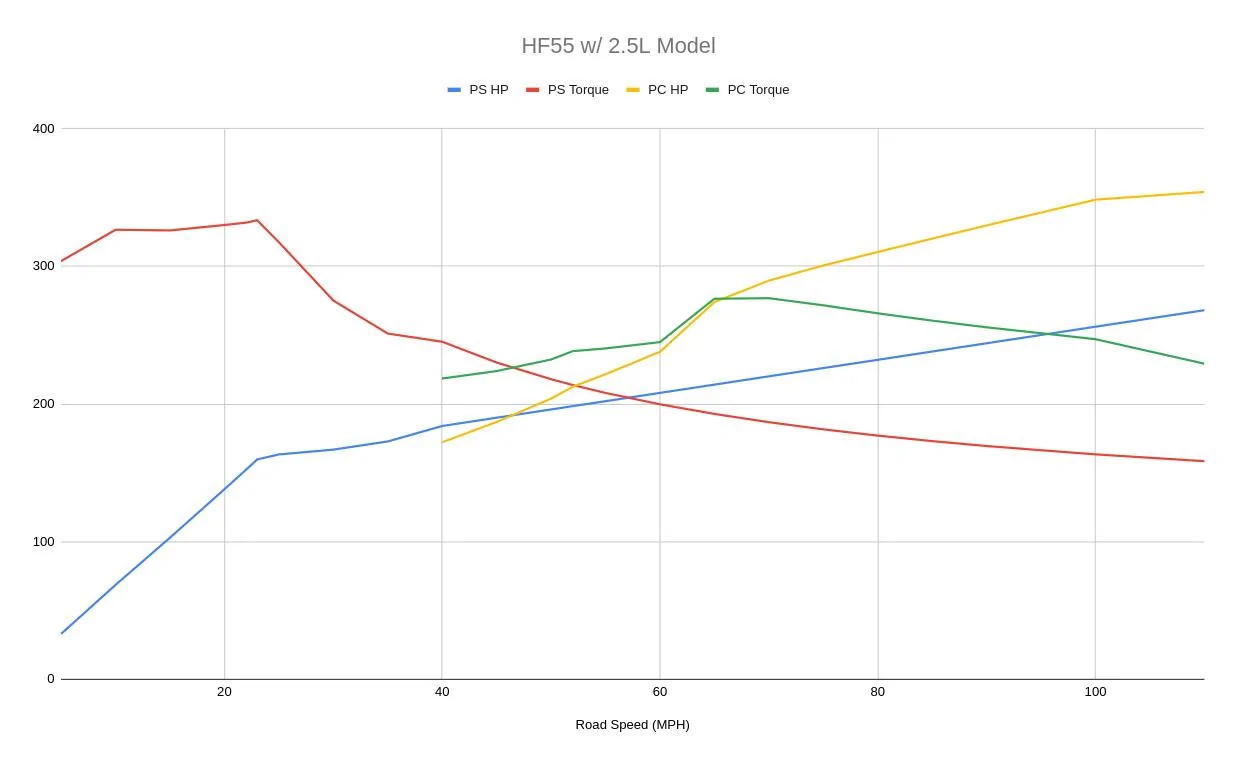
Ford Maverick What happens when tuners realize the hybrid HP/TQ numbers? Screenshot_20250713_105658


PS = Power Split, PC = Power Combine

What restricts the motor power?

1. In the planetary, the torque ratio and RPM target for the engine speed restricts generator/starter/(MG1) power output. At wide open throttle, once the power output is allowed to reach peak HP RPM, it gradually falls to ~30HP at ~110MPH in power split mode

2. The traction motor HP is a function of motor RPM. Given the Ford specification of 136 HP/235 lb-ft we can calculate the RPM where that peak HP occurs, 3039 RPM. This is likely the torque knee of the motor. Below, 3039 RPM, the TM HP output is a product of the torque multiplied by the RPM divided by 5252. Above 3039 RPM, the motor would be in field weakening, holding the HP relatively constant is possible here, and the torque falls off as the RPM rises above this point.

3. Below ~40 MPH, the engine cannot reach its full RPM or HP - this is restricted by the starter/generator's maximum RPM and its relationship to road speed. The values in the "Engine Override" columns in this example are taken from data logs that demonstrate these RPM limits.

Peak torque is at low speeds, and peak HP at the earliest point peak engine HP comes available in power split mode. In power combiner mode, peak HP will continue to rise at least until or if the torque begins to fall as we approach the max transaxle road speed. You can see that due to the planetary and fixed traction motor gearing, the maximum power changes at different road speeds. For example, the traction motor can only deliver 30 HP at 5 MPH and 117 HP at 20 MPH with its gearing. On this chart, only at 40 MPH and above is the TM and engine RPM high enough to deliver rated horsepower. The maximum theoretical torque is at the low speeds and is 333 lb-ft, and the maximum HP is near max speed in power combine mode at 354 HP.

The electrical HP or kW in a peak power configuration is no more thermal or electrical load than the transmission experiences in normal operation, the two motors are already often >230 HP combined depending on the requested torque demand and the power split ratios, and in this peak example maxes out at less HP on each motor; only the power direction changes on the MG1/starter/generator. Duty cycle potential is exactly the same in both cases, and depends on the rate of heat removal to prevent or delay current limiting. There is no additional heat generated in the transmission from the electric motors, because the actual power levels flowing through the motors are actually lower in the peak output modelling case. You can see that even though you have a lot of combined power available from three separate mechanical sources, the fixed gearing choices restricts the combination of power that is available at different road speeds.

*edit: added "Engine Override" data from live capture to more accurately depict performance potential at low speeds.

*edit: Added distinct graph outputs for power split and combining planetary modes of operation.
 
Last edited:
OP
OP
heady

heady

2.5L Hybrid
Well-known member
Joined
May 14, 2025
Threads
4
Messages
328
Reaction score
520
Location
MI
Vehicle(s)
'25 Lariat
Engine
2.5L Hybrid
So you're giving up on hopes that "tuners will GO WOW"?
?


I've never seen tuners do anything with electric or hybrid drivetrains, probably because they don't know or care anything about them. The only people who I've seen use these types of transmissions to suit their own purposes are DIY electric hobbyists, who usually have no use for a tuners knowledge of programming OEM factory modules and instead throw those modules away and use open motor controllers with the factory power stage. Tuners mostly exist to sell canned stuff to consumers, so there'd have to be some demand, chicken and egg. If it's like other EV powerplants, nothing fun will happen with this drivetrain until people start plucking them out of junkyards for other projects.

Ford will pick some power output somewhere between the hybrid ratings and the estimated maximum ratings if they do a PHEV vehicle with this transaxle, if they compete with something like the RAV4 it will be towards the high end of the estimates provided, and if they don't, they'll pick whatever they they want in between.
Sponsored


Top