
Sponsored

The rolling circumference of the tire is essentially constant on all models and all tire sizes. The 17-inch wheels need 65-series, the 18-inch get 60-series and the 19-inch get 55-series tires. The lower the profile of the tire, the less sidewall you have to absorb bumps. So the best-riding tire will generally be a 17-inch one, and the worst will be the 19-inch. Also if you put LT tires on, then the super-reinforced sidewalls that don't flex much will get you a really crummy ride. Similarly, the super-flexible ice tire sidewalls will give you a very smooth ride, but with a bit of shimmy. Another thing to think about is wheel weight. A 19-inch tire and rim will weigh less than a 17-inch combination, giving you a bit better ride control in potholes and somewhat better mileage. Then there are the aesthetics to consider. Its a truck. Most truck owners want a lot of sidewall showing, while most car owners seem to want a lot of rim and as little sidewall as possible showing. YMMV of course.
OP
OP
- Thread starter
- #3
great summary! Thank you!The rolling circumference of the tire is essentially constant on all models and all tire sizes. The 17-inch wheels need 65-series, the 18-inch get 60-series and the 19-inch get 55-series tires. The lower the profile of the tire, the less sidewall you have to absorb bumps. So the best-riding tire will generally be a 17-inch one, and the worst will be the 19-inch. Also if you put LT tires on, then the super-reinforced sidewalls that don't flex much will get you a really crummy ride. Similarly, the super-flexible ice tire sidewalls will give you a very smooth ride, but with a bit of shimmy. Another thing to think about is wheel weight. A 19-inch tire and rim will weigh less than a 17-inch combination, giving you a bit better ride control in potholes and somewhat better mileage. Then there are the aesthetics to consider. Its a truck. Most truck owners want a lot of sidewall showing, while most car owners seem to want a lot of rim and as little sidewall as possible showing. YMMV of course.


A large pothole or pavement break will wreck a 19" rim where 17" has more sidewall to absorb the impact and more likely to make it through intact. The larger sidewall of a 17" may have higher load capacity. Load capacity varies a lot from one tire to another, but generally speaking a larger sidewall enables more load bearing capacity.
- Joined
- Nov 5, 2021
- Threads
- 19
- Messages
- 3,802
- Reaction score
- 5,902
- Location
- British Columbia, Canada
- Vehicle(s)
- 2022 XLT Maverick Hybrid
- Engine
- 2.5L Hybrid
This is the opposite of what every review of this subject I've seen has said. What is the source of this information? My understand is that lower profile tires are worse in potholes and are more likely to end up with damaged wheels. Professional car reviewers often say that you will get better fuel economy and a better ride with smaller wheel sizes.A 19-inch tire and rim will weigh less than a 17-inch combination, giving you a bit better ride control in potholes and somewhat better mileage.
Sponsored
Yeah, you are right and the stuff you quoted is wrong. Bigger diameter wheels pretty much always weigh more, given equivalent construction methods and materials.This is the opposite of what every review of this subject I've seen has said. What is the source of this information? My understand is that lower profile tires are worse in potholes and are more likely to end up with damaged wheels. Professional car reviewers often say that you will get better fuel economy and a better ride with smaller wheel sizes.
- Joined
- Nov 25, 2023
- Threads
- 7
- Messages
- 544
- Reaction score
- 732
- Location
- Alberta, Canada
- Vehicle(s)
- 2024 Maverick, 1991 Toyota Dyna
- Engine
- 2.0L EcoBoost
17" gives more comfort while 19" (debatably) gives more style.
In the performance car world serious racers want larger diameter wheels to reduce sidewall flex and wheel weight but on a little pickup truck you aren't going to see much, if any gains around a track. Not sure I'd want to track a Mav anyways, the suspension and brakes would get pretty unhappy in a hurry.

- Joined
- Jan 3, 2025
- Threads
- 49
- Messages
- 3,686
- Reaction score
- 6,872
- Location
- North Carolina
- Vehicle(s)
- 2004 Ford Escape Platinum, 2024 Ford Maverick Lariat 2.0L AWD
- Engine
- 2.0L EcoBoost
My 18’s are right in the middle.
I read in here there were less tire choices as rim size goes up.
I read in here there were less tire choices as rim size goes up.
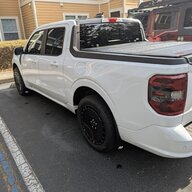
I didn't know XL rated load tires are stiffer (which is obvious why now that I know). Before was thinking going a smaller sidewall on the 19s... yeah probably not now
The bigger the rim, the less sidewall and better performance in turns. The smaller the rim, the higher the sidewall and better comfort over bumps.
Sponsored

- First Name
- Hal
- Joined
- Dec 13, 2022
- Threads
- 6
- Messages
- 106
- Reaction score
- 112
- Location
- Appleton, WI
- Vehicle(s)
- Buick Reatta, Ford Ranger, Subaru Forester
- Engine
- 2.5L Hybrid
Weight is certainly a factor regarding mileage, but distribution of the weight is also a factor. I don't have specific examples to quote, but as the mass moves outward, primarily the rim in this case, resistance to change in rotational speed also increases. It probably also carries a bit more energy for regen in a hybrid, but overall, it is a net loss.

- First Name
- Mike
- Joined
- Jan 28, 2025
- Threads
- 7
- Messages
- 170
- Reaction score
- 374
- Location
- Central Jersey
- Vehicle(s)
- 2025 Maverick XLT
- Engine
- 2.0L EcoBoost
When you need to replace the tires, 17s are usually gonna cost less than 19s.
When looking at overall unsprung weight, think about material weights and distance from the centre. The tire and rim being the furthest from the centre, they will contribute the most. Rubber weighs a lot more than aluminum, so a larger tire diameter will weigh more, given the same construction. Most tires will go up by about 2.5 lbs per tire size increase, and the matching rim goes up by about 1 lb.This is the opposite of what every review of this subject I've seen has said. What is the source of this information? My understand is that lower profile tires are worse in potholes and are more likely to end up with damaged wheels. Professional car reviewers often say that you will get better fuel economy and a better ride with smaller wheel sizes.
Yes, lower profile tires are more likely to give you rim destruction on real roads. People with Tesla, Porsche and Genesys 15- and 20-series performance tires can attest to the extreme repair costs that a pothole causes on those vehicles. Unsprung weight is also a big factor in pothole destruction, as the tire cannot ride easily through the pothole if there is a lot of mass to move. With a 65-series tire on a 17-inch rim, its pretty likely that it can flex enough to ride through the edge of the hole. With a 55-series tire on the 19-inch 2025 rim, that 63 lb weight is going to still need a New York size pothole size to destroy the rim, although damaging the tire cords is more likely. With a lower-profile race tire, kiss the rim and tire off.
19” looks better when the truck is upside down in a ditch after pushing the performance tires to the limit.
Sponsored
Similar threads


- Replies
- 11
- Views
- 2,275


