

- Banned
- #46
Very good post.I would suggest reading Methodology for Determining Octane Response at Different Altitudes for Vehicles Equipped with Knock Sensors, Andy D. B. Yates, Samson Mkwanazi, SAE Transactions, Vol. 111, Section 4: JOURNAL OF FUELS AND LUBRICANTS (2002), pp. 583-591 for a more thorough treatment, but I can summarize for you.
- 18% of the test vehicles were turbocharged in the study
- All vehicles exhibited reduced thrust at altitude
- "In terms of the difference in altitude between the two test sites (418 meters and 1485 meters respectively), the altitude correction factor was therefore -1.8 R0N/300m (octane), which was in good agreement with the previously published values."
This is known as the altitude-octane effect in most papers and books I've seen on the subject.
Here's a representative sample of one of the turbo cars thrust at two elevations plotted against RON (octane):
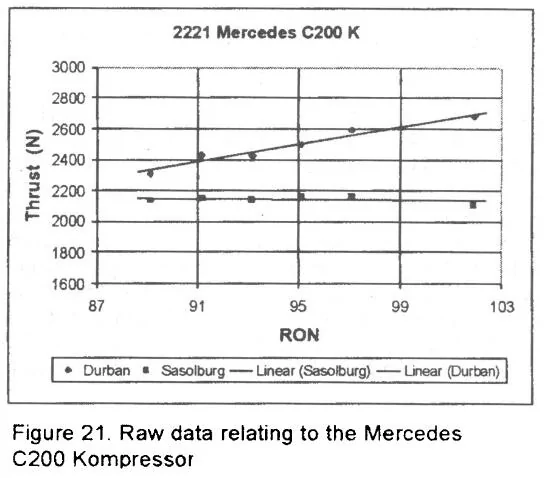
Sasolburg is the high altitude site, and Durban the sea level site. The flat plot of the square sample values shows the impact of increased octane at high elevations on vehicle thrust. There isn't any. There is a difference at sea level, higher octane is of more value there. This is not new or surprising information, published octane studies on cars both NA and FI reach back over a hundred years or more. Don't get confused by the "higher" octane numbers, RON is calculated differently than US pump numbers and are numerically larger.
The minimum suggested octane for an EcoBoost is indeed 87, at any altitude.
Adding a reference added much credibility also. Thanks for doing that.
Too many people swear by hunches, theories, and urban legends.
Science is not always intuitive.
Two thumbs up!

Sponsored




 . But my sister would be looking to see what I was putting in it . And she's one of those people who would tell her husband. And I get along with my brother-in-law, and he's bigger than I am , sooo...