Sponsored

Tire weight - how much does it matter?

fbov

Well-known member
First Name
Frank
Joined
Jun 28, 2021
Threads
0
Messages
452
Reaction score
502
Location
Bushnell's Basin
Vehicle(s)
2020 Escape Hybrid
This is a nice academic discussion, but none of it matters in a 2-ton road vehicle. You'll never be able to tell the difference. If you do, the best advice for many of us then becomes to start a weight loss program.

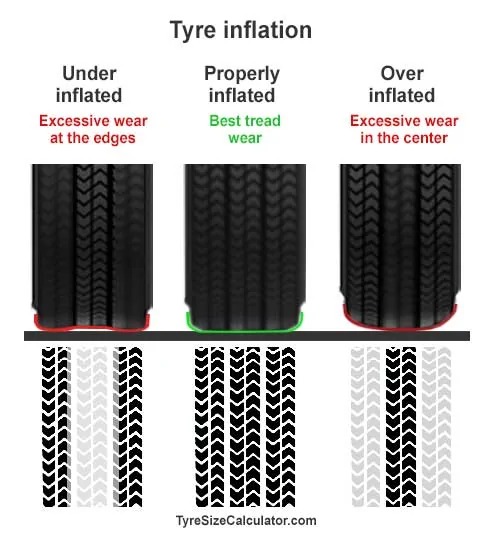
Yeah, it reduces the contact patch to run over pressure. Also get bad ride quality, less traction, and uneven wear on the middle of the tread though.
I agree with the first part but the rest is bunk. And the reduction in contact patch comes with a great improvement in contact patch stability at cornering limits.

If you've ever autocrossed, you would have adjusted tire pressure for optimum cornering performance, typically at a front-rear pressure difference that mirrored the front-rear weight distribution of the car. 45 psi front, 35 rear was kind of the starting point. White shoe polish at the edge of the tread told you if you needed to add or subtract between runs.

Since then (1980), I've set just below the pressure listed on the sidewall, and the ride's fine, there's better lateral traction and today's belted tires wear nice and uniformly at these pressures. Apparently, YMMV.
Sponsored


 

JASmith

2.5L Hybrid
Well-known member
First Name
Jessica
Joined
Jun 16, 2021
Threads
71
Messages
1,674
Reaction score
3,846
Location
Texas
Vehicle(s)
Dodge Ram 1500
Engine
2.5L Hybrid
I agree with the first part but the rest is bunk. And the reduction in contact patch comes with a great improvement in contact patch stability at cornering limits.

If you've ever autocrossed, you would have adjusted tire pressure for optimum cornering performance, typically at a front-rear pressure difference that mirrored the front-rear weight distribution of the car. 45 psi front, 35 rear was kind of the starting point. White shoe polish at the edge of the tread told you if you needed to add or subtract between runs.
That's a very specific use case though in which you're running overpressure to stiffen the sidewalls in the rapid high-G maneuvers in order to avoid rolling over onto the sidewall, which I'd wager is not going to be a common occurrence for Mavericks.

Ford Maverick Tire weight - how much does it matter? tyre-pressure-tread-wear-tyre-tracks-comparison
 

Darksider

Well-known member
Banned
Joined
Oct 24, 2021
Threads
4
Messages
330
Reaction score
388
Location
Here
Vehicle(s)
Two
You all arguments on rotation weight mass is way off. Like the barbell windmill, this is forgetting one important detail coutermass. Since a wheel has coutermass (balance) when it is rotating the only effect of added mass is the weight itself. So a 100 pound added mass added balance to the outside will will have the same effect as adding a 100 pound passanger. The main thing is rolling resistance that will effect mpg. And since the contact patch on a tire is small its easy to add 10% with just wider tIres .. Added taller tires and you are 20% more contact patch to the road which will have that more drag.
 

fbov

Well-known member
First Name
Frank
Joined
Jun 28, 2021
Threads
0
Messages
452
Reaction score
502
Location
Bushnell's Basin
Vehicle(s)
2020 Escape Hybrid
That's a very specific use case...
True, but I have seen cars roll on the highway when they did a quick maneuver and the tire came off the bead. Thankfully, it was in my rearview mirror.

I remember diagrams like this from my youth, when bias-ply tires were the standard, and this kind of thing was critical to making 20K miles on a set. Then came belted bias-ply (Anyone remember Wide Oval tires? They were 70 series.) That's when this diagram stopped making sense. Of course, Michelin had been making radial ply tires for decades, and they have a far wider pressure range due to the more compliant construction.

I'll be removing my OE tires in the coming weeks, and would be happy to share my tread depth profile at end-of-life. I set them at 38 psi a year ago (15K miles), and have seen 36-41 psi on the road. Sidewall rating is 41 psi.

The C-Max spent several years in the high 40's (51 psi rating) and its Michelin Energy Savers were nice and flat when traded in. Others report similar experiences. No idea why you'd see something different.
And since the contact patch on a tire is small its easy to add 10% with just wider tIres .. Added taller tires and you are 20% more contact patch to the road which will have that more drag.
Careful... changing tire size, per se, has no effect on contact patch size. In this case force = pressure x area (Pascal's Law), so tire size can change the shape of the contact patch, but not the size (assuming similar carcass construction). It's a tradeoff:
- wider tires shorten the contact area, reducing straight line traction
- narrower tires lengthen the contact area, reducing lateral traction.

The "best" size depends on what you're trying to do.
 

Darksider

Well-known member
Banned
Joined
Oct 24, 2021
Threads
4
Messages
330
Reaction score
388
Location
Here
Vehicle(s)
Two
Changing tire sizes has a direct effect on contact patch for instance. All else being the same going with a 245/60/17 tire (only witdh change) you get a 293cm2 contact patch vs a stock 268cm2 or 9% increase. Now if you went with the 245/65/17 which increases width and height you get a 300cm2 contact patch or 12% increase over stock. These numbers are with tires under load.

If you can find a tire size change that nothing else changes and contact patch stays the same let me know. http://bndtechsource.ucoz.com/index/tire_data_calculator/0-20
 
OP
OP

93tilInfinity

2.0L EcoBoost
Well-known member
Joined
Sep 4, 2021
Threads
13
Messages
52
Reaction score
78
Location
Paso Robles, CA
Vehicle(s)
Maverick
Engine
2.0L EcoBoost
Soooo I'm just gonna get the Toyos because they're the lightest, and try not to think about the dead sexy KO2s that are 10 lbs more per corner.
Sound good guys? :D
Sponsored


Top