

- First Name
- Stuart
- Joined
- Mar 22, 2022
- Threads
- 29
- Messages
- 1,730
- Reaction score
- 1,701
- Location
- Dallas South
- Vehicle(s)
- 2004 Avalon
- Engine
- 2.5L Hybrid
I figured the bend would occur when shutting the hood, just a thought
Sponsored
So what you're saying is that the aftermarket strut kit that you purchased was not correctly designed to add some stiffener plates to mitigate the extra bending forces that were not there on the original vehicle. So remove the cheapo struts and find a set that is correctly designed.I recently installed one of the hood strut setups.
Now I’m noticing that the hood on the Maverick is in no way reinforced at the hood hinge mount, so there is a lot of flex when you open the hood.
My concern is that we will start developing cracks or bending at those mounting points.
Has anyone at this point had any cracking or bending?
The only way I can think of to help distribute the load of the hood hanging out there is to make and bond to the hood some reinforcement plates.
The best thing would be if one of the oh so many companies selling these products would produce and sell such a thing.
So what you're saying is that the aftermarket strut kit that you purchased was not correctly designed to add some stiffener plates to mitigate the extra bending forces that were not there on the original vehicle. So remove the cheapo struts and find a set that is correctly designed.
There is no such thing on the market.
It didn’t occur to me when I was looking at these kits all have one fatal problem, that the area where the hood mounts to the hinges is not reinforced like it was on my old 1976 Toyota Corolla
In order for there to be a bend the hood must first flex. And that happens when the hood is hanging on the hinges unsupported, then flex’s further until it bends when closing it.I figured the bend would occur when shutting the hood, just a thought
Does your gas strut mount to the front of the hood where the stock prop rod mounts? If so there should be no problem with the stock hinges.I recently installed one of the hood strut setups.
Now I’m noticing that the hood on the Maverick is in no way reinforced at the hood hinge mount, so there is a lot of flex when you open the hood.
My concern is that we will start developing cracks or bending at those mounting points.
Has anyone at this point had any cracking or bending?
The only way I can think of to help distribute the load of the hood hanging out there is to make and bond to the hood some reinforcement plates.
The best thing would be if one of the oh so many companies selling these products would produce and sell such a thing.
All of these many kits have the pivot point right at point that the hood is bolted to the hinges, so yes the full weight of the hood is unsupported and hanging out there.Does your gas strut mount to the front of the hood where the stock prop rod mounts? If so there should be no problem with the stock hinges.
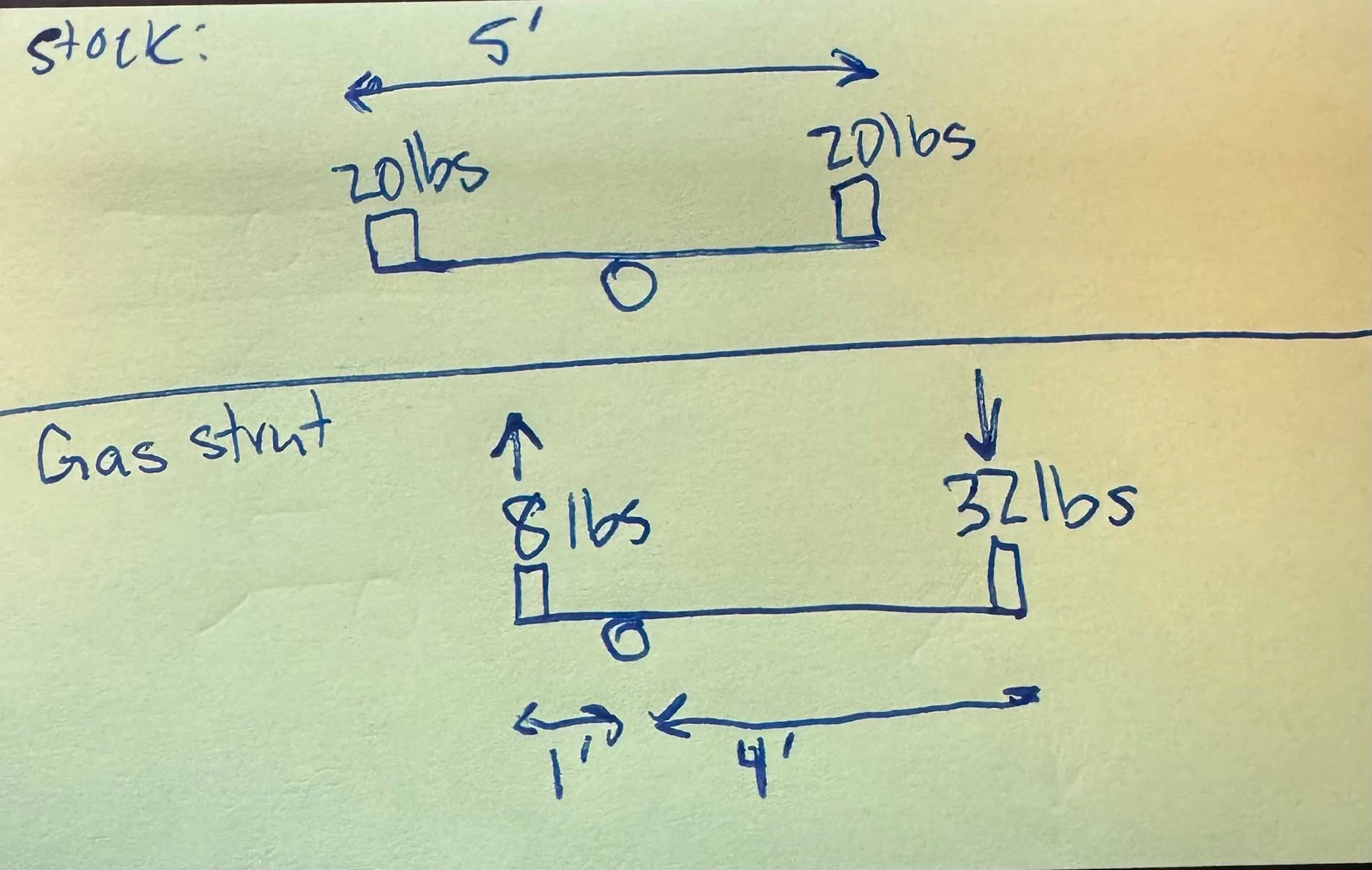
If it mounts to the back, say a foot from the hinge, it is likely going to damage the hinges and/or the hood. Here’s why: Think of your 5’ x 5’ hood being a 40 lb teeter totter, or a lever arm, that is balanced in the center, the fulcrum, 2.5 feet from the ends. 20 lbs goes on the prop rod, 15 lbs goes on one hinge and 5 lbs goes on the other hinge. Why are the hinges loaded asymmetrically? Because the prop rod attaches at the side, not at the center. It would need to be mounted on the centerline in order for the hinges to have equal loading. If you have 2 gas struts, the loads will be equal.
Now if you have a gas strut that mounts one foot from the hinge, it is like having a teeter-totter with the teeter part measuring 1 foot long and the totter part measuring 4 feet long.
So the totter is going to be able to lift 4x as much because of the mechanical advantage. Since the fulcrum has been moved to 1 ft from the end of the hood and the hood weighs 8 lbs per foot (8x5=40), the teeter part is now 8 lbs and the totter part is 32 lbs, the totter part will be able to lift 128 lbs because of the lever arm mechanical advantage and the net force will be 120 pounds of lifting force applied to the teeter, which is the hinge. And also because of the mechanical advantage, the load on the mounting point at the lifting end of the gas strut, the fulcrum in the lever arm example, is going to be 128 lbs. (Yes the hood still only weighs 40 lbs total, but it is a torque load. 32 lbs applied to a 4 foot lever arm is 128 lb/ft or torque.)
These loads are significantly higher than what the stock hinges and sheet metal are designed to handle, which will significantly increase the probability of failure.
I read a report about a year ago of someone installing hood struts, and the struts would push the hood either forward or backwards, and this would disengage the cable to the interior hood release. I don't know which struts they were using, I don't recall them saying which ones they were. The video was mainly about how to reattach the cable to the release handle.So what you're saying is that the aftermarket strut kit that you purchased was not correctly designed to add some stiffener plates to mitigate the extra bending forces that were not there on the original vehicle. So remove the cheapo struts and find a set that is correctly designed.
ALL my Rangers (three of them) had ONLY Props... with NO assists..The point of prop-open hoods is you can make them lighter. It seems obvious the hood wasn't designed for struts.



