

Sponsored

Codes P0496 & P0451

JohnnyApplespeed

2.0L EcoBoost
Active member
First Name
John
Joined
May 3, 2023
Threads
5
Messages
42
Reaction score
54
Location
Waukesha, WI
Vehicle(s)
'23 Maverick Lariat EB
Engine
2.0L EcoBoost
I have a question for those in the know about the EVAP system and the tests that the vehicle runs on itself to determine if everything is kosher.

I took my 2.0 EB in a few weeks ago for a P0496 code ("EVAP Emission High Purge Flow Fault"), and they replaced the purge valve to remedy. I picked up the vehicle and took it home, only to find the CEL back on again the next morning with a P0451 ("EVAP Emission Control System Pres Sensor Range"). Oddly enough, about two days later, the CEL cleared, and I figured it had just gone through a test sequence and determined itself to be functioning properly. I parked the truck for about 3 weeks while on the road for work, and returned Friday to find the CEL back on again, with the P0451 persisting.

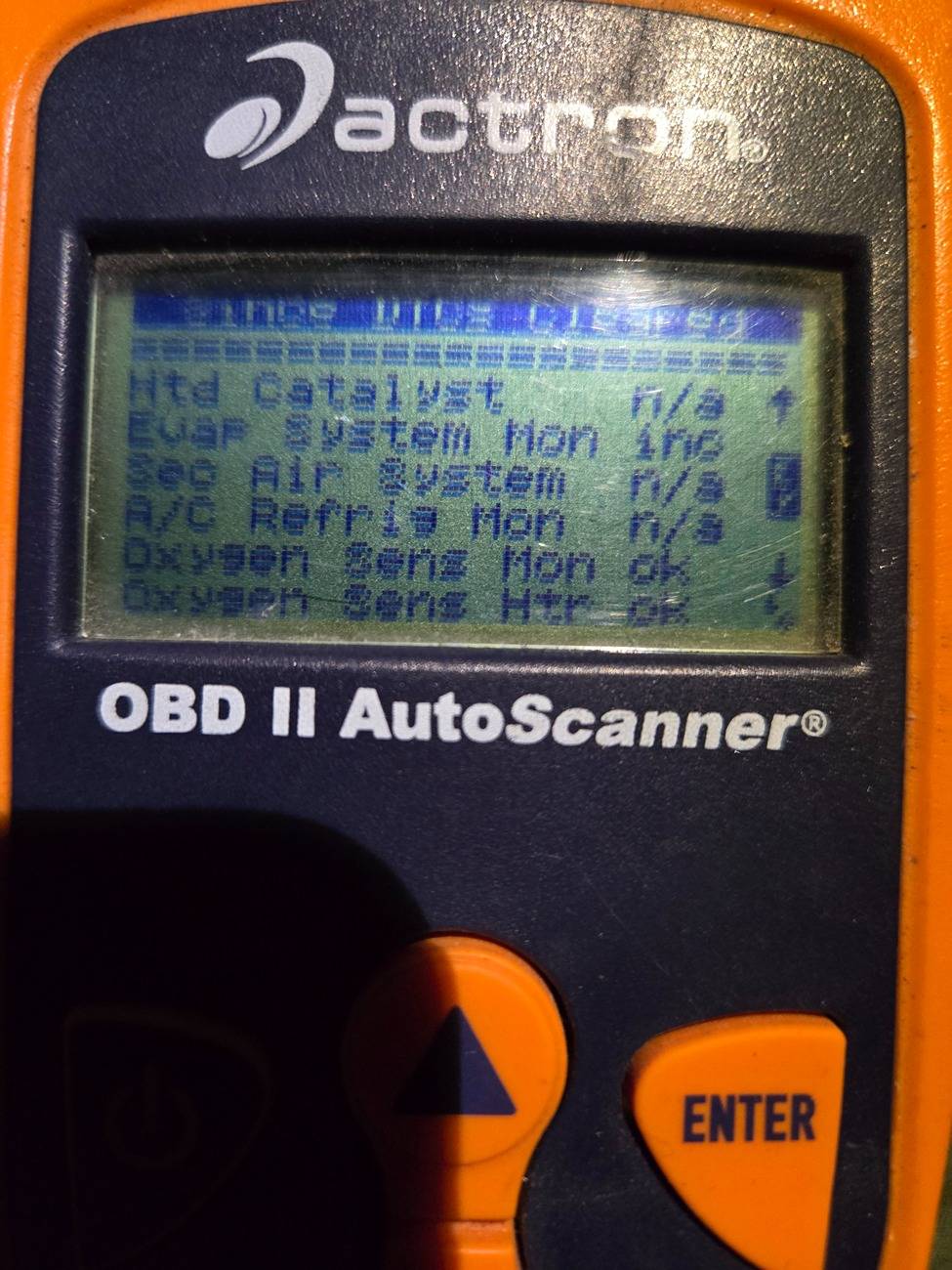
I toggled through the options on my ODBII reader, and found a way to display the various monitor tests. It currently lists "Inc" for the "Evap System Mon" test. I suspect that this simply means the diagnostic test sequence has not yet been completed, and when the tests finally runs to completion, that it may indeed clear itself. But it's also my understanding that the EVAP system tests only run when certain ambient conditions are met (minimum air temperature, among other things), and when they are, the system uses solenoids and pressure sensors to confirm that the system is properly sealed. Since it's wicked cold outside right now here in Wisconsin, I suspect that it might be a while before conditions are met for the vehicle to complete its diagnostic test, thus causing the CEL to persist until warmer weather.

Anyway, just checking in here to see if anyone can confirm my understanding of this system and its self-diagnostic tests. Can the diagnostic test be forced to run via a ODBII device, even if ambient conditions would otherwise restrict it? I have another service appointment scheduled for tomorrow morning, and I'd like to avoid an ongoing parts-swapping circus if this problem will likely solve itself with proper operating conditions. Any insights or suggestions are appreciated.
Ford Maverick Codes P0496 & P0451 20241220_174734
Sponsored

 
Last edited:

Gray Goose

2.0L EcoBoost
Well-known member
First Name
RG
Joined
Jul 14, 2023
Threads
21
Messages
1,037
Reaction score
1,825
Location
Wissota
Vehicle(s)
Maverick XL 2024, Escape 2012, GMC Terrain 2017
Engine
2.0L EcoBoost
Clubs
 
My experience with the EVAP-ECS is that they are extremely hard to diagnose. I had a Toyota that would continually throw ECS codes. After several technicians saying it could be any number of different sensors, they recommended to just run it that way. That was about 15 years ago and the car is still going. Of course that car was out of warranty. With the Maverick under warranty I would be more persistent about a fix.

That said, have you checked the fuel filler little flap to make sure there's no dust/ice/snowflake from the last fill up? Any little particle that prevents the flap from closing could throw a code. On the Toyota, I would clean the gas cap seal and that would help some. Since the Maverick has no gas cap, carefully clean around the filler flap.
I also noticed the codes are more likely to happen on an empty tank. Have you noticed the codes more likely to throw on a full or empty tank? That may help the technician diagnose.
 

Msradke

2.0L EcoBoost
Well-known member
First Name
Mark
Joined
Mar 11, 2024
Threads
1
Messages
65
Reaction score
72
Location
Indiana
Vehicle(s)
2024 Maverick XLT
Engine
2.0L EcoBoost
evap codes can be hard to diag. Do you top off the tank? can create codes. cold temps can cause o rings to not seal properly. to do proper diag rec 1/2 a tank at 70 degs . you run diag with scan tool to monitor everything. good luck
 
OP
OP

JohnnyApplespeed

2.0L EcoBoost
Active member
First Name
John
Joined
May 3, 2023
Threads
5
Messages
42
Reaction score
54
Location
Waukesha, WI
Vehicle(s)
'23 Maverick Lariat EB
Engine
2.0L EcoBoost
Thanks for the feedback, gents. The tech swapped out a fuel pressure sensor and performed a pressure test, which indicated that the system behaves properly.. The service writer stated that the old sensor tested at -.5V under proper reading and its replacement tested at the proper 2V. So far, after a few days post-repair, no further codes have been thrown. However, the evap monitor still comes back as "Inc" according to my reader, likely for the aforementioned reasons.

I'll check in here with any further updates, but as of now I'm hopeful that the problem has been resolved.
 

The Real Maverick

2.5L Hybrid
Banned
Banned
First Name
Jack
Joined
Jan 13, 2024
Threads
31
Messages
2,999
Reaction score
4,143
Location
USA
Vehicle(s)
Maverick Hybrid
Engine
2.5L Hybrid
Thanks for the feedback, gents. The tech swapped out a fuel pressure sensor and performed a pressure test, which indicated that the system behaves properly.. The service writer stated that the old sensor tested at -.5V under proper reading and its replacement tested at the proper 2V. So far, after a few days post-repair, no further codes have been thrown. However, the evap monitor still comes back as "Inc" according to my reader, likely for the aforementioned reasons.

I'll check in here with any further updates, but as of now I'm hopeful that the problem has been resolved.
There are a lot of hoops to jump through to get the emissions system to clear.

I've not had issues with my Maverick.
But some hoops to jump though in a Chevy are:

Fuel tank has to be between 25% and 75% full.
You have to do a couple wide open throttle accelerations. You have to run a few miles between 50 mph and 60 mph.
You have to "coast down" from at least 50 MPH or more down to 10 MPH or less without touching either pedal. That was the tricky part. I had to find the ideal freeway offramp for that last one.
I think one test is you have to let it warm-up from idle, at idle.

Usually in a few weeks most owners will do all these aspects by happenstance but a PITA when you are in a hurry.
 

Sponsored

OP
OP

JohnnyApplespeed

2.0L EcoBoost
Active member
First Name
John
Joined
May 3, 2023
Threads
5
Messages
42
Reaction score
54
Location
Waukesha, WI
Vehicle(s)
'23 Maverick Lariat EB
Engine
2.0L EcoBoost
There are a lot of hoops to jump through to get the emissions system to clear.

I've not had issues with my Maverick.
But some hoops to jump though in a Chevy are:

Fuel tank has to be between 25% and 75% full.
You have to do a couple wide open throttle accelerations. You have to run a few miles between 50 mph and 60 mph.
You have to "coast down" from at least 50 MPH or more down to 10 MPH or less without touching either pedal. That was the tricky part. I had to find the ideal freeway offramp for that last one.
I think one test is you have to let it warm-up from idle, at idle.

Usually in a few weeks most owners will do all these aspects by happenstance but a PITA when you are in a hurry.
Thanks for the insights about the test. Do you know if there's a minimum ambient temperature requirement for the test to execute? I can manage to check the boxes you listed, but it's gonna be a while before my steed runs in warm weather.
 

The Real Maverick

2.5L Hybrid
Banned
Banned
First Name
Jack
Joined
Jan 13, 2024
Threads
31
Messages
2,999
Reaction score
4,143
Location
USA
Vehicle(s)
Maverick Hybrid
Engine
2.5L Hybrid
Thanks for the insights about the test. Do you know if there's a minimum ambient temperature requirement for the test to execute? I can manage to check the boxes you listed, but it's gonna be a while before my steed runs in warm weather.
Ford Steps:

1. Install the scan tool. Turn the ignition ON with the engine OFF. Cycle the ignition OFF, then ON. If needed, select the appropriate vehicle and engine qualifier. Clear the continuous DTC s and reset the emission monitors information in the PCM .

2. Begin to monitor the following PID s (if available): AAT, ECT, EVAPDC, FLI, IAT and TP MODE. Start the vehicle without returning the ignition to the OFF position.

3. Idle the vehicle for 15 seconds. Drive at 77 to 104 km/h (48 to 65 mph) until the engine coolant temperature is at least 76.7° C (170°F).

4. Is the ambient air temperature between 4.4 and 37.8°C (40 and 100°F)? If AAT is not available, IAT is used. If not, complete the following steps, but note that step 16 is required to bypass the EVAP monitor and complete the OBD drive cycle.

5. Cruise at 77 to 104 km/h (48 to 65 mph) for greater than 5 minutes.

6. Cruise at 77 to 104 km/h (48 to 65 mph) for 10 minutes (avoid sharp turns and hills). NOTE: To initiate the monitor, the throttle should be at part throttle, EVAPDC must be greater than 75%, and FLI must be between 15 and 85%, and for fuel tanks over 25 gallons FLI must be between 30 and 85%. Executes the EVAP purge flow monitor if the ambient air temperature is between 4.4 to 37.8°C (40 to 100°F).

7. Drive in stop and go traffic conditions. Decelerate at closed throttle and then moderately accelerate from each stop. Include 5 different constant cruise speeds, ranging from 40 to 72 km/h (25 to 45 mph) over a 10 minute period.

8. From a stop, idle for 30 seconds, accelerate to 72 km/ h (45 mph) at 1/2 to 3/4 throttle, cruise at steady throttle for 1 minute. Repeat idle, acceleration and cruise 3 times.

9. Bring the vehicle to a stop. Idle with the transmission in drive for 2 minutes.

10. For M/T, accelerate from 0 to 80 km/h (0 to 50 mph)

11. For A/T From a stop and in overdrive, moderately accelerate to 80 km/h (50 mph) and cruise for greater than 15 seconds. Stop the vehicle and repeat without overdrive to 64 km/h (40 mph) cruising for greater than 30 seconds. While at 64 km/h (40 mph), activate the overdrive, accelerate to 80 km/h (50 mph) and cruise for greater than 15 seconds. Stop for at least 20 seconds and repeat step five times.

11. From a stop, accelerate to 104 km/h (65 mph), hold steady throttle for 5 seconds, then decelerate at closed throttle (foot off accelerator) to 64 km/h (40 mph) (no brakes), accelerate from 64 km/h (40 mph) to 104 km/ h (65 mph), hold steady throttle for 5 seconds, repeat deceleration test 5 times. Allows learning for the misfire monitor, and completion of the deceleration fuel shut off rear HO2S monitor.

12. Access the On Board System Readiness ( OBD monitor status) function on the scan tool. Determine whether all non-continuous monitors except the EVAP monitor have completed. If not, go to step 15.

13. Turn the ignition OFF for 1 hour to allow the engine off 0.508 mm (0.020 inch) leak check to run. Executes the 0.508 mm (0.020 inch) EVAP monitor.

14. Turn the ignition ON. Access the On-Board System Readiness ( OBD II monitor status) function on the scan tool. Determine whether all non-continuous monitors including the EVAP monitor have completed. If not, go to step 15. Determine if any monitor has not completed. Pending Code Check And EVAP Monitor

15. With the scan tool, check for pending codes. Conduct the normal repair procedures for any pending code concern. Otherwise, repeat any incomplete monitor. If the EVAP monitor is not complete and the ambient air temperature was out of the 4.4 to 37.8°C (40 to 100°F) temperature range in step 4, or the altitude is over 2438 m (8000 ft.), the EVAP bypass procedure must be followed. Go to Step 16. Determines if a pending code is preventing the completion of the OBD drive cycle.

16. Park the vehicle for a minimum of 8 hours. Repeat steps 2 through 14. Do not repeat step 1.
 
Last edited:
OP
OP

JohnnyApplespeed

2.0L EcoBoost
Active member
First Name
John
Joined
May 3, 2023
Threads
5
Messages
42
Reaction score
54
Location
Waukesha, WI
Vehicle(s)
'23 Maverick Lariat EB
Engine
2.0L EcoBoost
Ford Steps:

1. Install the scan tool. Turn the ignition ON with the engine OFF. Cycle the ignition OFF, then ON. If needed, select the appropriate vehicle and engine qualifier. Clear the continuous DTC s and reset the emission monitors information in the PCM .

2. Begin to monitor the following PID s (if available): AAT, ECT, EVAPDC, FLI, IAT and TP MODE. Start the vehicle without returning the ignition to the OFF position.

3. Idle the vehicle for 15 seconds. Drive at 77 to 104 km/h (48 to 65 mph) until the engine coolant temperature is at least 76.7° C (170°F).

4. Is the ambient air temperature between 4.4 and 37.8°C (40 and 100°F)? If AAT is not available, IAT is used. If not, complete the following steps, but note that step 16 is required to bypass the EVAP monitor and complete the OBD drive cycle.

5. Cruise at 77 to 104 km/h (48 to 65 mph) for greater than 5 minutes.

6. Cruise at 77 to 104 km/h (48 to 65 mph) for 10 minutes (avoid sharp turns and hills). NOTE: To initiate the monitor, the throttle should be at part throttle, EVAPDC must be greater than 75%, and FLI must be between 15 and 85%, and for fuel tanks over 25 gallons FLI must be between 30 and 85%. Executes the EVAP purge flow monitor if the ambient air temperature is between 4.4 to 37.8°C (40 to 100°F).

7. Drive in stop and go traffic conditions. Decelerate at closed throttle and then moderately accelerate from each stop. Include 5 different constant cruise speeds, ranging from 40 to 72 km/h (25 to 45 mph) over a 10 minute period.

8. From a stop, idle for 30 seconds, accelerate to 72 km/ h (45 mph) at 1/2 to 3/4 throttle, cruise at steady throttle for 1 minute. Repeat idle, acceleration and cruise 3 times.

9. Bring the vehicle to a stop. Idle with the transmission in drive for 2 minutes.

10. For M/T, accelerate from 0 to 80 km/h (0 to 50 mph)

11. For A/T From a stop and in overdrive, moderately accelerate to 80 km/h (50 mph) and cruise for greater than 15 seconds. Stop the vehicle and repeat without overdrive to 64 km/h (40 mph) cruising for greater than 30 seconds. While at 64 km/h (40 mph), activate the overdrive, accelerate to 80 km/h (50 mph) and cruise for greater than 15 seconds. Stop for at least 20 seconds and repeat step five times.

11. From a stop, accelerate to 104 km/h (65 mph), hold steady throttle for 5 seconds, then decelerate at closed throttle (foot off accelerator) to 64 km/h (40 mph) (no brakes), accelerate from 64 km/h (40 mph) to 104 km/ h (65 mph), hold steady throttle for 5 seconds, repeat deceleration test 5 times. Allows learning for the misfire monitor, and completion of the deceleration fuel shut off rear HO2S monitor.

12. Access the On Board System Readiness ( OBD monitor status) function on the scan tool. Determine whether all non-continuous monitors except the EVAP monitor have completed. If not, go to step 15.

13. Turn the ignition OFF for 1 hour to allow the engine off 0.508 mm (0.020 inch) leak check to run. Executes the 0.508 mm (0.020 inch) EVAP monitor.

14. Turn the ignition ON. Access the On-Board System Readiness ( OBD II monitor status) function on the scan tool. Determine whether all non-continuous monitors including the EVAP monitor have completed. If not, go to step 15. Determine if any monitor has not completed. Pending Code Check And EVAP Monitor

15. With the scan tool, check for pending codes. Conduct the normal repair procedures for any pending code concern. Otherwise, repeat any incomplete monitor. If the EVAP monitor is not complete and the ambient air temperature was out of the 4.4 to 37.8°C (40 to 100°F) temperature range in step 4, or the altitude is over 2438 m (8000 ft.), the EVAP bypass procedure must be followed. Go to Step 16. Determines if a pending code is preventing the completion of the OBD drive cycle.

16. Park the vehicle for a minimum of 8 hours. Repeat steps 2 through 14. Do not repeat step 1.
They forgot the old "rub your belly and pat your head" step. Thanks for the info, @The Real Maverick!
Sponsored

 
Last edited:


Top