
- Thread starter
- #1
Hey MTC,
I've been towing for a bit and wanted to post my experience/advice for others thinking about towing heavy loads or a trailer.
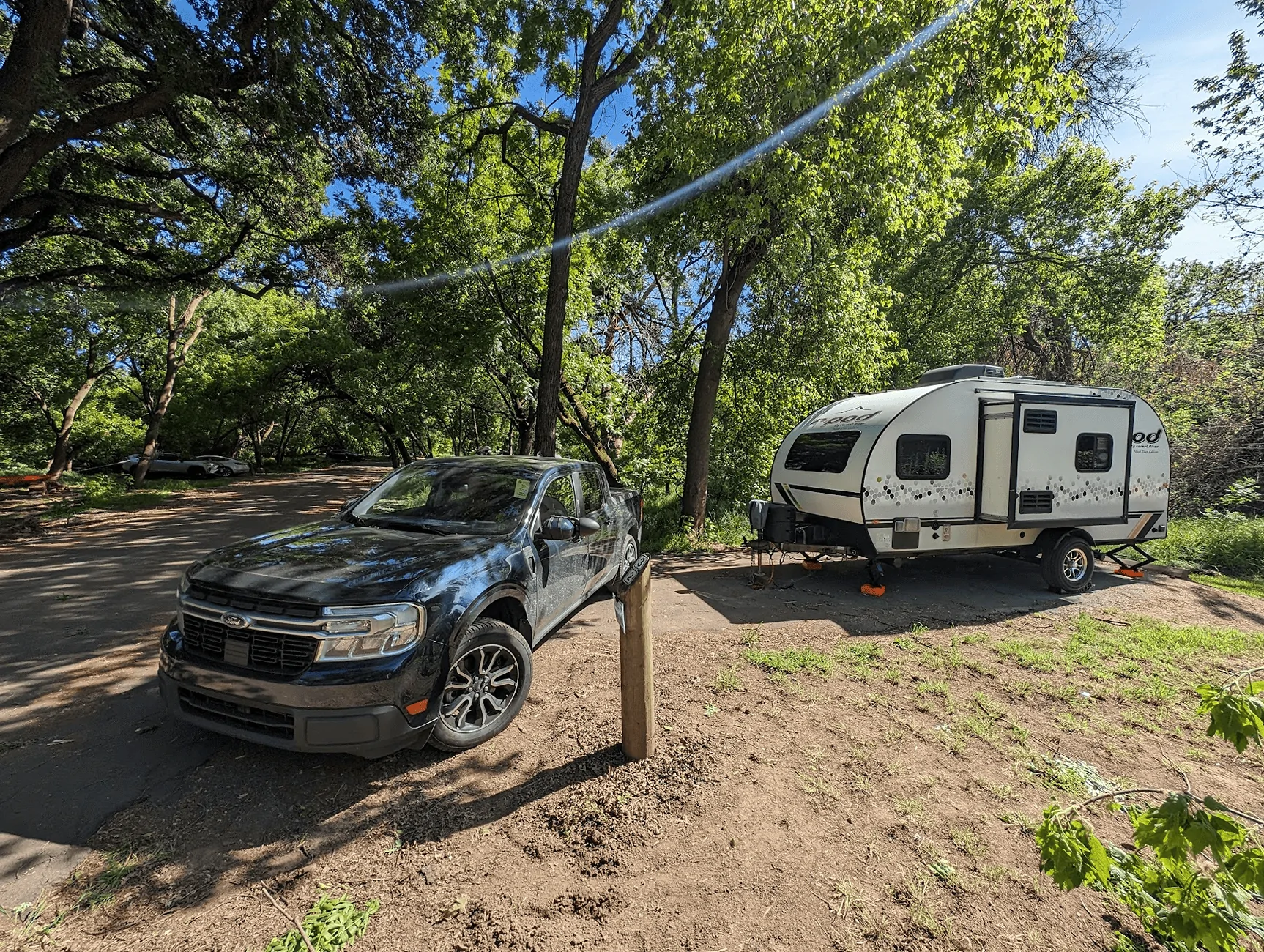
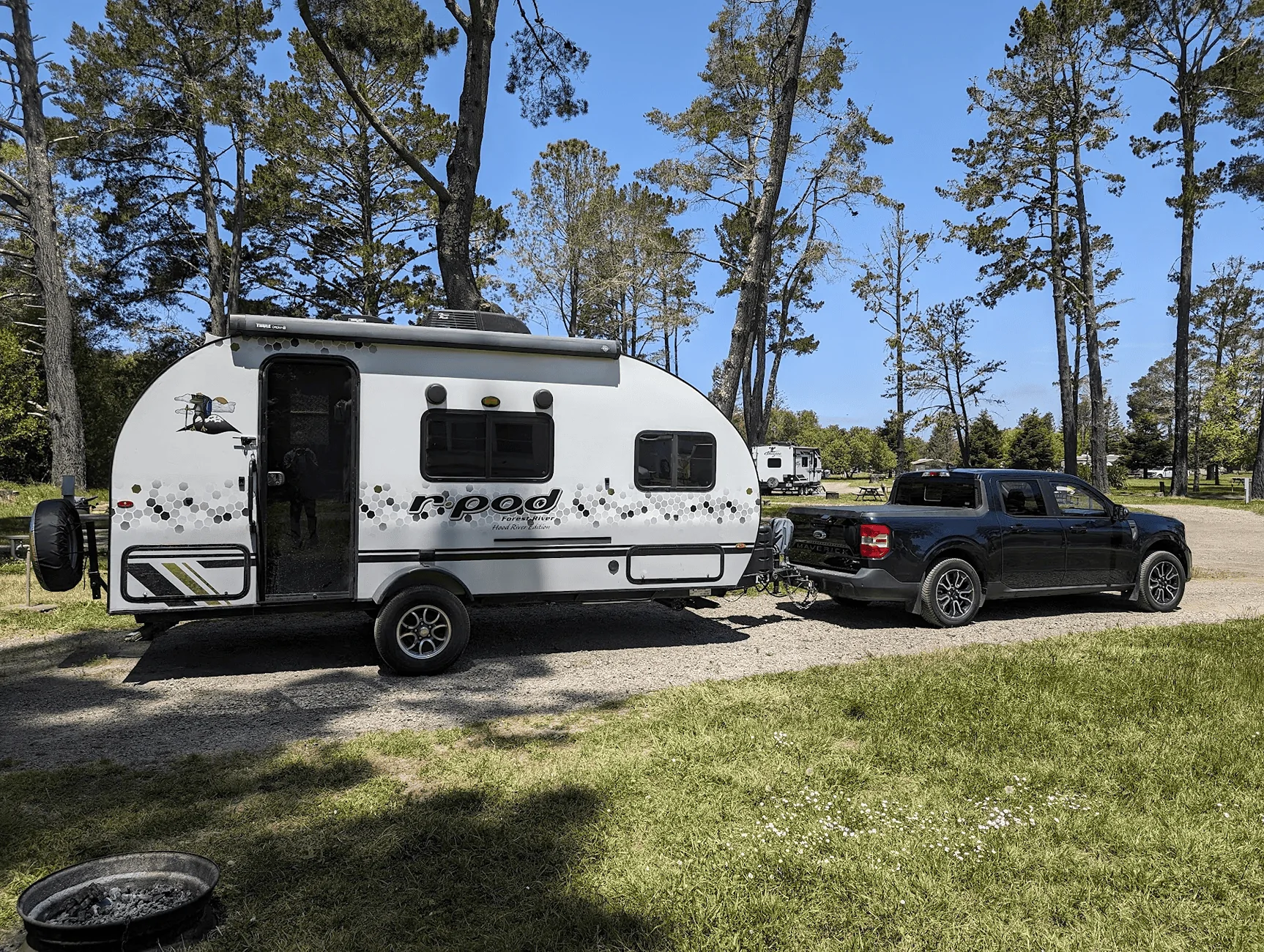
I use my 2022 EB-4k Maverick to tow a 2021 R-pod 180. It's an 18' trailer with a 20' frame that weights ~2,900 lbs dry and is 3,500 - 4,000 lbs with gear & water. I did weigh it on a CAT scale and was a bit over the GCWR with all the gear/people I had in the truck (more on that below).
I'm not going to weigh in on adding your own safety factors over spec, interpreting Ford's ratings, or to tell you to push the limits with your tuck.
I'll just talk about my personal experience & recommendations.
Update- (also in comments)
I did some high elevation (5,000+) and temps (100+) with a heavy load. We took the trailer, 3 people/stuff, and a weeks worth of food to Crater Lake. The truck definitely showed the difference over a larger engine, but overall did well. I added a separate section to detail
1st- Power
The mav tows like a dream! I can't believe how well a 2.0 L can pull this trailer, even up hills. The r-pod design goes a long way limiting drag (it's narrow and has a curved front/back), but the engine seems to have plenty of power to get the job done. You'll definitely want to run it in tow mode, but I have everything I need to merge onto the freeway, pull up steep hills, and even on uneven dirt roads.
I normally get 15 mpg over an entire trip (which is crazy good MPG for towing a trailer), and got 18 going over the grapevine in socal (@40 mph with traffic). For what it's worth, I also try to keep the truck close to 60 mph
The engine has never changed the temp on the dash (mine is always at 4 bars), but I don't have additional sensors to check the actual temps or in the transmission, but am installing an MX+ Bluetooth obd II scanner to track temps.
There is 1 issue with these engines at low speed/rpms. I was pulling the trailer up a steep incline and the engine wanted to stay at a low rpm. This is a semi-flaw in Ecoboost engines as they like to use tons of boost in situations like this (creating a LOT of heat) instead of increasing rpms. This is 1 of the advantages of a larger intercooler as it keeps the engine cooler in these low speed high power conditions.
2nd- Driving
The truck is compact. Meaning, you will feel the wind and pressure change from passing vehicles/semis. It's not wild nor hard to manage as the truck stays straight on the road. It kind of just "wiggles" and is a bit bouncy, but keeps straight in the lane. It's similar to towing with other trucks and is actually easier to drive than a converted short bus/RV I've used in the past.
I don't mind long drives, and am not crazy stressed going down the road. Again, this could be a factor of the size/shape of the rpod 180.
I highly recommend using a rental service like outdoorsy.com to make sure you're comfortable towing a trailer that's a similar weight and shape as the 1 you want to buy. We did this first with a local 45 min-away trip to make sure the truck (and I) were up to for it.
General rules:
1. Slow down! Set a max speed (~60 mph) and go slower if there are other hazards like wind. I often go 50-55 if there are a lot of semi-trucks as it just feels (and is) safer.
2. Leave space, brake early. Similar to #1, just drive like a grandma and life will be easier. Leave lots of space in front of you, and start slowing before the car in front of you does. The mav/trailer has a good amount of stopping power (be warned HOW it applies the breaks in tow mode is different), but it helps your sanity/enjoyment of driving
3. Use the trailer brake (when needed). The trailer brake is your friend, and can save your life if there is an emergency or sway. This video dives into how it can save your life. I've never had to use it in an emergency, but sometimes add a little extra trailer brake when stopping.
3rd- Recommenced Upgrades
- Air lift kit for rear suspension (my write up)
- Anti-sway friction hitch bar (not a weight distribution hitch, I got this)
- Raised hitch/ball (increase ball height)
- Optional: larger intercooler (colder intake temps), temp sensors (transmission, engine, etc.), water wetter (coolant can take more heat),
Right now, tongue weight is my main concern. Total weight of the trailer is under my tow rating, but there is a lot of weight that is coming down on the rear wheels from the hitch, gear in the bed, and people. The trailer is rated at 332 lbs hitch weight, but this normally doesn't include the propane, battery, gear, nor aftermarket stuff. This means that your rear wheels handling a lot more than they should and you could introduce some serious/dangerous instability (aka: sway).
To help addresses this, I HIGHLY recommend getting an airlift kit for your rear springs. It will limit a ton of sag/compression at the back suspension and better distribute the weight to all 4 wheels. Plus, it keeps your trailer more level to reduce the tongue weight. On my truck I installed an air lift kit, Timbren SES (limits impacts & violent swings), and a rear anti-sway bar. It's definitely overkill (I was originally going to do an in-bed camper), but if you're going to be towing this lunch, you should spend the ~$150 to get the airlift bags. You can check my write up here.
When I weighed the setup on a CAT scale, I was ~100 lbs over my GCVR (not great), but there was similar weight on rear wheels then the front. You don't want to exceed your ratings, but this means that more of my load is distributed across all 3 of the axles (truck & trailer) which is much safer than a super heavy load on the rear of the truck.
Next, I added afriction anti-sway hitch bar (I got this). Because this is a uni-body truck (vs body on frame), I had a lot of concern with the rotational torque that a weight distribution hitch (WDH) would put on the body panels & welds. It's different than a standard body-on-frame truck. This video talks about the impacts WDHs put on the trailer frames, and there really isn't a solid consensus about how it will/won't hurt uni-body trucks, there aren't that many. (Note: the Ridgeline and many SUVs seem to be more of a hybrid uni-body/body on frame so be careful with comparisons).
Either way, this device was pretty cheap ~$65, easy to install, and uses friction to limit side-to-side sway. I'm honestly not sure if it makes a huge difference as the truck doesn't sway too much as-in, but it's there for crazy wind gusts, unseen potholes, or evasive maneuvers where I could introduce some sway. It's something I want to have in-case I need it!
Finally, make sure you get a hitch that raises the ball height. I got 1 from Uhaul that firsts perfect with tailgate down. I believe it's the 3-1/2" drop, that adds 2-1/4" when inverted. Mavericks beds/receivers are pretty low and you don't want the trailer leaning down on the receive. You want to keep the trailer flat which also means less weight on the rear wheels. It raises the towing height of the ball and still lets me open the tailgate without contact.
Optional-
I purchased a OBDLink MX+ Bluetooth scanner (link to Amazon) that monitors temperature of the transmission, PTU, and a ton of things in real time. It'll let you track your temps to know if you're pushing too hard and to back off/stop.
I'm planning on upgrading my intercooler. This is just all around a good idea as it keeps everything in the engine cooler. Meaning more HP, less work, less thermal expansion, ware, better oil life......... even when you're not towing! I had some trouble going up slow steep hill when the engine was over-boosting, and was concerned this extra heat could cause problems.
I did put in some "water wetter" from redline that's supposed to change the specific heat capacity of the coolant to absorb/transfer more heat (easily could be a gimmick).
NOTE: These upgrades don't change the ratings of the truck and do NOT make it ok to exceed manufacturer specs. They just make it much easier to tow and safer/easier to drive.
4th- Maintenance
- Change PTU & RDU fluids before hand (write up)
- Oil changes @5,000 miles
As many have pointed out, this is stressful for your truck. You're pushing it hard, even if you're staying in spec. The PTU & RDU are gonna take a heavy brunt of that and should have some fresh fluids. I actually recommend doing this for all mavs and did a write up about it here. I'll probably change mine every 20-30k miles as preventative maintenance.
5th- Elevation & Heat: 5,000+ ft, 90-110 F
The truck continued to do great on the highway, but I was definitely aware of the additional weight when maneuvering, breaking, etc. (as with any heavy load).
Definitely a power struggle going up the mountain. We were in some of the worst conditions for multiple hours (low speed, frequent accelerations up hill, regular breaking down hill), all in 90-110 F heat and at ~5,000 ft of elevation.
Overall, the truck still did well. But, there were times I slowed down to 35-45 mph (55 zone) going up hill when temps started to get high. Good news, the transmission and PTU didn't go over 200 F most of the time, and the Mav is pretty good at cooling itself when given the chance.
I did install a larger CVF intercooler (wire up here) and the intake temps stayed incredibly low (rarely over 135F), which I'm sure helped a lot. I'm also glad I had the scanner (OBDLink MX+) to monitor the temps and back off when things got hot. I was worried when the cylinder head temps started pushing over 280F with the coolant temps following suit. This is where I slowed down and the truck was able to cool itself down.
Without the scanner, the Mav showed 1 extra bar on the temp gauge (5 instead of norm 4). So if you're towing a heavy load, just back off a bit when you see it start that warm up.
Overall-
Yeah the truck can tow! I am very happy with how it worked out and will continue to pull around my r-pod. I'm sure it would do better with a bigger/higher/more powerful truck, but I am very happy with this setup and feel safe going down the road!
I've been towing for a bit and wanted to post my experience/advice for others thinking about towing heavy loads or a trailer.
I use my 2022 EB-4k Maverick to tow a 2021 R-pod 180. It's an 18' trailer with a 20' frame that weights ~2,900 lbs dry and is 3,500 - 4,000 lbs with gear & water. I did weigh it on a CAT scale and was a bit over the GCWR with all the gear/people I had in the truck (more on that below).
I'm not going to weigh in on adding your own safety factors over spec, interpreting Ford's ratings, or to tell you to push the limits with your tuck.
I'll just talk about my personal experience & recommendations.
Update- (also in comments)
I did some high elevation (5,000+) and temps (100+) with a heavy load. We took the trailer, 3 people/stuff, and a weeks worth of food to Crater Lake. The truck definitely showed the difference over a larger engine, but overall did well. I added a separate section to detail
1st- Power
The mav tows like a dream! I can't believe how well a 2.0 L can pull this trailer, even up hills. The r-pod design goes a long way limiting drag (it's narrow and has a curved front/back), but the engine seems to have plenty of power to get the job done. You'll definitely want to run it in tow mode, but I have everything I need to merge onto the freeway, pull up steep hills, and even on uneven dirt roads.
I normally get 15 mpg over an entire trip (which is crazy good MPG for towing a trailer), and got 18 going over the grapevine in socal (@40 mph with traffic). For what it's worth, I also try to keep the truck close to 60 mph
The engine has never changed the temp on the dash (mine is always at 4 bars), but I don't have additional sensors to check the actual temps or in the transmission, but am installing an MX+ Bluetooth obd II scanner to track temps.
There is 1 issue with these engines at low speed/rpms. I was pulling the trailer up a steep incline and the engine wanted to stay at a low rpm. This is a semi-flaw in Ecoboost engines as they like to use tons of boost in situations like this (creating a LOT of heat) instead of increasing rpms. This is 1 of the advantages of a larger intercooler as it keeps the engine cooler in these low speed high power conditions.
2nd- Driving
The truck is compact. Meaning, you will feel the wind and pressure change from passing vehicles/semis. It's not wild nor hard to manage as the truck stays straight on the road. It kind of just "wiggles" and is a bit bouncy, but keeps straight in the lane. It's similar to towing with other trucks and is actually easier to drive than a converted short bus/RV I've used in the past.
I don't mind long drives, and am not crazy stressed going down the road. Again, this could be a factor of the size/shape of the rpod 180.
I highly recommend using a rental service like outdoorsy.com to make sure you're comfortable towing a trailer that's a similar weight and shape as the 1 you want to buy. We did this first with a local 45 min-away trip to make sure the truck (and I) were up to for it.
General rules:
1. Slow down! Set a max speed (~60 mph) and go slower if there are other hazards like wind. I often go 50-55 if there are a lot of semi-trucks as it just feels (and is) safer.
2. Leave space, brake early. Similar to #1, just drive like a grandma and life will be easier. Leave lots of space in front of you, and start slowing before the car in front of you does. The mav/trailer has a good amount of stopping power (be warned HOW it applies the breaks in tow mode is different), but it helps your sanity/enjoyment of driving
3. Use the trailer brake (when needed). The trailer brake is your friend, and can save your life if there is an emergency or sway. This video dives into how it can save your life. I've never had to use it in an emergency, but sometimes add a little extra trailer brake when stopping.
3rd- Recommenced Upgrades
- Air lift kit for rear suspension (my write up)
- Anti-sway friction hitch bar (not a weight distribution hitch, I got this)
- Raised hitch/ball (increase ball height)
- Optional: larger intercooler (colder intake temps), temp sensors (transmission, engine, etc.), water wetter (coolant can take more heat),
Right now, tongue weight is my main concern. Total weight of the trailer is under my tow rating, but there is a lot of weight that is coming down on the rear wheels from the hitch, gear in the bed, and people. The trailer is rated at 332 lbs hitch weight, but this normally doesn't include the propane, battery, gear, nor aftermarket stuff. This means that your rear wheels handling a lot more than they should and you could introduce some serious/dangerous instability (aka: sway).
To help addresses this, I HIGHLY recommend getting an airlift kit for your rear springs. It will limit a ton of sag/compression at the back suspension and better distribute the weight to all 4 wheels. Plus, it keeps your trailer more level to reduce the tongue weight. On my truck I installed an air lift kit, Timbren SES (limits impacts & violent swings), and a rear anti-sway bar. It's definitely overkill (I was originally going to do an in-bed camper), but if you're going to be towing this lunch, you should spend the ~$150 to get the airlift bags. You can check my write up here.
When I weighed the setup on a CAT scale, I was ~100 lbs over my GCVR (not great), but there was similar weight on rear wheels then the front. You don't want to exceed your ratings, but this means that more of my load is distributed across all 3 of the axles (truck & trailer) which is much safer than a super heavy load on the rear of the truck.
Next, I added afriction anti-sway hitch bar (I got this). Because this is a uni-body truck (vs body on frame), I had a lot of concern with the rotational torque that a weight distribution hitch (WDH) would put on the body panels & welds. It's different than a standard body-on-frame truck. This video talks about the impacts WDHs put on the trailer frames, and there really isn't a solid consensus about how it will/won't hurt uni-body trucks, there aren't that many. (Note: the Ridgeline and many SUVs seem to be more of a hybrid uni-body/body on frame so be careful with comparisons).
Either way, this device was pretty cheap ~$65, easy to install, and uses friction to limit side-to-side sway. I'm honestly not sure if it makes a huge difference as the truck doesn't sway too much as-in, but it's there for crazy wind gusts, unseen potholes, or evasive maneuvers where I could introduce some sway. It's something I want to have in-case I need it!
Finally, make sure you get a hitch that raises the ball height. I got 1 from Uhaul that firsts perfect with tailgate down. I believe it's the 3-1/2" drop, that adds 2-1/4" when inverted. Mavericks beds/receivers are pretty low and you don't want the trailer leaning down on the receive. You want to keep the trailer flat which also means less weight on the rear wheels. It raises the towing height of the ball and still lets me open the tailgate without contact.
Optional-
I purchased a OBDLink MX+ Bluetooth scanner (link to Amazon) that monitors temperature of the transmission, PTU, and a ton of things in real time. It'll let you track your temps to know if you're pushing too hard and to back off/stop.
I'm planning on upgrading my intercooler. This is just all around a good idea as it keeps everything in the engine cooler. Meaning more HP, less work, less thermal expansion, ware, better oil life......... even when you're not towing! I had some trouble going up slow steep hill when the engine was over-boosting, and was concerned this extra heat could cause problems.
I did put in some "water wetter" from redline that's supposed to change the specific heat capacity of the coolant to absorb/transfer more heat (easily could be a gimmick).
NOTE: These upgrades don't change the ratings of the truck and do NOT make it ok to exceed manufacturer specs. They just make it much easier to tow and safer/easier to drive.
4th- Maintenance
- Change PTU & RDU fluids before hand (write up)
- Oil changes @5,000 miles
As many have pointed out, this is stressful for your truck. You're pushing it hard, even if you're staying in spec. The PTU & RDU are gonna take a heavy brunt of that and should have some fresh fluids. I actually recommend doing this for all mavs and did a write up about it here. I'll probably change mine every 20-30k miles as preventative maintenance.
5th- Elevation & Heat: 5,000+ ft, 90-110 F
The truck continued to do great on the highway, but I was definitely aware of the additional weight when maneuvering, breaking, etc. (as with any heavy load).
Definitely a power struggle going up the mountain. We were in some of the worst conditions for multiple hours (low speed, frequent accelerations up hill, regular breaking down hill), all in 90-110 F heat and at ~5,000 ft of elevation.
Overall, the truck still did well. But, there were times I slowed down to 35-45 mph (55 zone) going up hill when temps started to get high. Good news, the transmission and PTU didn't go over 200 F most of the time, and the Mav is pretty good at cooling itself when given the chance.
I did install a larger CVF intercooler (wire up here) and the intake temps stayed incredibly low (rarely over 135F), which I'm sure helped a lot. I'm also glad I had the scanner (OBDLink MX+) to monitor the temps and back off when things got hot. I was worried when the cylinder head temps started pushing over 280F with the coolant temps following suit. This is where I slowed down and the truck was able to cool itself down.
Without the scanner, the Mav showed 1 extra bar on the temp gauge (5 instead of norm 4). So if you're towing a heavy load, just back off a bit when you see it start that warm up.
Overall-
Yeah the truck can tow! I am very happy with how it worked out and will continue to pull around my r-pod. I'm sure it would do better with a bigger/higher/more powerful truck, but I am very happy with this setup and feel safe going down the road!
Sponsored
Last edited: