

Sponsored

For those who are shocked by current auto loan rates here is historical rates since 1972

Status
Not open for further replies.

RichardCranium

2.0L EcoBoost
Well-known member
First Name
R
Joined
Sep 1, 2023
Threads
20
Messages
1,075
Reaction score
1,463
Location
California
Vehicle(s)
2024 Maverick XL 2.0 AWD 4K CP360
Engine
2.0L EcoBoost
Clubs
 
I think the biggest struggle that people have with the high interest rate is that the interest is for something that costs a lot more. For easy math, 10% of 100,000 (10,000) is still less than 5% of 500,000 (25,000). In terms of a 30 year house loan, the majority of the monthly payment is interest at first, and when that interest triples, your house payment does as well.
The banks are making a lot more with these high interest rates today, than they were back in the 80s. There is a reason that people are extending their loans, and it isn’t because cars last longer.
congratulations @SLINGSHOT for paying off your house and being able to pay cash for everything since then (100% sincere). My 5 year plan is to be able to do the same thing as you.
Sponsored

 

MakinDoForNow

2.5L Hybrid
Well-known member
First Name
James
Joined
Sep 24, 2021
Threads
2
Messages
8,430
Reaction score
5,994
Location
Texas
Vehicle(s)
2022 Maverick
Engine
2.5L Hybrid
1943.
Still think I'm a boomer?
Why can us old folks afford houses? How many grey hairs do you see in Starbucks? We actually WORKED. More time at the job, less time on FaceCrap and Witless (now known as X). No $200 concert tickets watching air heads parade on stage.
By the way, I paid off that house in 1994. That's the last time I paid interest on ANYTHING. If I can't pay cash, like I did for my Maverick, I don't buy it.
I am also 1943.
After Vietnam got job $650/mo wife had 8-5 5 day $240/mo. I worked 6/12's + some Sundays (on monthly so no overtime) for 10 years. Bought fixer upper house $12,500 owner carry $120/mo @8% interest. Spent $3600 on materials and did work on time off for 2.5 years. In March 2022 had cash to buy maverick hybrid lariat loaded but financed 100% out the door $ at 2.25% for 60 months. Money invested earnings varies depending on where and what but from 5% to some for as much as 60% APR. I did pay my current house off in 8 years and my property taxes + house insurance + utilities exceed $12,500/year. I think I would like to downsize from 4100 sqft to 1800 but at 81 would prefer to hire all work done but all electric off grid would run around $500-$600/sq ft and take who knows how long it would take.
 

surfstar

2.5L Hybrid
Well-known member
Joined
Feb 7, 2023
Threads
14
Messages
1,125
Reaction score
2,409
Location
CA
Vehicle(s)
2023 XL Hybrid
Engine
2.5L Hybrid
Yeah ok boomer. What did you pay for that house in 1985? When most boomers like you turned 30 around 1985, the average single-family home cost $82,800. But today, millennials' dollars don't stretch nearly as far. The sense that homeownership is no longer within reach isn't imagined, as the average millennial who turned 30 in 2019 would have spent $313,000 on a typical home — a cost that far outpaces inflation since 1985, when the average boomer turned 30.
If someone bought a house in 2019, they could have refi'd and locked in a sub 3% mortgage and watched the home's value balloon quite a bit. They'd be sitting pretty in 2023, actually.
 

shadowthrone

2.0L EcoBoost
Well-known member
Joined
Nov 29, 2022
Threads
1
Messages
58
Reaction score
122
Location
us
Vehicle(s)
23 Maverick
Engine
2.0L EcoBoost
Boomers grew up in basically the easiest times in history of USA. A simple search tells me, for example, the average salary in 70s was 10k, and an average house cost about 25k. 2.5x single full time salary. Today an average salary is 60k and an average house price is 346k. Adjusting for inflation is great, but prices for EVERYTHING far outpaced wages. So yeah, the generations that earn the least while working the most (so far) has a full right to complain about how hard it is to afford things.
And if your perception of x-z-m-whatever is that they are lazy good-for-nothings, then maybe it's you, the boomers, who should get off DumbBook and FauxNews and open your eyes to how badly YOU and YOUR generation screwed everyone born after 1980s.
 

icegradner

2.5L Hybrid
Well-known member
Joined
Nov 5, 2021
Threads
19
Messages
3,802
Reaction score
5,902
Location
British Columbia, Canada
Vehicle(s)
2022 XLT Maverick Hybrid
Engine
2.5L Hybrid
Clubs
 
Man you American's had it easy. In the 1980's in Canada interest rates peaked at around 22%. :ROFLMAO: That was the rate my parents mortgage was in 1980 when they bought their first home. People crying over 5-8% just makes them laugh.

 
Last edited:

Sponsored

bbhaag

Well-known member
Joined
Jul 21, 2021
Threads
15
Messages
1,796
Reaction score
3,298
Location
Illinois
Vehicle(s)
Maverick XLT, Mustang Mach-E GT Performance
Engine
Undecided
Boomers grew up in basically the easiest times in history of USA. A simple search tells me, for example, the average salary in 70s was 10k, and an average house cost about 25k. 2.5x single full time salary. Today an average salary is 60k and an average house price is 346k. Adjusting for inflation is great, but prices for EVERYTHING far outpaced wages. So yeah, the generations that earn the least while working the most (so far) has a full right to complain about how hard it is to afford things.
And if your perception of x-z-m-whatever is that they are lazy good-for-nothings, then maybe it's you, the boomers, who should get off DumbBook and FauxNews and open your eyes to how badly YOU and YOUR generation screwed everyone born after 1980s.
Man I get it just look at my posts in this thread. This is the wrong place though. The average age of your MTC member is not going see it like you and I do.
 

Camlt12010

Well-known member
Joined
Jul 31, 2021
Threads
1
Messages
162
Reaction score
64
Location
19067
Vehicle(s)
04 Ford Escape
Engine
Undecided
Many people got spoiled with the extremely low or even 0% loan rates that were recently offered.

Those rates were unnaturally pushed down because of shocks to the financial system.

Now rates have moved to a more balanced market.

For reference here is a look at the Historical Auto Loan Rates since 1972

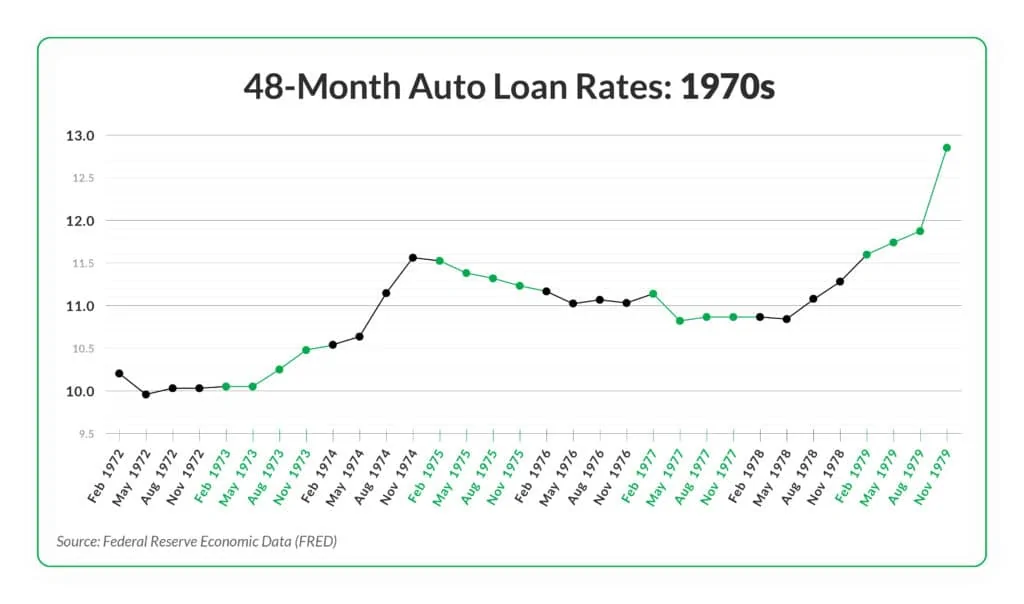
Rates in the 1970's were consistently above 10% hitting a peak of 11.57% in November 1974

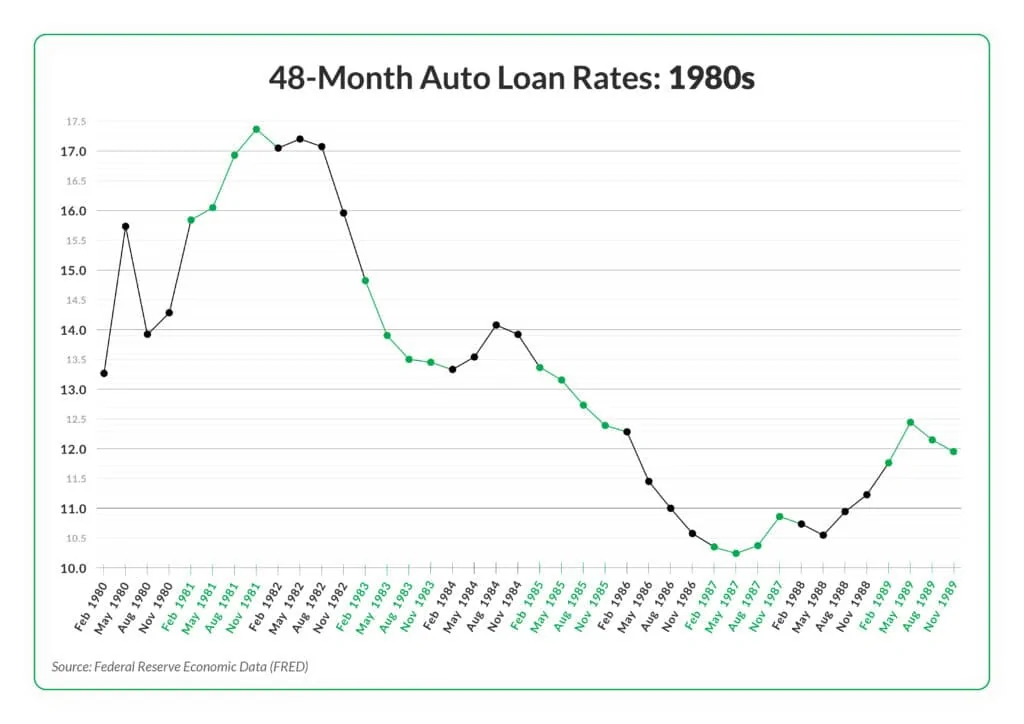
Rates in the 1980's were consistently above 10% hitting a peak of 17.36% by November 1981

Rates in the 1990's ranged from 11.6% in February 1991 to a low of 7.54% in February 1994. Although they would climb again to reach 9.78% in May 1995, they never crested 10%. For the rest of the decade, auto loan rates hung between 8.31% and 9.44%.

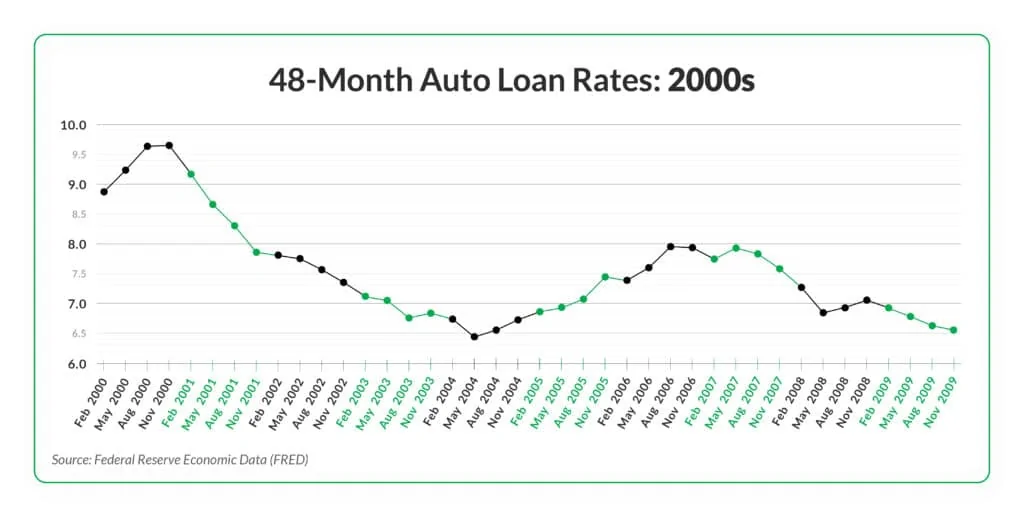
Rates in the 2000's ranged from 9.64% in November 2000 to 6.43% by May 2004

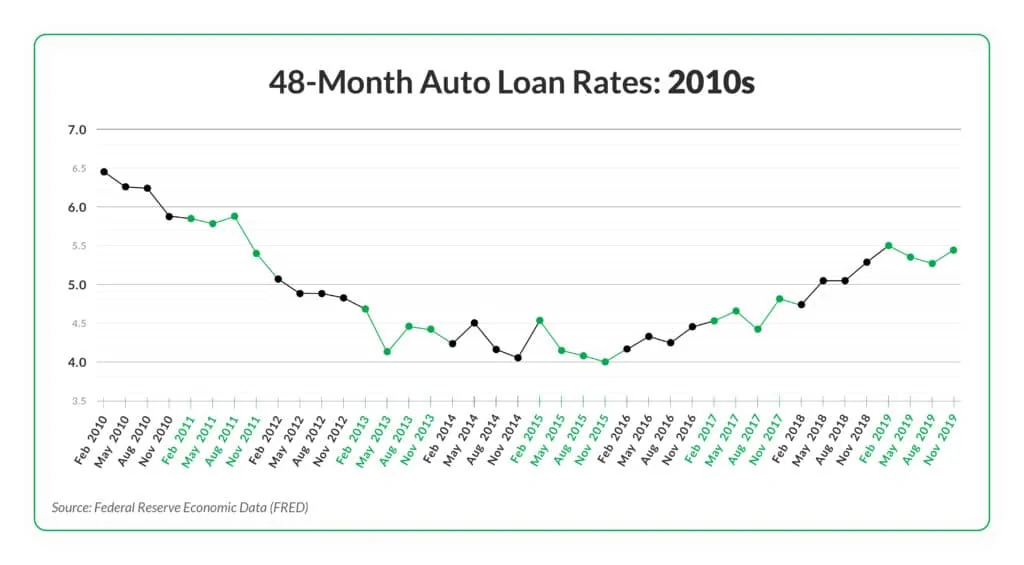
Rates in the 2010's were at their highest in 2011, peaking at 5.89% in August before falling to exceptionally low levels for the first half of the decade. There were moments of slight volatility between 2013 and 2015: Rates sat at 4.13% in May 2013, then rose to 4.5% a year later, immediately sank to 4.06% in November 2014, and then jumped back up to 4.53% by February 2015.

Auto loan rates hit their all-time lowest point in November 2015 at an even 4%. By 2019

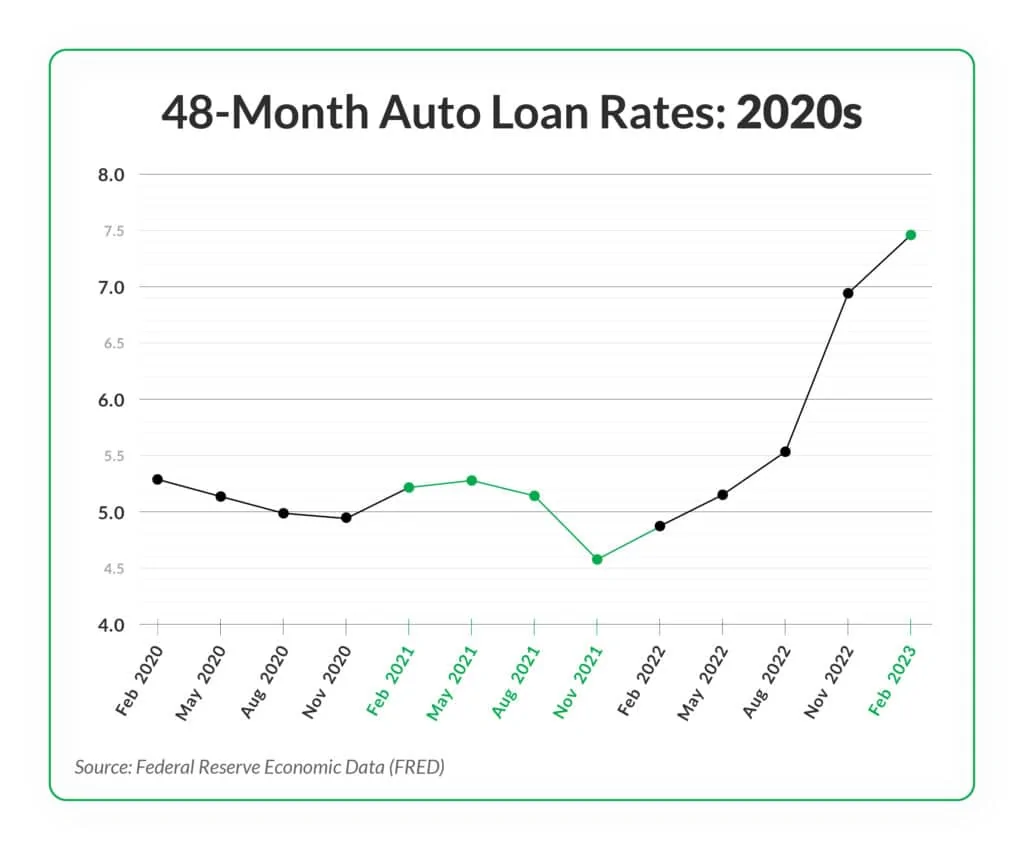
2020-2023 Auto loan rates were significantly influenced by the COVID-19 pandemic and the effect it had on the U.S. economy. Rates started off relatively low in 2020 and continued to decline in the first year of the pandemic. Once the world began to recover, auto loan rates skyrocketed, climbing to 6.94% by November 2022. As of February 2023, which is the most recent data collected by the Fed, rates sat at 7.46%.

Historical Auto Loan Rates


Historical Auto Loan Rates: 48-Month Loans

The Fed began tracking auto loan rates for new cars with 48-month loan terms in February 1972. We’ll summarize the FRED findings by decade below.

1972-1979

When the Fed first began tracking this data in February 1972, auto loan rates sat at 10.2%. They hovered consistently around 10% until about May 1973. The 1973-1975 recession saw rates slowly begin to rise as the country dealt with issues like high inflation, high unemployment and a global stock market crash. Rates peaked at 11.57% in November 1974, and it took several years for them to drop below 11% again.

As the U.S. continued to face high inflation following the recession, this led to a sharper increase in auto loan rates toward the end of the 1970s.

MW-DPR-48-Month-Auto-Loan-Rates-1970s-04-1024x604.webp


1980-1989

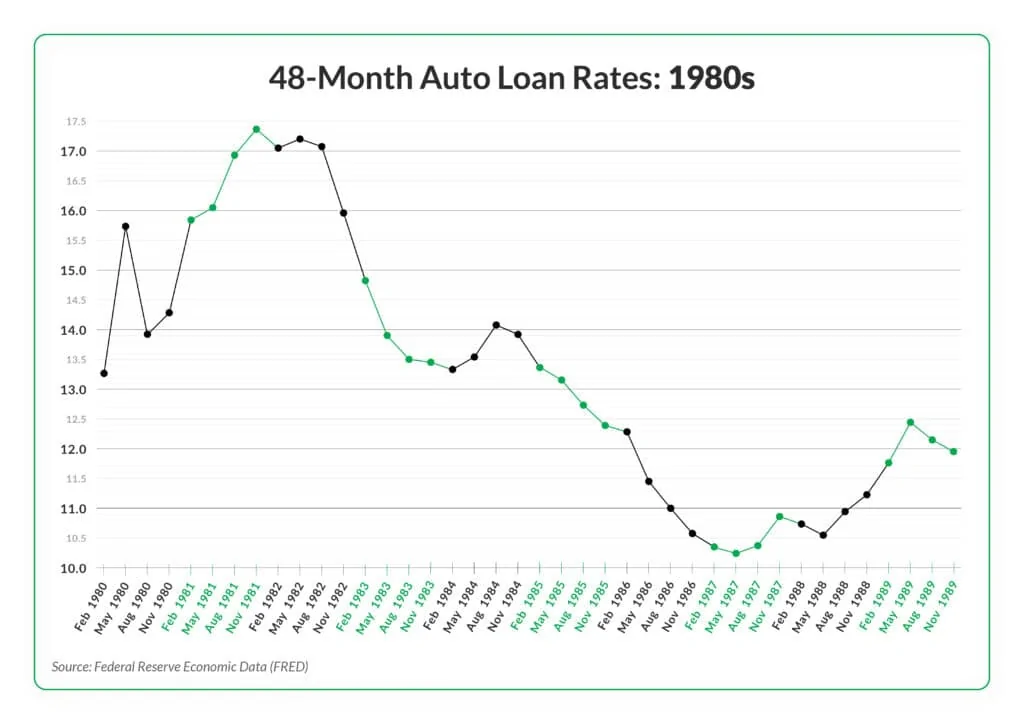
The 1980s started with auto loan rates at an all-time high, reaching a record 17.36% by November 1981. The early ā€˜80s was a period marked by extreme economic contraction, with the country facing another recession in 1981-1982. Monetary policy focused on controlling the inflation left over from the 1970s, and the Fed raised interest rates to combat this sky-high inflation, leading to high auto loan rates.

By November 1982, rates had begun to come down, dropping 1.39 points from the year before to 15.97%. The downward trend continued through much of the ā€˜80s as rates saw a relatively steady decline, reaching a low of 10.23% in May 1987. Rates would climb back up to 12.44% by May 1989 but would begin to wane almost immediately.

MW-DPR-48-Month-Auto-Loan-Rates-1980s-02-1024x724.webp


1990-1999

In August 1990, Iraq invaded Kuwait, causing what’s now referred to as the 1990 oil price shock. A sudden rise in oil prices triggered a mild recession in the U.S., which caused loan rates to remain fairly high at the start of the ā€˜90s.

However, the recession was short-lived. It ended in March 1991, and the U.S. saw a drastic reduction in auto loan rates following its conclusion. They decreased from 11.6% in February 1991 to a low of 7.54% in February 1994. Although they would climb again to reach 9.78% in May 1995, they never crested 10%. For the rest of the decade, auto loan rates hung between 8.31% and 9.44%.

2000-2009

The early 2000s was another period of decline for new car loan rates, decreasing from 9.64% in November 2000 to 6.43% by May 2004. The 2001 New York City terrorist attack played a significant role in this decline, but rates began to steadily rise again starting in 2004.

The increase in rates continued until the Great Recession struck the economy in 2008, causing a sharp, rapid drop in new automobile loan rates. At the beginning of the downturn, rates stood at 7.27% — by May 2009, they had dropped to 6.79%.

MW-DPR-48-Month-Auto-Loan-Rates-2000s-02-1024x517.webp


2010-2019

As the economy began to recover in 2010, auto loan rates continued to fall, sinking to 5.87% by November of that year. Rates were at their highest in 2011, peaking at 5.89% in August before falling to exceptionally low levels for the first half of the decade. There were moments of slight volatility between 2013 and 2015: Rates sat at 4.13% in May 2013, then rose to 4.5% a year later, immediately sank to 4.06% in November 2014, and then jumped back up to 4.53% by February 2015.

Auto loan rates hit their all-time lowest point in November 2015 at an even 4%. By 2019, they’d climbed up 1.5%, only to begin falling once the COVID-19 pandemic struck in early 2020.

MW-DPR-48-Month-Auto-Loan-Rates-2010s-02-1024x565.webp


2020-2023

Auto loan rates were significantly influenced by the COVID-19 pandemic and the effect it had on the U.S. economy. Rates started off relatively low in 2020 and continued to decline in the first year of the pandemic. Once the world began to recover, auto loan rates skyrocketed, climbing to 6.94% by November 2022. As of February 2023, which is the most recent data collected by the Fed, rates sat at 7.46%.

MW-DPR-48-Month-Auto-Loan-Rates-2020s-03-1024x850.webp


Historical Auto Loan Rates: 60-Month Loans

The Fed only started collecting data on 60-month loans for new cars in August 2006, so the available information isn’t nearly as extensive as it is for 48-month loans.

2006-2009

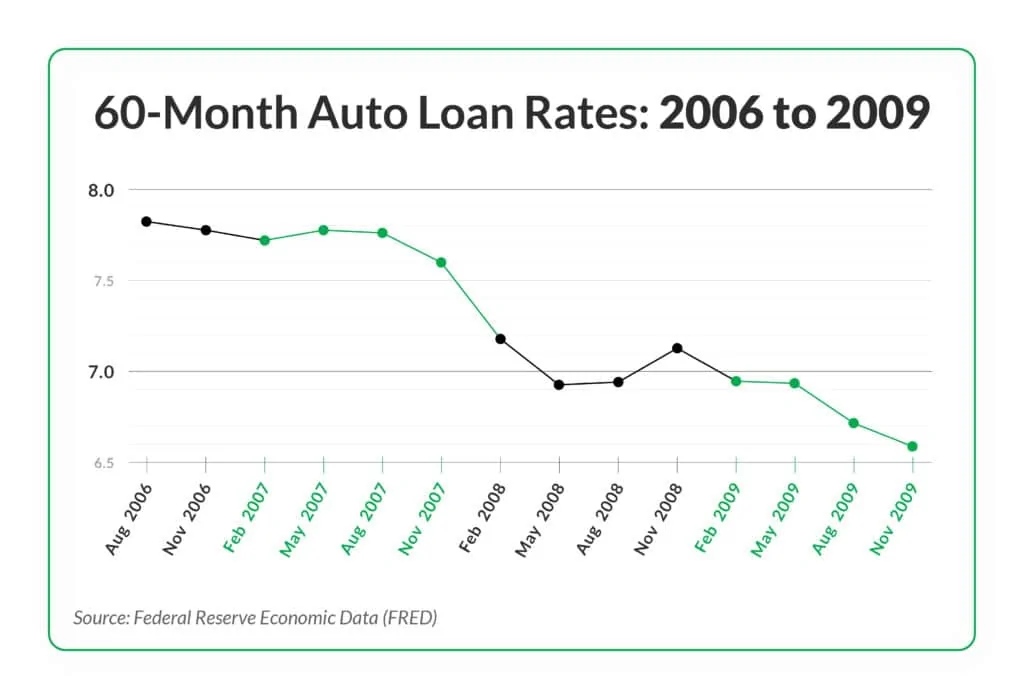
Auto loan rates saw a relatively steady decline from 2006 to 2009, falling from a high of 7.82% in August 2006 to 6.59% in November 2009. The steepest drop occurred between November 2007 and February 2008, when rates fell from 7.6% to 7.18%. During the Great Recession, rates settled around 7% but began falling gradually as the markets recovered.

-60-Month-Auto-Loan-Rates-2006-to-2009-01-1024x699.webp


2010-2019

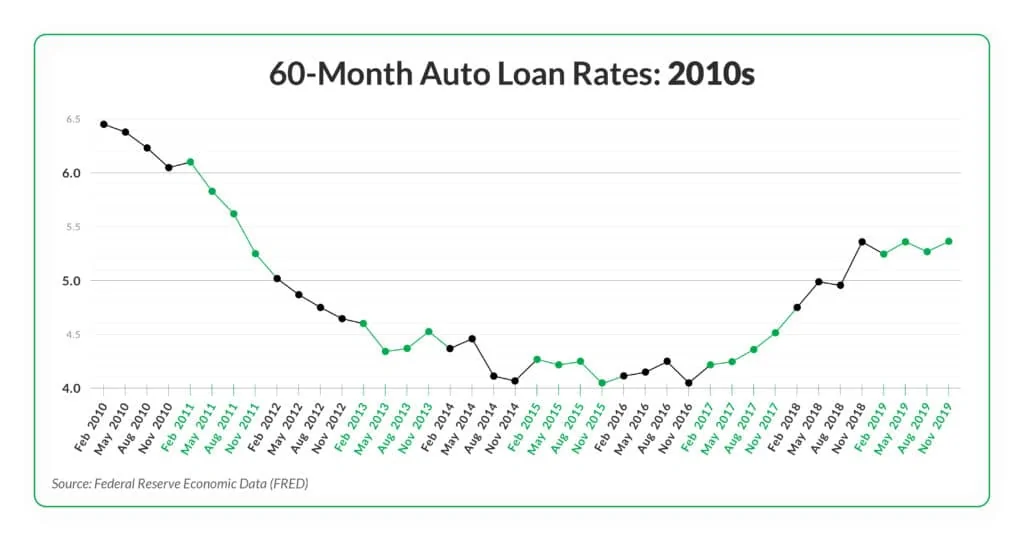
In the 2010s, 60-month auto loans rates saw a similar pattern to 48-month rates, declining steadily for the first four years to a low of 4.05% in November 2015. Rates stayed relatively consistent over the next year, until they began creeping back up in the following two years. From November 2016 to November 2018, rates climbed more than a percentage point from 4.05% to 5.36%. They remained right around that level through the end of 2019, just before the start of the COVID-19 pandemic.

MW-DPR-60-Month-Auto-Loan-Rates-2010s-01-1024x541.webp


2020-2023

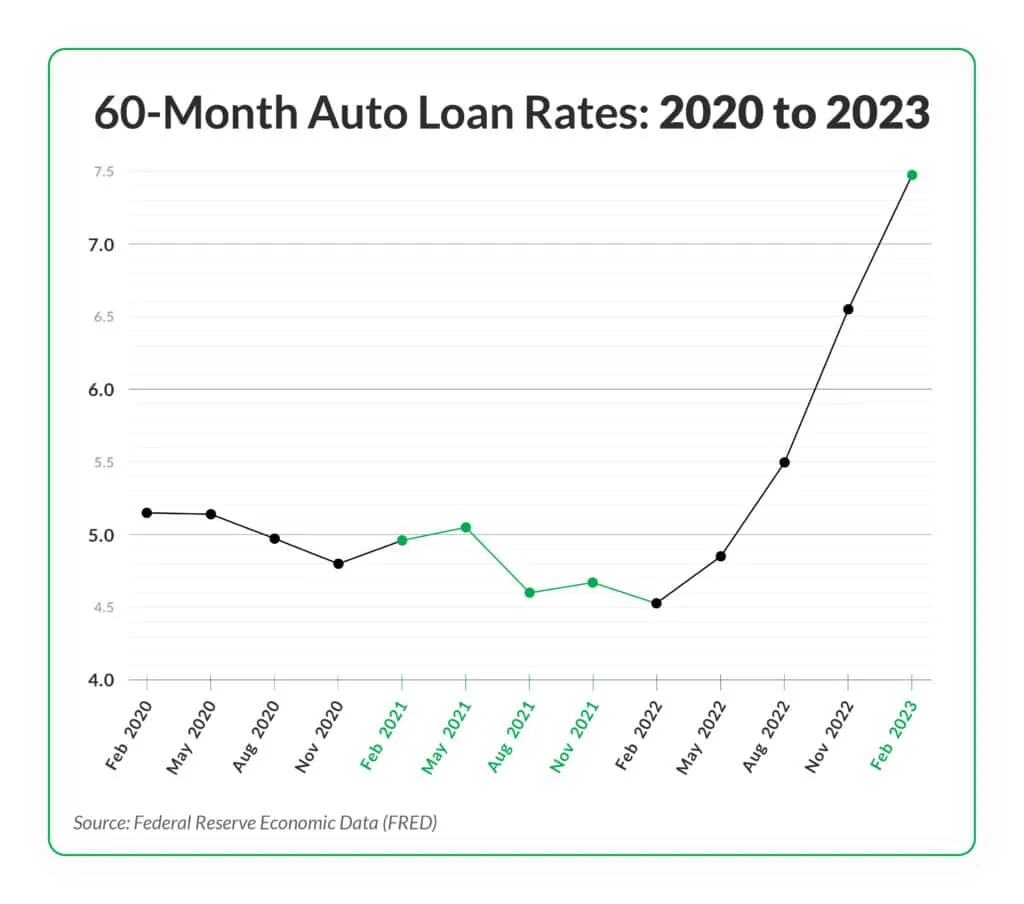
As the Fed cut interest rates in response to the economic effects of the COVID-19 pandemic, auto loan rates began a steady decline through all of 2020. While there were slight changes throughout 2021 and early 2022, rates for 60-month loans stayed between 4.52% (February 2022) and 5.05% (May 2021). By August 2022, rates had climbed to 5.5% and began to rise significantly, hitting 7.48% by February 2023.

-60-Month-Auto-Loan-Rates-2020-to-2023-01-1024x904.webp


Historical Auto Loan Rates: 72-Month Loans

The Fed’s data for 72-month loans on new cars is the most limited, starting in August 2015.
2015-2019

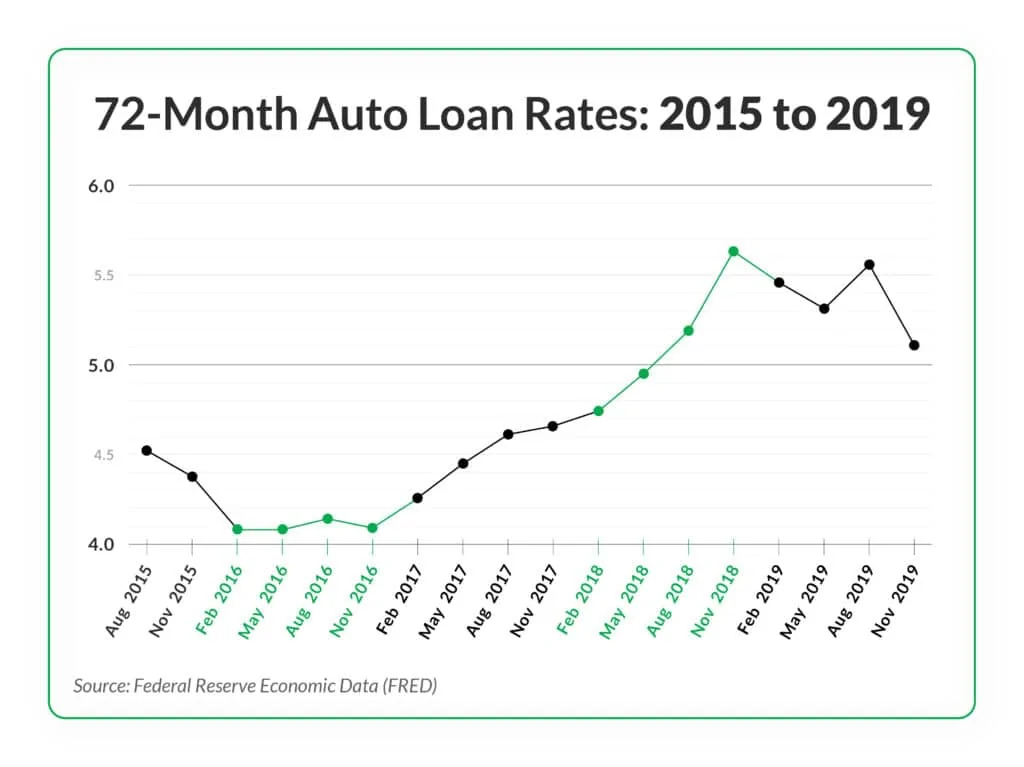
When the Fed first started collecting data on 72-month loans for new autos in August 2015, rates stood at 4.52%. By May of 2016, they’d declined by 0.44 percentage points, landing at 4.08%. From there, rates began a steady rise for most of the remainder of the decade, topping off at 5.63% in November 2018. From there, they stayed between 5% and 5.5% throughout 2019.

-72-Month-Auto-Loan-Rates-2015-to-2019-01-1024x767.webp


2020-2023

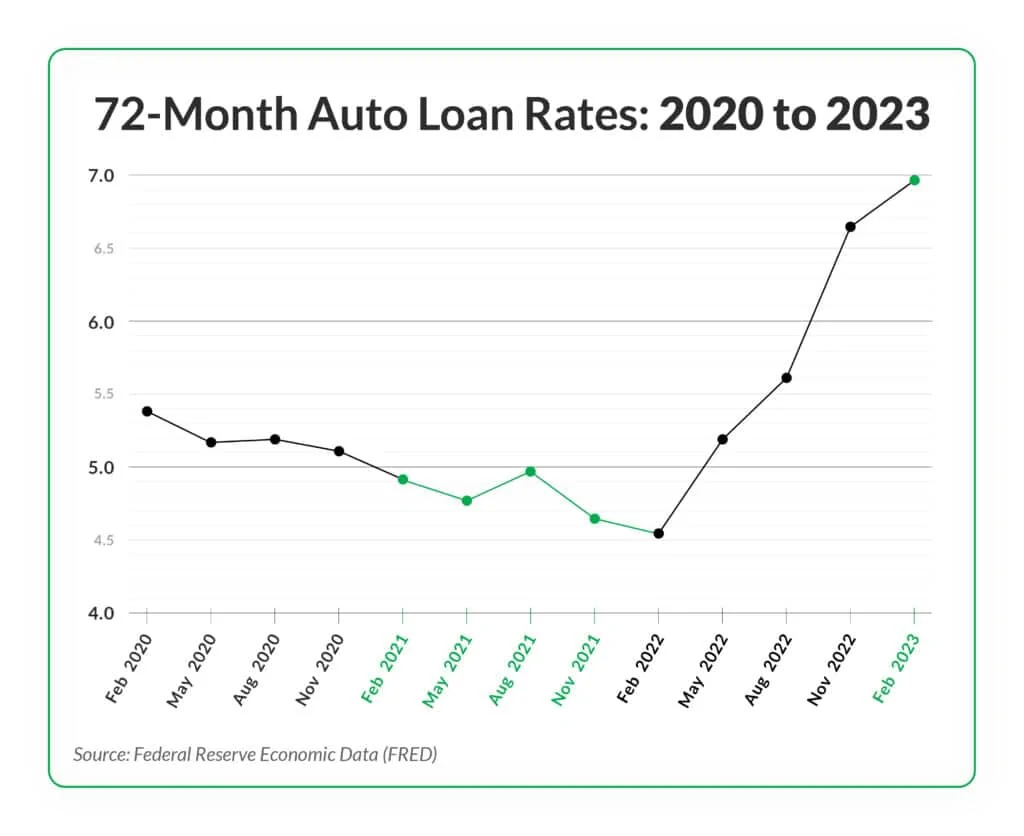
Similar to rates for all other loan terms, 72-month loan rates experienced a drop throughout 2020 and remained low for most of 2021 and early 2022. Rates didn’t rise above 5% again until May 2022, when they reached 5.19%. From there, they increased every few months, reaching 6.97% in February 2023.

-72-Month-Auto-Loan-Rates-2020-to-2023-01-1024x836.webp


How Did the COVID-19 Pandemic Impact Auto Loan Rates?

Based on Federal Reserve data, auto loan rates experienced a decline during 2020 following the start of the COVID-19 pandemic. This is due in part to the fact that the Fed drastically lowered interest rates to help stabilize the economy during that time. Rates remained low throughout 2021 and early 2022 as the country looked to recover from the economic challenges it faced in an ongoing pandemic.

However, as the U.S. dealt with rising inflation, the Federal Reserve began to take steps in 2022 to counteract it. March 2022 marked the beginning of a series of rate hikes in which the Fed raised rates by five percentage points, with the most recent increase occurring in May 2023.

W-DPR-48-Month-Auto-Loan-Rates-1980s-02-1-1024x724.webp
This is true , but vehicles didn't go up in price that much from like the mid 1950's Even to 1970. My Parents paid 2700 for a new leftover 69 Ford Galaxie 500 in 1970. You can't have High interest rates and super high vehicle prices at the same time. Car prices are not relative to paychecks either the way they were in the 50s 60s and even the 70s. Anything over a 3 year loan was almost unheard of back in those days.
 
Last edited:

lapazleo

New member
Joined
Nov 29, 2023
Threads
0
Messages
4
Reaction score
14
Location
321
Vehicle(s)
12345
Engine
Undecided
Boomers grew up in basically the easiest times in history of USA. A simple search tells me, for example, the average salary in 70s was 10k, and an average house cost about 25k. 2.5x single full time salary. Today an average salary is 60k and an average house price is 346k. Adjusting for inflation is great, but prices for EVERYTHING far outpaced wages. So yeah, the generations that earn the least while working the most (so far) has a full right to complain about how hard it is to afford things.
And if your perception of x-z-m-whatever is that they are lazy good-for-nothings, then maybe it's you, the boomers, who should get off DumbBook and FauxNews and open your eyes to how badly YOU and YOUR generation screwed everyone born after 1980s.
Beside your facts being incorrect your comment makes no sense.
 

Camlt12010

Well-known member
Joined
Jul 31, 2021
Threads
1
Messages
162
Reaction score
64
Location
19067
Vehicle(s)
04 Ford Escape
Engine
Undecided
I paid 12% on a house loan taken out in July of 1985. I just smile when I hear the whiney ass x-y-z whatever current generation cry about 5%. Move back into Mommy's basement.
Right . My first mortgage was 8.5.
 
Sponsored

NedF

2.5L Hybrid
Well-known member
Joined
Apr 13, 2023
Threads
13
Messages
566
Reaction score
623
Location
BC Canada
Vehicle(s)
Was a '23 now a '24 Lariat Lux
Engine
2.5L Hybrid
I bought my first Nissan Sentra (the first year of Nissan’s it still had a ā€˜Datsun’ badge) in 1981 with a 12.5% loan. I was 16 and just out of school… Fast forward to 2016 and we were able to pick my wife up a 2015 2.4l Turbo Chevy Eco Cruze with a good discount, for 0% interest and they even through in some custom made leather seats just to make the sale. Fortunately I have the cash for my Maverick once it is built. As funny as it may seem the Hybrid Lariat is the most I have ever paid for a vehicle in my life and it may be my last new vehicle unless prices come back into reality (referring to the current EV prices)!
 

Flomounier1

2.5L Hybrid
Well-known member
Joined
Oct 7, 2021
Threads
26
Messages
629
Reaction score
881
Location
Los Angeles
Vehicle(s)
2022 Ford Maverick Hybrid
Engine
2.5L Hybrid
Rates don't mean a whole hell of a lot when the buying power of your money is the real issue.
 

OrCoaster

2.5L Hybrid
Well-known member
First Name
Dale
Joined
Oct 28, 2022
Threads
4
Messages
418
Reaction score
528
Location
Mid Coast Oregon
Vehicle(s)
81 VW Caddy and 96 Ford Ranger
Engine
2.5L Hybrid
1943.
Still think I'm a boomer?

By the way, I paid off that house in 1994. That's the last time I paid interest on ANYTHING. If I can't pay cash, like I did for my Maverick, I don't buy it.
The way to pay cash is to save. In order to save you need willpower and sacrifice for the greater goal.

Something I don’t see much of from the younger generation.
 
First Name
Ty
Joined
Jun 8, 2022
Threads
0
Messages
10
Reaction score
10
Location
California
Vehicle(s)
25 XL hybrid Maverick
Engine
2.5L Hybrid
Old heads always gotta jump in and ruin a thread. For people who constantly bemoan how soft kids are these days they always seem to put on an oppression Olympics about how terrible EVERYTHING was for them.

Give me a break. This thread should be locked.
 

EchoPear

2.5L Hybrid
Well-known member
First Name
Nathanael
Joined
Jul 17, 2023
Threads
4
Messages
145
Reaction score
132
Location
Indiana
Vehicle(s)
ā€˜24 XLT Hyb/HPR/Lux/360/Bed Rail/Moonroof on order
Engine
2.5L Hybrid
Market is just tough these days. Seems like when I was cross shopping the Maverick I was either gonna end up with a higher mileage SUV or super high mileage larger pickup (both would cost me 10 grand more in gas over the years of ownership). Even a beater these days is too much for a beater. I remember my first car in high school in 2015 cost me 4000 out the door. Not nice but not going to strand me in 2 weeks either. I just looked on cargurus and older versions of the same car are going for 2-3k more today in my area

I think for most of us who need reliable transportation financing is a hard reality. My wife and I bought cars cash when married, I switched cars cash once, now we are trading in and financing the maverick as a family/utility car. So it just also sucks that rates aren’t as low anymore!
Sponsored

 
Status
Not open for further replies.


Top