

Sponsored

matmondro

2.0L EcoBoost
Well-known member
First Name
Mathieu
Joined
Sep 15, 2022
Threads
9
Messages
1,030
Reaction score
2,036
Location
Vassar, MI
Vehicle(s)
2022 Maverick XLT FX4, 1992 Corvette 6-speed
Engine
2.0L EcoBoost
My truck just rolled 25k miles. Today I changed the transmission fluid (partial change, really), PTU fluid, and RDU fluid. These were quite simple and anyone with some basic hand tools should be able to do them. About the only two things you'd need to pick up at Harbor Freight or some auto parts store are a fluid pump (for the PTU and RDU) and a long neck funnel.

With the transmission fluid, you're essentially draining it, filling it back up, then leveling it off with the leveling plug on the side of the case near the drivers' side CV axle. Draining the fluid is just like draining the engine oil, there's a bolt (14 mm) on the bottom of the transmission that comes out pretty easy. This bolt/plug has a seal built into the flange.

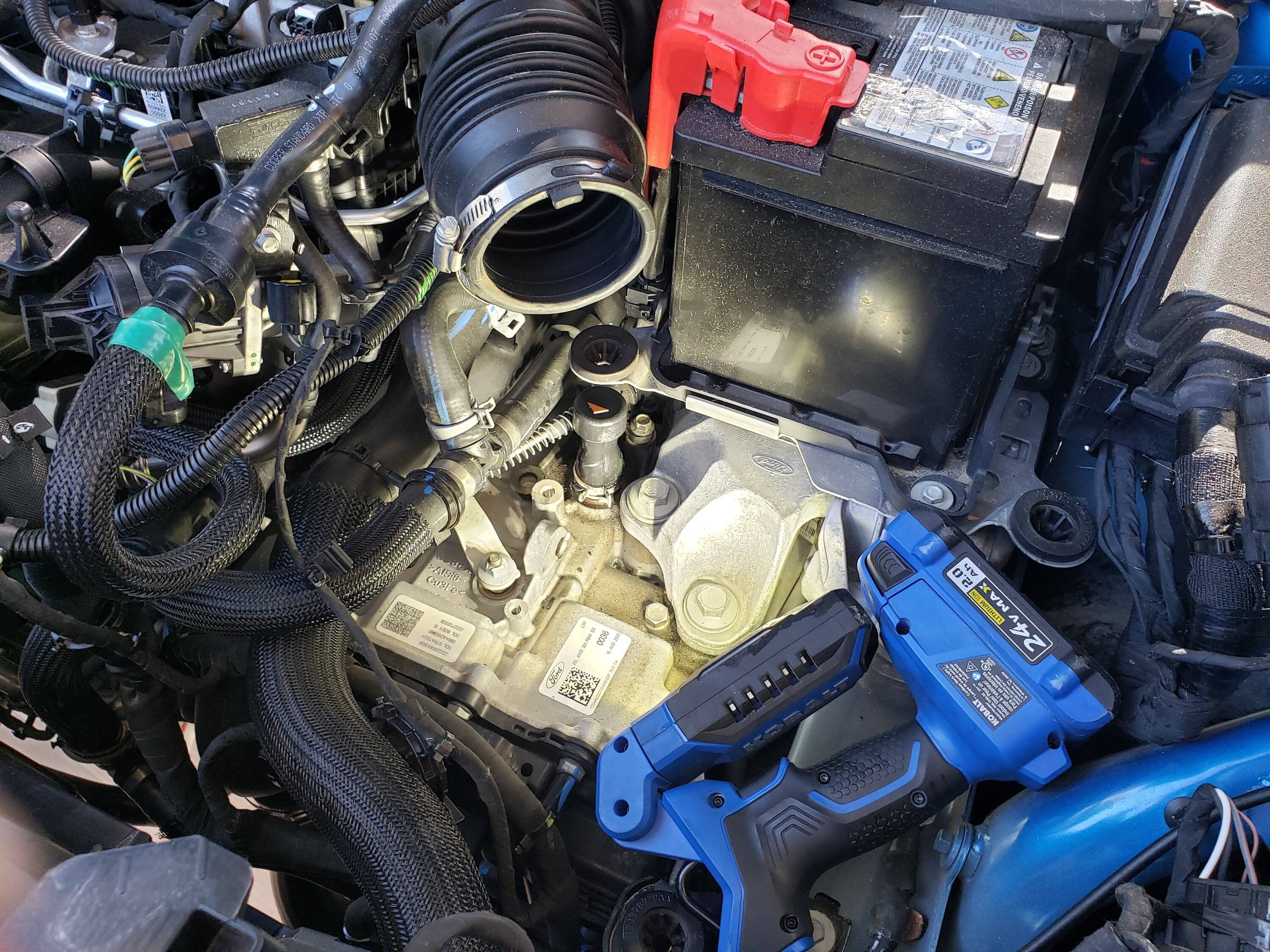
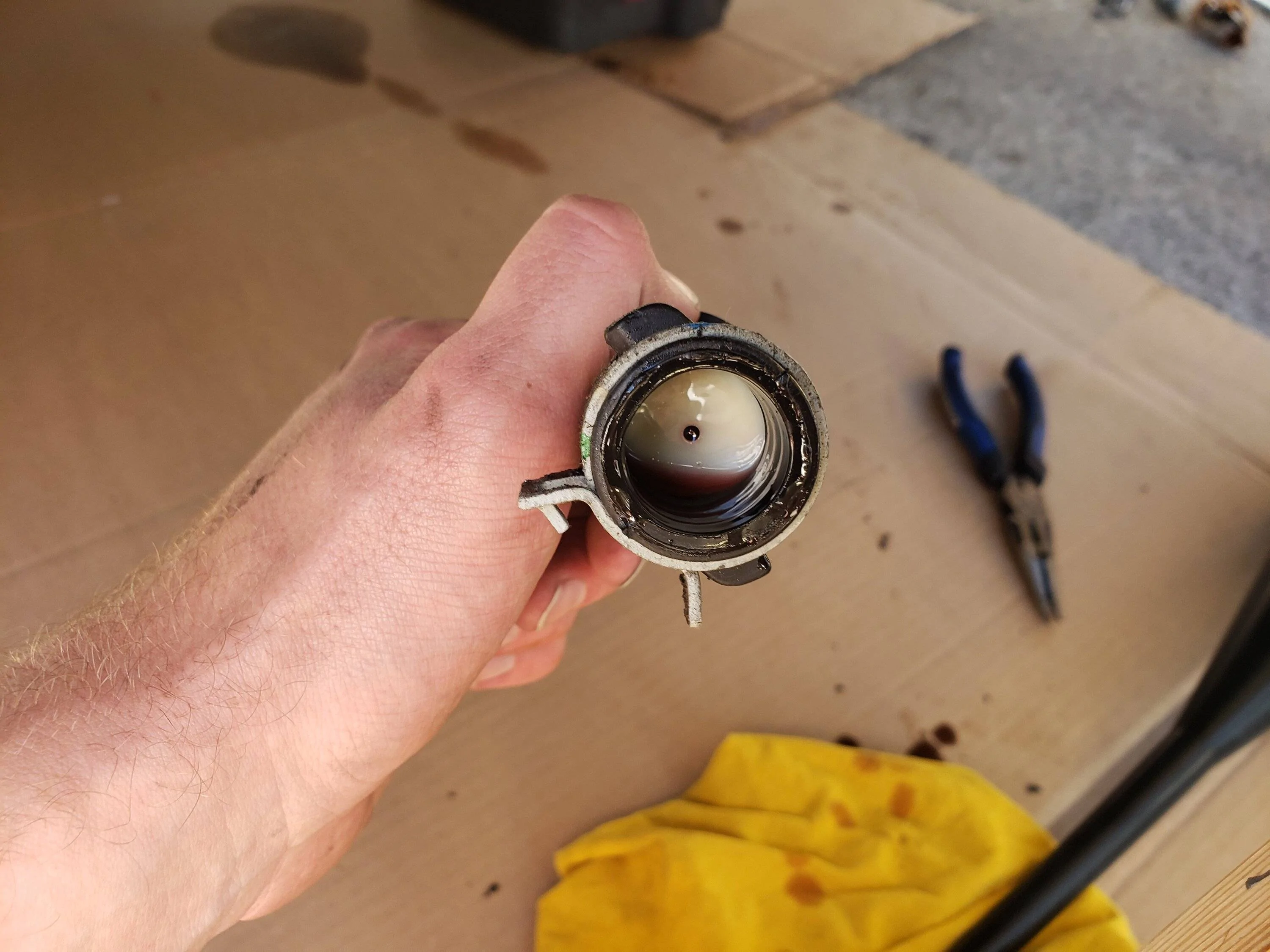
The interesting part is filling the transmission back up. I've read some very helpful threads here (thanks to those who have posted them!) but the one thing I would change is actually removing the entire transmission vent (which is where you're filling from), which means removing the entire airbox. The vent has a rubber neck with a vented cap on top, held on by a spring clamp. Some suggestions were to just pull the cap off and place the funnel into the rubber neck. This method is very restrictive and it would take a long time to get the fluid in. Below is a pic of the restrictor at the bottom of this neck:
Ford Maverick Ecoboost Transmission fluid, PTU and RDU fluid change @ 25k miles -- Tips & Results 178194-19d6f7905e94bba027a0be973e1a01d1


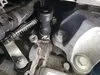
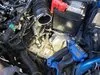
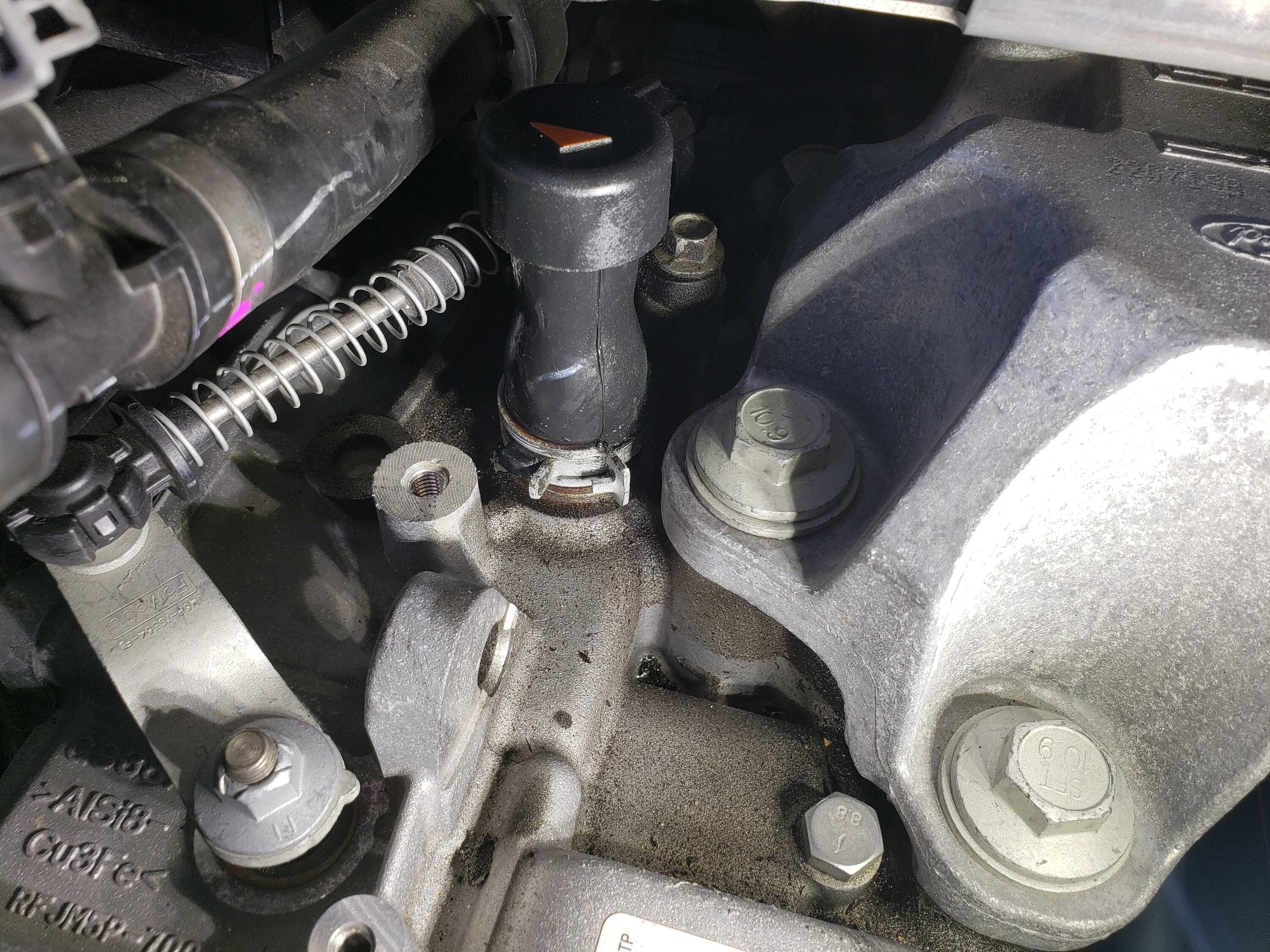
While it might seem daunting, removing the entire airbox is the best bet to gain full access to this vent tube and just remove the whole thing (which is actually specified in the Ford service manual). The airbox is only held on by two plastic clips on the air dam where the "ram air" tube starts, the hose clamp holding the intake tube to the box, then three grommets below the box. With the two clips up on the air dam removed and the hose clamp loosened, the entire box just lifts right out (unplug the MAF too). Only takes about a minute altogether. The vent tube and spring clamp was now very easily accessible. You'll need a pair of needle nose pliers to pinch the clamp and remove. The tabs on the clamp were facing the engine block, so upon reinstallation I rotated the whole assembly to face forward for even easier access next time (I'll be doing this every 25k miles).
Ford Maverick Ecoboost Transmission fluid, PTU and RDU fluid change @ 25k miles -- Tips & Results 178195-55bfa5d974afacfc8aae207979746880

Ford Maverick Ecoboost Transmission fluid, PTU and RDU fluid change @ 25k miles -- Tips & Results 178196-10a6fd90890ad1971c9611bc5dd0effd


Transmission took about 5.5 quarts of Mercon ULV. I initially put 4.5 quarts in, warmed up the truck, and gently drove around the block. Upon pulling the leveling plug (10 mm hex/allen) with the truck running (remove the front drivers' wheel) and lowering the jack to what would be normal ride height, it was low/nothing came out. Added a little more than a quart and upon pulling the plug again, fluid was coming out. I let it fall down to a slow stream/trickle then screwed the plug back in. In this process, I'd say a few ounces came out. I've seen some say 4.5 quarts, others take a whole 6 quarts, so I think it's just a case-by-case basis. Overall, pretty easy and with no hiccups should take about 45 minutes to an hour.

EDIT: I'll add for the RDU and PTU fluid changes, I just used the spec Motorcraft fluids. 75W85 Hypoid Gear Oil for the PTU, then 75W Rear Disconnect Drive Oil for the RDU. Both of these were as simple as drain, replace drain plug, then fill until fluid comes out of the fill hole. PTU drain plug was a standard 3/8" ratchet/square drive, PTU fill plug was an 8mm hex/allen and was accessed through the passenger side wheel well with the wheel removed. RDU drain and fill plugs were both standard 3/8" ratchet/square drive.

I did not teflon seal any of the plugs. The RDU plugs actually appeared to have some sort of sealer on the threads from the factory, so I just wiped off the plugs but did not remove the sealer, then snugged them up. None of these plugs require a lot of torque, I just choked up on the ratchet handle and tightened to snug.

RDU took a little less than a quart, I think I had about 4 or 5 fl-oz left in that bottle. The PTU took 0.5 qt.
Ford Maverick Ecoboost Transmission fluid, PTU and RDU fluid change @ 25k miles -- Tips & Results 20241019_150510


Ford Maverick Ecoboost Transmission fluid, PTU and RDU fluid change @ 25k miles -- Tips & Results 20241019_151728


Ford Maverick Ecoboost Transmission fluid, PTU and RDU fluid change @ 25k miles -- Tips & Results 20241019_151734
Sponsored

 
Last edited:
OP
OP
matmondro

matmondro

2.0L EcoBoost
Well-known member
First Name
Mathieu
Joined
Sep 15, 2022
Threads
9
Messages
1,030
Reaction score
2,036
Location
Vassar, MI
Vehicle(s)
2022 Maverick XLT FX4, 1992 Corvette 6-speed
Engine
2.0L EcoBoost
Make sure you heat your engine up to 185-200 degrees then check your fill plug. Best to use a scan tester to monitor transmission temperature.👍
Yes! Did that after filling it up. Test drove after I finished everything too and it all felt good. No CEL or errors either, so I say it's a win! 👍🏻
 

Rwills

2.0L EcoBoost
Well-known member
First Name
Ron
Joined
Apr 25, 2024
Threads
7
Messages
136
Reaction score
153
Location
Blue Ridge Ga
Vehicle(s)
2024 maverick
Engine
2.0L EcoBoost
My truck just rolled 25k miles. Today I changed the transmission fluid (partial change, really), PTU fluid, and RDU fluid. These were quite simple and anyone with some basic hand tools should be able to do them. About the only two things you'd need to pick up at Harbor Freight or some auto parts store are a fluid pump (for the PTU and RDU) and a long neck funnel.

With the transmission fluid, you're essentially draining it, filling it back up, then leveling it off with the leveling plug on the side of the case near the drivers' side CV axle. Draining the fluid is just like draining the engine oil, there's a bolt (14 mm) on the bottom of the transmission that comes out pretty easy. This bolt/plug has a seal built into the flange.

The interesting part is filling the transmission back up. I've read some very helpful threads here (thanks to those who have posted them!) but the one thing I would change is actually removing the entire transmission vent (which is where you're filling from), which means removing the entire airbox. The vent has a rubber neck with a vented cap on top, held on by a spring clamp. Some suggestions were to just pull the cap off and place the funnel into the rubber neck. This method is very restrictive and it would take a long time to get the fluid in. Below is a pic of the restrictor at the bottom of this neck:

178194-19d6f7905e94bba027a0be973e1a01d1.jpg


While it might seem daunting, removing the entire airbox is the best bet to gain full access to this vent tube and just remove the whole thing (which is actually specified in the Ford service manual). The airbox is only held on by two plastic clips on the air dam where the "ram air" tube starts, the hose clamp holding the intake tube to the box, then three grommets below the box. With the two clips up on the air dam removed and the hose clamp loosened, the entire box just lifts right out (unplug the MAF too). Only takes about a minute altogether. The vent tube and spring clamp was now very easily accessible. You'll need a pair of needle nose pliers to pinch the clamp and remove. The tabs on the clamp were facing the engine block, so upon reinstallation I rotated the whole assembly to face forward for even easier access next time (I'll be doing this every 25k miles).

178195-55bfa5d974afacfc8aae207979746880.jpg

178196-10a6fd90890ad1971c9611bc5dd0effd.jpg


Transmission took about 5.5 quarts of Mercon ULV. I initially put 4.5 quarts in, warmed up the truck, and gently drove around the block. Upon pulling the leveling plug (10 mm hex/allen) with the truck running (remove the front drivers' wheel) and lowering the jack to what would be normal ride height, it was low/nothing came out. Added a little more than a quart and upon pulling the plug again, fluid was coming out. I let it fall down to a slow stream/trickle then screwed the plug back in. In this process, I'd say a few ounces came out. I've seen some say 4.5 quarts, others take a whole 6 quarts, so I think it's just a case-by-case basis. Overall, pretty easy and with no hiccups should take about 45 minutes to an hour.

20241019_150510.jpg


20241019_151728.jpg


20241019_151734.jpg
My truck just rolled 25k miles. Today I changed the transmission fluid (partial change, really), PTU fluid, and RDU fluid. These were quite simple and anyone with some basic hand tools should be able to do them. About the only two things you'd need to pick up at Harbor Freight or some auto parts store are a fluid pump (for the PTU and RDU) and a long neck funnel.

With the transmission fluid, you're essentially draining it, filling it back up, then leveling it off with the leveling plug on the side of the case near the drivers' side CV axle. Draining the fluid is just like draining the engine oil, there's a bolt (14 mm) on the bottom of the transmission that comes out pretty easy. This bolt/plug has a seal built into the flange.

The interesting part is filling the transmission back up. I've read some very helpful threads here (thanks to those who have posted them!) but the one thing I would change is actually removing the entire transmission vent (which is where you're filling from), which means removing the entire airbox. The vent has a rubber neck with a vented cap on top, held on by a spring clamp. Some suggestions were to just pull the cap off and place the funnel into the rubber neck. This method is very restrictive and it would take a long time to get the fluid in. Below is a pic of the restrictor at the bottom of this neck:

178194-19d6f7905e94bba027a0be973e1a01d1.jpg


While it might seem daunting, removing the entire airbox is the best bet to gain full access to this vent tube and just remove the whole thing (which is actually specified in the Ford service manual). The airbox is only held on by two plastic clips on the air dam where the "ram air" tube starts, the hose clamp holding the intake tube to the box, then three grommets below the box. With the two clips up on the air dam removed and the hose clamp loosened, the entire box just lifts right out (unplug the MAF too). Only takes about a minute altogether. The vent tube and spring clamp was now very easily accessible. You'll need a pair of needle nose pliers to pinch the clamp and remove. The tabs on the clamp were facing the engine block, so upon reinstallation I rotated the whole assembly to face forward for even easier access next time (I'll be doing this every 25k miles).

178195-55bfa5d974afacfc8aae207979746880.jpg

178196-10a6fd90890ad1971c9611bc5dd0effd.jpg


Transmission took about 5.5 quarts of Mercon ULV. I initially put 4.5 quarts in, warmed up the truck, and gently drove around the block. Upon pulling the leveling plug (10 mm hex/allen) with the truck running (remove the front drivers' wheel) and lowering the jack to what would be normal ride height, it was low/nothing came out. Added a little more than a quart and upon pulling the plug again, fluid was coming out. I let it fall down to a slow stream/trickle then screwed the plug back in. In this process, I'd say a few ounces came out. I've seen some say 4.5 quarts, others take a whole 6 quarts, so I think it's just a case-by-case basis. Overall, pretty easy and with no hiccups should take about 45 minutes to an hour.

20241019_150510.jpg


20241019_151728.jpg


20241019_151734.jpg
Where is this vent you removed located?
 
OP
OP
matmondro

matmondro

2.0L EcoBoost
Well-known member
First Name
Mathieu
Joined
Sep 15, 2022
Threads
9
Messages
1,030
Reaction score
2,036
Location
Vassar, MI
Vehicle(s)
2022 Maverick XLT FX4, 1992 Corvette 6-speed
Engine
2.0L EcoBoost
Where is this vent you removed located?
It's on top of the transmission right under the air intake, just to the passenger side of the battery tray. It's a rubber neck about 2 or 3 inches long with a cap on top. The cap has an orange triangle on it.
 

Sponsored

fossil

2.0L EcoBoost
Well-known member
First Name
ernie
Joined
Aug 23, 2020
Threads
48
Messages
3,432
Reaction score
5,797
Location
ohio
Vehicle(s)
95 SVT Cobra Mustang, HPR Lariat Tremor
Engine
2.0L EcoBoost
Nice write up. Guarantee I'd be adding an aprox 12" extension to that vent hose to facilitate further oil changes and to raise it above the splash zone.
 

mikeymaverick

2.0L EcoBoost
Active member
First Name
Mike
Joined
Oct 24, 2023
Threads
10
Messages
25
Reaction score
162
Location
Wisconsin
Vehicle(s)
2023 Maverick Lariat
Engine
2.0L EcoBoost
What is the recommended service interval for the transaxle? I had planned on doing a drain fill at 30,000 miles.
 

Jalopy Technology

2.0L EcoBoost
Well-known member
First Name
Rick
Joined
Oct 19, 2024
Threads
32
Messages
325
Reaction score
545
Location
Central Wisconsin
Vehicle(s)
'25 Maverick, '04 LeSabre, '99 Grand Cherokee, '88 F350 crew cab, '65 Dodge Coro
Engine
2.0L EcoBoost
YouTube Ford guy "FordTechMakuloco" has a good video on these procedures...


Guv

2.0L EcoBoost
Well-known member
First Name
Steve
Joined
Jan 15, 2022
Threads
15
Messages
1,287
Reaction score
1,145
Location
USA
Vehicle(s)
Ford
Engine
2.0L EcoBoost
Is the truck on a lift or on ramps?
 
Sponsored
OP
OP
matmondro

matmondro

2.0L EcoBoost
Well-known member
First Name
Mathieu
Joined
Sep 15, 2022
Threads
9
Messages
1,030
Reaction score
2,036
Location
Vassar, MI
Vehicle(s)
2022 Maverick XLT FX4, 1992 Corvette 6-speed
Engine
2.0L EcoBoost
OP
OP
matmondro

matmondro

2.0L EcoBoost
Well-known member
First Name
Mathieu
Joined
Sep 15, 2022
Threads
9
Messages
1,030
Reaction score
2,036
Location
Vassar, MI
Vehicle(s)
2022 Maverick XLT FX4, 1992 Corvette 6-speed
Engine
2.0L EcoBoost
What is the recommended service interval for the transaxle? I had planned on doing a drain fill at 30,000 miles.
I'm not too sure honestly, but I'd probably stick to 25-30k miles. The PTU works quite a bit, especially in an AWD vehicle. I occasionally tow with my Mav and do some light off-roading so I figured it was due, especially being on the factory fill.
 
OP
OP
matmondro

matmondro

2.0L EcoBoost
Well-known member
First Name
Mathieu
Joined
Sep 15, 2022
Threads
9
Messages
1,030
Reaction score
2,036
Location
Vassar, MI
Vehicle(s)
2022 Maverick XLT FX4, 1992 Corvette 6-speed
Engine
2.0L EcoBoost
Is the truck on a lift or on ramps?
Just on jack stands in the front for the draining. After you refill the fluid, the truck needs to be at its normal ride height for proper leveling. You'll have to remove the jack stands anyways to drive the truck and get the transmission up to operating temp after filling.

When leveling, jack up the drivers' front, remove the wheel, then lower the jack back down to normal ride height. You'll need to measure the height from the ground up to a trim line (bottom of door will work) so that you know where to stop when lowering the jack.
 
  • Like
Reactions: Guv

Jalopy Technology

2.0L EcoBoost
Well-known member
First Name
Rick
Joined
Oct 19, 2024
Threads
32
Messages
325
Reaction score
545
Location
Central Wisconsin
Vehicle(s)
'25 Maverick, '04 LeSabre, '99 Grand Cherokee, '88 F350 crew cab, '65 Dodge Coro
Engine
2.0L EcoBoost
The biggest favor you can do for your vehicle is keep fresh fluids in all systems...and good filters if applicable.
 
OP
OP
matmondro

matmondro

2.0L EcoBoost
Well-known member
First Name
Mathieu
Joined
Sep 15, 2022
Threads
9
Messages
1,030
Reaction score
2,036
Location
Vassar, MI
Vehicle(s)
2022 Maverick XLT FX4, 1992 Corvette 6-speed
Engine
2.0L EcoBoost
The biggest favor you can do for your vehicle is keep fresh fluids in all systems...and good filters if applicable.
Absolutely! It's like a cheap form of insurance. I think anyone who plans on keeping their Mav, or any vehicle, for a long period of time should make a point to replace these fluids regularly.
Sponsored


Top