Sponsored

brake issues on Mavericks with 2.0 eco boost engine only.

  • Thread starter Deleted member 6849
  • Start date
  • Watchers 4

Deleted member 6849

Guest
I have a 2022 Ford Maverick, 2.0 ecoboost engine, awd with tow package. I have been having brake problems since the beginning. The problem is the front brakes do not back out enough to leave a proper air gap between the brake pad and rotor when deactivating the service mode. Therefore the pads keep riding on the rotors causing glazing and grabby brakes when coming to a stop behind a vehicle. Turning off the active breaking did help with the grabby brakes when coming to a stop behind a vehicle, but did not resolve the glazing issue. I took the truck into two dealerships and the techs. could not find a solution. the calipers,brake hoses and the brake master cylinder have been replaced with no success. I now suspect it may be a setting somewhere in the software that causes the brake pads to not back out enough to leave a proper air gap between the pads and rotors. I was thinking about learning to use forscan to adjust the air gap setting when deativating the service mode. but I am not familiar with forscan and I wonder if there is even enough information out there for the maverick? correct me if im wrong i believe the brake system (settings and perameters in the software) maybe familiar to the ford bronco sport and possibly the 2020-2022 ford escape vehicles. any help would be greatly appreciated .
Sponsored

 

Bob The Builder

2.0L EcoBoost
Well-known member
First Name
Butch
Joined
Dec 2, 2021
Threads
54
Messages
2,598
Reaction score
4,884
Location
Vermont
Vehicle(s)
2020 Jeep Cherokee ** 2023 Mav FX/4
Engine
2.0L EcoBoost
Is this an issue with the '22's or are the 23's affected as well. The reason I ask is, if by chance, this is a 22 issue only maybe Ford can share what they changed with the mechanics so this can be resolved once and for all because there have been similar posts here for over a year now. :rolleyes:
 

Senior Master Ford Guy

2.5L Hybrid
Well-known member
First Name
Mike
Joined
Apr 2, 2023
Threads
10
Messages
226
Reaction score
546
Location
Illinois
Vehicle(s)
99 Ranger, 04 and 18 Escape, 2023 Maverick Lariat
Engine
2.5L Hybrid
First of all, the " service mode" is for servicing the rear brakes, it retracts the electric parking brake motors so that the pistons can be pushed back in without motor damage. Secondly, "Air gap" is not a setting you can adjust with anything: Forscan or otherwise. The minimal distance a caliper piston retracts the pads away from the rotor is created by the lipped seals of the caliper piston. We are talking the width of a human hair, maybe 2 at the most. If the gap were any larger this would create a soft or low pedal, as the initial pressing of the pedal would be pushing hydraulic fluid through the system with no resistance until the pad contacts the rotor, then the pedal would(and does) become firm. Typically if you are having a problem as described, it is one of three things 1) drivers braking habits, 2) contamination on the braking surfaces(either the pads or the rotors) or 3) the brake pad material compound. In not so typical cases, this can be caused by an ABS/Traction control system not functioning properly( not releasing pressure) or even a stoplamp switch out of adjustment and allowing the pedal to stay slightly pressed( which would be easily detected by brake lights staying on).
 
Last edited:

Montana

2.0L EcoBoost
Banned
Banned
Joined
Jun 13, 2023
Threads
24
Messages
4,094
Reaction score
6,347
Location
USA
Vehicle(s)
.
Engine
2.0L EcoBoost
Be advised, there is an SSM where Mavericks are not going into brake service mode. FORD's only solution is to use FDRS to force it. Forscan will not enable brake service mode.

Before you purchase pads, test if your vehicle will go into brake service mode.
 

Sponsored

OP
OP

Deleted member 6849

Guest
Is this an issue with the '22's or are the 23's affected as well. The reason I ask is, if by chance, this is a 22 issue only maybe Ford can share what they changed with the mechanics so this can be resolved once and for all because there have been similar posts here for over a year now. :rolleyes:
Good question, As of right now I have not heard of any 23 Mavericks with brake issues of this sort. Only time will tell.
 

Hardening2753

2.5L Hybrid
Well-known member
Joined
Jul 30, 2022
Threads
19
Messages
966
Reaction score
807
Location
USA
Vehicle(s)
Ford Maverick Hybrid
Engine
2.5L Hybrid
Clubs
 
I have a 2022 Ford Maverick, 2.0 ecoboost engine, awd with tow package. I have been having brake problems since the beginning. The problem is the front brakes do not back out enough to leave a proper air gap between the brake pad and rotor when deactivating the service mode. Therefore the pads keep riding on the rotors causing glazing and grabby brakes when coming to a stop behind a vehicle. Turning off the active breaking did help with the grabby brakes when coming to a stop behind a vehicle, but did not resolve the glazing issue. I took the truck into two dealerships and the techs. could not find a solution. the calipers,brake hoses and the brake master cylinder have been replaced with no success. I now suspect it may be a setting somewhere in the software that causes the brake pads to not back out enough to leave a proper air gap between the pads and rotors. I was thinking about learning to use forscan to adjust the air gap setting when deativating the service mode. but I am not familiar with forscan and I wonder if there is even enough information out there for the maverick? correct me if im wrong i believe the brake system (settings and perameters in the software) maybe familiar to the ford bronco sport and possibly the 2020-2022 ford escape vehicles. any help would be greatly appreciated .
Do you happen to have any pic of the gap?
 
OP
OP

Deleted member 6849

Guest
First of all, the " service mode" is for servicing the rear brakes, it retracts the electric parking brake motors so that the pistons can be pushed back in without motor damage. Secondly, "Air gap" is not a setting you can adjust with anything: Forscan or otherwise. The minimal distance a caliper piston retracts the pads away from the rotor is created by the lipped seals of the caliper piston. We are talking the width of a human hair, maybe 2 at the most. If the gap were any larger this would create a soft or low pedal, as the initial pressing of the pedal would be pushing hydraulic fluid through the system with no resistance until the pad contacts the rotor, then the pedal would(and does) become firm. Typically if you are having a problem as described, it is one of three things 1) drivers braking habits, 2) contamination on the braking surfaces(either the pads or the rotors) or 3) the brake pad material compound. In not so typical cases, this can be caused by an ABS/Traction control system not functioning properly( not releasing pressure) or even a stoplamp switch out of adjustment and allowing the pedal to stay slightly pressed( which would be easily detected by brake lights staying on).
[/QUOTE
Hello Senior Master Ford Guy, I am so thankful for your reply. Looking at your list of three things I can tell you it is not my braking habits. Im 49 years old and I have never had brake problems like this with none of my vehicles in the past. Because of the brake issues with the maverick, I have been very careful when braking while driving to make sure that its not me. LOL! Number two I know how important it is to keep the rotor and brake pad free of grease or oily contamination when installing new rotors and pads, with the brake problems I have been having on the maverick I have been extra careful with cleaning everything. As far as the brake pad material I have used both the oem pads and even purchased ceramic pads after researching on line with no success. It seems no matter what I do whether its replacing the rotors/brake pads, or replacing brake calipers or even replacing the master brake cylinder (because only the front rotors are glazing) the rotors always end up glazed after two weeks of driving. I even went as far as gapping the front break pads with a shim of .011" and scuffing the rotors and brake pads as an experiment to see if this would keep the pads off the rotors. I was able to drive three weeks before the rotors were glazed again. The results of this experiment, had me thinking that there is constant pressure on the front brake pads. but why? I decided to replace the brake master cylinder ( with no success) and to check if it was possible to adjust the push rod. the push rod does not look like its adjustable as it does not have a hex head like you would see on older vehicles. Then I was thinking the push rod is not adjustable because of the active breaking and trailer sway features on my truck. I could be wrong though, what are you thoughts? Something on your post did catch my eye, the part you talking about the abs/traction control system not functioning properly. unfortunately as of this reply, I know nothing about abs/traction control. But I can learn, like I learned everything else through research research research. lol Maybe it is best to take the truck into the dealership and have them look at the abs/traction control system. As I am running out of time, not patience. I love my truck, I just want it fixed. thank you sir
 
OP
OP

Deleted member 6849

Guest
Do you happen to have any pic of the gap?
no I dont. but I can tell you it after a visual inspection, it looks like there is no gap. but keep in mind the air gap should be in the thousands of an inch range. very small.
 

Senior Master Ford Guy

2.5L Hybrid
Well-known member
First Name
Mike
Joined
Apr 2, 2023
Threads
10
Messages
226
Reaction score
546
Location
Illinois
Vehicle(s)
99 Ranger, 04 and 18 Escape, 2023 Maverick Lariat
Engine
2.5L Hybrid
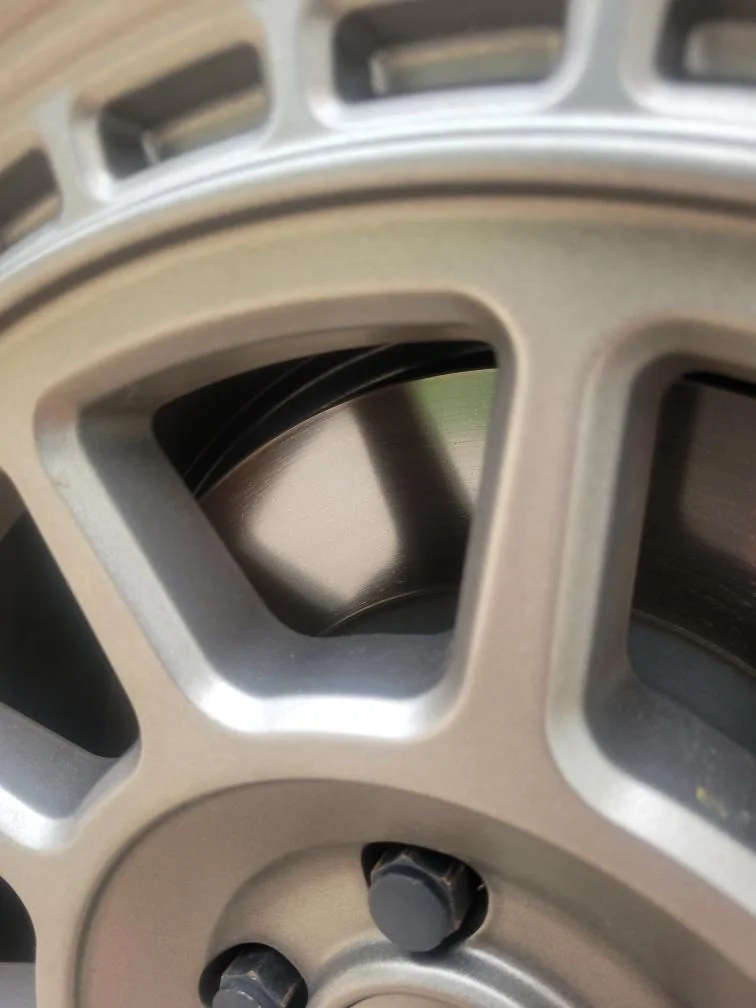
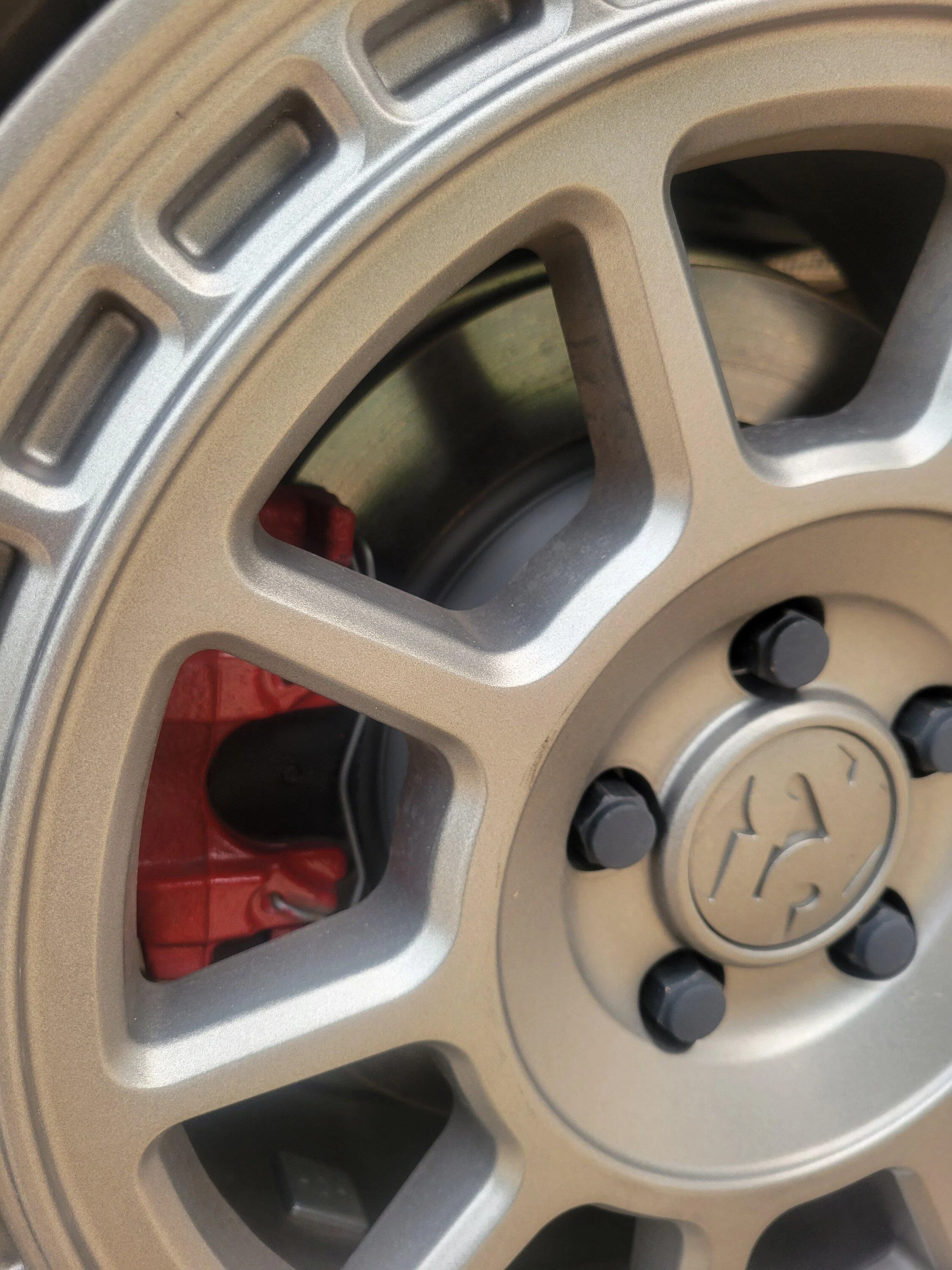
I'm not there to be able to see your "glazing", however I have attached front(upper picture) and rear pics of my sons Maverick rotors which is now 3 and a half months old with 3600 miles . There is going to be more of a "mirror" like look to the surface of the fronts as they do the majority of the braking(this is due to the weight transfer towards the front when braking, and the obviously greater weight at the front of the vehicle) and this is totally normal. So for now, disregarding the "glazing" issue which once again without personally inspecting them, I will distinguish as normal( don't take this as I don't believe you, I just can't see them from here lol)and move on to your "grabbing brakes" which is really a more important issue( I would assume, if you were not having this problem, you wouldn't be focusing on the "glazing" as being an issue or the cause of your real issue). I have copied some info on how a couple of systems work, I assume since you mentioned turning off " active braking" that by this you are referring to Supplemental braking assist as controlled during adaptive cruise control use that is described in the following. Unless you are referring to trailer braking(you didn't mention any trailer or towing so I assume not). But the first section "Electronic Brake Force Distribution (EBD)" describes how the hydraulic pressure is applied/routed to the front and rear wheels upon initial pressing of the brake pedal. This could cause your problem if the pressure is not being properly sent to the rear brakes prior to applying the front brakes. The last section, "Vacuum On Demand System" could also give you a grabby brake concern if the sensor that monitors the vacuum level in the brake booster is not functioning properly. This is what I suspect may be the problem and a problem like this is hard to diagnose as the PCM is getting a reading it is happy with but is not a correct reading, here is the scenario : Say your vacuum sensor is showing the PCM there is sufficient (let's call it 16 psi) in the booster, but actually there is only 12 psi. You apply the brake and the sensor finally reads low enough for the PCM to turn the vacuum solenoid to open to allow vacuum to the booster( somewhere between 16-20 psi), but you are already braking, so in the middle of your braking the booster actually starts functioning as designed and you perceive the "grabby" brakes because all of a sudden there is more pressure being applied to the hydraulic system without you actually increasing the force you are using to push the pedal( it just becomes easier all of a sudden and therefore you " over brake" . Once again, I'm not there to see or feel your concern, but the first step of something out of the ordinary like this, especially with everything but the kitchen sink thrown at it already is to compare to a like vehicle and see if it is a normal characteristic, then continue diagnostics or call it working as designed, whichever the case may be. Here are the sections from the Maverick service manual:
Electronic Brake Force Distribution (EBD)
On initial application of the brake pedal, full pressure is applied to the rear brakes. The ABS module then uses wheel speed sensor inputs to evaluate rear wheel slip. Once the rear wheel slip exceeds a predetermined threshold, the ABS module commands the HCU to close the appropriate isolation valves to hold the rear brake pressure constant while allowing the front brake pressure to build. This creates a balanced braking condition between the front and rear wheels. If the rear wheel slip continues and exceeds a second predetermined threshold, the ABS module commands the HCU to open the dump valves to decrease the rear brake pressure and allow the rear wheels to recover. A slight bump sensation may be felt in the brake pedal when EBD is active.

Supplemental Braking Assist
In addition to preventing wheel lock up during braking events, the ABS module also provides supplemental hydraulic brake assist through the use of the hydraulic pump motor and the HCU . This is done in the event of a severe braking event or to maintain the distance gap set by the adaptive cruise control system.
The ABS module continually monitors CAN messages and sensor inputs. When the messages or sensors indicate a severe braking event is about to occur or is occurring, the ABS module activates the hydraulic pump motor in the HCU to assist with vehicle braking.
On vehicles equipped with adaptive cruise control, the CCM monitors the area forward of the vehicle.
When an object enters this area and closes the distance gap set by the driver, the CCM sends a deceleration request to the IPMA over a LIN . The IPMA then sends the message to the ABS module over the HS-CAN2 .
When the deceleration request message is received, the ABS module activates the hydraulic pump motor and solenoid valves in the HCU to slow the vehicle down to maintain the distance gap set by the driver. Once the distance gap set by the driver is achieved, the CCM stops sending the deceleration request message and the ABS module deactivates the hydraulic pump motor and solenoid valves in the HCU .
If the CCM determines the amount of braking provided by the ABS module is insufficient, the CCM sends a forward collision avoidance braking request message and warns the driver, both audibly and visually, through the use of the HUD . After receiving the braking request message, the ABS module waits for brake pedal input and, once received, applies maximum braking assist using the hydraulic pump motor and the HCU .
Vacuum On Demand System
On vacuum boosted vehicles equipped with a 2.0L engine, vacuum is supplied to the brake booster through the use of a valve solenoid and an aspirator in the brake booster vacuum tube. When the ABS module detects a low vacuum condition in the brake booster, a message is sent to the PCM requesting additional vacuum. The PCM responds by opening the valve solenoid which allows the engine to draw air from the brake booster, increasing vacuum in the booster. Once the vacuum in the booster has reached the required level, the ABS module stops sending the message and the PCM closes the valve solenoid.

Ford Maverick brake issues on Mavericks with 2.0 eco boost engine only. front rotor


Ford Maverick brake issues on Mavericks with 2.0 eco boost engine only. rear rotor
 
Last edited:
Sponsored

MAJB Retired

2.5L Hybrid
Member
First Name
Ernie
Joined
Mar 27, 2023
Threads
0
Messages
9
Reaction score
12
Location
Indiana
Vehicle(s)
2018 F150 and Exprorer, plus two Jeep Renegade
Engine
2.5L Hybrid
Sounds like a driver issue. Maybe you need to back off a little so you don't need to use your breaks so often,,,
 
OP
OP

Deleted member 6849

Guest
Be advised, there is an SSM where Mavericks are not going into brake service mode. FORD's only solution is to use FDRS to force it. Forscan will not enable brake service mode.

Before you purchase pads, test if your vehicle will go into brake service mode.
yes my truck can go into brake service mode


Top