
Sponsored

Trailering 1,000 miles advice needed.

Ranko Kohime

2.5L Hybrid
Well-known member
First Name
Ranko
Joined
Jul 21, 2025
Threads
7
Messages
158
Reaction score
220
Location
Texas
Vehicle(s)
2025 Maverick XLT
Engine
2.5L Hybrid
Holding the engine in lower gears/ higher RPM’s takes the strain off the crank bearings.

The gas mileage, pfft you can afford to spend a little more in fuel to not work your truck unnecessarily hard.
It always amazes me that people with obvious knowledge of engines do not seem to understand how they work internally. Strain on the crank bearings would result in a seized engine. 🙃

Put me down as one of those people with a non-4k who regularly tows as much and more. FWD and use Eco mode almost exclusively. The tow mode does exactly nothing but keep the engine on at light scenarios, keep the battery at a higher state of charge than it would otherwise to provide passing/hill power, and increase throttle pedal sensitivity. I’ve yet to run out of power on a hill in eco mode.

And oh yeah, about those rod bearings…
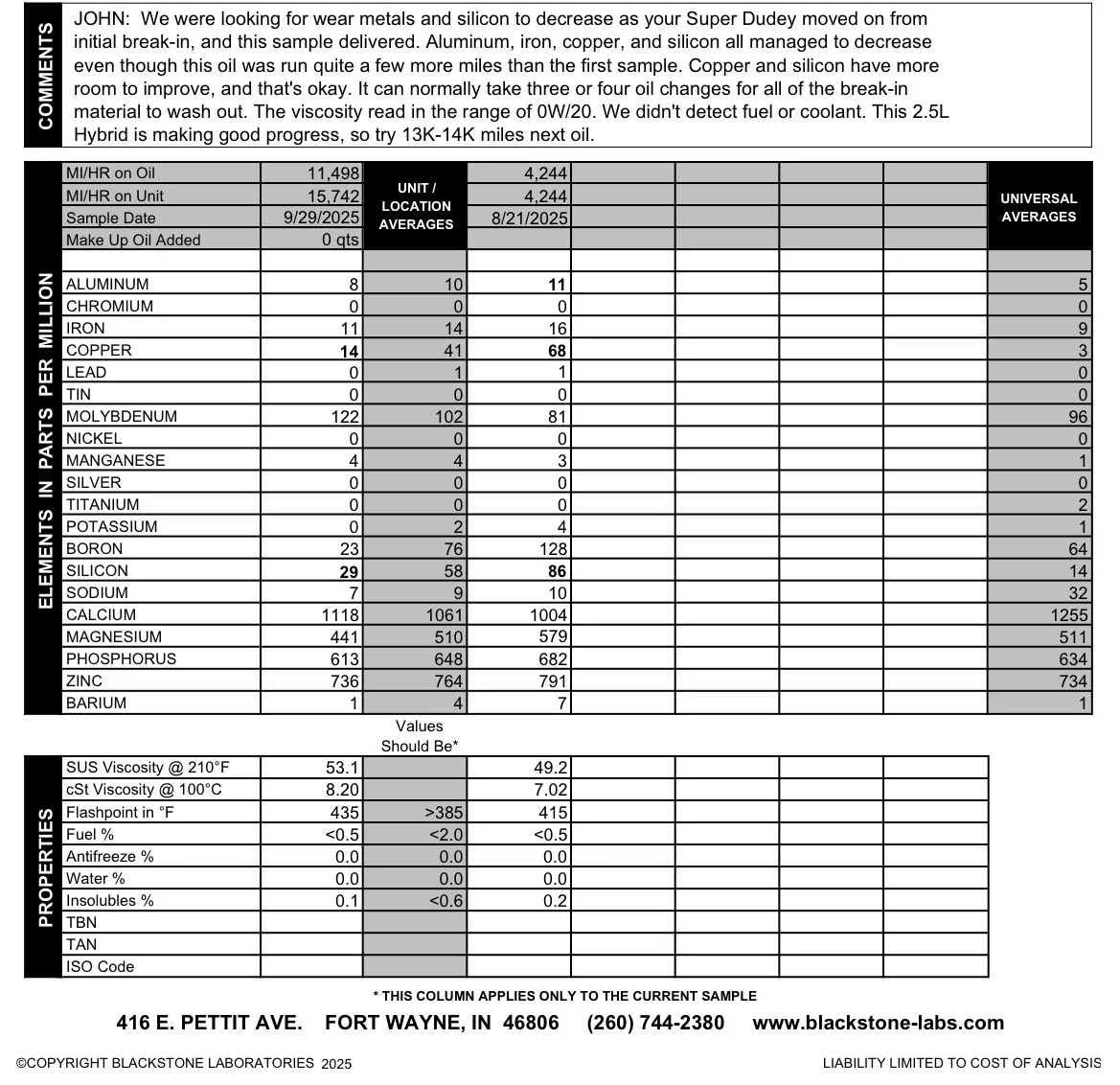
Ford Maverick Trailering 1,000 miles advice needed. IMG_1208
Sponsored


scharris99

2.0L EcoBoost
Well-known member
Joined
Mar 31, 2025
Threads
0
Messages
129
Reaction score
199
Location
Daytona Beach
Vehicle(s)
2025 Maverick XLT
Engine
2.0L EcoBoost
Survey says WRONG!
Basic physics, the relationship between weight and braking distance is the braking distance approximately increases with the square of the vehicle's weight (and the square of its speed). In the most simple example, if you double the weight of a vehicle, you'll need approximately four times the braking distance to stop from the same speed, all other factors being equal. Bottom line the heaver the vehicle the longer distance it needs to come to a complete stop. With all other factors being equal acceleration is proportional to weight, more weight the slower the acceleration will be. If you take into account things like wind resistance then yeah bigger vehicle can possibly accelerate as fast as a smaller vehicle but now all things are not equal.

edit to restate acceleration in terms of mass since weight and mass are not the same and to correct mental laziness on my part.

F=M*A aka Force = Mass * Acceleration

Weight is just a type of representation of a force
W=M*A aka Weight = Mass * Gravity

So if
A = F/M then simply the value of Acceleration gets smaller for larger values of Mass with Force being equal and also larger Masses = larger Weights.

Survey says WRONG!
Basic physics, the relationship between weight and braking distance is the braking distance approximately increases with the square of the vehicle's weight (and the square of its speed). In the most simple example, if you double the weight of a vehicle, you'll need approximately four times the braking distance to stop from the same speed, all other factors being equal. Bottom line the heaver the vehicle the longer distance it needs to come to a complete stop. With all other factors being equal acceleration is proportional to weight, more weight the slower the acceleration will be. If you take into account things like wind resistance then yeah bigger vehicle can possibly accelerate as fast as a smaller vehicle but now all things are not equal.

edit to restate acceleration in terms of mass since weight and mass are not the same and to correct mental laziness on my part.

F=M*A aka Force = Mass * Acceleration

Weight is just a type of representation of a force
W=M*A aka Weight = Mass * Gravity

So if
A = F/M then simply the value of Acceleration gets smaller for larger values of Mass with Force being equal and also larger Masses = larger Weights.
I passed high school physics.

I'm just saying that if I had a 10,000+ pound tow capacity full frame vehicle with larger brakes, more torque, a much stronger transmission, beefier rear end, wider stance and higher load capacity tires, I'd gladly take the gas mileage hit vs driving my current mini truck with a 4,000 pound capacity with known issues with the drivetrain and rather small brakes. That's all.
 

Cherokee

2.0L EcoBoost
Well-known member
Joined
Jan 3, 2025
Threads
49
Messages
3,721
Reaction score
6,956
Location
North Carolina
Vehicle(s)
2004 Ford Escape Platinum, 2024 Ford Maverick Lariat 2.0L AWD
Engine
2.0L EcoBoost
It always amazes me that people with obvious knowledge of engines do not seem to understand how they work internally. Strain on the crank bearings would result in a seized engine. 🙃

Put me down as one of those people with a non-4k who regularly tows as much and more. FWD and use Eco mode almost exclusively. The tow mode does exactly nothing but keep the engine on at light scenarios, keep the battery at a higher state of charge than it would otherwise to provide passing/hill power, and increase throttle pedal sensitivity. I’ve yet to run out of power on a hill in eco mode.

And oh yeah, about those rod bearings…

IMG_1208.webp
I was talking to an Ecoboost owner.
We don’t have electric motors we can lean on.
Your in a Mavbrid, different tech.
 

Ranko Kohime

2.5L Hybrid
Well-known member
First Name
Ranko
Joined
Jul 21, 2025
Threads
7
Messages
158
Reaction score
220
Location
Texas
Vehicle(s)
2025 Maverick XLT
Engine
2.5L Hybrid
I was talking to an Ecoboost owner.
We don’t have electric motors we can lean on.
Your in a Mavbrid, different tech.
I was under the impression you were replying to the OP, who has a hybrid. :confused:

Though, the point about rod bearings stands, they're the same whether hybrid or EB. Or even a 5.0L in an F-150.
Sponsored


Top