

Sponsored

Tire Chains.

tom_tucker

2.5L Hybrid
Well-known member
Joined
Nov 8, 2021
Threads
14
Messages
1,060
Reaction score
1,337
Location
mid atlantic (VA)
Vehicle(s)
2023 Maverick XLT (FWD)
Engine
2.5L Hybrid
Just a reminder on snow chains...30 mph, stock tire size only, front tires, low profile 10mm and steel wheels...

https://www.fordservicecontent.com/...ingEnabled=False&userMarket=USA&buildType=web


  • Chains may damage aluminum wheels.
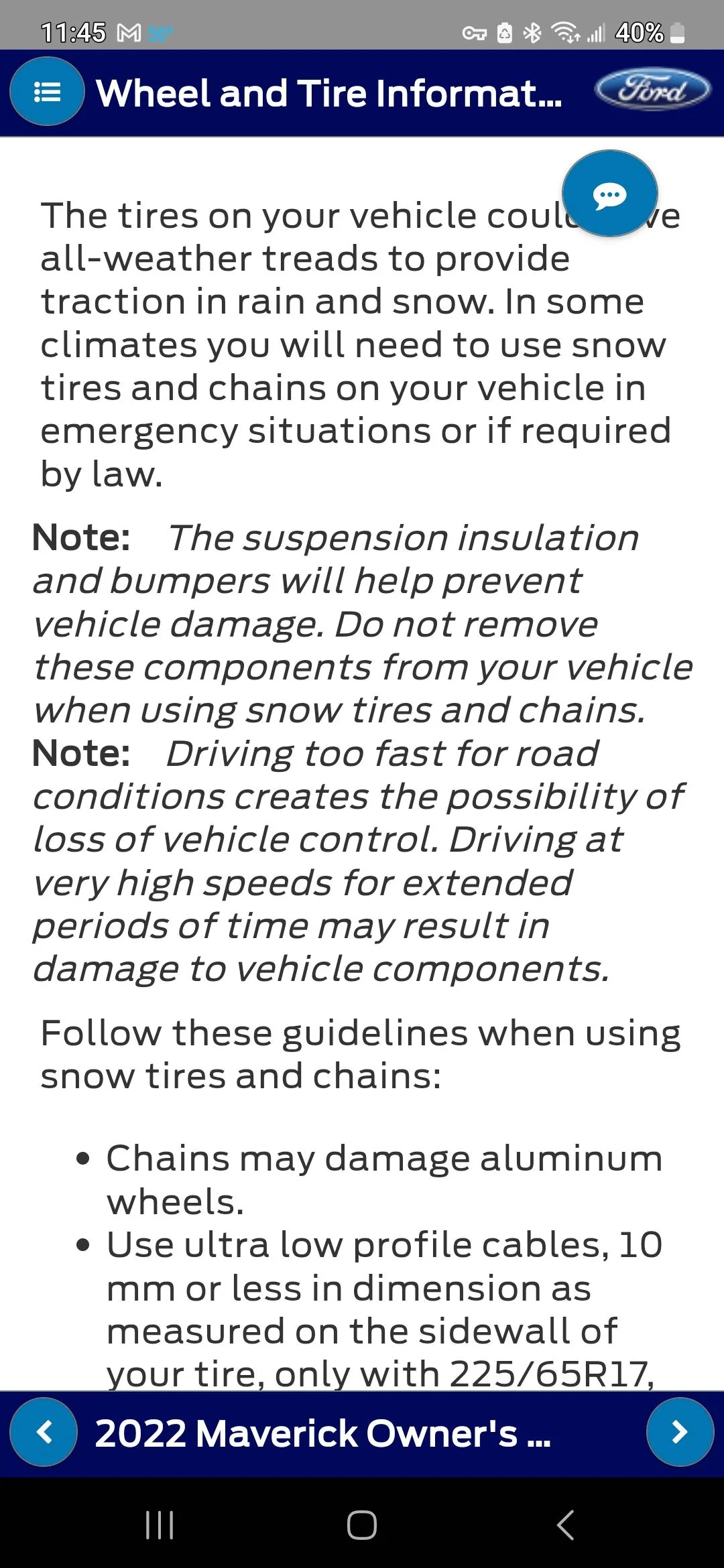
  • Use ultra low profile cables, 10 mm or less in dimension as measured on the sidewall of your tire, only with 225/65R17, or 225/60R18 all season tires.
  • Do not use snow chains or cables with 235/65R17.
  • Not all S-class snow chains or cables meet these restrictions. Chains of this size restriction will include a tensioning device.
  • Purchase chains or cables from a manufacturer that clearly labels body to tire dimension restrictions.
  • The snow chains or cables must be mounted in pairs on the front tires only.
  • When driving with snow chains do not exceed 30 mph (50 km/h) or the maximum speed recommended by the chain manufacturer, whichever is less.
  • Install cables securely, verifying that the cables do not touch any wiring or brake lines.
  • Drive cautiously. If you hear the cables rub or bang against the vehicle, stop and retighten them. If this does not work, remove the cables to prevent vehicle damage.
  • Remove the tire chains when they are no longer needed. Do not use tire chains on dry roads.
Sponsored
 

Bic

2.5L Hybrid
Well-known member
First Name
Bic
Joined
Jun 1, 2025
Threads
2
Messages
58
Reaction score
135
Location
Olympic Penninsula of Washington State
Vehicle(s)
2025 Maverick Lariat AWD Hybrid 2024 F-250 w/ 6.7 HO
Engine
2.5L Hybrid
Clubs
 
I don't know where you got your info but it is incorrect.
The owners manual clearly states when and how to use tire chains. If it's in the manual it can't void your warranty. People need to open that book instead of listening to so much misinformation.
Screenshot_20231122_114517_FordPass.webp


The Ford' text you cited mentions "...as required by law" and that is important info in states where "chain enforcement" occurs as a matter of law.

These states typically have high-elevation mountain passes that have uphill grades steep enough that vehicles can't get enough traction to move uphill if they don't have chains. Every uphill has a downhill and vehicles without sufficient traction also can't slow down enough on the downhill to stay on the road. Drive off a mountain curve into a several thousand foot drop and you will soon discover the ironically named terminal velocity of your vehicle :)

So to deter drivers from such fatal lessons states decree certain "traction devices" are required under certain weather conditions and then enforce those decrees with roadblocks.

For example on the mountain pass between Oregon and California on Interstate 5 (Siskiyou Summit) when chain enforcement is declared, both states legally require chains on at least one drive axle to proceed past roadblocks which enforce the chain requirement. When the chains required sign is lit if you don't have chains properly installed at the roadblock you have to exit the highway. Troopers won't pass a FWD vehicle with one set of chains on the rear axle for example or a RWD vehicle with only chains on the steering axle. Enforcement is typically a State Trooper but sometimes DOT personnel are manning the roadblocks.

In Washington State 4WD vehicles are generally not required to "chain up" but there are a list of exceptions to that general rule. Chains are required to be installed when towing, when over 10K GVW (e.g full-size pickups). If this isn't confusing enough the state sometimes requires chains just have to "carried" but doesn't require them to be installed at that time. But since weather conditions change rapidly at higher elevation you have to show chains to pass the roadblock.

Under really bad weather conditions they sometimes declare "Chains Required on ALL vehicles" which means that even 4WDs under 10,000 have to "chain up" to pass the roadblock.

Pro Tip One: if you see the Chains Required on ALL vehicles sign that means that DOT is considering closing the pass to all traffic. Drivers need to decide if they want to turn around and retreat back downhill or alternatively get over the pass before DOT closes the pass to all traffic.

ProTip Two: the summit of a mountain pass is frequently the border between two states. So you might see one state enforcing their rules as you head uphill and then find the neighboring state enforcing their rules at the summit!

Best advice I can offer for driving in mountainous country in winter is to assess the tire-to-inner fender clearance at full lock and then buy the beefiest set of chains that will clear. Better to buy two sets for AWD or 4WD vehicles. Carry the chains all winter and PLEASE PLEASE PLEASE ensure you can actually properly install and remove them before you head up the mountain. You don't want to be that idiot that "throws" one mis-installed chain causing the wheel with traction to spin the vehicle into a 360 crashing into several other cars and causing the type of multiple-vehicle, multiple-injuries accident that strands hundreds of of people in sub-freezing conditions at high elevation. Yup, that happens every single year in mountainous country.


Top