

Sponsored
OP
OP
Joaquin F

Joaquin F

2.5L Hybrid
Well-known member
First Name
Joaquin
Joined
Jun 10, 2024
Threads
28
Messages
366
Reaction score
794
Location
LA
Vehicle(s)
2022 Mav Hybrid XL
Engine
2.5L Hybrid
Clubs
 
I figured I’d share a quick write-up on the batteries I’ve run in my Maverick so far. I’ve now gone through the stock battery, an AGM upgrade, and now a sodium battery, so I thought the comparison might be helpful.

Also this is my first DIY write-up, so if something doesn’t make sense or I missed something please ask.

Stock Battery
The truck originally came with the factory lead-acid battery, which weighed about 26 lbs.

Pretty early on I started having the truck constantly go into deep sleep mode. I’ve personally experienced it and I’ve seen it mentioned across a lot of Mavericks, especially the earlier ones. The truck would get really sensitive to voltage and throw itself into deep sleep.

Because of that I decided to swap it out.

AGM Upgrade
The next step for me was an AGM battery. The main goal was just better reliability and hopefully avoiding the deep sleep issue.

It definitely helped with that. The truck behaved much better after the switch.

The downside though was weight. The AGM I ran weighed about 33.5 lbs, which is quite a bit heavier than the factory battery.

At the same time I’m also running a lot of accessories on the truck, so having a stronger battery was already becoming important. Between that and planning some longer trips that could involve pretty extreme temperatures, I started looking at other battery options.

Trying Sodium (Ohmmu H5)
That’s what led me to try the Ohmmu Sodium H5.

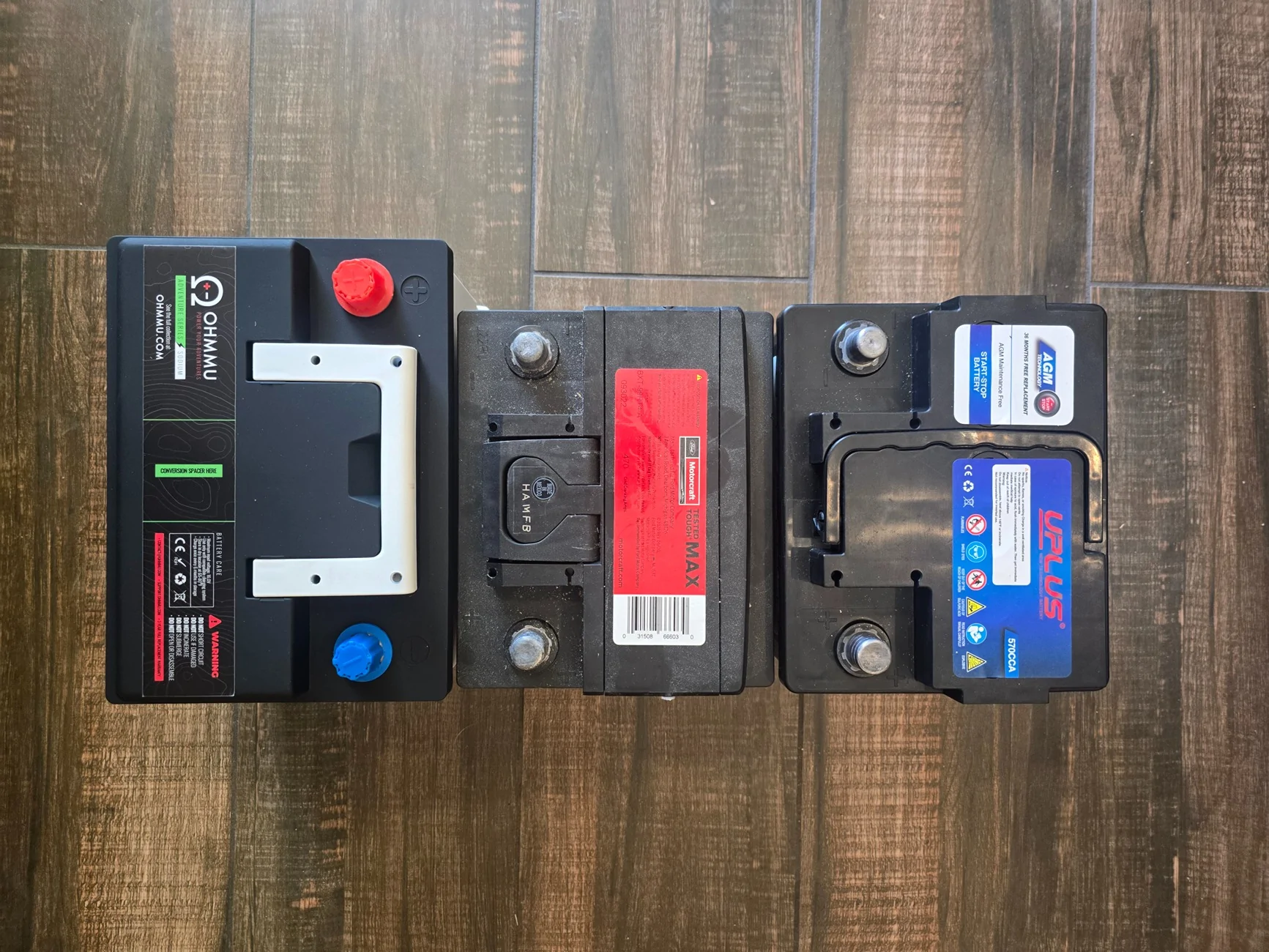
It is a little bigger than the stock battery, but it still fits in the Maverick tray. The only thing I had to do was bend two small tabs on the battery tray. They’re thin and bend easily with pliers. Once those are bent out of the way the battery drops right in and bolts down normally.

I go over exactly where those tabs are in the video for anyone who wants to see it before doing it.

Weight Comparison
Factory lead-acid: ~26 lbs
AGM upgrade: ~33.5 lbs
Ohmmu H5: ~12 lbs

So it’s way lighter than both.

Starting Power
Most lead-acid or AGM batteries in this size range usually land somewhere around 400–900 CCA.

The H5 is rated at 1200+ CCA, so it has quite a bit more starting power.

Discount
I reached out to Ohmmu to see if they’d be open to offering a small discount for the Maverick community, and they were cool enough to set one up.
https://www.ohmmu.com/?ref=MAVTRUCK

Video
I also put together a short video showing the install, the weight comparison, and the tray tabs that need to be bent.

The file was too big to upload here so I put it here:
https://photos.app.goo.gl/nVa53f5gmxP9XaeA9

And thanks again to everyone supporting the Instagram page(Ford.Maverick.Trucks) — that support is what helps me reach out to companies and get things like these discounts for the community. Video could also be found there!
20260307_133029.webp
UPDATE – Ancel BM200 Data (First Few Days)

I’ve had the Ancel BM200 battery monitor running for the past few days, so I wanted to share some early data from the sodium battery.

So far everything looks very normal with the Maverick’s charging system.

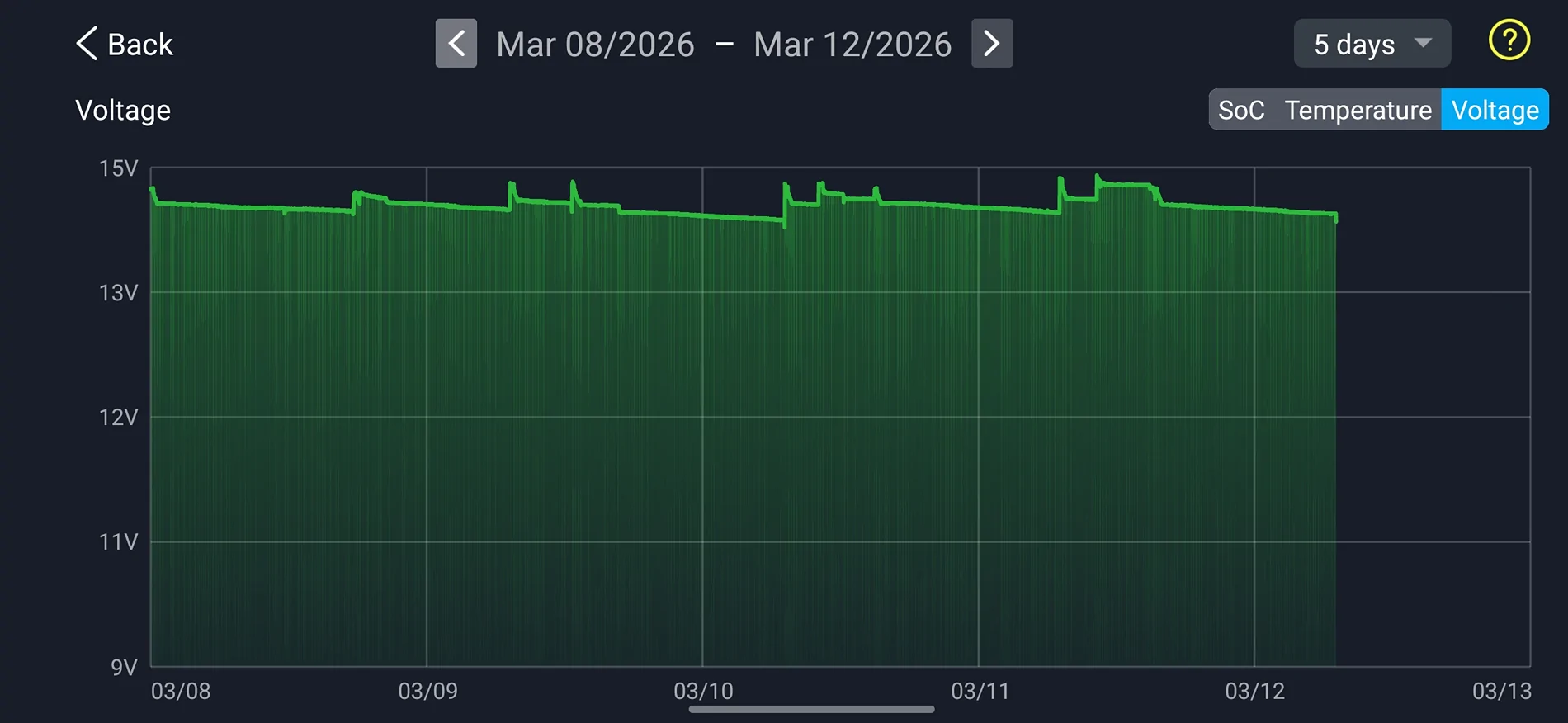
From the ~5 day voltage graph (Mar 8–12):
1773332413389-p7.webp


• Voltage mostly sits between ~13.8V and ~14.7V
• You can see the DC-DC converter cycling the 12V system, which is normal for the hybrid
• No unusual voltage drops or instability
• Overall the curve looks very stable

So at least from the truck’s perspective, it appears to be treating the battery basically the same as an AGM.

One thing I’m watching closely is how it behaves with:

• Short trips
• Battery saver mode
• Accessory loads (dashcams, lighting, etc.)

I’ll keep the BM200 logging data and post more updates as I get longer drive cycles and more days of monitoring.

Right now the goal of this thread is mostly just documenting real-world data for anyone curious about these batteries in the Maverick platform.
Sponsored

 
OP
OP
Joaquin F

Joaquin F

2.5L Hybrid
Well-known member
First Name
Joaquin
Joined
Jun 10, 2024
Threads
28
Messages
366
Reaction score
794
Location
LA
Vehicle(s)
2022 Mav Hybrid XL
Engine
2.5L Hybrid
Clubs
 
Unless the manufacturer of the Sodium battery is willing to put that in their warranty to protect against lawsuits, I would tread with caution on the addition of a Sodium battery as a solution to the issues associated with an enclosed installation. Not doubting your word, mind you...just want a protection that only the manufacturer can extend.

ADD ON: The fact that you had to modify your battery tray to fit the battery and the fact there is currently no application on your provided website that includes the Maverick are "no go" issues for me.
That’s a fair point, and I understand where you’re coming from.

At the end of the day the manufacturer’s guidance is what really matters. The sodium battery I’m using is designed as a sealed 12V replacement, similar to other sealed batteries, so it doesn’t produce hydrogen gas the way traditional flooded lead-acid batteries do.

My install is based on the specs and information provided by the manufacturer, but I definitely agree that anyone considering one should look at the documentation and warranty themselves and make the decision they’re comfortable with.
 

ScottyC

2.5L Hybrid
Well-known member
Joined
Feb 5, 2025
Threads
10
Messages
830
Reaction score
1,825
Location
Central NY
Vehicle(s)
2025 Ford Maverick AWD hybrid
Engine
2.5L Hybrid
My install is based on the specs and information provided by the manufacturer, but I definitely agree that anyone considering one should look at the documentation and warranty themselves and make the decision they’re comfortable with.
Just looking at specs and measurements - I was wondering why you didn't go with an H3 Group Size - there is one that is spec'ed for Mustang Mach E and by the looks of it, it would not need any modifications to the battery tray and the Ohmmu H3 is still higher in CCA and CA as the stock flooded lead-acid and AGM variants that are currently available. Plus, it is even lighter. H4 group size is even closer in measurements (5/8" taller could be an issue with the plastic cover enclosure) but I digress...the H3 would have handily been able to meet your stated need.
 
OP
OP
Joaquin F

Joaquin F

2.5L Hybrid
Well-known member
First Name
Joaquin
Joined
Jun 10, 2024
Threads
28
Messages
366
Reaction score
794
Location
LA
Vehicle(s)
2022 Mav Hybrid XL
Engine
2.5L Hybrid
Clubs
 
Just looking at specs and measurements - I was wondering why you didn't go with an H3 Group Size - there is one that is spec'ed for Mustang Mach E and by the looks of it, it would not need any modifications to the battery tray and the Ohmmu H3 is still higher in CCA and CA as the stock flooded lead-acid and AGM variants that are currently available. Plus, it is even lighter. H4 group size is even closer in measurements (5/8" taller could be an issue with the plastic cover enclosure) but I digress...the H3 would have handily been able to meet your stated need.
That’s a good observation and honestly something I looked at briefly when I was comparing group sizes.

From what I could find, the H3 would likely fit the tray without bending the tabs, and you’re right that it still exceeds the starting requirements compared to most of the lead-acid and AGM batteries people run in the Maverick.

The main reason I ended up trying the H5 was
Higher reserve capacity potential – even though sodium batteries don’t list RC/Ah the same way as lead-acid, the larger case size generally means more internal capacity for accessory loads. Since I run dashcams, lighting, and other electronics, I preferred having the larger battery.

The tray tabs that needed bending are very thin stamped metal and don’t affect the hold-down or structure of the tray. But instead seem to be a guide to offset the difference below the seats.

HOWEVER I completely understand why some people would prefer a drop-in fit like the H3 instead.

If someone wants the easiest install, the H3 is probably the cleaner option. I just chose the H5 because I wanted the larger battery and didn’t mind the small tray adjustment.
 

BlueSpec1

Well-known member
First Name
Gene
Joined
Jul 10, 2022
Threads
3
Messages
779
Reaction score
796
Location
Texas
Vehicle(s)
23 F150 XLT Powerboost, 22 Escape Plug-In, 23 Bolt EUV
Engine
Undecided
UPDATE – Ancel BM200 Data (First Few Days)

I’ve had the Ancel BM200 battery monitor running for the past few days, so I wanted to share some early data from the sodium battery.

So far everything looks very normal with the Maverick’s charging system.
...
• Voltage mostly sits between ~13.8V and ~14.7V
• You can see the DC-DC converter cycling the 12V system, which is normal for the hybrid
• No unusual voltage drops or instability
• Overall the curve looks very stable

So at least from the truck’s perspective, it appears to be treating the battery basically the same as an AGM.

One thing I’m watching closely is how it behaves with:

• Short trips
• Battery saver mode
• Accessory loads (dashcams, lighting, etc.)

I’ll keep the BM200 logging data and post more updates as I get longer drive cycles and more days of monitoring.

Right now the goal of this thread is mostly just documenting real-world data for anyone curious about these batteries in the Maverick platform.
I think it's very good idea to keep monitoring.
Just from my brief check on sodium ion batteries, it looks like they don't have a built in BMS like the lithium ion ones by Ohmmu.
I have seen a couple of post in F150 Lightning forum of the sodium ion failing.
 

Sponsored

OP
OP
Joaquin F

Joaquin F

2.5L Hybrid
Well-known member
First Name
Joaquin
Joined
Jun 10, 2024
Threads
28
Messages
366
Reaction score
794
Location
LA
Vehicle(s)
2022 Mav Hybrid XL
Engine
2.5L Hybrid
Clubs
 
I think it's very good idea to keep monitoring.
Just from my brief check on sodium ion batteries, it looks like they don't have a built in BMS like the lithium ion ones by Ohmmu.
I have seen a couple of post in F150 Lightning forum of the sodium ion failing.
That’s a good point and something I’ve been keeping an eye on as well.

I did see a couple of the posts on the Lightning forums, and I also watched the YouTube video where a woman talks about having issues with the Ohmmu sodium battery.

One thing I noticed though is that the Lightning itself had known 12V battery management issues early on, even with the original factory batteries. Ford has since released software updates to the truck’s BMS/DC-DC system to address some of those behaviors.

Because of that, it’s a little hard to isolate whether those failures were purely battery related or if they were tied to how the vehicle was managing the 12V system at the time.

That’s actually one of the reasons I added the Ancel BM200 monitor. I wanted to see exactly how the Maverick’s DC-DC converter interacts with the battery in real-world driving instead of just relying on specs.

So far from the data:
• Voltage cycling ~13.8V–14.7V
• Normal DC-DC charging behavior
• No abnormal drops or instability in the graph

Of course a few days of data doesn’t prove anything long-term yet, which is why I’m continuing to log it.

The goal of this thread isn’t to say this is the perfect battery off the rip; But instead to document real-world data over time for the Maverick platform, in hopes to provide insight!

If anything unusual shows up in the logs I’ll definitely post it here; Updates to come :) "Follow" this forum to stay up to date!

 

ScottyC

2.5L Hybrid
Well-known member
Joined
Feb 5, 2025
Threads
10
Messages
830
Reaction score
1,825
Location
Central NY
Vehicle(s)
2025 Ford Maverick AWD hybrid
Engine
2.5L Hybrid
The main reason I ended up trying the H5 was
Higher reserve capacity potential – even though sodium batteries don’t list RC/Ah the same way as lead-acid, the larger case size generally means more internal capacity for accessory loads. Since I run dashcams, lighting, and other electronics, I preferred having the larger battery.
Copy that - Go big or go home....lol. Although, in the case of Maverick, small can have it all...
 
OP
OP
Joaquin F

Joaquin F

2.5L Hybrid
Well-known member
First Name
Joaquin
Joined
Jun 10, 2024
Threads
28
Messages
366
Reaction score
794
Location
LA
Vehicle(s)
2022 Mav Hybrid XL
Engine
2.5L Hybrid
Clubs
 
Copy that - Go big or go home....lol. Although, in the case of Maverick, small can have it all...

If you get a chance, check out the install video I linked above:
https://photos.app.goo.gl/nVa53f5gmxP9XaeA9

I show the exact tabs that needed to be bent, and you’ll see they’re just very small stamped guide tabs in the tray. It’s a really minimal adjustment and doesn’t affect the hold-down or the structural part of the tray at all.

With that small adjustment needed, I personally leaned toward the larger battery go big or go home.
 

ScottyC

2.5L Hybrid
Well-known member
Joined
Feb 5, 2025
Threads
10
Messages
830
Reaction score
1,825
Location
Central NY
Vehicle(s)
2025 Ford Maverick AWD hybrid
Engine
2.5L Hybrid
If you get a chance, check out the install video I linked above:
https://photos.app.goo.gl/nVa53f5gmxP9XaeA9

I show the exact tabs that needed to be bent, and you’ll see they’re just very small stamped guide tabs in the tray. It’s a really minimal adjustment and doesn’t affect the hold-down or the structural part of the tray at all.

With that small adjustment needed, I personally leaned toward the larger battery go big or go home.
Yep - saw it.
 

Krys

2.5L Hybrid
Well-known member
First Name
Krys
Joined
Feb 17, 2024
Threads
2
Messages
57
Reaction score
39
Location
Pennsylvania
Vehicle(s)
2023 Ford Maverick
Engine
2.5L Hybrid
Weight and energy density look very good, but because of past experience with sodium fire, I run an AI question on battery safety, and here is what I got:
Safety of Sodium-Ion Batteries

Sodium-ion batteries (Na-ion) are considered to be safer than traditional lithium-ion batteries (Li-ion) in several aspects, but they still have some risks.

What are the specific safety risks associated with sodium-ion batteries?

Sodium-ion batteries face significant safety risks, particularly the potential for thermal runaway due to sodium clusters that can trigger early overheating at lower temperatures compared to lithium-ion batteries. Additionally, they are more reactive, especially with moisture, which can lead to hazardous gas emissions and fire risks during manufacturing and storage.

Risks and Considerations

Reactivity: Sodium is more reactive than lithium, especially with moisture, which can pose risks during manufacturing and storage.

Thermal events: While they have lower energy density, sodium-ion batteries can still experience thermal events that may lead to the release of toxic gases.

Gas emissions: In the event of a thermal incident, sodium-ion batteries can emit hydrogen and toxic sodium oxides, which can be hazardous.
 
Sponsored

LC48

2.0L EcoBoost
Well-known member
First Name
Bill
Joined
Oct 24, 2021
Threads
6
Messages
456
Reaction score
676
Location
Johnson County Texas
Vehicle(s)
Maverick XLT, AWD, Carbonized Gray. Highlander Lim
Engine
2.0L EcoBoost
Clubs
 
Bless you OP, patience of Job.......subscribed for the data
 
OP
OP
Joaquin F

Joaquin F

2.5L Hybrid
Well-known member
First Name
Joaquin
Joined
Jun 10, 2024
Threads
28
Messages
366
Reaction score
794
Location
LA
Vehicle(s)
2022 Mav Hybrid XL
Engine
2.5L Hybrid
Clubs
 
Weight and energy density look very good, but because of past experience with sodium fire, I run an AI question on battery safety, and here is what I got:
Safety of Sodium-Ion Batteries

Sodium-ion batteries (Na-ion) are considered to be safer than traditional lithium-ion batteries (Li-ion) in several aspects, but they still have some risks.

What are the specific safety risks associated with sodium-ion batteries?

Sodium-ion batteries face significant safety risks, particularly the potential for thermal runaway due to sodium clusters that can trigger early overheating at lower temperatures compared to lithium-ion batteries. Additionally, they are more reactive, especially with moisture, which can lead to hazardous gas emissions and fire risks during manufacturing and storage.

Risks and Considerations

Reactivity: Sodium is more reactive than lithium, especially with moisture, which can pose risks during manufacturing and storage.

Thermal events: While they have lower energy density, sodium-ion batteries can still experience thermal events that may lead to the release of toxic gases.

Gas emissions: In the event of a thermal incident, sodium-ion batteries can emit hydrogen and toxic sodium oxides, which can be hazardous.
That’s a fair concern, but AI summaries about battery chemistry often mix up metallic sodium reactions with sodium-ion battery chemistry, which are very different things.

In sodium-ion batteries the sodium is stored as ions within electrode materials, similar to lithium in lithium-ion batteries. It is not present as exposed metallic sodium, which is what people usually think of when they remember sodium reacting violently with water.

There is actually some good research on this. A 2025 paper in Energy & Environmental Science (Royal Society of Chemistry) looked specifically at thermal safety mechanisms in sodium-ion batteries. The study found that during heavy sodiation of hard-carbon anodes, small sodium clusters can form, which may initiate exothermic reactions earlier than the SEI breakdown seen in lithium-ion systems. However, the paper’s conclusion wasn’t that sodium batteries are inherently dangerous — it highlighted that their thermal behavior is different and still being actively studied as the technology matures.

A couple other important points that the AI summary glosses over:

• Energy density: Sodium-ion batteries typically have lower energy density than lithium-ion, which generally reduces the severity of thermal events.

• Gas generation: Flooded lead-acid batteries are actually more likely to produce hydrogen gas during normal charging, which is why they require venting. Most sealed sodium-ion 12V replacements are designed similarly to AGM or lithium batteries and do not vent under normal operation.

• Moisture reactivity: Sodium’s strong reaction with water is mainly a manufacturing and raw material handling issue, not a behavior of sealed cells during normal use.

For context, sodium-ion batteries are already being deployed for grid storage and EV auxiliary systems, largely because they avoid lithium supply issues and operate well across wider temperature ranges.

In my case I’m not just relying on spec sheets — I installed an Ancel BM200 battery monitor to log real-world data from the Maverick’s DC-DC system.

So far the data looks normal:

• Charging cycling roughly 13.8–14.7 V
• Normal DC-DC converter behavior for the hybrid system
• No abnormal voltage drops or instability in the voltage graph

Obviously a few days of data doesn’t prove long-term reliability yet, which is why I’m continuing to monitor it.

The goal of this thread really isn’t to convince anyone they need this battery — it’s just to document real-world behavior on the Maverick platform so people can make their own decisions based on actual data rather than AI summaries.
 
OP
OP
Joaquin F

Joaquin F

2.5L Hybrid
Well-known member
First Name
Joaquin
Joined
Jun 10, 2024
Threads
28
Messages
366
Reaction score
794
Location
LA
Vehicle(s)
2022 Mav Hybrid XL
Engine
2.5L Hybrid
Clubs
 
Bless you OP, patience of Job.......subscribed for the data
Hey, thanks for the support!

I’m mainly just trying to document real-world data so people can see how the battery behaves over time in the Maverick.

I’ll keep posting updates as the BM200 logs more cycles.
 
OP
OP
Joaquin F

Joaquin F

2.5L Hybrid
Well-known member
First Name
Joaquin
Joined
Jun 10, 2024
Threads
28
Messages
366
Reaction score
794
Location
LA
Vehicle(s)
2022 Mav Hybrid XL
Engine
2.5L Hybrid
Clubs
 
Unless the manufacturer of the Sodium battery is willing to put that in their warranty to protect against lawsuits, I would tread with caution on the addition of a Sodium battery as a solution to the issues associated with an enclosed installation. Not doubting your word, mind you...just want a protection that only the manufacturer can extend.

ADD ON: The fact that you had to modify your battery tray to fit the battery and the fact there is currently no application on your provided website that includes the Maverick are "no go" issues for me.
Just a quick update on that part; I actually reached out to Ohmmu about the Maverick fitment after posting the thread.

They’ve now added a Ford Maverick listing for the Group 24F / H5 sodium battery on their site:

https://www.ohmmu.com/product-page/ford-maverick-group-24f-h5-adventure-series-sodium?ref=MAVTRUCK

So the Maverick is now listed as a supported application on their page.
 

First Sergeant

2.5L Hybrid
Well-known member
First Name
Dave
Joined
Jan 2, 2024
Threads
16
Messages
836
Reaction score
1,056
Location
Fruitland Idaho
Vehicle(s)
2023 XLT Hybrid pushing a 40 foot diesel motorhome 2014 Toyota 4Runner Limited
Engine
2.5L Hybrid
Clubs
 
I am very interested to know how this works out for you. I have been considering an AGM once my dash cams are installed as I have heard, depending on the settings, that they can be quite a draw on your battery.
Many dash cams have a power brick with settings where you set the cam to turn itself off if power sinks too low. I have a Viofo and the settings are 11.8, 12.0, 12.2, 12.4. It works. Here is a link to just that accessory. https://www.viofo.com/products/viof...rl0GI_2DVZGTXoc54X3_L0eYzrFrWadBoCTYMQAvD_BwE
Sponsored


Top