
Sponsored



A comparison chart may be good to add. Of course values vary. I filled in some "typical" numbers from higher-end batteries at auto stores to get started...
Sodium seems to be all over the place. Some are similar to FLA and AGM, though.
| Size/Type | CCA | RC | AH | ~lbs | ~$$$ |
|---|---|---|---|---|---|
| H4 FLA | 480 | 75-95 | 50 | 26 | 260 |
| H4 AGM | 570 | 80 | 50 | 34 | 280 |
| H4 Sodium | 900 | 11 | 380 | ||
| H5 FLA | 650 | 100-110 | 60 | 33 | 260 |
| H5 AGM | 680 | 100-105 | 60 | 39 | 280 |
| H5 Sodium | 1200 | 12 | 380 |
Sodium seems to be all over the place. Some are similar to FLA and AGM, though.


- Joined
- Jan 3, 2025
- Threads
- 51
- Messages
- 3,796
- Reaction score
- 7,187
- Location
- North Carolina
- Vehicle(s)
- 2004 Ford Escape Platinum, 2024 Ford Maverick Lariat 2.0L AWD
- Engine
- 2.0L EcoBoost
Sodium tech is what ?
8-10 years old ?
Weighs nothing,
More cca than anyone would need. I call bullshit on this 1200 cca. I’d have to see test data.
Can you even pull that through a regular battery cable ?
3 or 4 year warranty, likely a prorated warranty.
I would think for double the cost of an AGM you should get twice the service life.
Somebody take me to school. I’ll hunt the data another day.
No RC or AH numbers on post 17’s chart ?
8-10 years old ?
Weighs nothing,
More cca than anyone would need. I call bullshit on this 1200 cca. I’d have to see test data.
Can you even pull that through a regular battery cable ?
3 or 4 year warranty, likely a prorated warranty.
I would think for double the cost of an AGM you should get twice the service life.
Somebody take me to school. I’ll hunt the data another day.
No RC or AH numbers on post 17’s chart ?
- Joined
- Jan 3, 2025
- Threads
- 51
- Messages
- 3,796
- Reaction score
- 7,187
- Location
- North Carolina
- Vehicle(s)
- 2004 Ford Escape Platinum, 2024 Ford Maverick Lariat 2.0L AWD
- Engine
- 2.0L EcoBoost
Hey wait a dang second !A comparison chart may be good to add. Of course values vary. I filled in some "typical" numbers from higher-end batteries at auto stores to get started...
Size/Type CCA RC AH ~lbs ~$$$ H4 FLA 480 75-95 50 26 260 H4 AGM 570 80 50 34 280 H4 Sodium 900 11 380 H5 FLA 650 100-110 60 33 260 H5 AGM 680 100-105 60 39 280 H5 Sodium 1200 12 380
Sodium seems to be all over the place. Some are similar to FLA and AGM, though.
Where’s the RC and AH numbers ?
Sponsored
OP
OP

- Thread starter
- #21
I think a few things are getting mixed together here.Sodium tech is what ?
8-10 years old ?
Weighs nothing,
More cca than anyone would need. I call bullshit on this 1200 cca. I’d have to see test data.
Can you even pull that through a regular battery cable ?
3 or 4 year warranty, likely a prorated warranty.
I would think for double the cost of an AGM you should get twice the service life.
Somebody take me to school. I’ll hunt the data another day.
No RC or AH numbers on post 17’s chart ?
First, sodium batteries themselves aren’t brand new, but using sodium chemistry in a 12V automotive starter format is relatively new, which is why you’re starting to see them show up more in EV and hybrid applications.
On the 1200 CCA, that’s simply the manufacturer rating. I didn’t test it myself on a load tester capable of measuring that, so I’m not claiming anything beyond the published spec. That said, high CCA numbers aren’t unusual for newer chemistries because they can deliver very high discharge current for short bursts. And yes, standard automotive cables can handle that — starter motors routinely pull several hundred amps already.
Also worth remembering that CCA is mostly irrelevant on the Maverick hybrid anyway since the engine isn’t cranked by the 12V battery. The high-voltage system spins the engine. The 12V battery mainly powers electronics and brings the hybrid system online.
As for price, I agree it’s not the cheapest option. If someone can get an AGM for $150 and it works for their needs, that’s a perfectly reasonable choice. I’m not suggesting everyone should switch — I’m testing it because my truck runs a lot of accessories and I wanted to see how the weight reduction and chemistry differences perform.
Right now this thread is just documenting real-world use, not trying to convince anyone to buy one. I’ll keep posting data from the battery monitor as I get more time on it.

- First Name
- Mike
- Joined
- May 3, 2024
- Threads
- 4
- Messages
- 4,949
- Reaction score
- 4,550
- Location
- KC Metro area
- Vehicle(s)
- 2005 Toyota RAV4, 2024 XLT Hybrid
- Engine
- 2.5L Hybrid
Not published - couldn't be found.Sodium tech is what ?
8-10 years old ?
Weighs nothing,
More cca than anyone would need. I call bullshit on this 1200 cca. I’d have to see test data.
Can you even pull that through a regular battery cable ?
3 or 4 year warranty, likely a prorated warranty.
I would think for double the cost of an AGM you should get twice the service life.
Somebody take me to school. I’ll hunt the data another day.
No RC or AH numbers on post 17’s chart ?
Perhaps they don't test well to get those numbers - so not reflective of what happens in practice.
No idea - but this manufacturer had nothing.
Not on the website given. I looked around Google but there is a wide range of info.Hey wait a dang second !
Where’s the RC and AH numbers ?

- Joined
- Feb 5, 2025
- Threads
- 10
- Messages
- 831
- Reaction score
- 1,832
- Location
- Central NY
- Vehicle(s)
- 2025 Ford Maverick AWD hybrid
- Engine
- 2.5L Hybrid
AGM is "less susceptible" to gas release but it is still recommended to "vent" them if they are in an enclosed space. Google AI also gives the venting suggestion to Sodium batteries as they are also less susceptible to gas release but the AI bot suggests that if it is enclosed, it should also have some venting in the event of overcharging which could release some gasses or vent a pressure build up. I would err on the side of caution and hook the vent up just because it is there already and it would not hurt it. I am always suspicious of "upgraded" items and what impact it would have in the event of accident and resultant insurance claim process.....in today's very litigious society, as always, proceed with caution.I also had this question but got clarification.
No vent tube is needed.
Traditional lead-acid batteries can produce hydrogen gas when charging, which is why some vehicles have vent tubes. Sodium batteries are sealed and non-gassing, so there aren’t fumes that need to be vented outside the vehicle.
So for my understanding it installs basically like a sealed AGM battery in that sense.
https://thebatterytips.com/author/thebatterytips/AGM batteries are usually sealed and do not need venting. However, in enclosed spaces, they should be vented. This is important because overcharging can release hydrogen gas. Always follow safety guidelines and installation instructions to ensure safe operation and maintenance-free performance.
Google search AI
Sodium batteries generally do not require venting like traditional lead-acid batteries, as they are designed to minimize gas emissions during operation. However, it's always best to follow the manufacturer's guidelines for specific installation and safety recommendations.
I am very interested to know how this works out for you. I have been considering an AGM once my dash cams are installed as I have heard, depending on the settings, that they can be quite a draw on your battery.Totally fair.
If your factory AGM is working well there’s definitely no urgent reason to swap. The main reasons I wanted to try it were:
• Temperature tolerance – sodium batteries handle both hot and cold better than typical lead-acid batteries
• Accessory load – I’m running a lot of electronics on the truck
• Weight –Side benefit
For someone running a mostly stock truck, AGM is still a perfectly good option.
I’m mostly curious to see how it performs long-term, which is why I’m logging everything with the battery monitor.
Sponsored
- First Name
- Mike
- Joined
- Aug 2, 2025
- Threads
- 2
- Messages
- 49
- Reaction score
- 127
- Location
- Hilliard, OH
- Vehicle(s)
- 2025 Ford Maverick Lariat 2.5 4k AWD
- Engine
- 2.5L Hybrid
Lithium Moto offers an H4 sodium battery rated at 36Ah and an H5 rated at 50Ah. The amp-hour (Ah) rating is the key specification when trying to prevent a deep sleep condition if battery drain is the root cause.A comparison chart may be good to add. Of course values vary. I filled in some "typical" numbers from higher-end batteries at auto stores to get started...
Size/Type CCA RC AH ~lbs ~$$$ H4 FLA 480 75-95 50 26 260 H4 AGM 570 80 50 34 280 H4 Sodium 900 11 380 H5 FLA 650 100-110 60 33 260 H5 AGM 680 100-105 60 39 280 H5 Sodium 1200 12 380
Sodium seems to be all over the place. Some are similar to FLA and AGM, though.
With only 36Ah of storage capacity, the system would enter deep sleep sooner than it would with a typical H4 FLA, lithium, or AGM battery. For that reason, moving up to the H5 size may be necessary simply to match the stored energy capacity of those other battery technologies.
I’m a fan of sodium batteries, but I don’t expect them to make a meaningful difference in the deep sleep issue if one is installed.
- First Name
- john
- Joined
- Mar 27, 2025
- Threads
- 1
- Messages
- 124
- Reaction score
- 95
- Location
- south haven mi
- Vehicle(s)
- 2023 ford maverick xlt hybrid
- Engine
- 2.5L Hybrid
Interesting, I will need to more research in to the sodium battery.
The big issue with the maverick hybrid is battery saver mode, and the battery charging scheme.
From what I am seeing on my mav haybrid is that a 15 minutes drive to work is not enough run time to fully recharge the battery back to before I started the truck.
The big question is how fast can that type of battery recharge back to full?
if its like a AGM in charging and discharging characteristics, if so I do not see any benefit.
Will it sulfate like lead acid or AGM batteries?
23 maverick hybrid xlt 22K milkes
The big issue with the maverick hybrid is battery saver mode, and the battery charging scheme.
From what I am seeing on my mav haybrid is that a 15 minutes drive to work is not enough run time to fully recharge the battery back to before I started the truck.
The big question is how fast can that type of battery recharge back to full?
if its like a AGM in charging and discharging characteristics, if so I do not see any benefit.
Will it sulfate like lead acid or AGM batteries?
23 maverick hybrid xlt 22K milkes
OP
OP
- Thread starter
- #28
Just to clear this up since there’s a lot of mixed info floating around:AGM is "less susceptible" to gas release but it is still recommended to "vent" them if they are in an enclosed space. Google AI also gives the venting suggestion to Sodium batteries as they are also less susceptible to gas release but the AI bot suggests that if it is enclosed, it should also have some venting in the event of overcharging which could release some gasses or vent a pressure build up. I would err on the side of caution and hook the vent up just because it is there already and it would not hurt it. I am always suspicious of "upgraded" items and what impact it would have in the event of accident and resultant insurance claim process.....in today's very litigious society, as always, proceed with caution.
https://thebatterytips.com/author/thebatterytips/
Google search AI
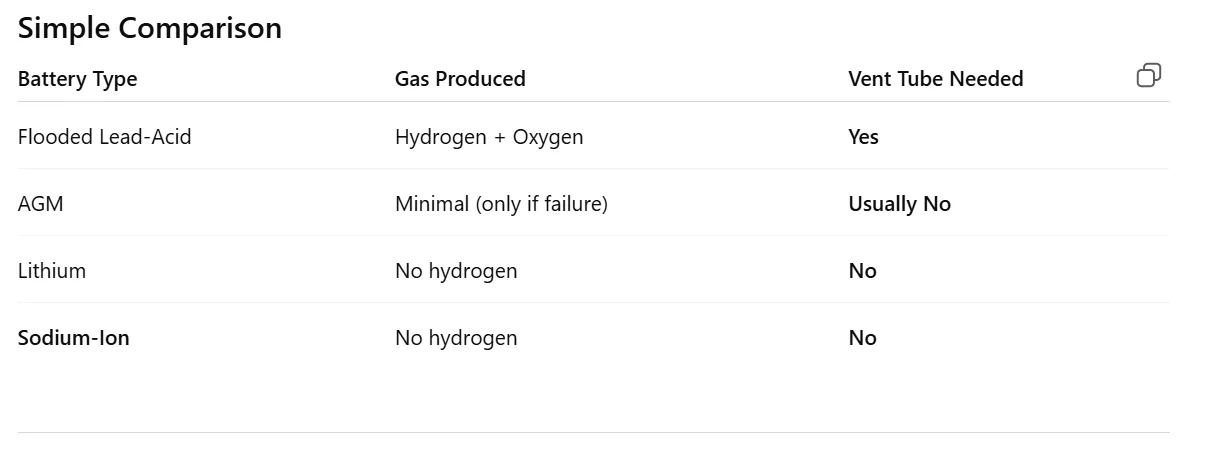
Sodium batteries do not need a vent tube.
Vent tubes exist because traditional flooded lead-acid batteries produce hydrogen gas during charging. That gas has to be routed outside the vehicle so it doesn’t build up in the cabin.
Sodium batteries are sealed and non-gassing, similar to lithium batteries. They don’t produce hydrogen during normal charging, so there’s nothing that needs to be vented. Because of that, they don’t use the factory vent hose that lead-acid batteries sometimes have.
Adding a vent tube wouldn’t really do anything either — there’s no gas being produced to remove, so it wouldn’t improve safety or performance.
The only time a sealed battery vents is if a pressure relief valve opens during a failure scenario, which is a built-in safety feature and not part of normal operation.
So the short version:
Lead-acid → vent tube needed (hydrogen gas)
AGM → usually not required
Lithium / Sodium → no vent tube needed
OP
OP
- Thread starter
- #29
You bring up a good point about the Maverick charging behavior. The hybrid system definitely doesn’t keep the 12V battery topped off the same way a traditional alternator vehicle does.Interesting, I will need to more research in to the sodium battery.
The big issue with the maverick hybrid is battery saver mode, and the battery charging scheme.
From what I am seeing on my mav haybrid is that a 15 minutes drive to work is not enough run time to fully recharge the battery back to before I started the truck.
The big question is how fast can that type of battery recharge back to full?
if its like a AGM in charging and discharging characteristics, if so I do not see any benefit.
Will it sulfate like lead acid or AGM batteries?
23 maverick hybrid xlt 22K milkes
From what I’ve been able to find so far, sodium batteries recharge faster than lead-acid/AGM because they don’t rely on the same chemical reaction that slows charging as the battery fills up. They can accept higher current earlier in the charge cycle, so in theory they should recover quicker after a start or accessory load.
That said, the Maverick’s DC-DC converter ultimately controls the charging rate, so the truck itself is still the limiting factor. The battery can accept charge faster, but it can only take what the vehicle sends it.
On sulfation — that’s actually one of the advantages of sodium chemistry. Sulfation is specific to lead-acid batteries when lead sulfate crystals build up on the plates after sitting partially discharged. Since sodium batteries don’t use lead plates or sulfuric acid, sulfation isn’t a thing with them.
So the main differences vs AGM are:
• No sulfation from partial charge
• Faster charge acceptance in theory
• Much lighter weight
• Higher burst discharge capability
The big question (and what I’m curious about too) is how it behaves with the Maverick’s battery saver mode and short trips, which is why I’m logging everything with the battery monitor. Real-world data will be more useful than spec sheets.
I’ll keep posting updates and a big one is coming shortly!
- Joined
- Feb 5, 2025
- Threads
- 10
- Messages
- 831
- Reaction score
- 1,832
- Location
- Central NY
- Vehicle(s)
- 2025 Ford Maverick AWD hybrid
- Engine
- 2.5L Hybrid
Unless the manufacturer of the Sodium battery is willing to put that in their warranty to protect against lawsuits, I would tread with caution on the addition of a Sodium battery as a solution to the issues associated with an enclosed installation. Not doubting your word, mind you...just want a protection that only the manufacturer can extend.So the short version:
Lead-acid → vent tube needed (hydrogen gas)
AGM → usually not required
Lithium / Sodium → no vent tube needed
ADD ON: The fact that you had to modify your battery tray to fit the battery and the fact there is currently no application on your provided website that includes the Maverick are "no go" issues for me.
Sponsored
Similar threads

- Replies
- 16
- Views
- 1,702

- Replies
- 52
- Views
- 5,308


- Replies
- 92
- Views
- 21,651

- Replies
- 18
- Views
- 2,282
